In short
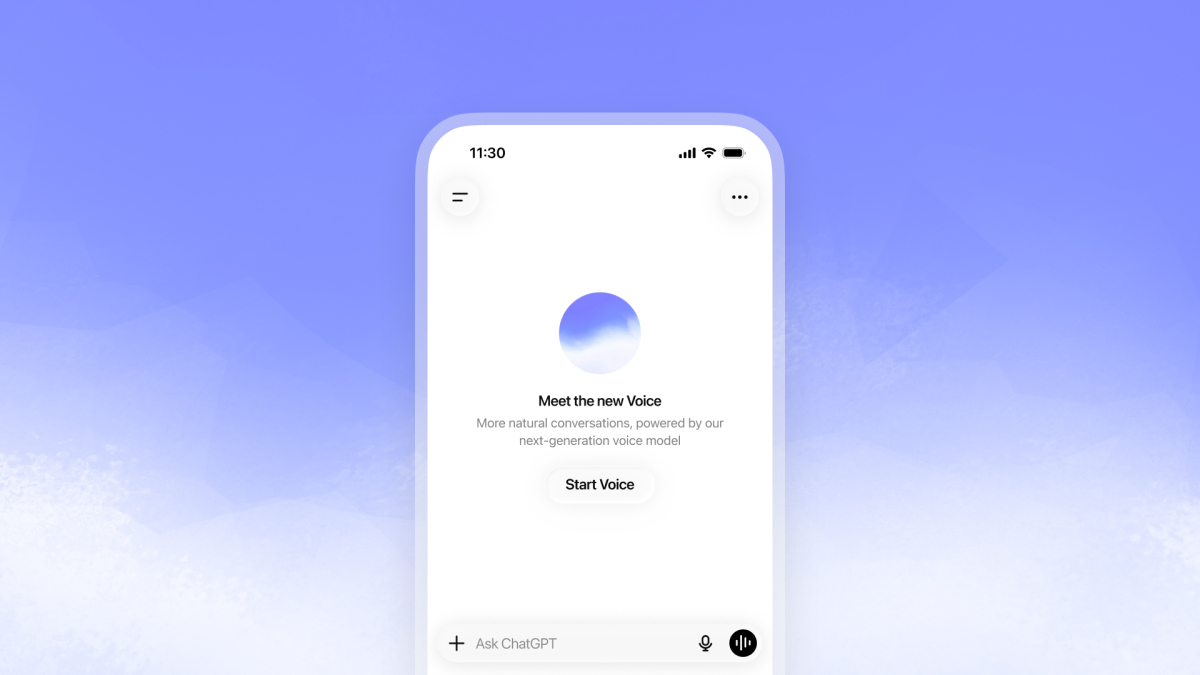
OpenAI has launched GPT-Live-1 and GPT-Live-1 mini to make ChatGPT voice more natural, responsive, and useful in longer live conversations. The default voice mode is being replaced with the smaller model, while paid users get access to the larger version.
- GPT-Live-1 and GPT-Live-1 mini are full-duplex voice models built for more natural turn-taking.
- ChatGPT’s default voice mode will switch to GPT-Live-1 mini, with GPT-Live-1 reserved for paid users.
- OpenAI says more than 150 million people already use ChatGPT voice and dictation features.
- The company sees voice as a potential primary interface for complex, agentic work.
- Language quality still needs improvement, especially in live translation demos like Hindi.
OpenAI is taking another step toward making voice the most natural way to use ChatGPT. The company on Wednesday introduced two new conversational speech models, GPT-Live-1 and GPT-Live-1 mini, designed to make live interactions sound less robotic, improve turn-taking, and support features such as real-time translation and longer back-and-forth sessions.
The bigger strategic shift is not just about how ChatGPT sounds. OpenAI is also changing how the product works under the hood. The new voice experience is built to keep listening while speaking, rather than forcing a rigid stop-and-start exchange. That means users should be able to interrupt naturally, pause without losing context, and continue a conversation more like they would with another person. For OpenAI, that matters because voice is increasingly being framed not as a novelty, but as a serious interface for work, search, and agentic tasks.
OpenAI said GPT-Live-1 mini will replace the existing Advanced Voice Mode inside ChatGPT by default, while paid subscribers will get access to the larger GPT-Live-1 model. The company presented the rollout as part of a broader effort to make voice both more capable and more conversational, with fewer of the awkward delays and misfires that have long limited voice assistants.
What OpenAI is changing
According to OpenAI, the earlier voice system relied on three separate components: speech-to-text to transcribe a user’s words, a large language model to generate the response, and text-to-speech to read it back aloud. That architecture worked, but it could feel segmented and sometimes clumsy, especially during fast-moving conversation.
The new setup is designed to behave more like a live speaker. OpenAI described the models as full-duplex, a term used to indicate that speaking and listening can happen at the same time. In practical terms, that should reduce unnatural pauses and make it easier for users to jump in mid-answer when they need clarification or want to redirect the conversation.
OpenAI says the models also improve another common frustration: assistants talking over users. The company’s goal, it said, is to make the voice experience better at recognizing when a person is still speaking and when it is actually time to respond.
How the new voice mode works
Rather than isolating the voice assistant from the rest of ChatGPT, the new system can call on OpenAI’s newer text models for harder tasks. That includes search, reasoning, and more agent-like behavior, while the voice conversation continues in parallel. In effect, the spoken interface becomes a front end for the company’s broader model stack.
OpenAI also showed that the assistant can remain quiet for long stretches and absorb the context of the conversation until it is prompted to speak. That quiet listening mode is important because many real conversations are not constant back-and-forth exchanges; they involve pauses, interruptions, and long user monologues.
The company also said the new voice mode can present certain answers visually, taking advantage of the newer models behind it. That could make the assistant more useful in situations where audio alone is not enough, such as explaining a plan, summarizing a process, or sharing a structured response.
| Feature | Previous ChatGPT Voice | GPT-Live-1 / GPT-Live-1 mini |
|---|---|---|
| Conversation style | Sequential, step-by-step | Full-duplex, more natural turn-taking |
| Interruptions | Often awkward or delayed | Designed for natural interruptions |
| Model stack | Speech-to-text + LLM + text-to-speech | Direct conversational voice models with access to newer text models |
| Long pauses | Less flexible | Can stay silent and hold context |
| Visual responses | Limited | Supported in some cases |
| Default ChatGPT voice | Current Advanced Voice Mode | GPT-Live-1 mini |
Why voice matters to OpenAI’s bigger product plan
OpenAI has been pushing voice for years, but the current update suggests the company sees a much larger opportunity than casual chat. Voice is increasingly being positioned as a way to interact with software without staring at a screen, typing prompts, or navigating menus.
At a briefing around the launch, ChatGPT Voice product lead Atty Eleti said he has used the feature in long walking conversations lasting 30 to 40 minutes. That detail hints at how OpenAI wants people to think about the product: not as a short utility for dictating a note or asking a factoid, but as a persistent assistant capable of extended engagement.
“Over time, we think this will also unlock the ability to use voice as a kind of primary interface to computing,” Eleti said, adding that the company sees a future in which voice helps users manage “increasingly complex long-running agentic work.”
That is a notable ambition. If voice becomes the main way people interact with AI for some tasks, then the rules of interface design change. The system must understand context, keep track of goals over time, and avoid becoming intrusive or repetitive. It also has to be reliable enough to support work that spans multiple steps and possibly multiple apps.
OpenAI’s comments suggest it sees voice as especially useful for things users already do with ChatGPT and its coding tools: longer tasks, workflow assistance, and problem-solving that benefits from a conversational back-and-forth rather than a single text prompt.
OpenAI is betting on longer sessions, not just faster replies
Many voice assistants are optimized for short exchanges. OpenAI is leaning in the opposite direction. The company said the redesigned voice mode is built for longer conversations, and it appears to want users to stay in a spoken session for as long as they would keep typing in a chat window.
That shift matters because it reflects how OpenAI sees the product evolving. A voice assistant that can manage extended discussion could support brainstorming, planning, tutoring, live translation, and hands-free task coordination. It may also serve as a bridge between consumer use and more agentic work in professional settings.
OpenAI said more than 150 million people already talk to ChatGPT using Voice and Dictation features. That is a large enough audience to justify deeper investment, and it indicates that voice is already mainstream inside the product even before this upgrade.
From dictation tool to interface layer
In earlier generations of consumer tech, voice often meant a narrow set of tasks: setting timers, asking for weather updates, or sending short messages. OpenAI is clearly trying to expand that definition.
The company’s pitch is that speaking to AI should feel less like issuing commands and more like collaborating. If the models can keep up with context, switch between silence and response, and surface information visually when necessary, then voice can become a flexible interface rather than a novelty feature.
That ambition also helps explain why OpenAI keeps connecting the voice experience to the company’s other products, including its reasoning and coding systems. It wants users to see voice as an access point to the full intelligence of its platform, not a separate product with limited capabilities.
Hardware rumors hover in the background
OpenAI did not announce any new device alongside the voice models, but the timing will inevitably invite speculation. Reports have previously suggested the company could be preparing AI hardware, including a possible pair of earbuds, though none of that was confirmed in this announcement.
For now, OpenAI is focused on software. Even so, a more fluid conversational model is exactly the kind of capability that could make custom hardware more compelling later. If the company ever releases a voice-first device, the quality of turn-taking, latency, and context retention will matter even more than it does in a desktop or mobile app.
In the current market, many AI companies are trying to solve the same basic problem: how to make assistants feel present without being irritating. Natural conversation is the design prize, and hardware is one of the paths to getting there.
Competitors are moving in the same direction
OpenAI is not alone in trying to make AI feel more human in conversation. Across the industry, assistant makers are racing to improve expressive speech, memory, and context handling. The push is about more than making a product sound pleasant; it is about making interactions efficient enough that people want to use them throughout the day.
Apple and Amazon have both updated their assistants to sound more conversational and better understand context. The broader goal is similar across companies: reduce the friction that has made many voice systems useful only in narrow, predictable situations.
Startups are taking a similar path. Sesame, the company founded by Oculus co-founder Brendan Iribe and Ankit Kumar, has drawn attention for assistants that speak more naturally while handling tasks in the background. Another startup, Monogram, which recently raised $40 million in seed funding from DST and Lux Capital, is also exploring visual responses as a way to make assistants feel more interactive and useful.
That matters because OpenAI is entering a market where “good enough” voice is no longer enough. Users can already compare products by how well they interrupt, how believable they sound, how gracefully they handle silence, and whether they can maintain a useful thread over a long exchange.
The industry race is no longer just about accuracy
For years, the main benchmark for voice tech was whether it correctly recognized speech and returned a decent answer. Now the standard has widened. Assistants need to manage timing, emotional tone, interruptions, and context in a way that feels smooth rather than mechanical.
That raises the bar for all of OpenAI’s rivals. A voice feature that merely transcribes and speaks back information will feel dated if competitors can sustain longer, more expressive, more useful conversations. OpenAI’s new release suggests it understands that the next generation of assistants will be judged as much by interaction design as by model quality.
Natural voice, but not a companion product
OpenAI was careful to draw a line between natural conversation and emotional dependence. Despite its push to make the model sound more fluid and engaging, the company said it is not aiming to build an AI companion product.
That distinction matters in a market where consumer AI is often criticized for blurring the line between utility and companionship. OpenAI’s messaging suggests that it wants voice to feel responsive and helpful without turning into a character designed to mimic friendship.
The company also said the system includes protections for younger users. Teenagers are supposed to receive age-appropriate responses, and if a conversation turns toward self-harm, the model is designed to provide resources and support rather than continue casually.
Those safeguards are increasingly important as voice systems become more immersive. A more convincing voice interface can be more helpful, but it can also create stronger expectations about trust and responsibility. OpenAI is signaling that it wants to broaden the experience without losing sight of safety concerns.
What still needs improvement
For all the progress, the new voice mode is not polished in every language or scenario. During a demonstration of live translation into Hindi, the assistant’s accent sounded heavily American, and the Hindi itself came across as unnatural, with a slightly textbook-like rhythm.
That kind of stumble highlights a recurring challenge in AI voice: fluency in one language or accent does not guarantee natural performance across many others. OpenAI said the new voice system is optimized for the most spoken languages, but it did not specify which ones or provide a detailed breakdown of performance by language.
That omission leaves open an important question for users outside English-speaking markets: how close is the experience to truly local speech, and how much will it still sound like an English-first product translated on the fly?
Language quality remains a major hurdle
Translation quality in voice systems is not only about correct words. It also depends on cadence, pronunciation, pacing, and tone. If any of those pieces feel off, the result may be intelligible but still awkward.
For OpenAI, the Hindi demo suggests that the company still has work to do if it wants voice to be truly global. The broader the target market, the harder it becomes to make the assistant sound natural in every language and dialect it supports.
That is especially relevant because voice is often more sensitive than text. A typed response can feel acceptable even when slightly formal or stilted. Spoken language is less forgiving, and any unnatural phrasing stands out immediately.
A timeline of ChatGPT voice’s evolution
The new release is the latest stage in a longer shift from simple spoken output to full conversational interfaces. The table below summarizes the broad arc of that development.
| Period | Development | What it meant for users |
|---|---|---|
| Earlier voice tools | Speech input and output handled separately | Basic voice queries, limited fluidity |
| Advanced Voice Mode | More natural spoken interaction in ChatGPT | Smoother conversations, but still some friction |
| 2026 update | GPT-Live-1 and GPT-Live-1 mini introduced | Full-duplex voice, better interruptions, longer sessions |
| Default rollout | GPT-Live-1 mini replaces current voice mode for all users | Broader access to the new experience |
| Paid tier expansion | GPT-Live-1 available to subscribers | Higher-capability voice for premium users |
Why this launch matters beyond ChatGPT
OpenAI’s voice update is important not just because it improves a popular feature, but because it reveals how the company thinks the next phase of AI adoption will unfold. The race is moving beyond prompts and chat windows toward systems that can stay engaged in real time, across modalities, for longer stretches of work.
If OpenAI succeeds, voice could become a bridge between casual consumer use and more ambitious agentic workflows. That would mean fewer one-off questions and more persistent collaboration with an assistant that can listen, reason, translate, search, and present information in different formats.
It also places OpenAI in direct competition with the broader consumer tech ecosystem, including platform companies that already control operating systems, devices, and default assistants. In that environment, being more natural may not be enough. The assistant must also be more useful, more reliable, and available where users already spend time.
The company’s claim that more than 150 million people already use ChatGPT voice features suggests there is real demand. The launch of GPT-Live-1 and GPT-Live-1 mini is OpenAI’s attempt to turn that demand into a more central part of the product, and possibly into a new paradigm for how people interact with software.
What to watch next
- Whether GPT-Live-1 mini noticeably improves the default ChatGPT voice experience for everyday users.
- How quickly OpenAI expands language support and improves accent quality outside English.
- Whether premium users find GPT-Live-1 meaningfully better for longer, more complex tasks.
- How rivals such as Apple, Amazon, and startups like Sesame respond to the upgraded voice push.
- Whether OpenAI eventually pairs its software advances with dedicated AI hardware.
For now, OpenAI’s message is clear: voice is no longer a side feature. It is becoming one of the company’s main bets on how people will work with AI in the future — hands-free, longer-lasting, and increasingly conversational.