In short
Solos has unveiled the AirGo A6, a lighter camera-free pair of smart glasses built around voice AI, translation, reminders, and open-ear audio. The company also introduced privacy accessories for its earlier AirGo V2 model.
- AirGo A6 weighs about 19 grams, far less than Solos’ previous model.
- The new glasses skip the camera and focus on voice AI, translation, and audio.
- Solos is also selling privacy accessories for the camera-equipped AirGo V2.
- Pricing and availability for the AirGo A6 have not yet been announced.
Solos is pushing smart glasses further toward the everyday-wear category with the AirGo A6, a slimmer follow-up to last year’s model that strips out the camera and trims the weight dramatically. The company says the new frame weighs roughly 19 grams, nearly half the mass of the previous AirGo A5 depending on style, while still delivering voice-driven AI features, translation tools, reminders, and hands-free audio.
The move arrives as the smart glasses market continues to split into two distinct camps: camera-equipped devices aimed at capturing the world around you, and lighter, more discreet products that emphasize convenience and privacy. Solos is clearly betting that a camera-less design will make smart glasses feel less intrusive, more socially acceptable, and easier to wear for long stretches of time.
A lighter frame designed for daily wear
The most immediate difference in the AirGo A6 is physical. Solos says the new version is built with slimmer temple arms and a more compact internal layout, allowing it to shed a significant amount of weight compared with the AirGo A5. At around 19 grams, the A6 sits well below many competing smart glasses, including Meta’s latest model, which is notably heavier by comparison.
That reduced weight matters because smart glasses live or die by comfort. Even a small increase in bulk can make them feel front-heavy, raise the pressure on the nose bridge, or make them less appealing for all-day use. By shaving off grams and removing the camera hardware entirely, Solos is aiming for something closer to traditional eyewear than a wearable gadget that happens to sit on your face.
Why weight matters in smart glasses
In wearables, comfort is not a luxury feature — it is the product. A device that feels awkward for just a few minutes is unlikely to become part of a daily routine. Smart glasses face a particularly difficult challenge because they must balance batteries, speakers, processing components, and sensors inside a form factor people expect to be lightweight and stylish.
Solos appears to be leaning into that reality by prioritizing discretion and wearability over advanced imaging capability. For users who want the benefits of an AI assistant without the baggage of a visible camera, that tradeoff could be appealing.
Camera-free by design, and that’s the point
The AirGo A6 does not include a camera, a notable choice at a time when many smart glasses makers are using cameras as the centerpiece of their pitch. Solos is framing the omission as an advantage, not a compromise. Without a camera, the glasses can be slimmer and less intimidating to people nearby, while also sidestepping some of the social and privacy concerns that have followed camera-enabled wearables from the beginning.
That privacy-first approach fits a wider pattern in consumer technology. As devices become more capable of recording, recognizing, and analyzing the world in real time, some users are becoming more cautious about where and when they want that capability activated. A camera-free smart glasses product gives Solos a cleaner answer to those concerns: there is nothing on the frame that can capture images or video in the first place.
Solos is positioning the AirGo A6 as a slimmer, lighter alternative that keeps the convenience of an AI assistant while avoiding the privacy and social friction that cameras can create.
A different answer to the smart glasses question
Meta’s glasses and other camera-equipped wearables have been marketed around image capture, multimodal AI, and hands-free documentation. Solos is taking a different route. Its bet is that many people want the interface benefits of smart glasses — spoken assistance, notifications, and audio — without any need to record what they see.
In practice, that may broaden the appeal of the A6 to users who are skeptical of camera wearables, workplace environments where recording is discouraged, or everyday settings where a more subtle device simply feels more comfortable to wear.
What the AirGo A6 can do
Despite the missing camera, the AirGo A6 is still built around AI-powered interactions. Solos says the glasses support voice-based assistance for answering questions, real-time translation, and calendar reminders. The device also includes speakers positioned behind the ears, so users can listen to music or take calls while still hearing their surroundings.
That open-ear audio design is one of the product’s most practical features. It allows for private listening without fully blocking ambient sound, which is useful for walking, commuting, or working in environments where situational awareness matters.
Core features at a glance
- Voice-based AI assistant
- Real-time translation
- Calendar reminders and alerts
- Open-ear audio for music and calls
- Full prescription lens compatibility
Solos also says the A6 will support full prescription lens compatibility, making it easier for everyday eyeglass wearers to adopt the product as a real replacement for their standard frames rather than a secondary gadget.
How it compares with the AirGo A5 and Meta’s glasses
The AirGo A6 is the next step in Solos’ AirGo line, and the comparison with last year’s A5 highlights how aggressively the company has pursued miniaturization. The earlier model weighed between 36 and 40 grams depending on frame style, already lighter than many smart glasses, but the A6 cuts that nearly in half.
Compared with Meta’s newest glasses, Solos is emphasizing portability and subtlety over hardware ambition. Meta’s model is heavier, largely because of the camera and broader sensor suite built into the frame. Solos’ design removes that layer of complexity and, in doing so, creates a product that may be easier to live with day after day.
| Model | Approximate Weight | Camera | Primary Focus |
|---|---|---|---|
| Solos AirGo A5 | 36–40g | No | Smart eyewear with AI features |
| Solos AirGo A6 | About 19g | No | Lighter AI glasses with voice controls |
| Meta Glasses | About 54–60g | Yes | Camera-enabled smart glasses |
The table underscores the strategic split in the category. Solos is chasing the lightest possible wearable with assistant features, while competitors are packing in more sensing and capture capability. Both approaches have audiences, but they solve very different problems.
Style options and prescription support
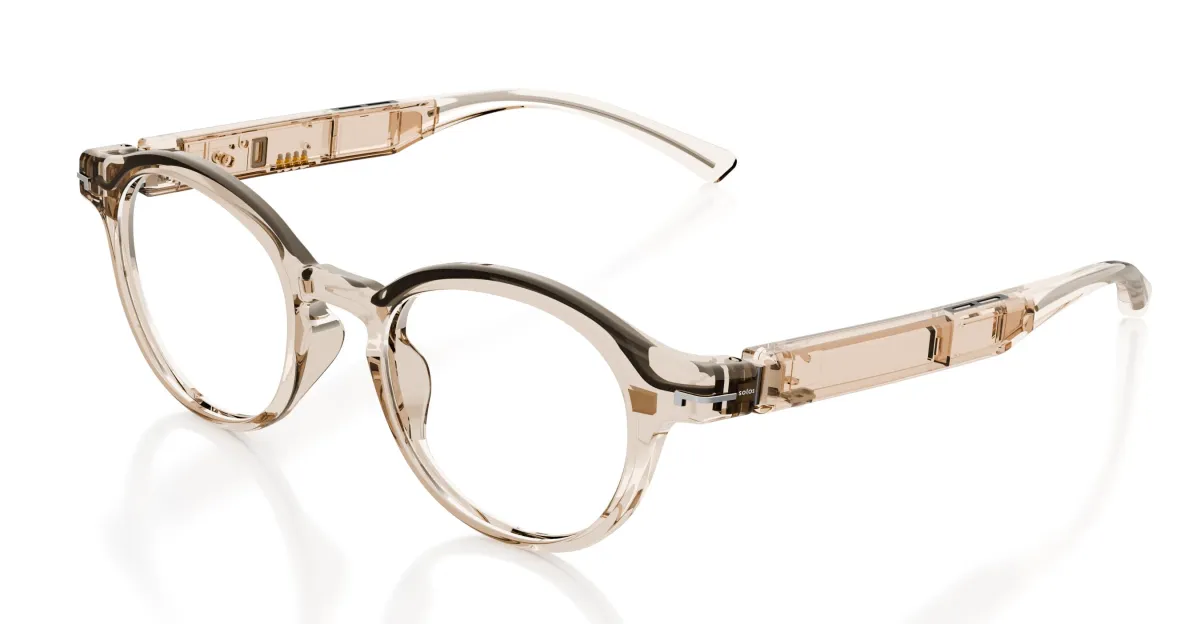
Solos says the AirGo A6 will arrive in multiple frame styles, including transparent versions that expose the electronics inside. That aesthetic gives the glasses a more gadget-forward look for users who want the technology to be visible, while other styles will likely aim for a more conventional eyewear appearance.
Prescription compatibility is another important detail. Smart glasses often struggle to become mainstream because many users need vision correction, and if the device cannot support lenses from an optician, it becomes a novelty instead of a primary pair of glasses. By building prescription support into the A6, Solos is signaling that the product is meant to be worn regularly.
Why transparent frames matter
Transparent or semi-transparent hardware has become a common way for consumer tech companies to make their devices feel less opaque and more intentional. In the case of smart glasses, it can also serve as a visual cue that the product contains electronics without looking overly industrial.
For some buyers, that creates a middle ground between fashion and function. For others, it reinforces the idea that the glasses are a personal tech statement, not just eyewear.
Privacy accessories for the AirGo V2
Alongside the A6 announcement, Solos introduced a set of privacy-focused accessories for its earlier AirGo V2 smart glasses. Those add-ons are aimed at users who want to keep the camera-equipped model but reduce the risk or discomfort associated with having a lens pointed outward.
The accessories include transparent non-powered replacement temples priced at $39, offered in several colors. Solos is also selling a clip-on privacy shield that physically blocks the V2’s camera from seeing anything, giving owners a simple way to disable capture without relying on software settings.
For users who want extra utility from the same accessory set, Solos is bundling the privacy shield with clip-on sunglasses for $49. The sunglasses add UV protection and reduce glare, while a full bundle containing the privacy accessories is priced at $79.
In its accessory lineup, Solos is essentially acknowledging that some buyers want the option to own a camera-equipped device, but also want straightforward ways to make it less intrusive.
The accessory strategy in context
That approach reflects a broader shift in wearable design. Rather than forcing all users into one hardware philosophy, companies are increasingly offering modular or optional privacy features that let people adapt devices to different settings. It is a pragmatic strategy, especially as the public remains divided over always-on cameras in everyday products.
For Solos, the accessory ecosystem also helps extend the life of older models. Instead of making previous-generation glasses feel obsolete, the company is giving owners new parts that can make the device more useful in both casual and professional settings.
What this says about the smart glasses market
Solos’ latest release is a reminder that smart glasses do not need to look like miniature surveillance systems to be useful. In fact, the company seems to believe that the most successful version of the category may be the one people forget they are wearing.
That is a meaningful bet. Consumer adoption of wearables often depends less on raw technical ambition than on whether a product fits into normal life. A lighter frame, a camera-free profile, and open-ear audio may not generate as much buzz as computer vision features, but they could make the product far more approachable for mainstream users.
Two paths for the category
- Capture-first glasses: focused on cameras, visual recognition, and multimodal AI.
- Comfort-first glasses: built around voice interaction, audio, translations, and discretion.
Solos is clearly planting itself in the second camp. That may limit some advanced use cases, but it also avoids the backlash that often follows wearable cameras in public places.
As the market matures, that distinction could become increasingly important. Buyers may begin choosing not just between brands, but between philosophies: do they want glasses that see the world, or glasses that simply help them move through it?
Pricing still to be announced
Solos has not yet finalized pricing or release timing for the AirGo A6. That leaves a key part of the product story unresolved. Even well-designed smart glasses can struggle if the price is too close to premium flagship eyewear or if the software experience does not match the hardware promise.
Still, the company’s emphasis on lighter construction, prescription compatibility, and privacy may help it appeal to buyers who have been waiting for smart glasses that feel more like normal glasses and less like experimental gear.
If Solos can keep the price accessible, the A6 could become a compelling entry point for users curious about AI wearables but wary of cameras, complexity, or bulk. If pricing is too aggressive, the company may find that even a 19-gram frame still needs to justify itself against both ordinary glasses and more feature-rich smart competitors.
The bigger picture for AI wearables
The AirGo A6 does not try to do everything. Instead, it narrows the focus to a few practical benefits: voice help, translation, reminders, and audio, all wrapped in a lighter and more discreet form factor. That restraint may be its strongest selling point.
As AI wearables become more common, manufacturers will likely keep testing how much sensing users are comfortable with. Solos’ answer is to remove the camera and center the experience on what can be done through voice alone. It is a conservative product decision, but one that could prove strategically smart if the wider market continues to value privacy and comfort as much as novelty.
| Announcement | What It Means | Likely Appeal |
|---|---|---|
| AirGo A6 launch | New lighter smart glasses with no camera | Users who want AI features without visual capture |
| Open-ear audio | Music and calls without blocking ambient sound | Commuters, walkers, office users |
| Prescription support | Can be fitted with vision correction lenses | Everyday eyeglass wearers |
| V2 privacy accessories | Physical camera block and clip-on add-ons | Existing owners seeking more control |
For now, Solos has delivered a clear message: smart glasses can be lighter, less invasive, and still genuinely useful. In a category often defined by what it records, the AirGo A6 is notable for what it leaves out.