In short
Riverside is adding AI tools that turn recorded podcasts and videos into newsletters, while also expanding its recording and enhancement features. The move reflects a broader race among creator platforms to own more of the publishing workflow.
- Riverside is launching AI-powered newsletter tools for users of its recording platform.
- The company says it is not trying to replace Substack or Beehiiv, but to repurpose spoken content.
- New features also include multi-camera support, remote guests, social hooks and video enhancement.
- The move fits a wider trend of creator platforms expanding into adjacent publishing formats.
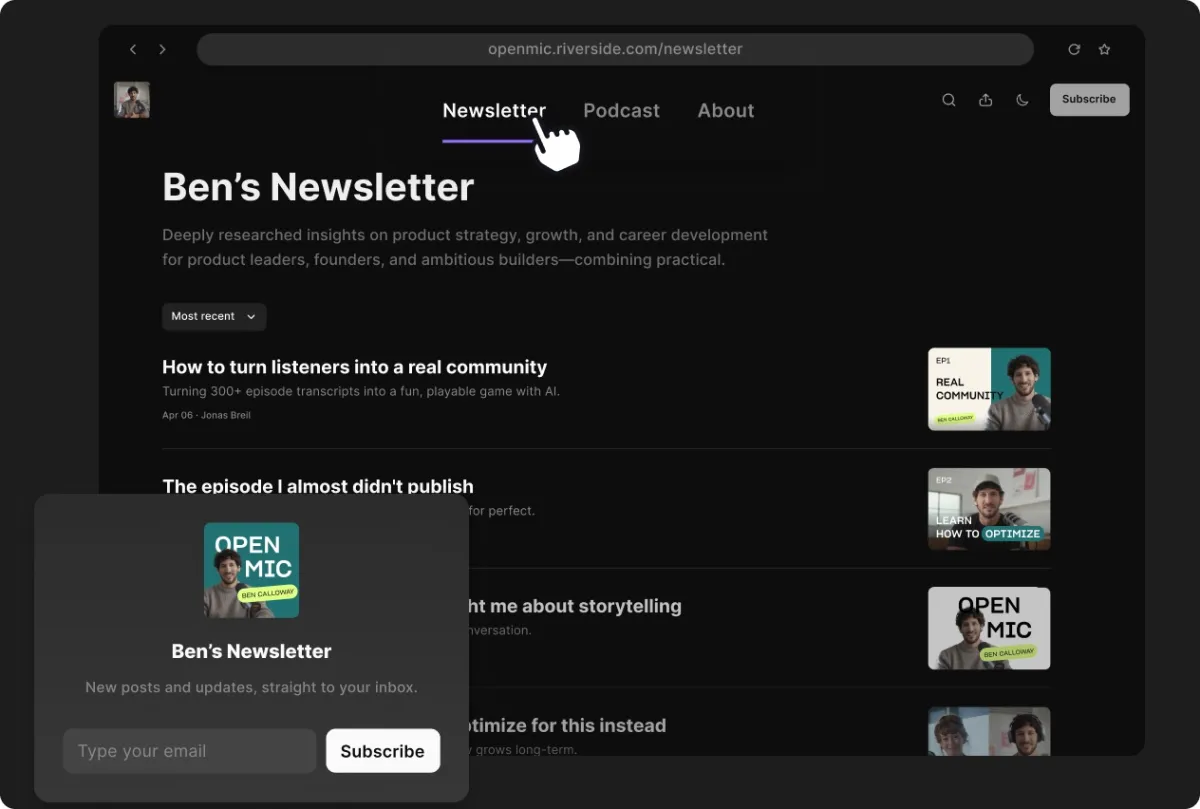
Riverside, best known as a remote recording platform for podcasters and video creators, is widening its ambitions. The company is adding newsletter publishing tools that let users transform recorded conversations into written updates and send them without leaving the app.
The move does not position Riverside as a direct replacement for newsletter specialists such as Substack, Beehiiv, Ghost or Mailchimp. Instead, the company is betting that the people already using its recording tools have a valuable advantage: they are producing long-form spoken content that can be repurposed into another format with relatively little extra work.
For creators, journalists, brands and businesses, that matters. A single interview, panel discussion or podcast episode can now become the basis for a newsletter draft, social posts and a polished video clip workflow, all from the same platform. Riverside is essentially trying to turn content capture into content distribution.
Why Riverside is making the leap
Riverside’s core product has always been about recording high-quality audio and video remotely. That puts it in a different lane from newsletter-first platforms. But the company sees an opportunity in the changing way creators and companies publish.
Many Riverside customers already record interviews, customer conversations, internal updates, thought leadership segments and show-style episodes. Those recordings are often packed with useful ideas, talking points and quotable moments, yet turning them into a newsletter still requires editing, summarising and formatting work in another tool.
Riverside’s answer is an AI-assisted publishing feature that starts with the recording itself. Rather than asking users to write from scratch, the platform is designed to extract the substance of a finished conversation and reshape it for email readers.
“Our creators and business customers are already producing rich, information-dense spoken content on Riverside,” company co-founder and chief executive Nadav Keyson explained. He said the product is meant to reduce friction for people who find speaking easier than drafting a newsletter from a blank page.
In practice, that means Riverside is leaning into a simple idea: if a recording already contains the story, the insights and the voice of the creator, then the newsletter should be the final packaging step rather than a separate creative burden.
What the new newsletter tools do
The newly announced publishing features are built around two main use cases. First, users can ask Riverside’s AI to convert existing video or podcast recordings into newsletter-ready copy. Second, they can write and send newsletters directly in Riverside even if they do not use the conversion feature.
That dual approach suggests Riverside wants to serve both time-strapped creators who want automation and more hands-on users who prefer to control the final wording themselves.
From recording to newsletter draft
The conversion workflow is the most important part of the update. Riverside’s system takes the substance of a finished recording and turns it into a first-pass newsletter. The idea is not to auto-publish a generic transcript, but to produce cleaner, readable copy that can be edited before sending.
That distinction matters. Many AI content tools are criticized for producing text that feels flattened or repetitive. Riverside’s pitch is that its users already generate material that is naturally conversational and substantive. The AI is there to package the ideas, not invent them.
Publishing inside the same app
Riverside is also adding the ability to send newsletters directly from within the platform. That makes the product more of an all-in-one content suite, reducing the need to export material into a separate email service.
For creators, the appeal is obvious: fewer tools, fewer transfers and fewer chances to lose momentum between recording and publication. For businesses, the addition may help keep production, marketing and audience communication inside a single workflow.
A broader AI push across the product
The newsletter feature is only one part of a larger product update. Riverside is also expanding the technical capabilities of its recording suite and adding more AI-powered editing and enhancement tools.
Multi-camera support and remote guests
One of the most practical upgrades is support for multi-camera recording setups. That should matter for teams producing interviews, panel discussions and more complex shows where a single-camera layout is too limiting.
The company is also making it easier to bring in remote guests during recordings. That places Riverside more squarely in the workflow of publishers, brands and studios that regularly host outside voices and need a reliable remote production environment.
AI-generated hooks and social content
Riverside says users will also be able to ask its AI assistant to create a first cut of a recording soon after it is finished. The same system can generate hooks and content tailored for different social platforms.
That feature set reflects a broader industry trend: software companies increasingly want to move from “record and edit” tools to full content repurposing platforms. The goal is to help users get more mileage out of a single piece of content by reshaping it for multiple channels.
AI video enhancement
The company is also rolling out an AI-based video enhancement tool trained on conversational video podcasts. Riverside says the feature can improve lighting, depth and sharpness, which could help lower-production-value recordings look more polished.
In a crowded creator economy, presentation quality can influence whether a clip feels professional enough for republishing. If Riverside can improve visible quality without requiring extensive manual editing, it may strengthen its appeal to teams that care about speed and brand consistency.
How Riverside fits into a changing creator stack
Riverside’s newsletter move is part of a larger shift in software for creators and media businesses. The lines between recording, editing, publishing and audience growth are becoming increasingly blurred.
Instead of separate apps for capture, post-production and distribution, companies are racing to offer integrated pipelines. The logic is straightforward: if a platform can own more steps in the workflow, it can become harder to replace and potentially more valuable to customers.
For Riverside, newsletters are a natural extension of that strategy. A recording platform already sits at the source of content creation. If it can help shape that content into written posts, social teasers and email newsletters, it becomes more than a studio. It becomes a publishing system.
Why this is not a direct attack on Substack or Beehiiv
Riverside is careful not to frame the launch as a head-on competition with established newsletter services. That is sensible. Companies such as Substack, Beehiiv, Ghost and Mailchimp are built around audience management, email delivery, list growth, analytics and monetisation features that go well beyond simple publishing.
Riverside’s strength is upstream. It is where the content originates. Its newsletter feature is designed to capitalise on that position rather than replace the deeper distribution tools of the email platforms.
Still, the overlap is real. If a creator can record, edit, generate and send a newsletter in one product, the incentive to use a separate writing and mailing service shrinks. The more Riverside expands its publishing workflow, the more it brushes against the edges of the newsletter market.
The blank-page problem
One of the clearest differences between Riverside and newsletter-first competitors is how the creative process begins. Traditional newsletter products assume the user is starting from scratch and needs a writing environment, templates and distribution tools.
Riverside assumes something else: the user has already made the content in another format. That distinction could make the platform attractive to creators who think more naturally in audio or video than in prose.
In that sense, the company is not asking users to become better newsletter writers. It is asking them to reuse what they have already said.
The competitive backdrop: platforms are converging
Riverside’s announcement arrives during a period of rapid feature borrowing across the creator platform landscape. Products that began in one category are increasingly reaching into adjacent ones to capture more of the creator workflow.
That is not just a matter of product expansion. It is also a defensive response to a market where user acquisition is expensive and retention matters more than ever. If a platform can help creators do more without leaving, it can reduce churn and raise switching costs.
Substack, Beehiiv and Mastodon have all moved outward
Recent moves by other platforms illustrate the same trend. Substack has added recording features that bring it closer to Riverside’s territory. Beehiiv has explored podcasting, stepping into a format once considered outside the newsletter core. Mastodon has also said it will allow posts to be published as newsletters.
Each of those moves reflects a broader recognition: audiences no longer consume content in rigid categories. A post, audio clip, transcript, newsletter and social snippet can all be versions of the same underlying idea.
That makes cross-format tooling more attractive, especially for solo creators and small teams that do not have large production staff.
Why multi-format publishing is becoming the norm
Creators are under constant pressure to produce more content across more channels. A single podcast recording might need to be clipped for social media, summarised for email, repackaged into blog copy and converted into a short video promo. Tools that can accelerate that process now have a strong market pitch.
Riverside is moving directly into that need. It is offering a way to make one recording serve several publishing goals, which can reduce the time and expense of content production.
What this means for businesses and media teams
Although Riverside’s brand is closely associated with podcasters and independent creators, the new features could also appeal to companies using recordings for thought leadership, customer communications or internal updates.
For a marketing team, a recorded founder interview could be turned into a newsletter announcing product strategy. For a media company, a guest conversation could be repackaged into subscriber communications. For an internal communications team, a town hall recording could become a polished recap.
The practical benefit is speed. Newsletter production often stalls because someone has to synthesise spoken material into written copy. If AI can handle a substantial portion of that work, teams can move faster and publish more often.
But the trade-off is also familiar: more automation can mean more editorial review. Businesses will still need to check tone, accuracy and brand voice before sending AI-assisted newsletters to a public audience.
The role of AI in Riverside’s strategy
AI is not a side feature in this update. It is the engine behind much of the product expansion. Riverside is using AI to transform raw media into usable content, to generate promotional copy and to enhance video quality.
That places the company within a broader wave of software products that are trying to make AI useful in specific workflows rather than as a generic chatbot overlay.
Why the company is emphasizing spoken content
Riverside’s argument is that spoken content is often easier for creators to produce than written content. That is especially true for interview-based formats, where the conversation already captures much of what a newsletter should say.
By focusing on spoken material, the company is trying to reduce the distance between creation and publication. The AI is not starting from zero; it is working from a structured conversation that already has a topic, cadence and point of view.
AI quality will be the key test
The real question is whether the output feels genuinely useful to users. AI-generated drafts can save time, but only if they preserve the creator’s voice and avoid generic phrasing.
That is especially important in newsletters, where readers often subscribe because they want a distinctive perspective. If Riverside’s drafts feel too templated, users may still prefer to rewrite them heavily or use the feature only as a rough outline.
The company seems aware of that risk, which is why the product is positioned as a content assistant rather than a fully autonomous publishing system.
Funding, scale and momentum
Riverside says it has raised more than $60 million to date, giving it enough capital to keep broadening its product set. That level of funding does not place it among the largest media software companies, but it does give the firm room to invest in AI features, recording infrastructure and new distribution tools.
In a market where many platforms are competing for creators, financial backing can be important. Product expansion costs money, and companies often need scale to support the kind of reliable infrastructure that live recording and publishing demand.
Riverside’s ability to bundle more features into a single environment could also help it increase customer value over time. If users adopt newsletters, social generation and video enhancement alongside recording, the platform becomes more embedded in their workflows.
Timeline of the platform race
The following table summarises some of the recent moves that show how recording, publishing and newsletter platforms are converging.
| Platform | Move | Timing | What it signals |
|---|---|---|---|
| Riverside | Added AI-assisted newsletter publishing from recordings | June 2026 | Recording tools moving into written distribution |
| Substack | Launched a built-in recording studio | March 2026 | Newsletter companies expanding into audio/video production |
| Beehiiv | Entered podcasting | April 2026 | Email platforms trying to own more creator formats |
| Mastodon | Announced newsletters for posts | June 2026 | Social platforms seeking longer-form publishing options |
What to watch next
Riverside’s newsletter launch raises several questions about how quickly the company can turn the feature into real usage.
- Will creators trust the AI draft enough to use it regularly?
- Can Riverside make the editing process simple without making the output feel generic?
- Will businesses use the newsletter tools for internal and external communications?
- How aggressively will the company expand into email distribution and audience management?
- Could the platform eventually become a broader publishing hub rather than just a recording tool?
The most likely near-term answer is that Riverside will remain focused on making spoken content easier to reuse. But the direction of travel is clear. The company is no longer selling only recording quality. It is selling a workflow that begins with a conversation and ends with a published message.
The bigger strategic picture
Riverside’s latest product change is not just a feature release. It is a signal that the company wants to own more of the creator journey.
That journey increasingly looks less like a linear process and more like a content graph: one conversation generating a podcast, a video, a newsletter, a social post and perhaps a blog summary. The winners in that environment may be the platforms that make those conversions effortless.
Riverside’s bet is that creators do not necessarily want more places to work. They want one place that helps them turn a recording into multiple forms of output. If the company can make that process fast, polished and reliable, it may carve out a strong niche in the crowded creator software market.
For now, the message from Riverside is clear. The company wants to be more than the place where content is recorded. It wants to be the place where content gets published.