In short
Ford has rehired 350 veteran engineers after automated quality systems and AI failed to meet the automaker’s standards. The company says the hybrid approach is improving quality and could save up to $1 billion this year.
- Ford rehired 350 experienced engineers after AI-driven quality checks underperformed.
- The company says the veterans are finding defects earlier and helping train younger staff.
- Ford still plans to use AI, but as a support tool rather than a standalone solution.
- The automaker expects the move to cut costs by as much as $1 billion this year.
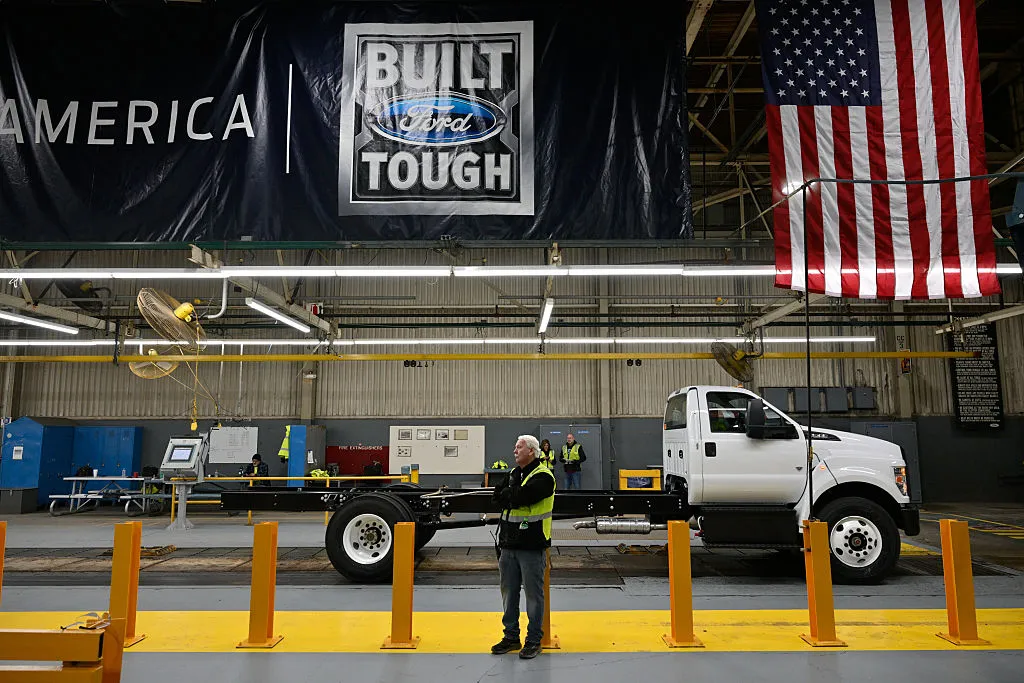
Ford is turning to experience to solve a problem technology alone could not crack. After a push to rely more heavily on artificial intelligence and automated quality checks failed to deliver the level of consistency the automaker wanted, the company has rehired 350 seasoned engineers — including former Ford employees and specialists who had been working for suppliers — to help catch defects earlier and improve vehicle quality.
The move offers a revealing look at the limits of automation in one of manufacturing’s most complex environments. While AI tools can process large volumes of design data and flag patterns that might escape human eyes, Ford’s leadership now says that software alone was not enough to guarantee a high-quality product. Instead, the company is combining AI with hard-earned human judgment, using its newly returned experts to identify weak points before parts reach the assembly line and to coach younger engineers on how to avoid repeat mistakes.
Ford says the approach is already producing measurable benefits. Executives say the retooled quality effort could help the company save as much as $1 billion this year, while the automaker also claimed the top position among mainstream brands in the latest JD Power Initial Quality Survey. The message from Dearborn is clear: AI still matters, but in Ford’s case, it works best with veteran engineers in the loop.
Why Ford changed course
The rethink came after Ford’s leadership concluded that automated quality systems were not delivering the results expected. According to company executives, the automaker had leaned more heavily on machine-driven checks and AI-assisted processes in an effort to raise quality and reduce waste. But the results were disappointing enough to prompt a reset.
Instead of continuing to depend so much on automation, Ford brought back technical specialists with years of hands-on experience in design, manufacturing and troubleshooting. These are the kinds of engineers who can spot subtle weaknesses in a component, understand how a small deviation in a specification can create downstream problems, and anticipate issues before a vehicle reaches the plant floor.
That shift is notable not because Ford is abandoning AI, but because it is redrawing the boundary between what software can do and what humans still do better. In a factory environment, quality is not just a digital problem. It is also a materials problem, an assembly problem and, often, a judgment problem.
The return of the “gray beard” engineers
Ford’s revived team has been described internally as a group of “gray beard” engineers — a shorthand for veteran specialists whose experience can be difficult to replace. Some came back from retirement or other employers. Others were recruited after spending time at suppliers, where they had remained close to the practical realities of parts production and automotive engineering.
The company’s chief operating officer, Kumar Galhotra, said Ford had increasingly relied on automated quality systems, but the outcome was not as strong as expected. He said the automaker has now brought back technical experts to look for failure points before components ever make it to the factory.
Ford’s leadership said the company had put too much faith in automated quality systems and brought back specialists to find defects earlier in the process, before parts hit the plant floor.
Charles Poon, Ford’s vice president of vehicle hardware engineering, acknowledged that the company overestimated what AI could achieve on its own. His comments suggest a broader lesson for manufacturing firms that are eager to use machine learning tools in product development and quality assurance: ingesting design requirements into a model does not automatically produce a reliable physical product.
Ford’s vehicle hardware engineering chief said the company initially assumed that feeding design requirements into AI would be enough to create a high-quality result.
What the veteran engineers are doing now
Ford is not simply bringing back older workers to fill seats or preserve institutional memory. The company is assigning them a specific operational role in a hybrid quality system that blends human expertise with automation.
Finding flaws before production begins
The most important task for the rehires is preventive. Rather than waiting for an issue to surface on the line or after a vehicle reaches a customer, these engineers are being used to spot potential problems in the design and sourcing stages. That includes identifying weak links in parts, verifying whether supplier components meet the intended specifications and using accumulated experience to anticipate how small defects can escalate.
This is especially valuable in auto manufacturing, where a tiny tolerance miss can affect safety, reliability, assembly speed or long-term durability. A machine can highlight anomalies, but a veteran engineer may understand why those anomalies matter in the real world.
Training the next generation
Ford is also using the rehired experts as mentors. The company says they are helping train younger engineers and reprogram AI tools so the software becomes more effective over time.
That training function is important because it suggests Ford is not treating AI as a replacement for expertise. Instead, the company is trying to preserve that expertise by transferring it into both people and systems. In practical terms, the knowledge held by experienced engineers can be used to teach younger staff what to look for and to improve the rules, prompts, and models that support automated quality checks.
Reprogramming the tools themselves
Another part of the strategy is technical rather than managerial. Veteran engineers are helping adjust the AI systems so they better reflect the realities of vehicle development and production. That can mean refining the data the models ingest, updating how defect patterns are interpreted or improving how alerts are prioritized.
In other words, Ford is not discarding automation. It is attempting to make automation smarter by giving it better guidance from people who have spent years dealing with complex mechanical systems and manufacturing constraints.
A reminder that AI is not a cure-all
Ford’s experience is part of a larger pattern across industry: companies often adopt AI expecting it to resolve longstanding operational problems, only to discover that the technology works best when paired with domain expertise. In fields like manufacturing, where product quality depends on physical processes, supply chains and human execution, AI can accelerate analysis, but it cannot always replace tacit knowledge.
The automaker’s admission is particularly striking because quality control is one of the areas where automation should, in theory, shine. Systems can inspect huge numbers of parts, compare readings against standards and flag deviations far faster than humans can. But quality in a complex vehicle is cumulative. A model may detect obvious defects while missing subtle interactions between design decisions, supplier variation and assembly conditions.
That is where veteran engineers add value. They can interpret the significance of a potential failure point and weigh whether a warning is merely statistical noise or a serious production risk.
How Ford’s approach compares with broader industry trends
Ford’s move may resonate beyond the auto sector, especially as more companies experiment with AI in industrial settings. Across manufacturing, logistics and product design, firms are investing in systems that promise faster analysis, lower labor costs and fewer defects. Yet many are finding that real-world complexity makes full automation difficult.
Manufacturing often involves a mix of legacy machinery, supplier variation, regulatory constraints and custom engineering decisions. AI can help manage that complexity, but only if the underlying data is accurate and the models are tuned by people who understand the business deeply. Without that, automated systems may generate blind spots rather than eliminate them.
Ford’s response suggests a practical formula:
- Use AI to process more data and identify patterns faster.
- Use experienced engineers to interpret the patterns and spot what the model misses.
- Feed human insight back into the system so future automated checks improve.
- Measure success not by adoption alone, but by actual quality outcomes on the factory floor.
Quality gains and financial impact
Ford says the revised strategy is already producing financial benefits. Executives anticipate that the quality push could save the automaker up to $1 billion this year. That is a substantial figure, and it underscores the cost of poor quality in automotive manufacturing, where defects can lead to rework, recalls, warranty claims and reputational damage.
Those savings also help explain why companies are willing to revisit older methods when digital ones underperform. In a business with slim margins and enormous fixed costs, even modest improvements in defect prevention can translate into major gains.
At the same time, the company’s quality ranking provides another sign that the strategy may be working. Ford says it led mainstream brands in the JD Power Initial Quality Survey released this week. While survey results do not tell the whole story about long-term durability, they are an important public benchmark and a useful indicator of whether the company’s manufacturing changes are being felt by customers.
What this means for AI in manufacturing
Ford’s decision does not amount to an anti-AI backlash. If anything, it is an argument for more disciplined AI deployment. The company appears to be moving toward a model in which automation handles scale and speed, while engineers supply context, judgment and oversight.
That lesson matters because many executives are currently under pressure to show immediate returns from AI investments. In manufacturing, those returns can be elusive if organizations assume that software can absorb all the know-how stored in experienced workers. Ford’s course correction highlights the danger of treating domain expertise as optional.
It also points to a broader issue facing industry as a generation of skilled engineers approaches retirement. Firms that lose those employees without capturing their knowledge may find that AI systems built on incomplete or shallow input do not perform as hoped. Rehiring veteran specialists can be one way to bridge that gap, but the more durable solution is to create systems that preserve expertise before it walks out the door.
Why experience still matters on the factory floor
Automotive manufacturing is a test of precision, patience and pattern recognition. A seasoned engineer often knows which issues are likely to remain isolated and which ones are symptoms of a deeper failure. That ability is difficult to encode in software, especially when the problem involves trade-offs among cost, manufacturability, supplier capability and product performance.
Experienced engineers also bring historical memory. They remember what went wrong in prior programs, how certain materials behaved in production and which shortcuts created headaches later. That institutional memory can be invaluable when new technologies are introduced.
In Ford’s case, the rehires appear to be serving as a bridge between old and new methods. The company is using long-tenured knowledge to improve the technology it once hoped would stand alone.
Timeline of Ford’s quality reset
| Stage | What happened | Why it matters |
|---|---|---|
| AI expansion | Ford increased reliance on automated quality systems and AI-driven checks. | The company hoped to improve consistency and catch defects faster. |
| Disappointing results | Executives said the automated approach did not achieve the desired quality level. | The shortfall prompted a reassessment of how quality was being managed. |
| Rehiring veteran engineers | Ford brought back 350 experienced engineers from former roles and suppliers. | These specialists were tasked with identifying failure points earlier. |
| Hybrid quality model | The engineers began training younger staff and improving AI tools. | Ford kept AI in the process but added human expertise. |
| Early results | Ford projected up to $1 billion in savings and reported strong JD Power quality performance. | The company suggests the new approach is already paying off. |
The bigger business lesson
Ford’s move may be remembered as a case study in the limits of over-automation. It does not suggest that AI has failed in manufacturing. Rather, it shows that the technology works best when companies understand exactly where it fits.
There is a difference between using AI to assist experts and using it to replace them. Ford’s experience suggests that the first approach is far more reliable. In complex industrial settings, the best outcomes may come from pairing machine speed with human judgment instead of choosing one over the other.
That insight could prove relevant for any company that wants AI to improve quality without weakening accountability. In Ford’s factory ecosystem, the answer was not to keep pushing automation harder. It was to bring back the people who know where the failures hide.
Looking ahead
Ford’s quality reset is still unfolding, and the real test will be whether the current gains continue across multiple vehicle programs and production cycles. Savings projections are useful, but long-term success will depend on whether the company can institutionalize what its veteran engineers know and turn that knowledge into better systems, better training and better products.
If the automaker succeeds, it may end up with a model that other manufacturers copy: AI for scale, human experts for judgment and a deliberate loop between the two. If it fails, the company may have to keep adjusting its balance between automation and experience.
For now, Ford’s message is unusually candid for a company that has invested heavily in modern tools. The lesson is not that AI is useless. It is that in manufacturing, quality still has a human face — and sometimes, that face belongs to a gray beard engineer who knows where the trouble starts.
| Key figure | Detail |
|---|---|
| 350 | Veteran engineers rehired by Ford |
| $1 billion | Potential cost savings Ford expects this year |
| Top mainstream brand | Ford’s ranking in the latest JD Power Initial Quality Survey |