Google is taking another swing at the smart speaker market, but this time the pitch is less about controlling lights and more about talking to an AI that can actually keep up. The company on Wednesday unveiled the Google Home Speaker, a $99.99 device designed specifically around Gemini, its flagship generative AI system, in what amounts to Google’s most aggressive attempt yet to make the home speaker feel current again.
The launch matters because the category has spent years in a holding pattern. Smart speakers once felt like a breakthrough: convenient voice-controlled hubs for music, timers, alarms and connected devices. Over time, though, the novelty faded. Voice assistants became increasingly good at simple tasks and increasingly frustrating when users deviated from rigid command patterns. Google’s answer is to rebuild the experience around natural conversation, multi-step prompts and more fluid interactions that resemble the way people now use AI chatbots on phones and laptops.
The move also signals a broader strategic shift. Google is not merely refreshing hardware; it is trying to turn Gemini into a consumer product people live with every day. If the company can persuade shoppers to embrace a more capable speaker, it could revive a stagnant category while creating a new subscription business around the home.
A new kind of smart speaker
The Google Home Speaker is the company’s first standalone smart speaker since the Nest Audio arrived in 2020. That gap alone tells the story: Google has largely let the category mature without much visible hardware ambition, while the market itself slipped from must-have status to background utility.
This new model is meant to change that by making Gemini the central interface. Instead of forcing users to memorize clunky phrasing, the speaker is designed to understand requests the way a person would speak them. That means the device can handle layered instructions, follow-up questions and mid-sentence corrections without making the user start over.
Google says the speaker is built so that people can speak naturally, interrupt themselves and ask for changes without restarting the command from scratch.
Examples given by the company point to the kind of flexibility it wants to unlock: a user could ask the device to switch off every light in the house except one lamp, or tell it to dim the kitchen lights, queue relaxing music and start a timer in a single breath. If the speaker mishears a request, the user should be able to correct it on the fly rather than restate the whole command.
What Gemini changes in the home
The most important difference between this device and earlier Google speakers is not the microphone array or the industrial design. It is the conversational model under the hood. Gemini is being positioned as the intelligence layer that makes the speaker feel less like a remote control and more like an always-available helper.
From commands to conversation
Traditional smart speakers excelled at narrow tasks. They could play music, set alarms, and toggle connected devices, but only when spoken to in a way they understood. The new Google Home Speaker aims to lower that barrier by supporting requests that sound closer to ordinary speech.
That matters because the current generation of users has become accustomed to interacting with AI systems that can parse context, remember the flow of a discussion and infer what the person really means. Google is trying to bring that expectation into the home, where voice interaction has often lagged behind what people experience on a smartphone.
Continued conversation without repeating wake words
The company is also leaning into what it calls Continued Conversation, a feature that keeps the microphone active briefly after a response so people can keep the exchange going naturally. In practice, that reduces the need to keep saying a wake phrase before every follow-up.
That capability may sound minor, but it is central to making a voice assistant feel less mechanical. It gives the interaction some of the back-and-forth quality people expect from AI chat tools, especially when they are asking follow-up questions or refining a request as they go.
Built-in voices and broader Q&A
The speaker will ship with 10 new voices, and Google says the device is not limited to home-control chores. Users will be able to ask questions, explore topics in more detail and hold a more open-ended exchange with Gemini, much like they would on a phone through the company’s broader AI products.
That is an important expansion of purpose. For years, the promise of the smart speaker was that it would become a household assistant. In practice, it mostly became a convenient remote control. Google is betting that generative AI can finally push the device closer to the original vision.
Hardware that looks familiar, but with a new signal light
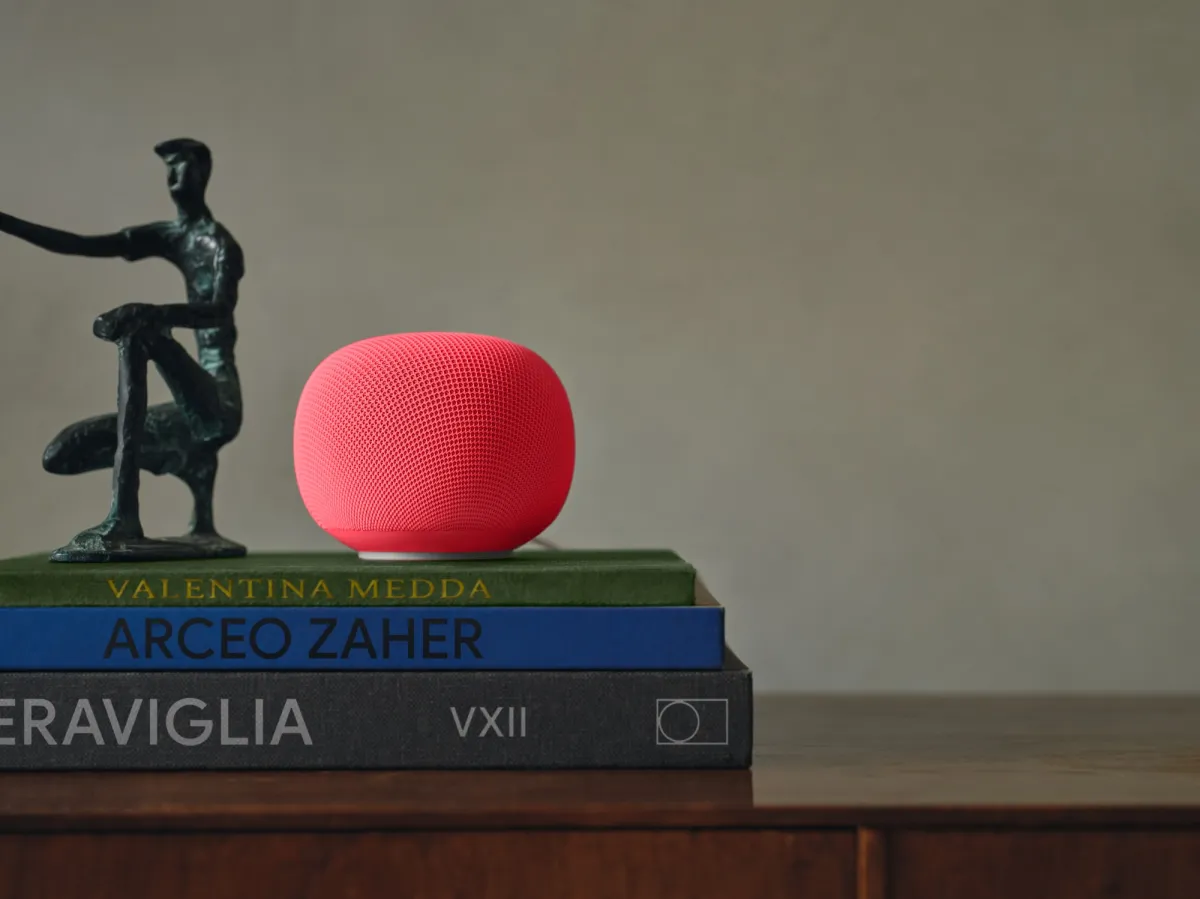
Visually, Google is not making a dramatic break from the past. The speaker retains the soft, rounded shape and 3D-knit textile covering associated with the company’s earlier Nest and Google Home hardware. It measures 3.4 by 4.2 inches, keeping it compact enough to blend into a shelf or counter rather than dominate a room.
In the United States, buyers will be able to choose Jade and Berry finishes, while Hazel and Porcelain remain available in other markets. The design language is familiar, but Google has added a new ring light at the base that changes state depending on what the speaker is doing.
- Listening: the device indicates that it has heard the wake phrase or command.
- Thinking: the light shows that Gemini is processing the request.
- Responding: the ring signals that the assistant is speaking back.
That small visual cue is significant because generative AI systems are less predictable than older voice assistants. Users benefit from clearer feedback about when the device is processing language versus when it is simply idle.
Google’s subscription strategy comes into focus
The biggest business question around the new speaker is not whether it sounds smarter. It is whether Google can get customers to pay more for smarter behavior in a product category that has traditionally been inexpensive and utility-driven.
To that end, Google is introducing Google Home Premium, a paid tier that starts at $10 per month or $100 per year. The subscription unlocks more advanced Gemini features, including the more conversational Gemini Live experience, which users can start by saying, “Hey Google, let’s chat.”
Google is also tying the service to home-security and awareness features. With Home Premium, users can ask the system to summarize activity captured by Nest cameras or help interpret what happened around the home while they were away. That extends the product beyond the speaker itself and into the broader connected-home ecosystem.
Google is offering the advanced functions free for six months before moving users toward a subscription, a move that suggests the company wants people to build habits before asking them to pay.
The challenge is clear: many of the speaker’s new capabilities are available without a fee. That creates a familiar consumer software problem. If the baseline experience is good enough, a monthly charge can feel hard to justify. If the premium features are compelling enough, however, Google could finally establish a recurring revenue model around the smart home.
Why this launch matters now
Google’s timing is notable. The consumer AI race has moved well beyond chatbots on phones and desktops. Companies across the tech industry are now trying to place generative AI into more ambient, everyday products: earbuds, cars, glasses, home devices and appliances. The home speaker is one of the most obvious candidates because it already sits at the center of voice interaction.
But it is also a category with baggage. Smart speakers rose quickly and then settled into a stable but unspectacular role. Many households that bought them years ago still use them for music and timers, but the devices have not seen the same level of excitement as newer AI-native hardware categories. Google is attempting to make the speaker matter again by making it feel less like an accessory and more like an AI endpoint.
That strategy has implications for the rest of the market. If Google proves that users will pay for better home AI, competitors will likely be pushed to sharpen their own offerings. If not, the industry may conclude that conversational upgrades alone are not enough to revive a hardware class that many consumers already consider “good enough.”
The broader competition for the smart home
Google’s move sits at the intersection of two trends: the resurgence of consumer AI and the long-running battle to control the smart home. The company already has a wide footprint through Google Home, Nest cameras, and its Android ecosystem. A Gemini-powered speaker could help it unify those pieces into a more coherent experience.
That matters because the home is a hard place to win. Devices must be useful every day, not just impressive at launch. They also need to play well with different routines, different family members and a wide range of third-party devices. The more the assistant can understand context and intent, the more value it can deliver in a shared household environment.
The new speaker suggests Google believes the old formula—“ask a question, get an answer”—is not enough anymore. Instead, the company wants the device to operate as a household memory and a conversational control layer, not just a voice-activated switch.
What could make the product succeed
Several factors could help Google gain traction:
- Better natural-language handling: if the speaker truly understands messy, human phrasing, it could reduce the frustration that has long plagued voice assistants.
- Useful home summaries: camera-based activity digests and event explanations could make the subscription feel practical rather than abstract.
- Habit formation: the six-month free period gives users time to integrate the device into daily routines.
- Familiar design: the soft, unobtrusive aesthetic may encourage the speaker to blend into homes rather than feel like a gadget.
What could hold it back
At the same time, Google faces real risks:
- Subscription fatigue: consumers are already paying for multiple digital services, and a monthly home-AI fee may be a difficult sell.
- Feature overlap: if too much of the useful functionality is free, the premium tier may lack urgency.
- Expectation gap: users may expect chatbot-level intelligence in every context, which can be difficult to deliver consistently on a home device.
- Privacy sensitivity: features tied to cameras and home activity summaries may raise questions about data handling and surveillance.
Key details at a glance
| Topic | Details |
|---|---|
| Product | Google Home Speaker |
| Price | $99.99 |
| AI platform | Gemini |
| Paid service | Google Home Premium |
| Subscription cost | $10 per month or $100 per year |
| Free trial period | Six months for advanced AI features |
| New voices | 10 |
| Dimensions | 3.4 x 4.2 inches |
| U.S. colors | Jade, Berry, Hazel, Porcelain |
| Availability | Pre-order available now; shipping later this month |
A return to hardware, but with AI at the center
For Google, the new speaker is more than a product refresh. It is an attempt to redefine what a smart home device should be in the era of generative AI. The company is no longer asking whether a speaker can answer simple questions. It is trying to prove that a speaker can participate in a real conversation, manage a household more intelligently and perhaps become worth paying for.
That is a much bigger ambition than the smart speaker market had when the first wave of devices arrived. Back then, the goal was convenience. Now, the goal is capability.
If the Google Home Speaker succeeds, it could become the template for a new generation of AI-first home devices: less like an appliance, more like a household companion. If it falls short, it may become another reminder that the leap from chatbot novelty to everyday consumer hardware is still harder than it looks.
Either way, Google has made its position clear. The future of the smart speaker, at least in the company’s view, depends on whether Gemini can make people want to talk to their homes again.