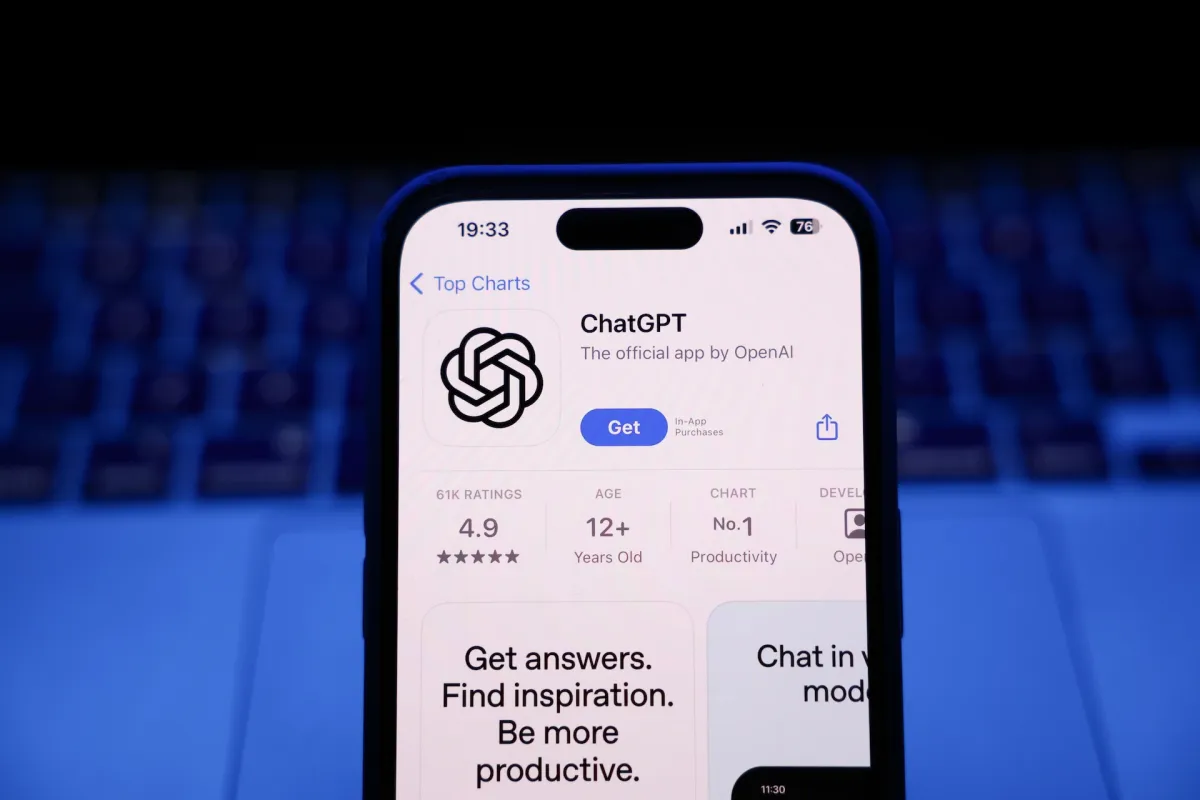
ChatGPT is still the biggest name in consumer AI, but its dominance is no longer absolute. For the first time since launch, OpenAI’s chatbot has slipped below 50% market share, a symbolic turning point in a market that has rapidly shifted from novelty to fierce competition.
New figures from Sensor Tower’s 2026 State of AI Report show that users are increasingly splitting their time among several assistants rather than settling on one default tool. Google’s Gemini, Anthropic’s Claude and xAI’s Grok are among the products drawing attention, while the broader category of AI apps is entering a new phase defined less by explosive adoption alone and more by retention, revenue and trust.
ChatGPT remains the world’s largest AI assistant by usage, but the competitive map has changed quickly over the past year. The latest data suggest that the era of one assistant capturing nearly all the momentum is giving way to a more crowded market where ecosystem advantages, pricing, product quality and brand perception all matter more than ever.
The market leader is still huge, but no longer unchallenged
OpenAI’s assistant still leads in scale by a wide margin. Sensor Tower estimates ChatGPT has more than 1.1 billion monthly users worldwide, ahead of Gemini at 662 million and Claude at 245 million. Even so, the share of total assistant usage attributed to ChatGPT fell to 46.4% by the end of May, down from more than half in January.
That decline matters less as an isolated number than as a sign of market normalization. The first wave of generative AI adoption was defined by a rush toward the most recognizable product. Now, users appear more willing to compare alternatives, migrate between apps and choose tools based on the task at hand.
ChatGPT’s own growth trajectory remains extraordinary. Sensor Tower said the app became the fastest in history to reach 1 billion monthly users. OpenAI, which measures weekly active users rather than monthly active users, last disclosed 900 million weekly users in February.
How the assistant market is being redistributed
The most striking change in the market is not that ChatGPT is losing its lead; it is that rivals are finding distinct paths to scale.
Gemini benefits from the Google ecosystem
Google’s Gemini has emerged as the clearest beneficiary of distribution. Its rise is tied closely to its placement across Google’s broader product suite, giving it a natural advantage in discovery and everyday use. Users who already rely on Google services for search, email, documents and mobile devices face fewer barriers to trying Gemini and returning to it regularly.
That ecosystem integration appears to be translating into meaningful market share. Gemini now accounts for 27.7% of assistant usage, according to Sensor Tower’s report, making it ChatGPT’s nearest rival by a wide margin.
Claude is becoming the productivity choice
Anthropic’s Claude is carving out a different identity. Rather than competing on breadth alone, it has built a reputation for stronger performance on work-related and productivity tasks. That positioning seems to be paying off, with Claude reaching 10.3% market share and narrowing the retention gap with ChatGPT.
One of the clearest signs of Claude’s momentum is paid conversion. Sensor Tower says 13% of Anthropic users subscribe to a paid plan, the highest conversion rate among the major assistants it tracked. For investors, that is an important signal: a product does not need to lead in scale to demonstrate strong monetization potential.
Smaller players remain in the game
Beyond the top three, the landscape is more fragmented. Grok, Perplexity, DeepSeek and Meta AI each hold less than 5% market share, but their presence still matters. These platforms may not yet threaten the leaders individually, yet they help shape user expectations and force the biggest companies to keep iterating on features, speed and pricing.
For the broader industry, that fragmentation suggests the market is not locked in. It is still early enough for new use cases, partnerships and distribution channels to reorder the rankings.
Users are switching more often — and trust now plays a role
Sensor Tower’s data point to an important shift in user behavior: people are no longer treating AI assistants as fixed destinations. Instead, they are increasingly sampling multiple tools and switching between them depending on the situation.
That mobility has implications for every player in the field. It means no assistant can assume loyalty simply because it was first to win the market’s attention. Product quality matters, but so do values, perceived reliability and the user’s sense of whether a company is aligned with their expectations.
Sensor Tower’s findings suggest that brand trust is becoming a meaningful factor in AI assistant usage, with specific corporate decisions prompting users to rethink which platforms they want to support.
One example stands out. According to the report, OpenAI’s agreement with the U.S. Department of Defense in February corresponded with a noticeable increase in app uninstalls. The data do not prove causation in a strict sense, but they do indicate that some users respond strongly to perceived ethical or political concerns, not just features and performance.
That dynamic may become more pronounced as assistants move deeper into work, education, shopping and personal organization. As AI becomes more embedded in daily life, the question is no longer simply which assistant can answer best, but which one users feel comfortable depending on.
A booming market is starting to mature
The broader AI app economy is still expanding quickly, but the nature of that expansion is changing. Sensor Tower estimates that in the first half of 2026, consumers will download nearly 2.3 billion AI apps and spend more than $4.2 billion on them.
That is a dramatic increase from the $1.83 billion spent in the first half of 2025. The jump shows that monetization is becoming real, not theoretical. At the same time, the pace of growth is slowing relative to earlier periods, which often happens when a market moves from hype-driven adoption into a more durable but less explosive phase.
In other words, AI apps are still growing rapidly in absolute terms, but the market is no longer in its earliest, most chaotic stage. Companies are now competing not only to attract users, but to keep them engaged long enough to generate subscription revenue, ad revenue or commerce-driven conversions.
Key market indicators at a glance
| Metric | H1 2025 | H1 2026 estimate | Trend |
|---|---|---|---|
| AI app downloads | Base period | Nearly 2.3 billion | Strong growth, but slowing rate |
| Consumer spending | $1.83 billion | Over $4.2 billion | Sharp increase |
| Hours spent on AI apps | 17.2 billion | About 36 billion | More than doubled |
| ChatGPT market share | Above 50% in January | 46.4% by end of May | Below 50% for first time |
| Claude paid conversion | Not disclosed | 13% | Leads the field |
Time spent is rising fast, but concentration remains high
Usage intensity is increasing just as fast as spending. Sensor Tower estimates that total time spent on AI apps will rise from 17.2 billion hours in the first half of 2025 to roughly 36 billion hours in the first half of 2026.
That surge reflects how quickly AI tools have moved into routine use. Many people are no longer opening these apps only to test them; they are using them for brainstorming, summaries, coding help, travel planning, writing, research and shopping.
Even with the market becoming more crowded, the top three assistants still dominate attention. ChatGPT, Gemini and Claude together account for 89% of time spent on AI assistant apps, a reminder that the market’s center of gravity remains heavily concentrated.
By contrast, adjacent categories such as AI companions and AI content-generation apps remain more open. Those segments are fragmented enough that a well-timed product shift or a strong distribution partnership could still reshape the field.
Monetization is shifting beyond subscriptions
The AI assistant business model is broadening. For the first phase of the market, subscriptions were the cleanest way to monetize enthusiasm. But companies are now testing ads, commerce referrals and embedded workplace features as they try to turn engagement into revenue.
ChatGPT begins experimenting with ads
OpenAI began running ads in ChatGPT in February, and Sensor Tower says the company has expanded the program gradually. By May, about 17% of daily users were being shown ads on average. That makes ad exposure an increasingly important variable in OpenAI’s monetization strategy.
The ad categories seen most often so far include software and shopping, followed by media and entertainment, and food and dining. That mix is consistent with an assistant that is being used both for productivity and consumer decision-making.
For OpenAI, the challenge is obvious: ad revenue can scale quickly, but the company must be careful not to compromise the usefulness and trustworthiness that made ChatGPT popular in the first place.
Premium users are willing to pay for productivity
Anthropic’s strength in conversion highlights a different route to sustainable business. Some users are willing to pay if they believe a tool genuinely improves their work. That seems especially true for AI products that are seen as reliable writing, reasoning or analysis companions.
This matters because the market may eventually reward different types of leaders in different ways. One company may dominate raw usage. Another may win on paid conversion. A third may succeed through distribution partnerships or enterprise adoption.
That separation between audience size and revenue efficiency is one of the defining features of the current AI race.
Shopping is becoming a major battleground
Commerce is increasingly central to the AI assistant story. ChatGPT is not only generating text; it is helping guide purchasing decisions and sending traffic toward retailers. That creates a new kind of competition between AI platforms and the companies whose products they surface.
According to Sensor Tower, ChatGPT is sending more referral traffic to retailers such as Target, Walmart and Costco as shopping features improve. That makes the assistant more than a conversational tool; it is becoming a gateway to retail discovery.
Amazon’s resistance is shaping the market
Amazon has blocked ChatGPT’s crawlers, which has limited referral traffic from the platform. As a result, Amazon has not benefited from the same uplift in ChatGPT-driven shopping activity that some other retailers have seen.
That creates an opening for competitors. Walmart, in particular, has moved to embed its own AI assistant to help users search for products and make purchasing decisions. The company’s Spark assistant has been gaining traction, while Amazon’s Rufus has reportedly seen flat user growth.
Even so, the data suggest that on-platform AI can influence shopper behavior when users engage with it directly. Sensor Tower found that Amazon customers who used Rufus spent more time in the app and converted at higher rates than those who did not. That finding underlines why retailers are racing to build their own assistant experiences rather than relying entirely on outside platforms.
Why shopping integrations matter
- They increase the value of AI assistants beyond information retrieval.
- They provide new monetization opportunities through referrals and ad placement.
- They give retailers direct influence over product discovery.
- They may reduce reliance on traditional search and navigation flows.
Regional patterns show a maturing global market
The AI app economy is not developing evenly across the world. Sensor Tower says Asia recorded its first download decline in the first quarter of 2026, down 3.3%, driven by weaker performance in China and India.
That slowdown does not necessarily signal a collapse in interest. Rather, it suggests the first wave of rapid adoption may be tapering off in some markets that were early and enthusiastic download hubs.
At the same time, the economics of AI usage differ substantially by region. Asia still leads the world in total downloads, but North America and Europe generate more in-app spending. That distinction is critical for companies deciding where to prioritize premium features, paid subscriptions and marketing budgets.
In practical terms, a market with massive downloads but weaker spending may be more useful for brand-building and scale, while regions with lower volume but higher monetization are more attractive for revenue growth.
What the latest data mean for the AI race
The most important takeaway from Sensor Tower’s report is that the AI assistant market is entering a more competitive and more commercial stage. Usage is still climbing, but the winners are beginning to separate themselves not only through popularity, but through how effectively they convert attention into revenue.
ChatGPT remains the category leader and likely will for some time. But the first time its market share has fallen below 50% marks a turning point. It signals that no single assistant can assume permanent dominance in a market where users can switch with minimal friction.
For Google, the opportunity is to keep leveraging distribution. For Anthropic, the challenge is to turn strong conversion and retention into broader awareness. For OpenAI, the task is to protect its lead while expanding monetization through ads and commerce without alienating users.
And for newer entrants, the lesson is that the field is still unsettled. In an industry where product cycles are short and users are willing to experiment, a strong niche can become a breakout position faster than traditional software markets would allow.
Why investors and competitors will be watching closely
These market shifts matter far beyond app rankings. They shape valuations, partnership strategies, product road maps and the long-term economics of the AI sector.
Investors will likely focus on three questions:
- Which assistant can sustain engagement as competition intensifies?
- Which company can monetize users most efficiently without hurting retention?
- Which products can convert one-time curiosity into habitual use?
Those questions may determine whether the next phase of AI is led by a single all-purpose assistant or by a small group of differentiated platforms serving different needs.
For now, the data show a market that is growing up quickly. The race is no longer just about who launched first or who made the biggest splash. It is about who can become indispensable.
Sensor Tower’s report points to a broader shift in the AI market: the early winner still leads, but users are increasingly behaving like consumers in a mature software category — comparing options, switching products and responding to pricing, ecosystem fit and trust.
That may be the clearest sign yet that the AI assistant boom has entered its next chapter.
Key takeaways
- ChatGPT’s market share fell below 50% for the first time, landing at 46.4% by the end of May.
- Gemini and Claude are the main beneficiaries, with 27.7% and 10.3% share respectively.
- ChatGPT still leads in absolute user numbers, with more than 1.1 billion monthly users.
- Claude has the highest paid conversion rate at 13%.
- AI app spending is on pace to more than double year over year in the first half of 2026.
- Shopping, ads and on-platform assistants are becoming increasingly important to monetization.