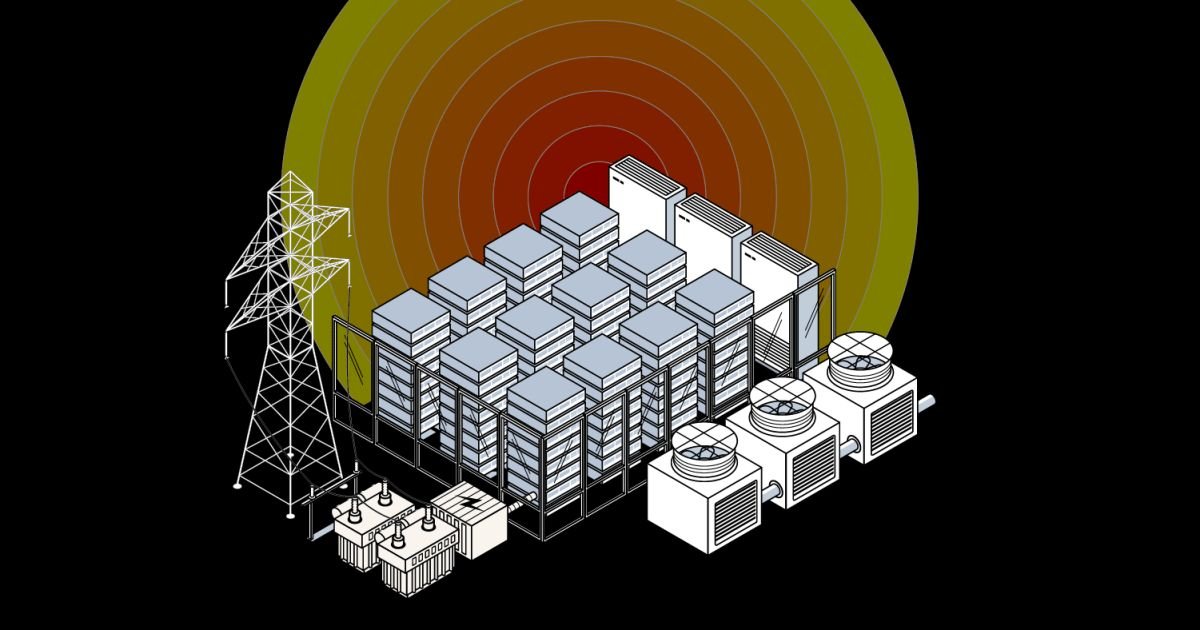
Artificial intelligence may feel weightless when it arrives as a chatbot reply or a generated image, but the infrastructure behind it is anything but invisible. Across the world, tech companies are racing to build enormous data centres that can train and run AI systems at industrial scale. New research suggests those facilities are doing more than drawing vast amounts of power: they are also warming the land around them.
A Cambridge-led study has found that temperatures at the surface of the ground around AI data centres rise, on average, by about 2C after facilities open, with some places seeing increases of as much as 9C. The effect, researchers say, resembles an industrial version of the urban heat island phenomenon — except instead of dense neighbourhoods and traffic, the source is banks of servers, cooling systems and nonstop electricity demand.
The findings land at a moment when data centre construction is accelerating rapidly. More than 11,600 data centres are active worldwide, and the biggest cloud and AI companies are preparing to spend trillions of dollars on new infrastructure over the next several years. That boom is helping shape the future of artificial intelligence, but it is also raising questions about energy use, water demand, local planning and what communities near these facilities may have to live with.
Why AI data centres are different from ordinary server farms
Data centres have existed for years as the quiet engine rooms of the internet. They store files, run websites, move emails and keep software services available around the clock. AI has changed the equation. Large language models and other advanced systems rely on specialised chips that perform enormous numbers of calculations in parallel, and they must often stay active continuously to answer prompts in real time or support large-scale training workloads.
That constant activity makes AI facilities significantly more demanding than conventional servers used for standard browsing or storage. The more intense the workload, the more electricity the chips draw and the more heat they generate. Because heat can damage hardware and reduce performance, operators must remove it quickly through cooling systems, many of which use water as part of the process.
The International Energy Agency says global data centres used about 415 terawatt hours of electricity in 2024, equal to roughly 1.5 percent of global supply. The agency says consumption has grown by about 15 percent a year over the past five years and could nearly double by 2030 to 945 TWh. For a sector that was once considered a niche utility in the background of the digital economy, those are extraordinary numbers.
The scale of hyperscale AI facilities
The most energy-intensive sites are hyperscale data centres, the giant campuses built by large cloud and technology companies to serve global demand. According to IBM, these facilities typically contain at least 5,000 servers and cover a minimum of 10,000 square feet, though many of the new AI campuses being planned are far larger.
Hyperscale operations generally need between 100 megawatts and 300 megawatts of power continuously. That is enough to supply electricity to hundreds of thousands of homes. With power consumption at that level, waste heat becomes a serious engineering problem, not a side effect. The cooling systems required to keep chips within safe operating ranges can be highly resource-intensive, particularly when water is used to carry heat away from the hardware and out into the environment.
One UK government sustainability report found that a single 100-megawatt hyperscale facility can use about 2.5 billion litres of water a year. That is roughly the annual water demand of 80,000 people. For nearby communities, that raises concerns not only about energy and climate footprints but also about local resource competition in places already dealing with drought, heat stress or strained infrastructure.
What the latest research says about the heat footprint
The Cambridge-led study used satellite data from NASA to examine land surface temperatures globally between 2004 and 2024 and matched those measurements against more than 11,000 data centre locations. Researchers then focused on 6,733 centres outside densely populated areas, comparing temperatures after the facilities opened with a five-year baseline for the same sites.
The result was a clear pattern of localised warming. Average land surface temperatures around AI data centres increased by 2C, with a range from 0.3C to 9.1C depending on the location. In some cases, the warming effect extended up to 10 kilometres from the site.
Researchers say the pattern is consistent with what they describe as a “data heat island effect”, a term that captures the way concentrated computing activity can alter the thermal profile of the surrounding land. The phrase intentionally echoes the urban heat island effect, where cities run hotter than nearby rural land because of buildings, paved surfaces and human activity. In this case, however, the warmth comes from machine workload, electrical load and the infrastructure needed to keep both under control.
Who could be affected?
The study estimates that more than 340 million people live within 10 kilometres of a data centre and could therefore experience some degree of exposure to the local warming effect. That does not mean every person will notice a dramatic change in daily life. But the research suggests that the cumulative impact on nearby areas may be meaningful, especially when combined with existing pressures such as high summer temperatures, urban sprawl or water scarcity.
According to the researchers, the implications go beyond the temperature readings themselves. They argue that the environmental footprint of AI infrastructure should be treated as part of a broader conversation about sustainability, land use and regional welfare as digital systems become more central to daily life and the economy.
Researchers involved in the study said the heat created by data centres can have a “remarkable influence” on communities and regional wellbeing, and should be considered in the wider debate over making AI more environmentally sustainable.
Where the world’s data centres are concentrated
The global map of data centre construction is heavily tilted toward a handful of major markets. The United States remains the dominant hub, with more than 4,300 facilities, according to Data Center Map, a crowdsourced database tracking locations worldwide. That concentration reflects the country’s large cloud market, its access to capital and its existing digital infrastructure.
Europe is the second-largest region for facilities, led by the United Kingdom, which has more than 540 data centres, many of them clustered around London. Germany follows with more than 520, while France has nearly 390. These locations often reflect access to network backbones, business demand and land suitable for large-scale industrial development.
Asia is also expanding quickly. China has more than 360 facilities and India more than 300, while Southeast Asia is emerging as one of the fastest-growing regions as cloud adoption rises and companies look to place computing capacity closer to users.
The global number of hyperscale data centres has nearly doubled since 2021, according to Synergy Research Group, climbing from about 700 to 1,297. That growth underlines how aggressively the industry is building for AI demand — and how quickly local impacts may spread alongside it.
| Metric | Latest figure | What it means |
|---|---|---|
| Global data centre electricity use | 415 TWh in 2024 | About 1.5% of global electricity supply |
| Projected electricity use | 945 TWh by 2030 | Nearly double the 2024 level |
| Average land surface temperature increase near AI data centres | 2C | Measured after facilities opened |
| Maximum temperature increase recorded in the study | 9.1C | In some locations near facilities |
| Hyperscale power demand | 100-300 MW | Equivalent to powering hundreds of thousands of homes |
| Water use of a 100MW facility | 2.5 billion litres per year | Roughly the annual needs of 80,000 people |
The money pouring into AI infrastructure
The heat issue is emerging just as capital spending on AI infrastructure reaches historic levels. Goldman Sachs estimates that Microsoft, Amazon, Alphabet and Meta together will spend about $5.3 trillion on capital expenditures between 2025 and 2030. That number encompasses the huge buildout needed for data centres, chip purchases, power contracts, networking and related facilities.
Some of the biggest projects now under development show the scale of the race.
- Meta is planning a $27bn Hyperion campus in Louisiana.
- Microsoft is expanding a multiphase data centre campus in Wisconsin at a reported cost of $20bn.
- Amazon is investing $25bn in data centre infrastructure in Mississippi.
- Google is developing Project Spade, a $15bn hyperscale campus in Missouri.
- Oracle is building Project Stargate in Abilene, Texas, a major AI supercluster dedicated to OpenAI with a capacity reportedly between 1.2GW and 2GW.
These projects are not only about storage or cloud services. They are part of the physical foundation for the next generation of AI products, from chatbots and search tools to enterprise software and synthetic media. Each new campus adds computing capacity, but also more demand on local power grids, more cooling requirements and, according to the new research, a greater risk of localised warming.
How local heat can affect communities
For people living nearby, the issue is not abstract. Even small increases in temperature can matter when they persist over time or stack on top of already hot climates. Extra heat can raise demand for air conditioning, increase stress on health systems and make outdoor work or play less comfortable. In areas already facing drought, the water demand of large cooling systems can also intensify tensions over supply.
That does not mean every data centre creates the same impact. Climate, facility design, operating practices and the surrounding landscape all matter. A site in a cooler, water-rich region may have a different footprint from one in a dry, hot or densely developed area. But the study suggests the basic pattern is real: where there is a concentration of AI computing, there can also be a measurable thermal effect nearby.
What makes this a policy issue
The rapid expansion of AI infrastructure is often discussed in terms of competition, investment and innovation. Yet the evidence now points to a more immediate set of local considerations that planners and regulators may need to address. These include:
- Whether utilities can handle the load of hyperscale campuses without straining regional grids.
- How much water cooling systems will require in different climates.
- What land-use rules should apply to huge industrial computing sites.
- How communities will be informed about heat and water impacts before facilities are approved.
- Whether environmental assessments should include the indirect warming effects found in satellite studies.
As AI becomes a larger part of the digital economy, these questions are likely to become more pressing. The debate is no longer limited to abstract carbon accounting. It now includes tangible questions about where the infrastructure sits, what it consumes and who lives next to it.
Why the issue is growing now
Three forces are converging. First, consumer and business demand for AI services is rising fast, pushing companies to build more capacity. Second, the hardware that powers AI is becoming more specialized and power-hungry, which increases cooling needs. Third, the investment climate is supporting huge new campuses at a pace that would have been difficult to imagine just a few years ago.
That combination means the environmental and social footprint of AI infrastructure is growing in lockstep with its capabilities. The same facilities that allow millions of people to use assistants, generators and search tools are also transforming local landscapes in ways that can be measured from space.
In practical terms, the challenge is not whether the industry will keep expanding. The evidence suggests it will. The harder question is how to build, power and cool these systems without placing too much strain on the communities and ecosystems around them.
What to watch next
The new findings are likely to sharpen discussion among regulators, utility planners and local officials as more AI campuses are proposed. Expect more scrutiny of site selection, cooling methods, water use and the resilience of electricity grids. There will also be growing pressure on companies to explain how they plan to reduce the heat and water footprint of their infrastructure as AI demand rises.
For now, the global buildout continues. The servers keep humming, the capital continues to flow and the data centres keep spreading across industrial parks and rural land alike. But the evidence is becoming harder to ignore: artificial intelligence is not just consuming electricity in the background. In some places, it is changing the temperature of the ground itself.
That makes AI infrastructure a local story as much as a technological one — a story about compute, power, water, land and the people living in the shadow of the digital economy’s newest and most energy-intensive buildings.