In short
OpenAI has launched ChatGPT Live Dictation globally, bringing real-time speech-to-text to all ChatGPT plans and removing the 10-minute limit. The update makes voice input more practical for note-taking, messaging and accessibility.
- ChatGPT Live Dictation now transcribes speech in real time as users talk.
- OpenAI removed the 10-minute dictation cap.
- The feature is available on all ChatGPT plans across web, desktop, iOS and Android.
- The Tech Outlook reported that deleted chats trigger audio deletion within 30 days, with exceptions.
OpenAI has rolled out ChatGPT Live Dictation globally, giving users real-time speech-to-text transcription and removing the old 10-minute recording limit. The update makes ChatGPT’s voice input more useful for note-taking, drafting messages, and hands-free use across web, desktop, iPhone, and Android.
What OpenAI changed
The biggest shift is timing. Instead of waiting for a recording to finish before turning audio into text, Live Dictation transcribes microphone input as a user speaks, according to The Verge. The company has also removed the 10-minute cap that previously constrained dictation sessions.
That matters because dictation is often most useful when it behaves like a live writing aid rather than a batch transcription tool. In practice, the feature can now support longer thoughts, longer messages, and longer notes without forcing a break at the ten-minute mark.
Where it works
According to The Verge, the rollout covers all ChatGPT plans and is available on the web, in the desktop app, and on iOS and Android. That broad availability suggests OpenAI is treating dictation as a core input method rather than a premium add-on.
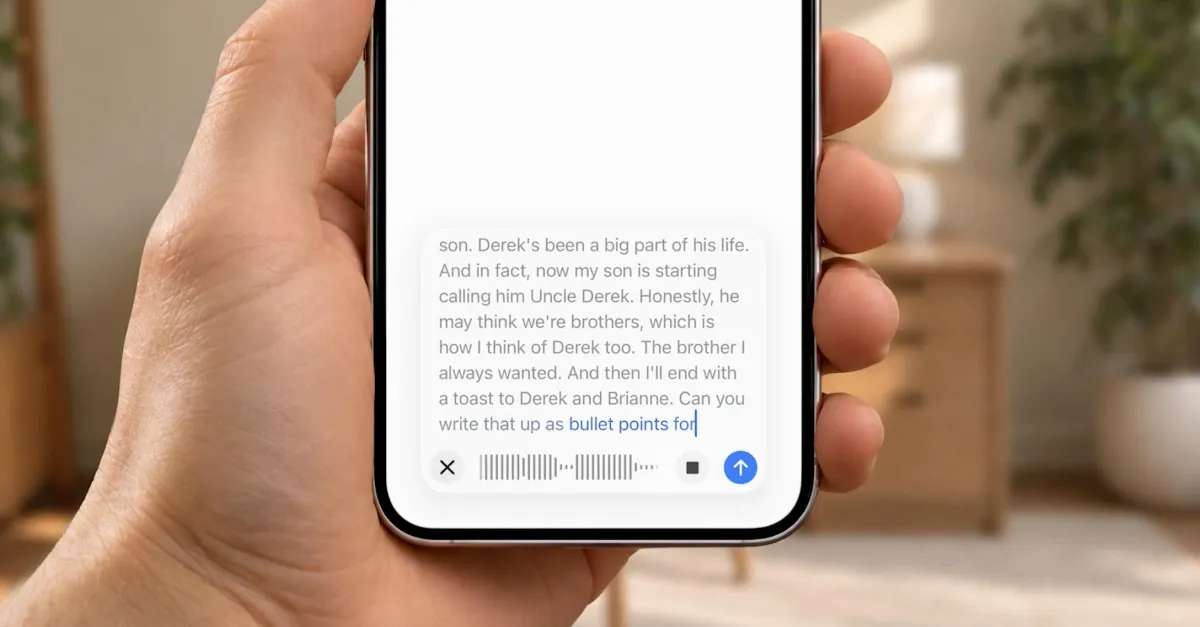
Users can tap or click the waveform to view a live transcript and then edit the prompt afterward. That small interface detail is important: it gives people a way to check what ChatGPT heard before sending the message onward.
Why it matters
Live dictation pushes ChatGPT closer to being a practical everyday interface, not just a text box with extra features. For mobile users, commuters, and people who prefer speaking over typing, real-time transcription can make the app easier to use for quick drafts, reminders, and long-form note-taking.
It may also improve accessibility. Speech-to-text tools can help users who find typing difficult or slow, and a live transcript can reduce the friction of interacting with an AI assistant on the go.
For OpenAI, the update reinforces a broader strategy: turn ChatGPT into a multi-modal workspace where voice, text, and file-like audio tasks all flow through the same product. That aligns with the company’s recent focus on voice, including an earlier overhaul of ChatGPT’s two-way voice mode.
How Live Dictation differs from OpenAI’s other voice tools
OpenAI already had more than one voice-related feature in the product. The Verge notes that the company previously launched Record Mode for voice notes and meetings, but that tool remains in beta and is limited to Plus, Enterprise, Edu, Business, and Pro workspaces.
Live Dictation appears to be positioned differently. Rather than serving as a meeting recorder or a separate note-taking utility, it is built into the everyday input flow of ChatGPT itself. That makes it closer to a keyboard replacement than a standalone recording feature.
Live Dictation vs. Record Mode
| Feature | Availability | Primary use | Notable limit |
|---|---|---|---|
| Live Dictation | All ChatGPT plans | Real-time speech-to-text input | No 10-minute dictation cap |
| Record Mode | Beta; Plus, Enterprise, Edu, Business, and Pro workspaces | Voice notes and meetings | Still limited to specific workspaces |
| Two-way voice mode | Previously overhauled by OpenAI | Conversational spoken interaction | Not described in the fact sheet |
What the rollout changes for users
For many people, the immediate advantage is speed. If dictation now appears on the screen as the user speaks, there is less need to wait, less need to re-record, and less chance of forgetting what was said at the beginning of a long prompt. OpenAI said the upgrade improves both speed and reliability, and The Verge reported that the company described the dictation as more reliable.
The update also makes ChatGPT more flexible for tasks that naturally unfold in speech. Users can dictate a longer prompt, convert voice messages into text, or ask the assistant to turn spoken thoughts into bullet points. That makes the feature useful not just for casual messaging but for planning and summarizing too.
There is also a more subtle benefit: editing. A live transcript gives users a chance to clean up their speech before submitting the message. That can matter when a prompt is long, detailed, or full of proper names that speech systems often mishear.
What The Verge, 9to5Mac and The Tech Outlook each added
The outlets covering the announcement emphasized slightly different angles. The Verge focused on the broad rollout, the removal of the 10-minute limit, and the fact that Live Dictation is available on all plans across web and apps. 9to5Mac highlighted OpenAI’s claim that dictation is now faster and more reliable, and quoted Atty Eleti saying that “the 10-minute dictation limit has also been removed.”
The Tech Outlook added a privacy and retention angle, reporting that dictation audio is kept while the chat remains in history. It also said deleting the chat triggers deletion of the associated audio within 30 days, subject to security and legal exceptions. That outlet further reported that users can stop sharing dictation audio in ChatGPT data controls, and that disabling audio sharing also affects voice chat audio.
Those details matter because product launches are often judged not just by speed or polish, but by data handling. A real-time voice tool can be more convenient only if users understand what is stored, for how long, and under what circumstances it can be removed.
Background: how OpenAI got here
ChatGPT has gradually expanded beyond plain text into a broader assistant with voice and dictation features across its apps and web interface. The company has been layering in different kinds of audio support rather than relying on a single voice feature to do everything.
That sequence helps explain why Live Dictation matters. OpenAI has already pushed into conversational voice mode, then Record Mode for longer audio tasks, and now a real-time dictation layer that looks aimed at the everyday act of typing less and speaking more. The result is a product that is becoming more modular, with different voice tools for different jobs.
In that context, removing the 10-minute limit is not just a minor tweak. It removes a ceiling from one of the most basic uses of voice input and makes ChatGPT more practical for sustained work sessions, longer memos, or extended brainstorming on a phone.
How does Live Dictation work?
Live Dictation turns spoken words into text while the user is still talking, rather than waiting for the microphone session to end. According to The Verge, the transcript appears in real time, and users can tap or click the waveform to inspect the live text and then edit the prompt after the fact.
OpenAI’s product account also underscored the update with the line:
“Dictation in ChatGPT is getting faster and more reliable.”
The company separately said,
“With Live Dictation, your speech turns into text as you talk”
Those two claims capture the core promise of the feature: less waiting and fewer transcription bottlenecks. In practical use, that could reduce the gap between speaking an idea and turning it into a useful AI prompt.
Why it matters for accessibility and mobility
Voice input is not just a convenience layer. For some users, it is the most usable way to interact with software. A live transcription tool can help someone who is driving, walking, cooking, or simply working faster than they can type. It can also help users who are more comfortable thinking out loud than composing a text prompt from scratch.
The update may also be particularly useful on phones, where typing long prompts can be cumbersome. If the transcript appears immediately and can be revised afterward, ChatGPT becomes easier to use for longer conversations while moving between tasks.
There is a market angle too. As major AI products compete on interface design as much as model quality, voice input is increasingly one of the battlegrounds. The assistant that lets users speak naturally, correct mistakes easily, and keep going without interruption may feel more useful than one that only works well in short bursts.
Privacy, retention and controls
According to The Tech Outlook, dictation audio remains stored while the chat stays in history. If the chat is deleted, the associated audio is deleted within 30 days, except where security or legal exceptions apply. That retention window gives the feature a defined lifecycle, but it also means users need to treat dictation as part of their chat record.
The Tech Outlook also reported that users can stop sharing dictation audio in ChatGPT data controls. Importantly, disabling audio sharing affects voice chat audio as well. That linkage suggests OpenAI is managing voice data through shared controls rather than separate switches for every audio feature.
For users, the practical takeaway is straightforward: if voice features matter, the settings deserve a closer look before long conversations or sensitive notes are dictated.
By the numbers
Here are the key figures tied to the rollout:
- 10-minute limit — the old ChatGPT dictation cap that OpenAI removed.
- 30 days — the reported window for deleting associated audio after a chat is deleted, absent exceptions.
- All ChatGPT plans — the rollout is available beyond paid tiers.
- Four platforms — web, desktop app, iOS and Android are supported.
Timeline
The rollout unfolded across a short news cycle, with each outlet adding a different part of the picture.
| Date | What happened | Outlet |
|---|---|---|
| 2026-11-18 | OpenAI announced Live Dictation on X | Reported by 9to5Mac |
| 2026-11-18 | 9to5Mac reported the streaming upgrade and the removal of the limit | 9to5Mac |
| 2026-11-19 | The Verge reported Live Dictation rolling out globally | The Verge |
| 2026-11-19 | The Tech Outlook reported rollout and audio-retention details | The Tech Outlook |
What happens next
The biggest open question is whether the rollout is truly immediate everywhere or still happening in stages by region or account. The fact sheet says the feature is rolling out globally, but it does not clarify whether every user will see it at the same moment.
Another question is whether the update includes anything beyond speed and reliability improvements. OpenAI has said dictation is more reliable, but there is no indication in the fact sheet of deeper accuracy changes, language expansion, or new editing tools.
Finally, the audio retention rules may still be more nuanced than a short product post can explain. The Tech Outlook noted security and legal exceptions, which leaves room for cases where deletion does not happen exactly on the user’s timeline.
For now, the practical impact is clear enough. ChatGPT is becoming more comfortable as a spoken input tool, and Live Dictation lowers the friction for anyone who wants to talk to the assistant instead of type at it.
The bottom line
OpenAI’s Live Dictation rollout is a practical upgrade, not a flashy one. It makes ChatGPT faster to use, removes a long-standing 10-minute limit, and extends voice input across the company’s main platforms and plan tiers. In a product category where small interface changes can shape daily habits, that is a meaningful step.
Frequently asked questions
What is ChatGPT Live Dictation?
ChatGPT Live Dictation is OpenAI’s real-time speech-to-text feature for ChatGPT. It turns microphone audio into text as users speak, rather than waiting until the recording ends, making the assistant easier to use for longer prompts, notes and message drafting.
Is ChatGPT Live Dictation available to everyone?
Yes, according to The Verge, the feature is available on all ChatGPT plans. It also works across the web, desktop app, iOS and Android, which makes it broadly accessible rather than limited to a single device or subscription tier.
Did OpenAI remove the 10-minute dictation limit?
Yes, OpenAI removed the 10-minute limit on ChatGPT voice dictation. 9to5Mac reported that Atty Eleti said the cap was removed as part of the streaming upgrade, which makes longer voice sessions possible.
How is Live Dictation different from Record Mode?
Live Dictation is built for real-time speech-to-text input inside ChatGPT, while Record Mode is a separate voice-notes and meetings feature. The Verge reported that Record Mode remains in beta and is limited to Plus, Enterprise, Edu, Business and Pro workspaces.
What happens to dictation audio if I delete a chat?
According to The Tech Outlook, deleting the chat triggers deletion of the associated audio within 30 days, except in security or legal cases. Users can also stop sharing dictation audio in ChatGPT data controls, which affects voice chat audio too.