In short
Microsoft CEO Satya Nadella says the company’s voluntary exit offers are part of an AI-driven redesign of work, not a straightforward move to replace employees with AI. The plan affects eligible workers across several countries and signals a broader shift toward smaller, agent-managed teams.
- Nadella says Microsoft’s voluntary exit offers are meant to give employees agency during an AI-driven reorganization.
- Windows Latest reported the offer covers eligible employees at level 70 and below in the US, Canada, the UK and India.
- Microsoft expects fewer than 5% of eligible workers to accept the buyout, according to Windows Latest.
- Nadella said AI is changing team structure and role content, not just automating tasks.
- He cited a Microsoft 365 AI-agent team of 11 developers as an example of the new operating model.
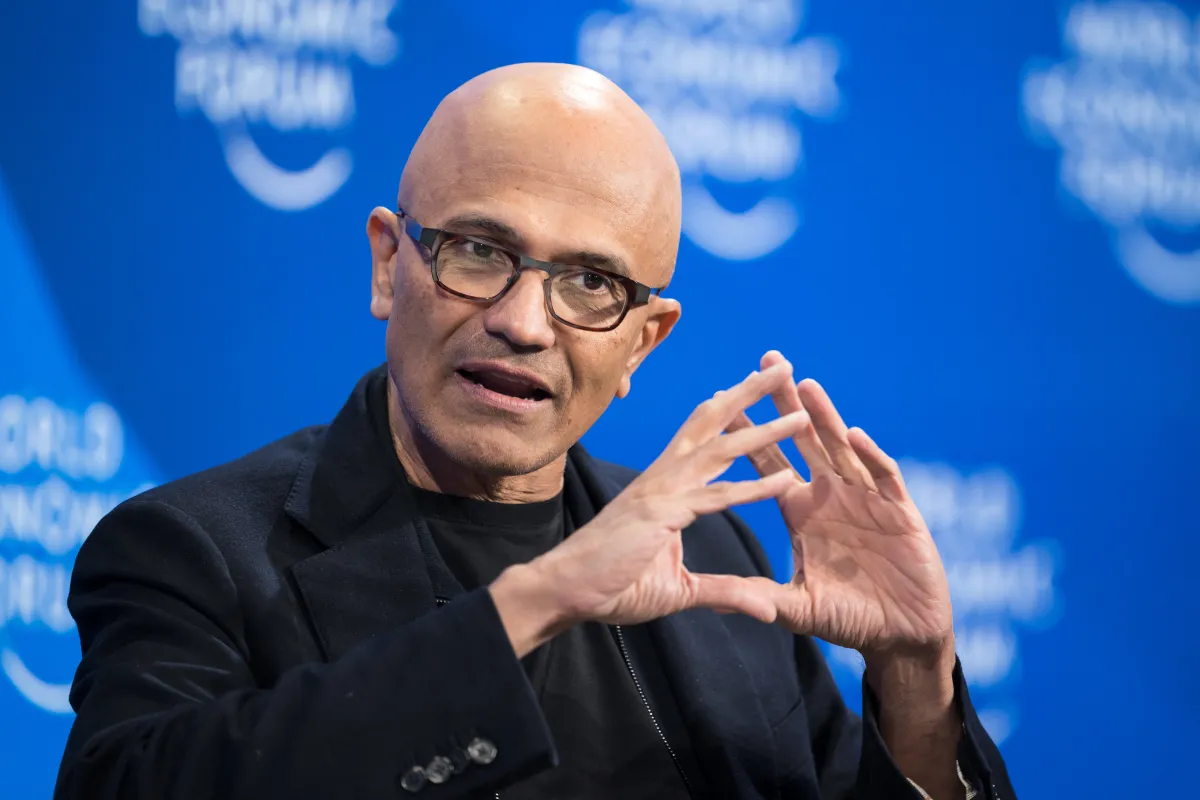
Microsoft CEO Satya Nadella is defending the company’s October voluntary exit offers as part of a broader AI-driven redesign of work, not a blunt move to swap people for machines. The message, delivered across recent interviews and remarks, is that Microsoft is reshaping jobs around AI agents and new workflows rather than simply eliminating software engineers.
That distinction matters because Microsoft is one of the clearest examples yet of how a major incumbent is trying to turn AI from a tool into an operating model. The company has offered buyouts to up to 60,000 employees while it reconfigures teams, output expectations and the way software gets built.
What Microsoft says the buyouts are for
According to TechCrunch, Nadella said the voluntary exit offers were designed to give employees agency over whether they want to remain through a major redesign tied to AI. In his telling, the buyouts are not a one-line substitute for layoffs; they are part of a transition in which people decide whether they want to stay for the next version of the company.
He framed the shift as a move away from employees acting as direct executors of work and toward employees managing AI agents. In practical terms, that means the job is less about doing every task manually and more about directing systems that can take on a growing share of the production process.
“to make sure that at least everyone felt like they had agency in making choices”
That line, attributed to Nadella by TechCrunch, captures the company’s central defense: the choice is meant to be voluntary, even if the context is unsettling. Microsoft is not denying change. It is arguing that the change should be navigable, at least for those who want to stay.
Why it matters
The story matters because it shows how AI is changing not just what companies build, but how they organize labor. At Microsoft, the debate is no longer only about whether AI can write code. It is about how many layers of management, coordination and execution remain necessary when software teams start using agents as part of the workflow.
For workers, that creates a more complicated choice than a standard layoff notice. A voluntary exit offer can look gentler than a forced reduction, but it can also signal that the company expects substantial role changes ahead. Employees are being asked to bet on an organization whose team structures, responsibilities and output expectations may not resemble the current model for long.
For the market, the signal is just as important. Microsoft is one of the biggest and most influential technology companies in the world, and its internal restructuring is likely to be watched as a template for other large firms trying to adopt AI without freezing up their existing operations.
What changes for employees?
According to TechCrunch, Nadella said software engineering will remain important, but both team structure and role content are changing. That is a crucial nuance. He is not describing the disappearance of engineering work; he is describing a shift in what engineering work looks like and how teams are built around it.
He also suggested that some employees may simply choose other paths as Microsoft changes work, workflows and output artifacts. In other words, the company is acknowledging that not everyone will want to stay through a transition that could change daily routines as much as job titles.
How Microsoft is redefining software work
Windows Latest reported that Nadella did not give a clear yes-or-no answer when asked whether the exit offers were a prelude to AI layoffs. That ambiguity is part of the story. Microsoft is presenting the move as a reorganization first, even as observers naturally read it against the backdrop of AI-related job fears across the tech sector.
He also described Microsoft’s more than 200,000 employees as needing to be configured differently as AI changes software building, according to Windows Latest. The idea is not that every role disappears. It is that the company’s scale now has to be arranged around different assumptions about how work gets done.
Windows Latest reported that Nadella said not every team has adapted to AI and that team sizes and workflows will change. That is an important admission. It suggests Microsoft sees uneven adoption inside the company, with some groups already adjusting and others still structured around older patterns.
How many people are affected?
Windows Latest said the Voluntary Exit Offer was announced Oct. 26 by Chief People Officer Amy Coleman and covers eligible employees at level 70 and below in participating teams in the US, Canada, the UK and India. The outlet also reported that Microsoft expects fewer than 5% of eligible workers to accept, which would mean fewer than 3,000 people.
That makes the offer sizable but not sweeping. It is broad enough to be noticed across the company, yet limited enough to keep the immediate headcount effect relatively contained.
| By the numbers | What it refers to | Source |
|---|---|---|
| 60,000 employees | Workers eligible for voluntary exit offers | TechCrunch / Windows Latest |
| 200,000-plus employees | Microsoft workforce size referenced by Nadella | Windows Latest |
| 11 developers | Team size for the Microsoft 365 Cowork AI agent | TechCrunch |
| Oct. 26 | Date the voluntary exit offer was announced | Windows Latest |
| Fewer than 5% | Expected acceptance rate for eligible employees | Windows Latest |
| 20% to 30% | Share of Microsoft code Nadella has said AI writes | Windows Latest |
Background: how Microsoft got here
Microsoft has spent the past several years pushing AI tools across its products and into its internal engineering workflows. That is the larger backdrop for the current buyout wave. The company is not experimenting at the edges anymore; it is trying to embed AI into the way it runs and builds software.
Large technology firms have already triggered widespread concern that AI could lead to fewer jobs, different job ladders and new expectations for engineers. Microsoft’s situation is especially notable because it has the scale, the influence and the product portfolio to make such changes visible far beyond its own payroll.
TechCrunch said Nadella described the company as being in the middle of a transformation that will take longer than many expect. He argued that turning an incumbent into an AI-first company is not a quick software update. It is an organizational overhaul that touches people, processes and output.
He also cited a Microsoft 365 AI-agent team with 11 developers as an example of the new operating model. That detail is revealing because it suggests that smaller teams may be able to produce more when they are centered on AI assistance rather than traditional task division.
What does “manager of AI agents” mean?
In Nadella’s framing, it means employees increasingly supervise AI systems instead of performing every step themselves. The worker becomes more of a coordinator, reviewer and decision-maker, while the software handles more of the execution.
That concept does not eliminate technical labor. It changes the nature of it. Software engineers still matter, but their value may increasingly lie in design judgment, oversight and orchestration rather than manual coding alone.
Windows Latest reported that Nadella has said AI writes 20% to 30% of Microsoft code. If that figure holds, it helps explain why the company is talking about reorganization rather than a simple hiring freeze. Once AI takes on a meaningful share of coding, the rest of the engineering stack has to adjust around it.
What Nadella said about anxiety inside the company
Nadella told The Pragmatic Engineer that the AI shift has created anxiety because people feel they lack control over their future. That is one of the most candid parts of the story. It recognizes that even if a buyout is voluntary, the atmosphere around it can still feel destabilizing.
He rejected the idea that AI will simply eliminate software engineers. At the same time, he made clear that the structure of the work is changing. That is the tension at the center of Microsoft’s approach: reassurance on one hand, disruption on the other.
Windows Latest said Nadella did not give a straight yes/no when asked whether the exit offers were a prelude to AI layoffs. Instead, he emphasized that Microsoft’s more than 200,000 employees need to be configured differently as software building evolves.
“I wish I could just sit here and say it’ll all be the same. I cannot,”
That quote, reported by Windows Latest, is notable not because it promises a specific outcome, but because it openly rejects the idea that Microsoft can preserve the status quo. Even if the company avoids broad layoffs, it is still signaling a deep shift in the job architecture.
What the company appears to be betting on
Microsoft appears to be betting that smaller, AI-augmented teams can do more than larger conventional ones. The example of the 11-developer Microsoft 365 Cowork agent team points to a model in which output is shaped less by headcount and more by the leverage AI provides to each person.
That kind of model has obvious appeal to executives. It may let the company move faster, reassign talent more flexibly and reduce the need for some layers of repetitive work. But it also raises hard questions about career paths, promotion structures and what kinds of experience will be valued next.
Windows Latest reported that Nadella expects existing staff to be reorganized before any return to more new-grad hiring. That suggests Microsoft is not rushing back to a traditional growth pattern. First comes internal reshaping; later, perhaps, a new hiring approach.
Where the reporting lines up — and where it differs
The two outlets cited in the fact sheet are largely aligned on the broad message: Microsoft is using voluntary exits as part of an AI-era reorganization, and Nadella is trying to frame that as a redesign of work rather than a simple replacement of workers.
They differ mainly in emphasis. TechCrunch focused more on Nadella’s explanation of agency, employee choice and the long transition to an AI-first company. Windows Latest added operational details about eligibility, timing, expected uptake and the extent of Microsoft code already being written with AI help.
Put together, the reporting paints a fuller picture: a company trying to soften a structural change with voluntary buyouts, while also acknowledging internally that workflows, team sizes and role content will not stay the same.
What happens next
The first thing to watch is how many eligible employees actually accept the offer. Microsoft expects fewer than 5% to take it, but the real number will matter because it will show whether the company’s framing of choice resonates with staff.
Second, watch which teams are reorganized next. The fact sheet says not every team has adapted to AI, which implies uneven progress. The most exposed groups may be the ones still built around older software development assumptions.
Third, monitor whether Microsoft pairs this AI transition with additional layoffs. Nadella did not answer directly when asked whether the offers were a prelude to cuts, so the company’s next workforce moves will be closely scrutinized.
Finally, keep an eye on how quickly Microsoft can convert more teams into AI-native workflows. Nadella has argued that the transformation will take longer than many expect, and the pace will likely determine whether this becomes a model for adaptation or a warning about how disruptive AI can be inside a mature tech giant.
The bigger signal for the industry
Microsoft’s move is part of a larger shift in how AI is being sold inside corporate America. The pitch is no longer just about productivity gains. It is about rebuilding the organization around AI, so that humans increasingly supervise systems rather than perform every task themselves.
That is a profound change for software workers, but also for the companies that employ them. If Microsoft succeeds, the lesson for the industry will not simply be that AI can write code. It will be that a large, established firm can redesign itself around AI without immediately declaring a sweeping layoff.
Whether that is a reassuring precedent or a more subtle kind of warning depends on where you sit. For executives, it may look like a practical transition strategy. For employees, it may look like a sign that the shape of the job is changing faster than the language used to describe it.
Frequently asked questions
Is Microsoft laying off workers because of AI?
Not directly, according to the reporting in the fact sheet. Satya Nadella framed the October buyouts as a voluntary exit program tied to an AI-driven redesign of work, while Windows Latest said he did not give a simple yes-or-no answer about whether they were a prelude to layoffs.
Who is eligible for Microsoft’s voluntary exit offer?
Eligible workers are employees at level 70 and below in participating teams in the US, Canada, the UK and India, according to Windows Latest. The fact sheet says Microsoft made the offer available to up to 60,000 employees.
How is AI changing Microsoft’s software jobs?
AI is changing how Microsoft organizes teams and what employees do day to day, according to Nadella. He described a model where workers increasingly manage AI agents rather than carry out every task themselves, while software engineering remains important.
How many Microsoft employees are expected to take the offer?
Windows Latest reported Microsoft expects fewer than 5% of eligible workers to accept the buyout, which would be fewer than 3,000 people. That suggests the program is significant, but not a mass departure from the company.
What does Microsoft’s AI-first shift mean for hiring?
Windows Latest said Nadella expects existing staff to be reorganized before any return to more new-grad hiring. That points to a phase focused on internal restructuring first, with future hiring patterns still undecided.