In short
Apple has opened enrollment for a large research study that will test how people use AI health tools and how useful they find the answers. The project, run with OpenEvidence, focuses on accuracy, privacy and clinical credibility.
- Apple is seeking up to 200,000 participants for a new AI health study.
- The study is limited to U.S. adults age 21 and older using an iPhone 15 Pro on iOS 26 or later.
- Participants will ask health questions in a new app and rate answers for accuracy, detail and relevance.
- Apple says study data will remain confidential and will not be used to train AI models.
- The project is meant to improve the design of AI health tools so advice is easier to understand and use.
Apple has launched a new research study to measure how people use AI health tools and how useful they find the answers, with enrollment starting today. The company says the project is designed to improve the design and functionality of health-focused AI so the advice is easier to understand, trust and act on.
What Apple launched
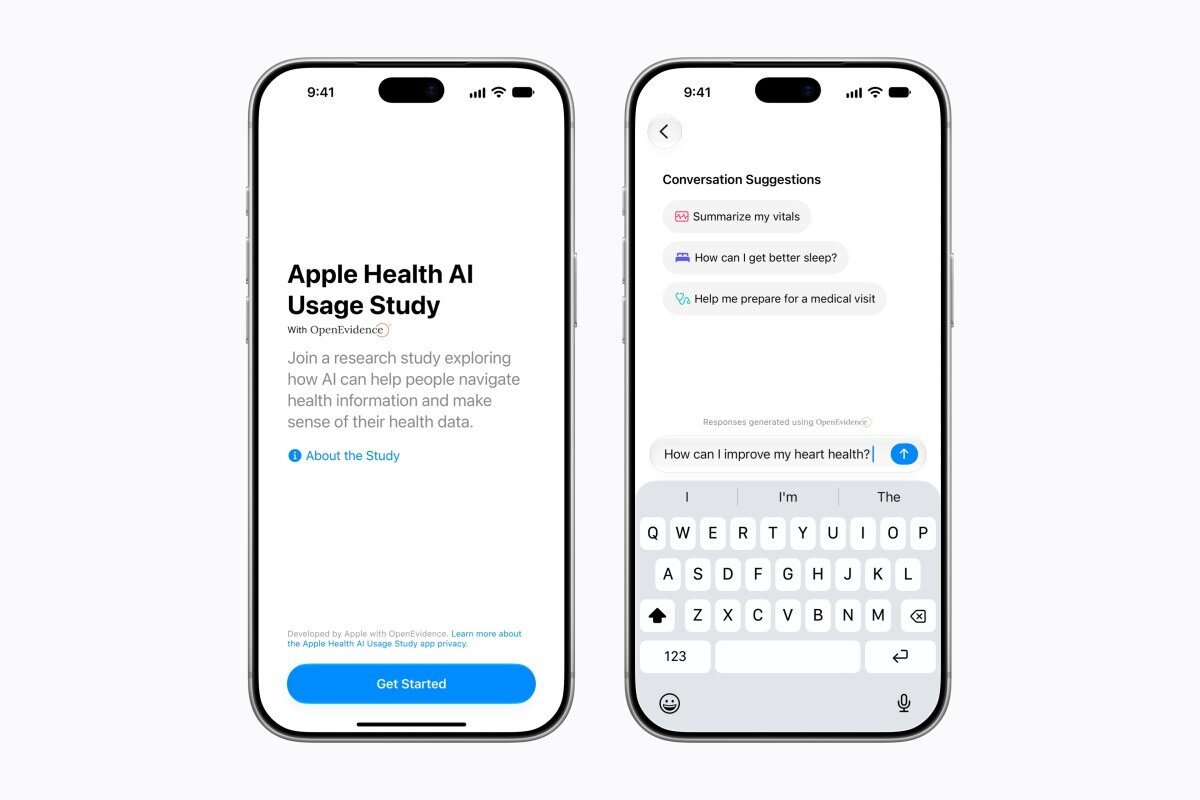
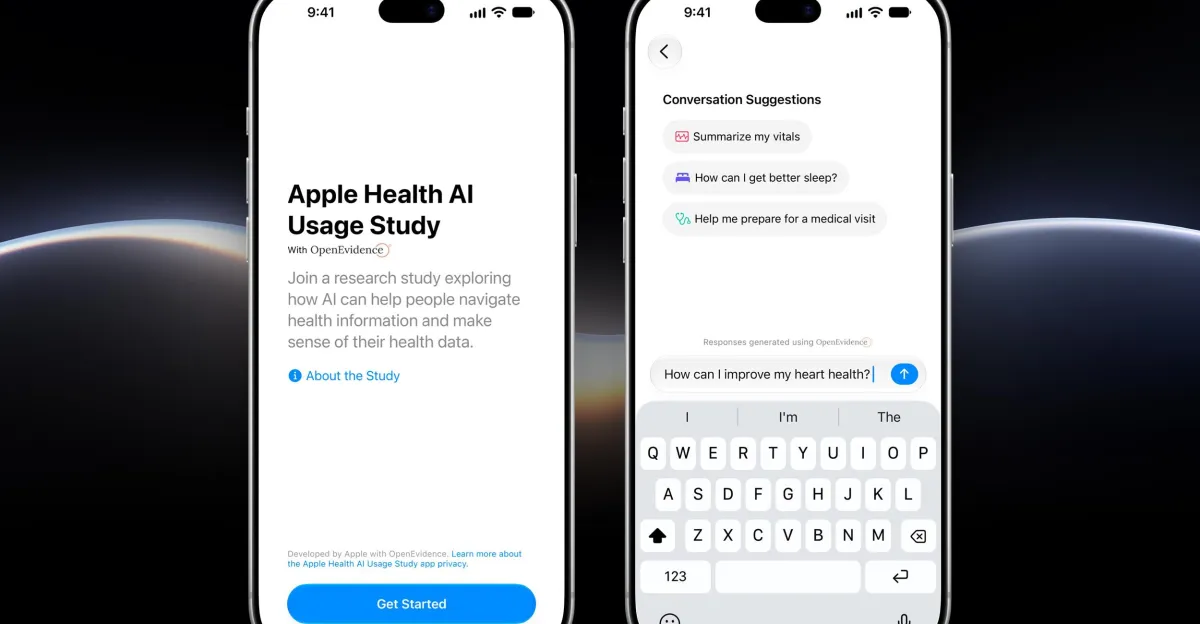
The study, called the Apple Health AI Usage Study, is being run with OpenEvidence, a clinical AI platform used by healthcare professionals, according to The Verge. Participants will use a new iOS app to ask health questions and then rate the answers for accuracy, detail and relevance.
Apple is seeking up to 200,000 participants, and the study is open only to people in the U.S. who are 21 or older, The Verge reported. The app is already available for download.
Apple says the study is not tied to Apple Intelligence, and the app is not integrated with Siri or Apple Intelligence. Instead, it is built as a separate research tool focused on health questions and response quality.
How the study works
According to The Verge, the app gives users text-based health answers and includes links to peer-reviewed clinical sources. Participants can also choose to share HealthKit data, including activity, sleep and clinical lab results, giving Apple a broader view of how people’s data intersects with the questions they ask.
Mint reported that Apple is positioning the project as a longitudinal, virtual study. That framing suggests the company wants to watch patterns over time, not just collect one-off opinions about a single answer.
Mint also said the study covers physical and mental health, including cardiovascular, sleep, metabolic, mobility, cognition and respiratory areas. That is a wider scope than a narrow chatbot experiment, and it shows Apple is trying to understand how consumers use AI across different health needs.
Who can join?
The study is limited to U.S.-based adults age 21 and older, and it requires an iPhone 15 Pro running iOS 26 or later, according to The Verge. That hardware and software requirement keeps the pilot inside Apple’s newest ecosystem, even though the company says the study is not part of Apple Intelligence.
Mint added that participants can decide what data they want to share and can withdraw at any time. Mint also reported that Apple will not have access to identifying information from the app.
Why it matters
This study matters because it puts a major consumer tech company in the middle of a question that is quickly becoming central to healthcare: how do people actually use AI for medical or health-related guidance, and when do they trust it?
Health AI has obvious appeal. It can summarize, explain and organize information quickly. But it also raises difficult questions about accuracy, context and whether users can act on an answer without misunderstanding it. Apple’s pitch is that scientific rigor and clinical grounding should shape the product experience from the start.
That is why the company is leaning so heavily on peer-reviewed sources, user ratings and opt-in data sharing. It is also why the privacy language is front and center. Apple says the study data will stay confidential and will not be used to train AI models, which is likely intended to reassure users who may be wary of sharing sensitive health details with a tech company.
The setup also reflects a broader industry reality: clinical AI tools are moving from the lab and the clinic into consumer settings, but trust remains fragile. For Apple, the study gives it a way to gather evidence before making health AI feel more productized or more personal.
What Apple says it is trying to learn
Apple says the goal is to improve how AI health tools are designed so advice is easier to understand and use. That sounds simple, but it points to a real product problem. A model may be able to produce a plausible health answer, yet still fail a user if the explanation is too technical, too vague or too difficult to act on.
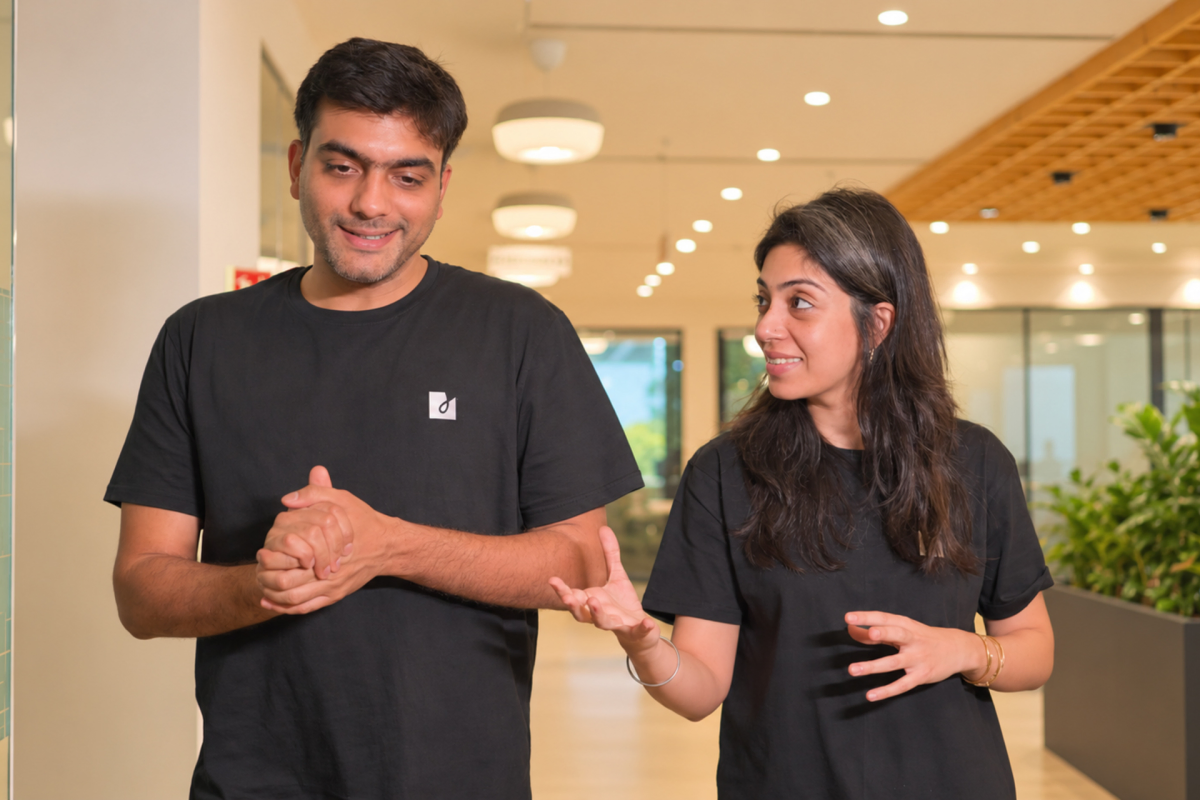
Sumbul Desai, Apple’s vice president of Health and Fitness, said “responsible innovation starts with scientific rigor and clinical grounding”. That line captures the company’s public posture: it wants to present health AI as measured, not speculative.
OpenEvidence’s role is also notable. The company is already known for a clinical AI platform used by healthcare professionals, which gives the study a more medical framing than a consumer chatbot test would have on its own.
Background and context
Apple has spent years building health features into its devices and software, and the company’s research programs have already enrolled more than 350,000 participants across the U.S., according to Mint. The new study fits that pattern: Apple uses the Research app model to collect real-world data from volunteers, then uses those findings to inform future products or features.
Mint reported that the study will look across Apple hardware and services including the iPhone, Apple Watch, AirPods and other technology. That broader device ecosystem matters because Apple’s health story has never been about one screen or one app. It is about connected devices feeding a health profile over time.
Apple HealthKit is central to that approach. It can collect user health and fitness data from connected Apple devices and apps, which makes it a useful source for a study that wants to understand how people ask questions and what data they are willing to share while doing it.
The timing also makes sense. The consumer AI market is crowded, and health is one of the most sensitive categories in which AI can be deployed. A chatbot that helps with travel or shopping is one thing; a tool that touches sleep, lab results or cardiovascular concerns is another. That is the gap Apple is trying to study.
How do the two reports differ?
The core story is consistent across The Verge and Mint, but the outlets emphasize different angles. The Verge focused on the AI health study, the OpenEvidence partnership and the technical requirements for participation. Mint framed the project more broadly as the Apple Health Study and emphasized the research structure, the range of health areas and the role of Apple’s existing study programs.
Those differences are not contradictory, but they do suggest Apple’s announcement can be read in more than one way: as a narrow test of conversational health AI, and as part of a larger health research effort built around the company’s devices.
| Key study details | What Apple disclosed | Source |
|---|---|---|
| Study name | Apple Health AI Usage Study | The Verge |
| Enrollment target | Up to 200,000 participants | The Verge |
| Eligibility | U.S.-based adults age 21 and older | The Verge |
| Device requirement | iPhone 15 Pro with iOS 26 or later | The Verge |
| Data handling | Confidential study data, not used to train AI models | The Verge |
| Research scope | Physical and mental health, including cardiovascular, sleep, metabolic, mobility, cognition and respiratory areas | Mint |
Why the privacy claims matter
Apple’s privacy messaging is doing a lot of work here. Health information is among the most sensitive data a person can share, and AI systems are often criticized for being opaque about how they use prompts, stored inputs or training material.
The company says the study data will remain confidential and will not be used to train AI models. Mint separately reported that Apple will not have access to identifying information from the app. Those promises are likely to be central to whether people sign up, especially given the sensitivity of the health topics involved.
That privacy structure may also help explain why the study is opt-in and why participants are asked to rate answers rather than simply use the app passively. Apple appears to be treating trust as something that must be measured, not assumed.
What happens next
The immediate next step is enrollment. Apple said registration begins today, and the app is already available to download. After that, the key question is how quickly the company starts collecting enough data to draw conclusions.
Several open questions remain:
- How Apple will compare user ratings across answer quality, health topics and data-sharing settings.
- Whether the company will turn the study into a public paper, a product change or a new health feature.
- When Apple will begin analyzing the results.
- Whether the findings will be published at all.
Mint said Apple has previously enrolled more than 350,000 participants across U.S. research programs, which suggests the company has the infrastructure to run a large-scale study of this kind. Still, scale alone will not answer the hard question: whether people actually want AI to play a bigger role in health advice, and under what conditions they will trust it.
By the numbers
Apple’s study is large enough to be meaningful, but selective enough to stay within a tightly controlled research framework.
| Metric | Number | Meaning |
|---|---|---|
| Maximum participants | 200,000 | Apple’s target enrollment |
| Minimum age | 21+ | Eligibility floor |
| Required phone | iPhone 15 Pro | Supported device for the app |
| Required software | iOS 26 or later | Minimum system version |
| Prior research enrollment | Over 350,000 | Apple’s earlier U.S. research participation total, according to Mint |
Bottom line
Apple is using a wide-ranging, opt-in research app to test how people use AI for health questions and how much they trust the results. The study’s real value may not be in any single answer it collects, but in whether it helps Apple decide how far consumer health AI can go without losing clinical credibility.
“responsible innovation starts with scientific rigor and clinical grounding”
For now, Apple is betting that if it can measure usefulness, accuracy and trust at scale, it may be able to shape the next phase of AI health tools on its own terms.
Frequently asked questions
What is Apple’s new AI health study?
Apple’s new AI health study is a research program that asks participants to use an iPhone app to pose health questions and then rate the answers for accuracy, detail and relevance. Apple says the goal is to improve how AI health tools are designed and understood.
Who can take part in the study?
The study is open to U.S.-based adults who are 21 or older. Apple also requires participants to have an iPhone 15 Pro running iOS 26 or later, according to The Verge.
Does Apple use the study data to train its AI models?
No. Apple says the study data will remain confidential and will not be used to train AI models. Mint also reported that Apple will not have access to identifying information from the app.
What kind of health topics does the study cover?
Mint says the study covers both physical and mental health, including cardiovascular, sleep, metabolic, mobility, cognition and respiratory areas. The Verge says participants can also share HealthKit data such as activity, sleep and clinical lab results.
Will the study affect Siri or Apple Intelligence?
No. Apple says the app is not integrated with Siri or Apple Intelligence, and the study is not tied to Apple Intelligence. It appears to be a separate research effort focused specifically on health AI.