Updated July 30, 2026 5:53 pm
In short
TechCrunch Disrupt 2026 still centers on AI, but the lineup has expanded with Andrew Feldman, Max Hodak and RJ Scaringe, while additional stages and a limited-time ticket discount have now been announced.
- Disrupt 2026 runs October 13–15 at Moscone Center in San Francisco.
- The main stage will feature leaders from Amazon, Replit, Tether, Flock Safety and Benchmark.
- AI is the conference’s central theme, with sessions on software, finance, security and compute.
- Additional tracks will cover payments, energy, startup fundraising and execution.
- TechCrunch says more speakers and one more stage are still to be announced.
Update — July 30, 2026 5:53 pm
TechCrunch says the current ticket discount window is closing in a few weeks, with savings of up to $300 on some pass types.
The Disrupt Stage lineup has also grown: added speakers now include Cerebras CEO Andrew Feldman, Science Corp founder Max Hodak and Rivian CEO RJ Scaringe. TechCrunch also says more announcements are still coming.
Beyond the main stage, the conference now lists separate tracks for AI, smart money, smart systems and builders, plus one more stage that has yet to be revealed.
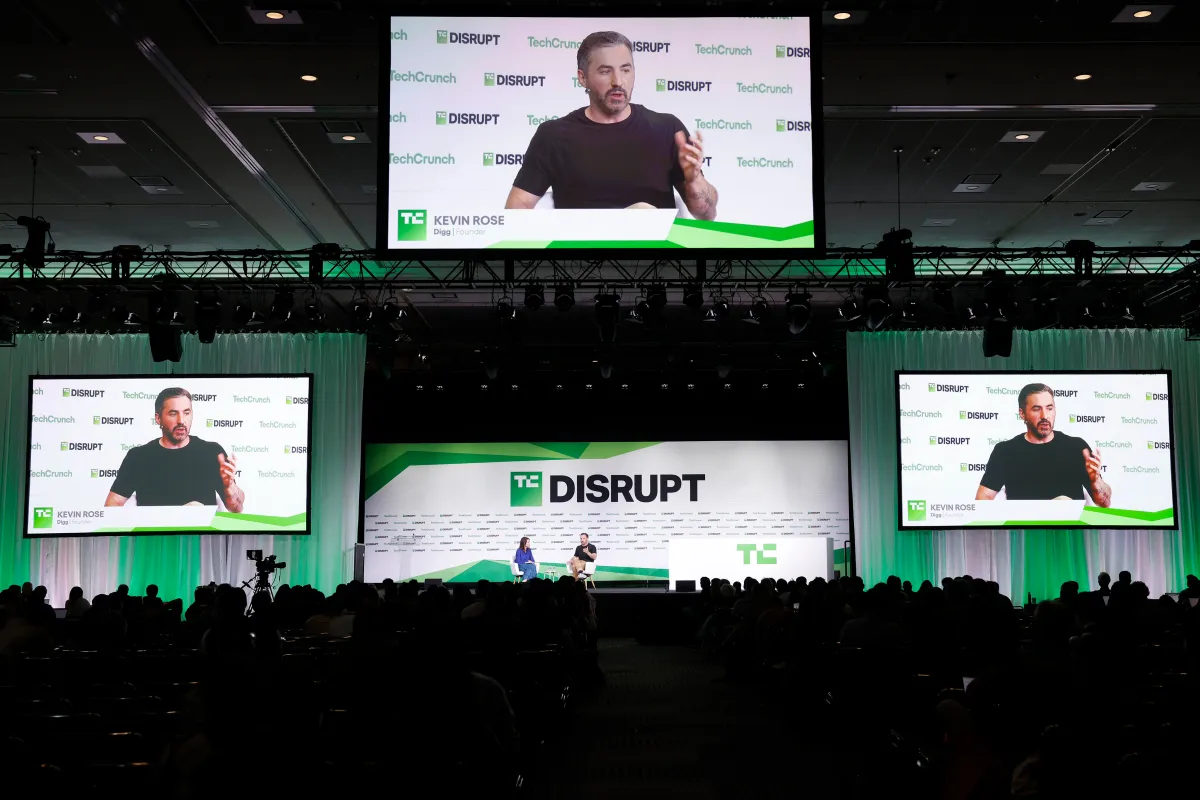
TechCrunch Disrupt 2026 will center its biggest stage on the AI era, bringing Amazon’s Panos Panay, Replit’s Amjad Masad, Tether’s Paolo Ardoino, Flock Safety’s Garrett Langley, Benchmark’s full partnership and other leaders to Moscone Center in San Francisco from October 13 to 15. The lineup is designed to spotlight how companies are building, funding and scaling in a market reshaped by AI, infrastructure demand and rapid shifts in software, finance and security.
The conference has long been one of the startup world’s most visible stages, and this year’s program aims to reflect a new reality: the most important debates are no longer just about product launches or fundraising rounds, but about compute, regulation, hardware, and the future of work itself. TechCrunch says more speakers and sessions are still to be announced, while ticket discounts are set to expire soon.
| Disrupt 2026 detail | Information |
|---|---|
| Event dates | October 13–15, 2026 |
| Location | Moscone Center, San Francisco |
| Main focus | Building, funding and scaling in the AI era |
| Notable speakers announced | Panos Panay, Amjad Masad, Paolo Ardoino, Garrett Langley, Benchmark partners, Winston Weinberg, Andrew Feldman, Max Hodak, RJ Scaringe |
| Audience | Founders, investors, technologists and startup operators |
Why Disrupt 2026 is leaning into AI now
Disrupt 2026 is putting AI at the center of its programming because the technology now affects nearly every layer of the startup economy, from code creation and enterprise software to payment systems, security tools and physical products. TechCrunch is using the Disrupt Stage to frame the hardest questions founders face this year: what to build, what to fund, and how to compete when AI changes the cost and speed of everything.
The event’s organizers are positioning the conference as a place for practical answers rather than abstract predictions. That matters because the industry is no longer debating whether AI will matter; it is wrestling with how quickly it will reshape entire categories of companies and whether the infrastructure behind it can keep up.
TechCrunch says the stage will focus on real-world solutions for founders instead of broad speculation about the future.
What’s on the Disrupt Stage?
The Disrupt Stage will host a mix of consumer-tech, enterprise, financial and infrastructure discussions. The speaker list spans incumbents, startups and investors, reflecting the broad reach of AI and the new pressures it has created across the tech sector.
What Comes After the Smartphone?
This session asks a direct question: if the smartphone has been the center of digital life for almost 20 years, what replaces it in the AI age? Amazon’s Panos Panay will discuss how future devices may evolve as AI becomes the primary interface rather than just a feature layered onto existing hardware.
The conversation is likely to resonate with hardware makers, operating system developers and consumer-tech investors trying to understand whether the next breakout product category will be wearable, ambient, voice-driven or something entirely new.
What We Believe Now
Benchmark’s full partnership will appear together on the Disrupt Stage for a discussion about where startup opportunities are still emerging and what today’s founders may be overlooking. The presence of all five partners underscores the ongoing influence of top-tier venture capital firms in shaping the themes and expectations of the startup market.
For founders, this is likely to be one of the most closely watched conversations of the conference because it may reveal how experienced investors are thinking about the post-hype environment for AI companies, software tooling and new infrastructure plays.
Everyone Can Build Software Now. What Happens Next?
Replit founder and CEO Amjad Masad will address one of the most consequential shifts in software creation: the growing ability for non-programmers to turn ideas into working products with AI-assisted tools. Replit sits near the center of that transformation, making the company a natural lens through which to examine the future of programming.
The broader implication is straightforward. If software becomes easier to build, the bottleneck moves from coding skill to product judgment, distribution and execution. That is why this session is likely to draw both technical founders and investors focused on developer tools.
The Company Behind the World’s Most Controversial Currency
Tether chief executive Paolo Ardoino is set to discuss one of the most scrutinized companies in crypto. Tether’s stablecoin operations process enormous transaction volume, but the company has long faced questions about transparency, reserve management, regulation and its role in global finance.
The conversation will likely center on whether stablecoins are becoming a mainstream part of payments infrastructure or remaining a niche instrument shaped by controversy. With regulators paying closer attention to digital assets, the discussion arrives at a moment when crypto’s next chapter may depend as much on compliance as on adoption.
AI, Surveillance, and the Future of Public Safety
Flock Safety founder and CEO Garrett Langley will take on a debate that has become increasingly unavoidable as AI expands into the physical world. The company’s technology is often discussed in the context of law enforcement, neighborhood security and automated surveillance, making privacy concerns central to any conversation about its growth.
This session is expected to examine the trade-off between safety and oversight, and whether AI-powered public safety systems can gain broader acceptance without triggering stronger concerns about civil liberties.
How is AI changing the way companies are built?
AI is changing companies by compressing the time it takes to build products, reducing the need for some specialized labor and increasing the pressure on infrastructure. That shift is why TechCrunch has structured one of its main conference tracks around the “AI workforce” and the companies built to serve it.
The pattern is visible across consumer apps, enterprise tools, capital markets and physical industries. Startups are no longer just trying to add AI features; they are trying to rethink the entire workflow around AI-first design.
Building the AI Workforce
Harvey co-founder and CEO Winston Weinberg will speak about how AI is changing knowledge work in sectors such as legal services and corporate operations. Harvey has become one of the most visible enterprise AI startups by focusing on highly regulated, high-value professional tasks where automation promises both efficiency and controversy.
The key question here is not whether AI can assist experts. It is how far organizations are willing to let software participate in work that used to require years of training, judgment and accountability.
- Legal services are among the clearest use cases for AI-powered automation.
- Enterprise buyers increasingly want tools that save time without sacrificing reliability.
- Regulated industries are likely to move more slowly, but the incentives to adopt remain strong.
Can AI Keep Scaling?
Cerebras founder and CEO Andrew Feldman will focus on one of the biggest constraints in the AI boom: the hardware and energy needed to support ever-larger models and more compute-intensive workloads. The question behind the session is whether current approaches to AI infrastructure can keep up with demand or whether new architectures are required.
That makes the topic especially relevant for cloud providers, chipmakers, data center operators and investors watching the economics of model training and inference. If AI is the next computing platform, the scale problem is still being solved in real time.
Beyond Screens
Max Hodak, founder of Science Corp, will present a more radical idea: that human-computer interaction may move beyond screens entirely. His work in brain-computer interfaces places him among the most ambitious voices thinking about how machines could eventually respond to people in more direct and intuitive ways.
While the timeline for such technologies remains uncertain, the discussion reflects a larger trend at Disrupt 2026: the boundary between software, hardware and human behavior is becoming less fixed.
What makes the hardware and manufacturing angle important?
The hardware and manufacturing angle matters because the AI boom is no longer only a software story. It is increasingly a story about physical products, supply chains, factories, power use and transportation systems that must adapt to faster-moving software intelligence.
That reality is captured by the appearance of Rivian founder and CEO RJ Scaringe, whose company sits at the intersection of AI, robotics, manufacturing and electric transport. His session will likely explore what it takes to build a durable hardware company in an era when software expectations are rising everywhere.
Building the Impossible
Rivian’s challenge is representative of a broader startup problem: companies that build physical products must also master software, autonomy, logistics and scaling. As AI becomes more embedded in vehicles and industrial systems, the line between a software startup and a hardware manufacturer becomes harder to define.
TechCrunch frames RJ Scaringe’s session around the challenge of building an enduring company across AI, software, robotics, manufacturing and transport.
Who else is shaping the broader Disrupt agenda?
Beyond the Disrupt Stage, the event will spread across multiple tracks focused on technical, financial and operational themes that reflect the current startup climate. Each stage is designed to serve a different part of the ecosystem, from early-stage builders to investors and industry operators.
AI Stage
The AI Stage will explore security gaps and business model changes affecting SaaS companies. As AI features move from optional add-ons to expected product capabilities, software firms are under pressure to rethink pricing, differentiation and data protection.
Smart Money Stage
This stage will examine stablecoins, instant payments and AI’s role in financial trust. That combination suggests a focus on how money movement, identity, fraud prevention and settlement systems are evolving alongside digital assets and automation.
Smart Systems Stage
The Smart Systems Stage will look at fusion breakthroughs and strain on the power grid, two topics that underscore the resource demands of next-generation compute. AI has pushed electricity consumption and infrastructure resilience into the center of technology planning.
Builders Stage
The Builders Stage is aimed at tactical startup questions, including fundraising, hiring and scaling. For founders, this is the practical track most directly tied to day-to-day company building.
One more stage to be announced
TechCrunch says another stage has yet to be revealed, signaling that the full program is still expanding. That leaves room for additional speakers or themes that could further reflect the changing priorities of the startup market.
Why this lineup matters for founders and investors
This lineup matters because it shows where the market’s center of gravity has moved. The speakers are not merely product executives; they are people operating in sectors where AI is forcing new business models, new regulatory questions and new capital needs.
For founders, the event offers a chance to hear how companies at different stages are navigating the same underlying shift. For investors, it offers an opportunity to spot which categories are likely to produce the next wave of breakout companies.
- AI is changing the economics of software creation.
- Infrastructure demand is shaping the next era of compute and energy use.
- Regulation and trust are becoming central in crypto, security and enterprise AI.
- Hardware is re-entering the startup conversation as products become more intelligent and connected.
How does this fit TechCrunch Disrupt’s history?
It fits the conference’s history by continuing its role as a stage for major technology debates, while updating the agenda for the current wave of disruption. Over the years, Disrupt has become associated with founders, investors and executives who helped define prior technology eras, and this year’s lineup suggests AI is now the organizing theme of the next one.
That continuity matters because Disrupt’s value has never been just about visibility. It has also been about timing: bringing together the people closest to the biggest shifts in software and startups while those shifts are still unfolding.
What attendees should know before registering
Attendance will give participants access to the main stage, other programming tracks, Startup Battlefield, networking opportunities and the exhibition floor. TechCrunch says more than 10,000 startup, tech and venture capital leaders are expected to be part of the event experience.
The publication also notes that current pricing windows are nearing expiration, with some ticket types still eligible for savings. For attendees weighing a trip to San Francisco, the combination of speaker access and founder-focused content is clearly being positioned as the central draw.
| Stage | Primary focus | Example topic |
|---|---|---|
| Disrupt Stage | Major industry conversations | AI, devices, finance, public safety |
| AI Stage | Product and security shifts | AI’s impact on SaaS business models |
| Smart Money Stage | Payments and financial trust | Stablecoins and instant payments |
| Smart Systems Stage | Infrastructure and energy | Compute demand and grid strain |
| Builders Stage | Startup execution | Fundraising, hiring and scaling |
What the speaker list reveals about the market
The speaker list reveals a startup market that is becoming more interdisciplinary. Consumer hardware, enterprise AI, crypto payments, surveillance technology, brain-computer interfaces, chip design and electric vehicles are all being treated as part of the same strategic conversation.
That breadth is a sign of how AI has become the connective tissue across the tech sector. It is no longer a standalone category. It is a force that shapes nearly every category founders care about.
For that reason, Disrupt 2026 is less about predicting one future than about mapping several overlapping ones. The most important questions may not be which company is biggest, but which business models can survive the next wave of change.
Bottom line
TechCrunch Disrupt 2026 is assembling one of its most AI-focused agendas yet, with major executives and founders set to discuss the future of devices, software, finance, safety, infrastructure and hardware. Held in San Francisco from October 13 to 15, the event is shaping up as a concentrated look at how the startup ecosystem is adapting to a new era of intelligence-driven products and companies.
Frequently asked questions
When is TechCrunch Disrupt 2026?
TechCrunch Disrupt 2026 will take place from October 13 to 15, 2026, at Moscone Center in San Francisco. The event is being positioned as a three-day gathering for founders, investors and technologists focused on the AI-driven startup economy.
Who is speaking on the Disrupt Stage?
The announced speakers include Amazon executive Panos Panay, Replit founder Amjad Masad, Tether CEO Paolo Ardoino, Flock Safety founder Garrett Langley, Benchmark partners, Harvey CEO Winston Weinberg, Cerebras CEO Andrew Feldman, Science Corp founder Max Hodak and Rivian CEO RJ Scaringe.
What is the main theme of Disrupt 2026?
The main theme is how AI is changing the way companies are built, funded and scaled. The conference is using its headline stage to examine software creation, infrastructure, payments, public safety, enterprise automation and the hardware required to support AI.
Why is Tether part of the lineup?
Tether is included because stablecoins and digital payments are becoming a major part of the fintech and crypto debate. Paolo Ardoino’s appearance gives the conference a direct conversation about regulation, transaction volume and whether crypto is moving into mainstream finance.
Are more speakers still to be announced?
Yes. TechCrunch says the current lineup is only the first wave of announcements, and one more stage has not yet been revealed. That suggests the final program will likely expand further before the conference begins.