In short
SpaceX shares briefly fell below the company’s $135 IPO price as investors reassessed the stock’s early surge. The decline comes just before a crucial Starship launch, a test that could shape sentiment around the company and future IPOs from AI firms.
- SpaceX shares dipped below the company’s $135 IPO price before recovering.
- The stock had surged above $200 shortly after the June 12 listing, then slid for weeks.
- Only about 4% of SpaceX shares are trading, which has amplified volatility.
- A new Starship test launch on Thursday is the next major market test.
- The stock’s performance is being watched as a signal for future AI IPOs like Anthropic and OpenAI.
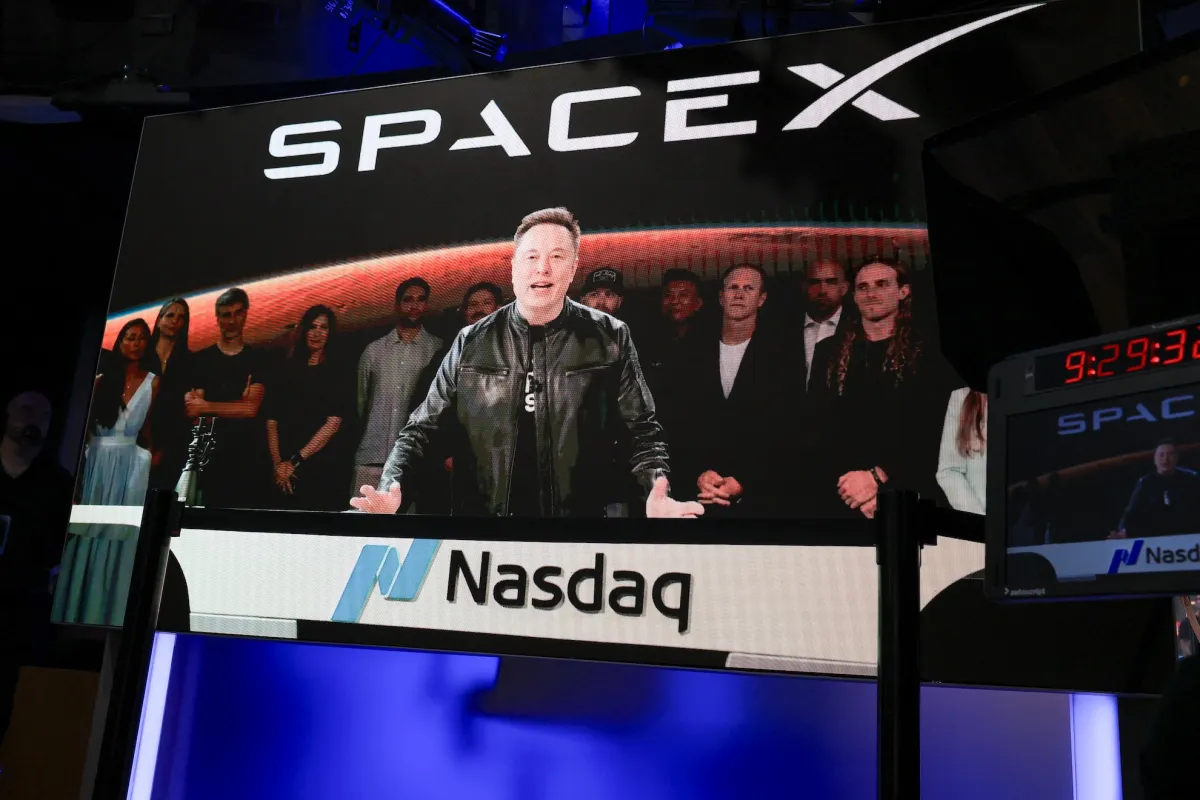
SpaceX shares slipped below the company’s $135 IPO price on Wednesday, marking a fresh setback for Elon Musk’s newly public rocket maker just one month after its blockbuster debut. The decline matters because the stock’s early reversal is shaping how investors judge both SpaceX’s valuation and the market appetite for future public offerings from high-profile AI firms such as Anthropic and OpenAI.
The stock briefly fell under $133 before recovering to around $135 later in the session. Even so, the move extends a steady slide from the post-IPO highs, when SpaceX’s shares surged above $200 and briefly placed the company in the same valuation conversation as Amazon and Microsoft.
The latest dip comes as SpaceX prepares for another major test of confidence: a Starship launch on Thursday, the first since the company went public and the first Starship flight since a booster failure in May. The mission underscores both the promise and the risk embedded in SpaceX’s business model, where rapid development is paired with highly visible failures.
Why SpaceX’s share price matters now
SpaceX’s trading performance is doing more than reflecting one company’s fortunes. It is being watched as a barometer for investor enthusiasm toward Musk’s long-range ambitions and for the broader market’s willingness to fund ambitious frontier-tech companies at premium valuations.
The company’s IPO was enormous by any standard. It reportedly raised nearly $86 billion, making it one of the most consequential public offerings in recent memory. But the market’s first-month reaction has been less stable than the headline numbers suggested.
After the stock’s post-listing spike, shares have fallen almost every week, erasing a large share of those initial gains. That kind of movement is common in thinly traded stocks, but it carries added significance here because SpaceX is no ordinary debutant: it is one of the most closely scrutinized companies in technology, aerospace, and venture capital.
How much of the company is actually trading?
Only a small slice of SpaceX’s total shares is available on Nasdaq, and that limited supply has amplified price swings. With roughly 4% of the company’s shares in circulation, even modest buy or sell pressure can move the stock sharply.
That structure helps explain why SpaceX first shot upward and then quickly reversed course. It also means the stock may remain volatile until more shares change hands or the market settles on a more durable view of the company’s value.
| Event | Date / Period | What happened |
|---|---|---|
| IPO pricing | June 12, 2026 | SpaceX debuted at $135 per share, raising nearly $86 billion. |
| Post-IPO peak | Days after listing | The stock climbed above $200, briefly lifting valuations into mega-cap territory. |
| Weekly decline | Following month | Shares lost ground nearly every week after the initial surge. |
| Intraday dip | Wednesday | The price slipped below $133 before recovering near $135. |
| Starship launch | Thursday | SpaceX plans its first post-IPO Starship test flight. |
What is driving the pullback?
The slide appears to be the result of several forces arriving at once: a cooler mood in technology markets, investor reassessment of SpaceX’s long-term promises, and the natural unwinding of early IPO enthusiasm.
SpaceX has always sold a story larger than its current financial results. Musk has positioned the company as a gateway to orbital transport, satellite communications, and eventually interplanetary travel. Those ambitions help support a lofty valuation, but they also make the stock especially sensitive to any sign that execution will take longer, cost more, or remain more experimental than bullish investors expected.
The broader tech sector has also softened over the past month, which has not helped. When investors become less willing to pay aggressive multiples for growth stories, companies built on future potential rather than present profits tend to feel the pressure first.
SpaceX’s early trading has become a test of whether investors still believe in Musk’s expansive vision at the same price they did when the company first listed.
What role does investor sentiment play?
Investor sentiment is central because SpaceX is not being valued like a traditional industrial company. Its worth depends heavily on expectations about future breakthroughs, especially in Starship, satellite expansion, and possible new revenue streams that are still emerging.
When enthusiasm is high, those expectations can be priced very aggressively. When confidence cools, the stock can correct quickly, even without a major negative event. That dynamic appears to be unfolding now.
How Starship could influence the stock
Starship is the company’s next big proof point, and Thursday’s launch is likely to be interpreted far beyond the aerospace world. Investors will be reading it as a sign of whether SpaceX can keep advancing its most important development program despite recent setbacks.
The vehicle is still in development, which means failures remain part of the process. SpaceX has long described its approach as “fly, fail, fix,” a strategy that prizes rapid iteration over caution. In practical terms, that means investors should expect mishaps along the way, even if the long-term trajectory remains positive.
This flight follows a booster failure in May and comes with no plan to recover the booster or upper stage. Instead, both parts of the system are expected to perform simulated landings over the Gulf of Mexico. If all goes according to plan, the mission will still end with both sections destroyed.
Why this flight is different from previous tests
The difference is timing and symbolism. This is the first Starship launch since SpaceX’s IPO, so the mission arrives at a moment when public-market investors are paying closer attention than ever. A strong performance could help steady sentiment. A failure, even one consistent with the program’s developmental nature, could deepen doubts about the pace of progress.
It is also the first test since May’s booster failure, which gives analysts another fresh data point to assess how quickly SpaceX is solving engineering problems at the heart of its most ambitious rocket.
What this means for other private tech giants
SpaceX’s stock performance may end up influencing more than just SpaceX. The company is being closely watched as a case study for other enormous private firms that have been preparing for eventual public listings, especially in artificial intelligence.
Anthropic and OpenAI have both filed confidentially for IPOs. Neither has announced a timetable, but SpaceX’s first month as a public company is likely to shape how investors think about those future debuts.
If SpaceX can sustain a premium valuation despite operational risk and market volatility, it would suggest strong appetite remains for highly ambitious growth stories. If the stock continues to fall, it may signal that the market wants more proof before it rewards these companies with enormous public-market expectations.
For companies like Anthropic and OpenAI, SpaceX is now serving as an early market read on how much investors will pay for a vision-heavy AI story in public trading.
Why the IPO pipeline is being watched so closely
Large private technology firms have often used each other as informal reference points when considering public-market timing. One company’s listing can reset expectations for the next. That is especially true when the businesses are known more for scale and narrative than for mature cash generation.
SpaceX’s debut is therefore not just a milestone for aerospace. It is also a signal to the broader market about whether investors remain eager for giant, high-conviction technology bets.
How does SpaceX’s decline compare with its early surge?
The contrast is sharp. In the first days after listing, SpaceX’s price climbed well above the IPO level and temporarily crossed the $200 mark. That surge suggested that buyers were willing to assign the company an ultra-premium valuation on the strength of its brand, technical leadership, and future plans.
Since then, the pattern has reversed. The stock has steadily drifted lower, and Wednesday’s move below the offer price set by Musk and the company itself marked a psychological turning point. Falling under the original IPO price does not necessarily mean the listing has failed, but it does indicate that the market has become more cautious than it was at the outset.
The fact that the shares bounced back toward $135 later in the day shows that buyers are still present. The question is whether they will be strong enough to absorb future volatility, especially if the Starship launch produces headlines the market dislikes.
What investors are likely watching next
- Whether Starship completes its planned flight profile without major anomalies.
- Whether the stock can hold near or above the $135 IPO price after launch day.
- How bonds issued after the IPO trade in the broader market.
- Whether the recent tech-stock pullback continues to pressure high-growth names.
- Whether sentiment toward future IPO candidates such as OpenAI and Anthropic stabilizes.
The risks and rewards behind Musk’s public-market experiment
SpaceX has entered a new phase. As a public company, its biggest milestones are no longer judged only by engineering teams, investors, and industry watchers. They are now interpreted in real time by a broader market that can reward confidence just as quickly as it punishes disappointment.
That makes the company’s next moves unusually consequential. Each Starship launch, each valuation swing, and each capital-markets signal will now feed directly into the public narrative around Musk’s empire.
For supporters, the recent dip may look like a temporary correction in a company still defining the future of spaceflight. For skeptics, it may look like a warning that the market is starting to separate vision from verifiable progress.
Either way, SpaceX has become more than a rocket company with an IPO. It is now a live test of how much faith public investors are willing to place in audacious technology promises when those promises must stand up to daily trading and quarterly scrutiny.
The next answer arrives Thursday, when Starship lifts off and the market gets another chance to decide whether the story is still being written upward or has entered a more skeptical chapter.
| Key issue | Why it matters | Current status |
|---|---|---|
| IPO price | Sets the benchmark for market confidence | $135 per share |
| Trading float | Limited supply can magnify volatility | About 4% of shares trading |
| Starship progress | Signals execution on SpaceX’s biggest program | New test launch scheduled |
| Broader IPO signal | Could affect AI companies planning listings | Closely watched by investors |
For now, the central question is not whether SpaceX can headline the future. It is whether the market believes that future is worth the price Musk put on it one month ago.
Frequently asked questions
Why did SpaceX shares fall below the IPO price?
SpaceX shares fell below the IPO price because the initial post-listing enthusiasm faded, tech stocks softened broadly, and investors reassessed how much of Elon Musk’s future vision was already priced in. Limited trading supply also likely amplified the move.
How much did SpaceX raise in its IPO?
SpaceX raised nearly $86 billion in its June 12 IPO, making it one of the largest and most closely watched public debuts in recent memory.
Why is the Starship launch important for investors?
The Starship launch is important because it is the company’s first major post-IPO test and a visible measure of progress on its most ambitious program. A clean flight could help sentiment; a failure could intensify doubts about the stock’s valuation.
How does SpaceX’s stock affect other companies?
SpaceX’s stock matters beyond aerospace because it is being used as a market signal for future listings from giant private firms, especially AI companies like Anthropic and OpenAI. Investors are watching to see how much public markets will pay for big visions.
What is causing the stock’s volatility?
The stock is volatile mainly because only about 4% of SpaceX’s shares are available for trading, which means relatively small amounts of buying or selling can move the price sharply. High attention on the company adds to those swings.