In short
Trump said he would not mind Jensen Huang returning as Nvidia CEO and dismissed claims that the controversy threatened U.S. national security. The comments came as Nvidia faced boardroom turmoil, a reinstatement petition and fresh scrutiny over China-linked chip issues.
- Trump said he would not mind Jensen Huang returning as Nvidia CEO.
- He dismissed the idea that the controversy created a U.S. national-security risk.
- A petition for Huang’s return topped 180,200 signatures in The Express Tribune’s report.
- WIRED said Nvidia’s board turned on Huang after misconduct allegations.
- Nvidia was due to report third-quarter earnings on Tuesday.
President Donald Trump said he would not mind if Jensen Huang returned as Nvidia CEO and insisted the company chief’s alleged ties to a Chinese intelligence figure did not threaten U.S. national security. The remarks put an already messy mix of corporate governance, China policy and boardroom scandal back in the spotlight just as Nvidia headed into earnings and Washington kept pressure on the chipmaker’s business in China.
Trump plays down the security risk
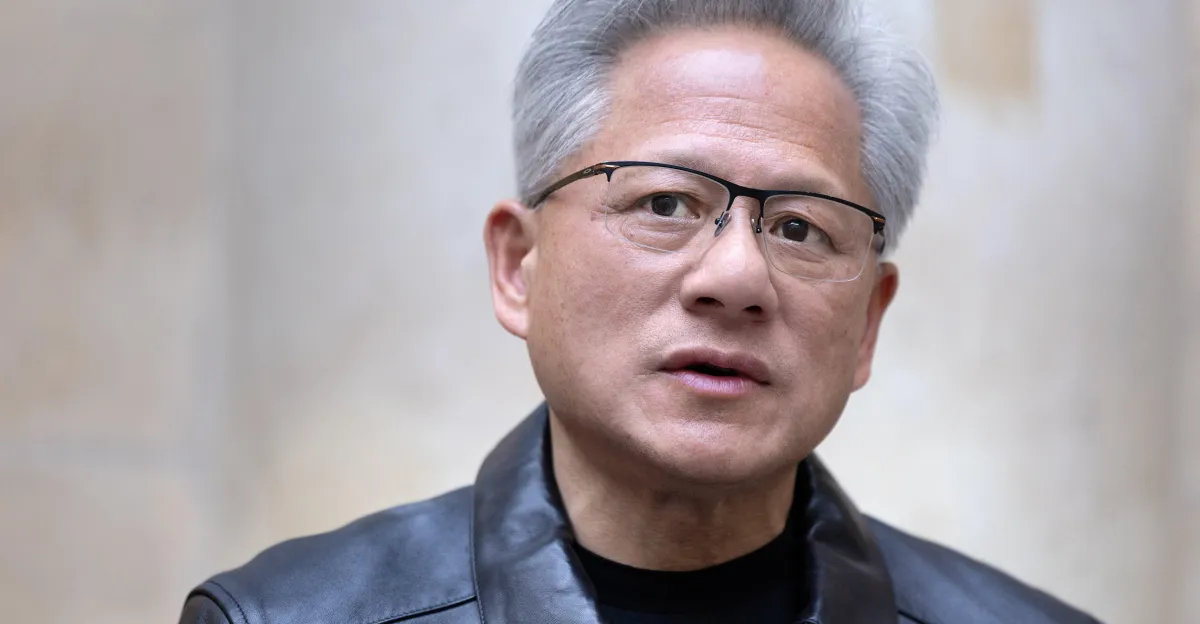
Trump’s comments, reported by TechCrunch and The Express Tribune, came after questions over Huang’s departure and the swirl of allegations around his personal life and contacts. Trump said he did not think the episode endangered national security and added that Huang could return, even saying there was a large group that wanted him back.
Asked about the spy allegation, Trump rejected the idea that the matter had been proven. In one exchange, he said,
“It was not put at risk”
and, in another account,
“He could return.”
TechCrunch also reported Trump saying, of the spying claims, “He may not be a spy at all.” The president said he had been briefed on the intelligence findings at least twice, including aboard Air Force One, but also said he was not aware of those claims.
What happened to Jensen Huang?
According to The Express Tribune, Huang stepped down as Nvidia CEO on Thursday, four days before Trump’s remarks. WIRED’s account framed the resignation more formally, saying Huang officially resigned after admitting an affair with an alleged Chinese intelligence asset. WIRED also said he faces reports of at least two more alleged affairs with Nvidia employees.
The accounts are broadly aligned on the central point — Huang is out, for now — but they differ in how they describe the circumstances. TechCrunch said he stepped down after more reporting. The Express Tribune said Trump was reacting to the possibility of a comeback, while WIRED emphasized that Nvidia’s board had turned on its founder after the scandals.
Who is running Nvidia now?
WIRED said interim CEO Colette Kress is taking over for now. Kress has been with Nvidia since 2013, according to WIRED, and now sits at the center of a company whose leadership has become a public issue well beyond Silicon Valley.
Why it matters
This is not just a celebrity-CEO story. Nvidia is the company at the center of the AI chip boom, and its relationship with China has become one of the most sensitive business-policy issues in the market. The White House has already imposed export controls on advanced chips destined for China, and any sign that the administration might soften, harden or personalize those rules matters to investors, rivals and policymakers.
Trump’s willingness to entertain a return for Huang matters for a second reason: it blurs the line between corporate governance and geopolitical signaling. A board decision about a chief executive can normally be handled inside a company. But when the CEO of a strategically important chipmaker is linked, fairly or not, to allegations involving Chinese intelligence, the issue quickly becomes political.
The story also lands at a sensitive time for Nvidia shareholders. The company’s stock fell 3.7% on Monday, according to The Express Tribune, and Nvidia was due to report third-quarter earnings on Tuesday. That combination — leadership uncertainty, market volatility and an earnings deadline — makes every public comment more consequential than it would be in calmer conditions.
How did the controversy build?
The timeline in the fact sheet shows the episode has been building for months, not days. TechCrunch reported that last year Senator Marco Rubio oversaw an internal memo warning that Alice Huang was a Chinese intelligence spy. TechCrunch also said Trump was briefed on the intelligence findings in May, and that the warnings had already circulated inside government circles before the latest round of reporting.
That background helps explain why the matter has become a national-security test as much as a personnel issue. If intelligence agencies have already been looking at possible links between Nvidia-related people and Chinese intelligence, then Huang’s fate could shape the political temperature around the company’s China business far beyond the boardroom.
What the board is facing
Corporate boards usually move fast when reputational or conduct issues threaten a company’s leadership. But the stakes are higher when the executive in question is a founder, the company is a market leader, and the underlying controversy touches China, intelligence and employee relationships. Nvidia’s board is being asked to weigh not only character and governance, but also whether any return would calm markets or inflame them further.
That is one reason the reinstatement push has drawn so much attention. The petition for Huang’s return had more than 177,000 signatures when The Express Tribune first reported it, and later in the same story that number had climbed to more than 180,200. The petition site, according to The Express Tribune, included more than 8,800 self-identified current Nvidia employees and more than 94,000 self-identified shareholders among the signers.
Those figures matter because they suggest the push was not just a social-media stunt. It had visible support from people claiming ties to the company and its investor base, giving the reinstatement campaign a rare blend of internal and external pressure.
Who is backing Huang’s comeback?
Supporters named in the fact sheet cut across the tech world. The Express Tribune said the petition included Elon Musk, Replit CEO Amjad Masad and Epic Games CEO Tim Sweeney. TechCrunch identified Musk, Y Combinator CEO Garry Tan and Sweeney as signers of a public letter urging reinstatement.
The overlap matters. The lists are not identical, which suggests the public support for Huang has been broad enough that different outlets surfaced different names, but they point in the same direction: influential tech figures are willing to publicly challenge the notion that Huang should be done at Nvidia.
That kind of support does not guarantee a comeback. It does, however, raise the political and market cost of keeping him out permanently. For a founder-led company with a big reputation premium, public backing from prominent industry names can become part of the pressure on a board to explain its decision.
What are the allegations?
The fact sheet contains two separate but related strands. One is the intelligence claim: TechCrunch said U.S. officials had warned Alice Huang was a spy for China’s Ministry of State Security. The other is the personal-misconduct claim: WIRED said Huang resigned after admitting an affair with an alleged Chinese intelligence asset, and that he also faces reports of at least two more alleged affairs with Nvidia employees.
Those allegations are not interchangeable. A relationship with a person alleged to have intelligence links is different from a direct allegation of espionage. But in a high-stakes export-control environment, either issue can become a corporate and political flashpoint.
Trump’s response suggests he is not ready to treat the allegations as dispositive. His comment that nobody had proven Alice Huang was a spy, together with his insistence that the episode did not put U.S. national security at risk, signals skepticism toward the more explosive interpretations of the reporting.
How do the outlets differ?
All three outlets agree on the broad outline: Huang is out, pressure for his return is real, and Trump has downplayed the national-security implications. But the details and emphasis vary.
- TechCrunch focused on the intelligence side, saying Trump had been briefed twice, that U.S. officials had warned about Alice Huang, and that the administration was already dealing with investigation and export-control issues.
- The Express Tribune emphasized the comeback campaign, the petition totals, and Trump’s public openness to Huang returning.
- WIRED leaned hardest into the internal scandal, describing the resignation as a response to admitted misconduct and saying the board had turned on Huang.
Those distinctions matter because they shape how readers should understand the story. This is not a single-source controversy with one clear framing. It is a convergence of corporate, legal, political and reputational pressures, with each outlet capturing a different facet of the same crisis.
Background: why Nvidia is so exposed
Nvidia is not an ordinary hardware company. It makes leading AI chips, and those chips have become central to the infrastructure race in artificial intelligence. That means any restriction on sales to China, any sign of smuggling, and any suggestion of a national-security breach lands harder than it would at a less strategically important company.
TechCrunch reported that the United States and Singapore were already investigating Megaspeed over alleged Nvidia chip smuggling to China. That detail is important because it shows the surrounding policy environment is already active. The Huang controversy is not unfolding in a vacuum; it is happening while authorities are scrutinizing whether Nvidia hardware is reaching China through channels that should not exist.
In that context, executive instability becomes more than a human-interest angle. It can affect how regulators, customers and investors interpret the company’s posture toward China, and whether Nvidia can keep navigating U.S. export rules without deeper political fallout.
By the numbers
| Metric | Figure | What it refers to | Source |
|---|---|---|---|
| Petition signatures | More than 177,000 | Initial count for Huang’s reinstatement push | The Express Tribune |
| Updated petition signatures | More than 180,200 | Later total cited in the same Tribune report | The Express Tribune |
| Current Nvidia employees on petition site | More than 8,800 | Self-identified signers | The Express Tribune |
| Shareholders on petition site | More than 94,000 | Self-identified signers | The Express Tribune |
| Share drop | 3.7% | Nvidia’s Monday decline | The Express Tribune |
| Tenure | 33 years | Huang’s time at Nvidia before stepping down | TechCrunch |
What happens next?
The immediate question is whether Nvidia’s board seriously considers reinstating Huang. That is the most obvious open issue, but not the only one. The company still needs a permanent leadership answer, and the fact sheet suggests interim CEO Colette Kress is only holding the line for now.
Another question is whether the U.S. and Singapore investigations into Megaspeed produce anything that changes the political climate. If authorities find evidence that Nvidia chips were being smuggled to China, the policy conversation around the company could become more restrictive. If they do not, the current noise may fade, though not necessarily disappear.
There is also the question of Trump’s own role. The Express Tribune said Trump may discuss the issue with Xi Jinping on his Asia trip. If that happens, the Huang matter could move from a corporate scandal into a diplomatic talking point, especially given the administration’s broader China-chip restrictions.
Trump also said Commerce Secretary Howard Lutnick was not being replaced, despite pressure over China chip restrictions. That matters because it suggests the White House is not about to rewrite its economic team, even while it is sending mixed signals on Nvidia’s leadership problem.
What to watch
- Whether Nvidia’s board issues any statement on Huang’s status or the petition campaign.
- Whether the earnings report changes investor sentiment after the 3.7% share drop.
- Whether Washington or Singapore advances any findings tied to Megaspeed.
- Whether Trump’s public comments soften pressure on Nvidia or intensify scrutiny.
- Whether more allegations about Huang surface in coming days.
Why it matters for readers, markets and the region
The bigger significance reaches well beyond one executive. For readers watching the AI boom, this is a reminder that the chip supply chain is being shaped not only by engineering and demand, but by politics, intelligence claims and personal conduct scandals. For markets, the question is whether governance drama at a critical supplier can dent confidence at the very moment AI spending remains central to valuations.
For the region, the story highlights the unresolved tension between U.S. controls and Asia-linked chip flows. Taiwan, China, Singapore and the United States are all part of the wider picture around Nvidia’s business and the allegations surrounding it. Even without a final answer on Huang, the controversy reinforces how tightly linked semiconductors, state power and boardroom decisions have become.
Trump’s comments did not settle anything. They did something else: they made clear that the possibility of Huang returning is now a live political question, not just an internal company debate.
Frequently asked questions
Did Trump say Jensen Huang could return as Nvidia CEO?
Yes. Trump said he would not mind Huang returning and, in The Express Tribune’s account, added that Huang could return. He also downplayed the national-security concerns tied to the controversy.
Why did Jensen Huang step down as Nvidia CEO?
The fact sheet says WIRED reported Huang resigned after admitting an affair with an alleged Chinese intelligence asset, while TechCrunch said he stepped down after more reporting. WIRED also said there were reports of at least two additional alleged affairs with Nvidia employees.
How many people signed the petition for Huang’s return?
The Express Tribune said the petition had more than 177,000 signatures and later in the same story more than 180,200. It also said more than 8,800 current Nvidia employees and more than 94,000 shareholders identified themselves on the petition site.
What national-security issue is tied to Nvidia in this story?
TechCrunch said U.S. officials had warned that Alice Huang was a spy for China’s Ministry of State Security, and that the U.S. and Singapore were investigating Megaspeed over alleged Nvidia chip smuggling to China. Those claims are part of the broader pressure on Nvidia’s China business.
Who is running Nvidia now?
WIRED said interim CEO Colette Kress is taking over for now. The fact sheet also says Kress joined Nvidia in 2013, placing her at the center of the company’s leadership transition.