Updated August 20, 2026 10:25 am
In short
Relativity Networks has raised $22 million and says a major hyperscaler has placed a $40 million follow-on order as it pushes faster hollow-core fiber for sprawling AI data-center campuses.
- Relativity Networks raised $22 million in SAFE financing.
- The company says hollow-core fiber can move data about 30% faster than conventional fiber.
- A hyperscaler has placed a $40 million follow-on order, according to the company.
- The technology could help AI data centers spread across larger campuses without as much latency.
- The story reflects growing investment in AI infrastructure beyond chips and software.
Update — August 20, 2026 10:25 am
Relativity’s latest pitch now puts the performance gain at about 50% faster than conventional fiber, a bigger claim than the roughly 30% figure it had given earlier.
The company also says the $40 million follow-on order came from a leading hyperscaler that has not been named. Relativity argues that kind of demand could let multi-campus AI deployments stretch about 50% farther before latency becomes a limiting factor.
Update — August 19, 2026 1:53 pm
Relativity says the hollow-core fiber it is commercializing can cut transmission times by about 50% versus conventional cable, a bigger performance claim than the roughly 30% speed boost described earlier.
TechCrunch also says the company’s follow-on order came from a leading hyperscaler that declined to be named, and quotes CEO Jason Eichenholz saying the shift to multi-campus AI systems could let developers span about 50% larger distances before latency becomes a problem.
The company’s latest pitch is that the next phase of AI infrastructure is not just about packing in more compute, but about optimizing the geography of where that compute sits.
Relativity Networks has raised $22 million in SAFE financing to commercialize hollow-core fiber for data centers, a move that could let AI infrastructure stretch farther across campuses without running into latency limits. The company also says a major hyperscaler has placed a $40 million follow-on order, underscoring growing interest in faster optical links as AI clusters spread over larger footprints.
The new money, announced Tuesday, comes from Rhapsody Venture Partners, Bell Ventures Inc. and Faster Than Glass LLC, among other backers. Relativity’s pitch is straightforward: if compute is increasingly distributed across multiple buildings or even multiple campuses, the networking between those sites needs to get faster or the whole system slows down.
That argument is gaining urgency as the world’s largest data-center developers race toward spending that could reach as much as $4 trillion by the end of the decade. Those projects are already constrained by power availability, zoning, permitting and politics. Relativity is betting that fiber latency is another bottleneck worth solving.
What Relativity Networks is selling
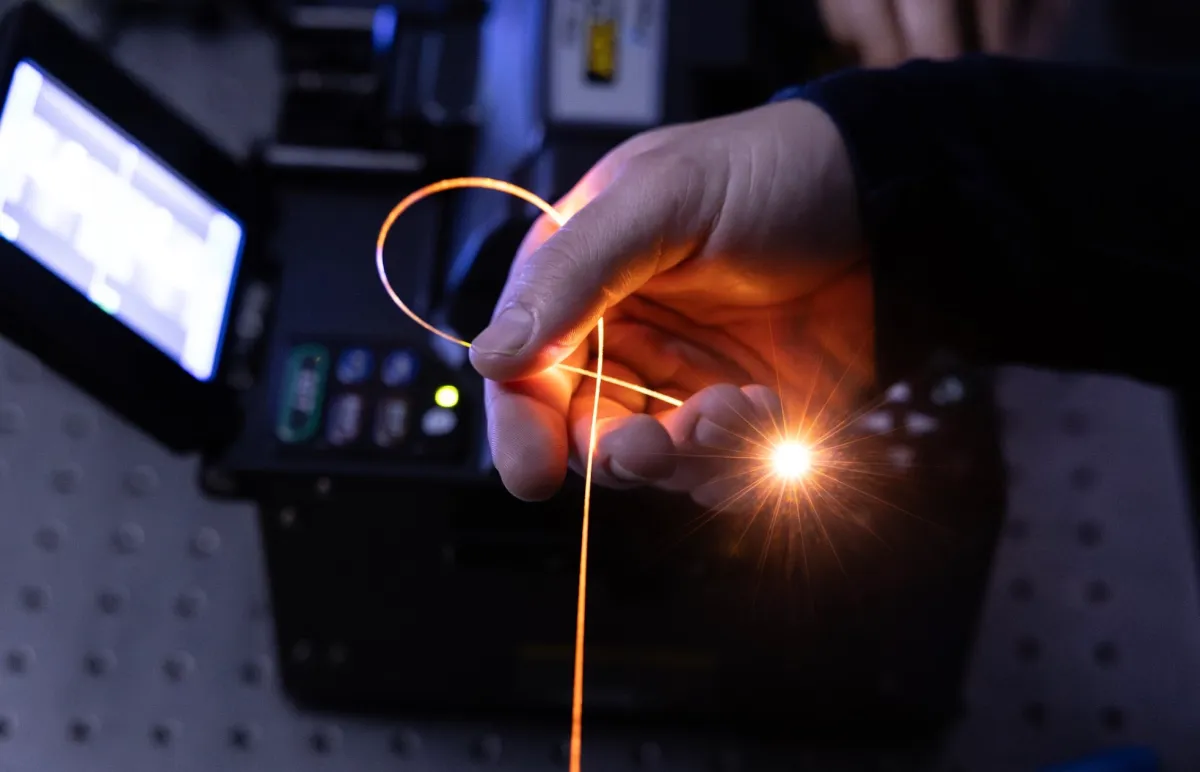
Relativity Networks is building hollow-core fiber, an uncommon form of optical cable that transmits data through an air-filled or vacuum-like center rather than through solid glass alone. In practical terms, that means light travels closer to its maximum possible speed inside the cable.
The company says the result is roughly 30% faster transmission than conventional fiber. In CEO Jason Eisenholz’s estimate, a signal traveling one kilometer through standard fiber takes about five microseconds, while hollow-core fiber can cut that to around three and a half microseconds.
That may sound tiny, but at the scale of AI infrastructure, tiny can matter. Modern model training and inference workloads often depend on thousands of GPUs communicating continuously. When those chips are packed into a single rack, a few microseconds may not change the user experience. When the same workload spans large campuses, the penalty compounds quickly.
How hollow-core fiber works
Hollow-core fiber changes the path of light by replacing most of the material the signal normally travels through with a central void. Because the signal is less slowed by the glass itself, latency drops compared with standard fiber-optic lines.
There are still engineering tradeoffs, and the technology is not yet widely deployed. But for operators trying to link separate facilities into one synchronized AI cluster, the performance gain could become strategically important.
| Metric | Conventional fiber | Hollow-core fiber |
|---|---|---|
| Approximate speed improvement | Baseline | About 30% faster |
| Latency per kilometer | About 5 microseconds | About 3.5 microseconds |
| Typical deployment maturity | Widely deployed | Rarely deployed |
| Best-fit use case | General networking | High-performance AI data-center links |
Why data-center geography is becoming a problem
The modern data center is no longer just a single warehouse full of servers. It is increasingly a spread-out campus with multiple buildings, utility hookups and networking corridors. As AI systems scale, operators often need to locate new infrastructure wherever sufficient power is available, even if that means separating compute across large distances.
Eisenholz argues that this shift creates a new design challenge: the compute may be physically split, but it still needs to function like a single machine. That makes network speed more than a technical specification. It becomes part of the basic architecture of the site.
The largest systems are distributing compute across multiple campuses to reach the power that exists, and they still need to operate as one synchronized machine, according to CEO Jason Eisenholz.
In other words, the industry is being pushed by energy and land constraints into a more geographically distributed model, while AI workloads keep demanding ever tighter coordination between machines. Relativity is targeting the gap between those two forces.
How AI changed the networking equation
AI development has changed the way infrastructure is optimized. Earlier generations of systems focused first on packing in more compute, then on improving networking within a single facility. Now, Relativity says the next major constraint is the distance between facilities themselves.
That progression matters because the economics of AI are no longer limited to what can fit inside one building. The biggest deployments increasingly rely on huge campuses, multiple utility feeds and distributed layouts that can cover hundreds of acres.
- First era: maximize raw GPU compute.
- Second era: improve internal data-center networking.
- Third era: optimize where that compute sits geographically.
Relativity believes hollow-core fiber is well suited to that third stage, especially where operators need to connect pre-existing sites or expand across a broad campus without sacrificing synchronization.
What the new financing means
The $22 million announced this week was raised through SAFE notes, a structure commonly used in early-stage fundraising. A SAFE, or simple agreement for future equity, gives investors the right to convert their investment into shares later, usually when the company raises a priced round.
For Relativity, the financing does two things at once. It provides capital to keep product development and commercialization moving, and it signals that the company’s technology is moving from niche concept toward something customers are willing to buy.
That second point may be even more significant. The company says it has already secured a $40 million follow-on order from a large hyperscaler that has not been publicly named. While the customer’s identity remains confidential, the order suggests a major cloud or AI infrastructure operator sees enough value to commit future spending.
In a sector where network infrastructure often becomes standard only after a long runway of testing, a follow-on order of that size is a notable endorsement.
Who backed the round?
Relativity said the financing included participation from Rhapsody Venture Partners, Bell Ventures Inc. and Faster Than Glass LLC, along with additional investors not identified in the announcement.
The investor base reflects a broader pattern in deep-tech infrastructure investing: backers are increasingly willing to fund highly specific hardware bets if the technology can unlock a larger market such as AI datacenters, cloud connectivity or next-generation telecom links.
How big could the opportunity be?
The opportunity could be meaningful if AI infrastructure continues expanding across geographically distributed campuses. The core logic is simple: if shorter latency allows operators to stretch a campus farther before communication becomes a problem, they can place facilities where power is available rather than where networking convenience dictates.
That matters because developers are already contending with power-grid bottlenecks, permitting delays and land-use restrictions. Any technology that helps them place servers farther apart while preserving performance could widen the set of viable build sites.
Relativity’s thesis is not that hollow-core fiber will replace conventional fiber everywhere. Instead, it is that the highest-value deployments will be those where microseconds matter and where connectivity between distributed sites becomes a limiting factor.
Potential benefits for hyperscalers
For hyperscale operators, the appeal of faster fiber includes three broad advantages:
- Longer campus spans: facilities can be spread farther apart before latency becomes disruptive.
- Better synchronization: distributed GPU clusters can behave more like a single system.
- More site options: operators may gain flexibility to build where power and land are available.
Those advantages do not eliminate the realities of physical infrastructure, but they may soften them enough to matter in large-scale AI rollouts.
Why does a few microseconds matter?
Because at hyperscale, small delays add up fast. A single microsecond can be negligible to a consumer application. Across thousands of machines exchanging signals constantly, though, the cumulative effect can influence system efficiency and coordination.
That is why networking improvements inside and between data centers have become a major focus in AI infrastructure. When workload orchestration spans racks, rows, buildings and sometimes campuses, the network is no longer just plumbing. It is a performance surface.
Relativity’s case is that hollow-core fiber can buy back enough time to change site planning decisions. A 30% reduction in propagation delay may not sound transformative in isolation, but in the context of multi-campus AI operations, it could be the difference between a feasible expansion and one that runs into latency limits.
Timeline of the announcement
The company’s update fits into a larger race to build and interconnect AI infrastructure. Here is the sequence of events around the announcement.
| When | Event | Why it matters |
|---|---|---|
| Tuesday, Aug. 19, 2026 | Relativity Networks announces $22 million SAFE financing | Provides capital for commercialization and expansion |
| Same announcement | Company discloses a $40 million follow-on order from an unnamed hyperscaler | Suggests market validation from a major customer |
| Current market backdrop | AI data-center developers face power and geography limits | Creates demand for lower-latency networking solutions |
What makes this technology unusual?
Hollow-core fiber is unusual because it has spent years as an advanced optical concept rather than a mainstream networking product. Traditional fiber has dominated because it is proven, manufacturable at scale and well understood by network operators. Relativity is trying to turn an edge-case technology into infrastructure.
That shift is not easy. New data-center technologies usually must overcome questions about durability, installation, interoperability and cost. Buyers also want confidence that a niche solution will fit into existing operational patterns.
Still, the AI boom has created an environment in which operators are more willing to test tools that shave off latency or improve physical flexibility. If power availability is dictating where campuses are built, the networking layer may need to evolve in parallel.
How this fits the broader AI infrastructure race
Relativity’s raise is part of a larger wave of investment into the physical layer of AI. Semiconductors, cooling systems, power delivery, switchgear and optical networking are all becoming more strategically important because each addresses a different bottleneck in the same stack.
In that context, hollow-core fiber is not merely a faster cable. It is one more attempt to remove friction from systems that are being forced to scale beyond the assumptions of older data-center layouts.
The real value proposition is not just speed but architectural freedom. If operators can connect campuses more efficiently, they may be able to use land and power resources that would otherwise be too remote from one another to support a tightly synchronized workload.
What investors may be betting on
Investors appear to be betting that networking will be one of the last major infrastructure frontiers in the AI buildout. Compute gets headlines, but without faster and more flexible interconnects, large clusters may hit practical limits long before they hit theoretical ones.
They may also be betting on a market where a single customer’s order can justify an early niche. If one hyperscaler is willing to commit tens of millions of dollars, other operators may be more willing to test the technology as their own campuses expand.
The road ahead for Relativity Networks
Relativity now has the combination of capital and customer demand that many early-stage hardware companies spend years chasing. The next challenge is turning that momentum into repeatable deployments that can scale beyond a handful of pilot or specialized installations.
The company’s long-term success will likely depend on whether hollow-core fiber can prove itself not just as a faster alternative, but as a practical one. That means fitting into real-world buildouts, surviving the rigors of data-center deployment and delivering enough operational benefit to justify the switch.
If it can do that, the company may become part of the next phase of AI infrastructure design: the phase in which geography, not just raw compute, becomes a competitive advantage.
For now, Relativity’s announcement signals that the market is paying attention. In a sector where enormous sums are being spent to push AI systems farther and faster, even microseconds can become a strategic asset.
Frequently asked questions
What did Relativity Networks announce?
Relativity Networks announced a $22 million SAFE financing round and said it secured a $40 million follow-on order from an unnamed hyperscaler. The funding is intended to support commercialization of its hollow-core fiber technology for data-center networking.
What is hollow-core fiber?
Hollow-core fiber is an optical cable design that sends light through a central void rather than primarily through solid glass. That allows the signal to travel closer to the speed of light and lowers latency compared with conventional fiber.
Why is faster fiber important for AI data centers?
Faster fiber matters because AI clusters are increasingly distributed across multiple buildings or campuses. Lower latency helps those systems behave more like one synchronized machine, which becomes more important as power constraints push data centers farther apart.
How much faster does Relativity say its fiber is?
Relativity says its hollow-core fiber is about 30% faster than traditional fiber. CEO Jason Eisenholz estimates that signal travel over one kilometer drops from roughly five microseconds in conventional fiber to about three and a half microseconds.
Who invested in the round?
The company said the round included Rhapsody Venture Partners, Bell Ventures Inc. and Faster Than Glass LLC, along with other investors that were not named in the announcement. The specific terms of the SAFE note were not disclosed.