In short
Nvidia said Jensen Huang resigned on Nov. 12 after an internal investigation tied to affair and spy allegations. Colette Kress is interim CEO while the board searches for a permanent replacement.
- Nvidia said Jensen Huang resigned effective immediately on Nov. 12.
- Colette Kress was named interim CEO as the board begins a replacement search.
- WIRED, The Verge and TechCrunch linked the exit to overlapping affair and security allegations.
- Huang’s departure could affect Nvidia’s policy influence, financing relationships and AI messaging.
- The company remains dominant, but the leadership transition raises new questions about its future direction.
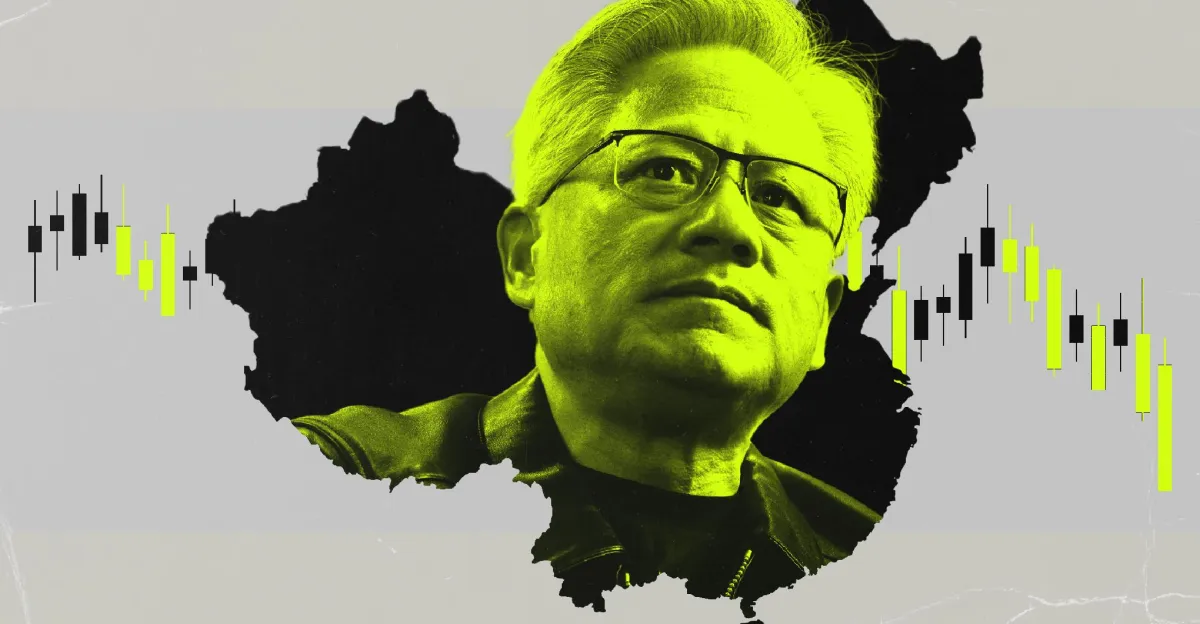
Nvidia said Jensen Huang resigned as chief executive, president and board member on Nov. 12, a stunning turn that removes the company’s most visible power broker at the center of the AI chip boom. Colette Kress, Nvidia’s chief financial officer, was named interim CEO as the board said it would weigh both internal and external candidates for the permanent job.
What happened
The resignation follows an internal investigation into allegations involving an affair with Alice Huang, who WIRED described as a suspected China Ministry of State Security asset. According to WIRED, the board said Huang’s resignation was effective immediately, and Huang later emailed staff on Sunday acknowledging the affair, apologizing and promising to cooperate.
The Verge reported that the board was already preparing to remove Huang before the resignation announcement, suggesting the departure was not a surprise inside the company. The Verge also reported a second alleged relationship involving Nvidia health care vice president Kimberly Powell, saying both Powell and Huang were married and were allegedly seen together at a San Jose hotel during GTC in March.
WIRED’s account and The Verge’s reporting point to overlapping strands in the crisis: a possible security issue, a relationship with a subordinate, and broader concerns about leadership conduct inside one of the world’s most important technology companies. WIRED said the subordinate affair and alleged ties to Megaspeed likely weighed more heavily in the ouster than the espionage allegations alone.
Why it matters
Huang was not just Nvidia’s CEO. He was the company’s chief evangelist, its most recognizable public face, and one of the most influential voices in AI policy and market development. His exit lands at a moment when Nvidia’s role in the AI economy is already under pressure from export controls, data-center financing questions and mounting scrutiny over the company’s reach.
TechCrunch said the scandal could weaken Huang precisely because he had become the AI industry’s loudest advocate on several fronts at once. That included arguing for open-weight models, promoting self-regulation through Nvidia’s Open Agent Safety Platform and describing AI as an engineered tool rather than a sentient system.
There is also a market dimension. Nvidia has ridden the AI boom to extraordinary scale, with WIRED noting its share price surge in 2023 and 2024 and its rise to a $4 trillion valuation in the summer of 2025. The company’s influence over the GPU market was still immense as of September 2026, when WIRED said it controlled about 90% of the market. Losing the executive most associated with that rise may affect how investors, customers and policy makers read Nvidia’s next moves.
How did Nvidia get here?
Huang cofounded Nvidia in 1993 with Chris Malachowsky and Curtis Priem, and for years the company was best known for graphics hardware. The major pivot came in 2012, after the AlexNet breakthrough pushed the industry toward the idea that graphics chips could power modern artificial intelligence. From there, Nvidia’s products and software stack became foundational to the AI buildout.
That foundation made Huang one of the most sought-after executives in tech. He became Nvidia’s public pitchman, selling the idea that AI infrastructure would be the next industrial platform. In WIRED’s account, that influence extended far beyond product launches: Huang was a regular presence in policy circles, supply-chain negotiations and high-stakes financing conversations around data-center expansion.
TechCrunch said he helped line up PC makers for Nvidia-powered AI PCs due this holiday season, and it reported that he also pushed a broader set of deals tied to data-center growth. Among the figures cited by TechCrunch were a $105 billion OpenAI data-center financing commitment Nvidia agreed to backstop, a $500 billion set of data-center buildout commitments from private equity firms announced by Huang, and a reported $750 billion circular-deal financing figure Bloomberg had cited. Those numbers show why his personal influence mattered: he was not simply selling chips, but knitting together an AI infrastructure market.
What the reports say about the investigation
WIRED said Nvidia’s board announced an internal investigation on Nov. 8. It also reported that the New York Times on Nov. 6 and Nov. 11 aired separate allegations tied to Chinese intelligence and a second romantic relationship. According to WIRED, Huang and Alice Huang were seen publicly together at least twice, in June 2024 and again in May 2025.
The exact balance of what triggered the resignation remains unclear from the reporting, and the outlets differ in emphasis. WIRED foregrounded the alleged China intelligence link and the internal inquiry. The Verge focused more heavily on the alleged second affair and the board’s move toward dismissal. TechCrunch, meanwhile, examined the fallout through the lens of Nvidia’s broader industry power and the policy role Huang played.
What emerges across the reporting is a company responding to a leadership crisis at the top of a highly sensitive business. Nvidia sits at the intersection of advanced computing, U.S.-China trade tensions and the enormous capital needs of AI infrastructure. That combination means even a personal scandal can quickly become a strategic one.
Who is Colette Kress, and what changes now?
Colette Kress is Nvidia’s chief financial officer and now its interim CEO. The board said it will consider both internal and external candidates for the permanent role. That makes clear Nvidia is not treating the transition as a temporary personnel adjustment; it is entering a search process that could reshape how the company presents itself to the market.
Kress is a logical stabilizing choice in the immediate term because she already knows the company’s finances, capital commitments and customer relationships. But the job is far larger than quarterly results. Huang’s successor will need to reassure investors, preserve confidence among cloud and data-center customers, manage the company’s stance on export controls and sustain Nvidia’s influence in AI policy debates.
The challenge is not simply replacing a chief executive. It is replacing a singular figure whose personal brand was fused with Nvidia’s rise. Huang was the person most often sent to explain why the company’s chips mattered, why AI spending would continue and why Nvidia’s ecosystem was more than a hardware business. That type of authority is difficult to hand off cleanly.
Background: why Huang mattered so much to Nvidia
Huang’s influence came from timing as much as talent. Nvidia’s transformation from graphics-chip maker to AI infrastructure giant happened during a period when every major technology company suddenly wanted more compute. As data-center expansion became the primary engine of AI spending, Nvidia became the supplier almost everyone needed.
That made Huang essential in three ways:
- He sold the vision — convincing customers and investors that the AI buildout had years of runway.
- He shaped the politics — positioning Nvidia as a central voice in debates over safety, regulation and export controls.
- He brokered the deals — helping draw in partners, financiers and hardware buyers across the AI stack.
TechCrunch said Huang was the loudest industry voice for open-weight models, which are downloadable models that can be run and adapted by others. It also said he championed AI as an engineered tool rather than a sentient system, and that he backed AI self-regulation through Nvidia’s Open Agent Safety Platform, which more than 100 companies signed. Those positions mattered because they gave Nvidia a place in the policy conversation beyond chips alone.
That public posture made Huang a bridge between the engineering story and the political one. His absence raises a simple question: can Nvidia keep playing that role with the same force if the person who embodied it is no longer in charge?
How serious is the fallout for Nvidia?
Short answer: potentially very serious, but not in the same way for every part of the business. Nvidia’s underlying products remain central to AI systems, and its customer relationships are still likely to matter more than any one executive. But the company’s standing in Washington, in global markets and in capital-heavy data-center negotiations may now be harder to manage without Huang.
TechCrunch argued that Huang’s exit could complicate Nvidia-linked financing for data-center buildouts. That concern is credible because those arrangements often depend on trust, momentum and a sense that the company’s top executive can keep many parties aligned. If he was the person making the rounds, reassuring counterparties and framing the long-term story, the transition could slow some of that machinery.
The policy risk is also real. Huang had become a leading public advocate in a moment when AI regulation, safety and export restrictions were all being contested. TechCrunch said his departure could weaken Nvidia as the industry’s leading advocate on multiple policy and market fronts. That is especially relevant given long-running U.S. export controls on advanced chip sales to China, which have repeatedly placed Nvidia in a difficult position.
There is also the reputational question. For a company that has leaned heavily on the clarity of its message, a leadership scandal involving personal conduct, alleged security concerns and possible board intervention can complicate the brand narrative. Even if the business remains strong, the story around it has changed.
By the numbers
| Number | What it refers to | Source in the reporting |
|---|---|---|
| Nov. 8, 2026 | Date Nvidia announced its internal investigation | WIRED |
| Nov. 12, 2026 | Date Nvidia said Jensen Huang resigned | WIRED |
| 100+ companies | Organizations that signed Nvidia’s Open Agent Safety Platform | TechCrunch |
| 90% | Approximate share of the GPU market Nvidia controlled in September 2026 | WIRED |
| $4 trillion | Nvidia’s peak valuation in summer 2025 | WIRED |
| $105 billion | OpenAI data-center financing Nvidia agreed to backstop | TechCrunch |
Timeline
The controversy sits on top of a long arc that explains why Huang’s departure matters so much now.
| Date | Event |
|---|---|
| 1993 | Huang cofounded Nvidia with Chris Malachowsky and Curtis Priem |
| 2012 | Nvidia pivoted toward AI chips after the AlexNet breakthrough |
| June 2024 | WIRED says Huang and Alice Huang were seen publicly together |
| May 2025 | WIRED says they were seen publicly together again |
| Summer 2025 | Nvidia became the first company to reach a $4 trillion valuation |
| October 2025 | A crisis PR firm began fielding Huang-related press inquiries |
| Nov. 6, 2026 | The New York Times and Financial Times reported China spy allegations, per WIRED |
| Nov. 8, 2026 | Nvidia announced an internal investigation into affair allegations |
| Nov. 11, 2026 | The New York Times reported an alleged second relationship with a direct report |
| Nov. 12, 2026 | Nvidia said Huang resigned and Kress became interim CEO |
What happens next
The immediate question is who replaces Huang permanently. The board has said it will consider internal and external candidates, which leaves open whether Nvidia wants continuity, a financial operator, a product leader or an outside reset.
Several other questions remain unresolved:
- Whether the board will disclose more about the findings of the investigation.
- Whether the alleged second affair or the China-related claims carry any legal or regulatory consequences.
- How much of Nvidia’s policy influence depended on Huang personally rather than on the company’s broader power.
- Whether large financing and partnership deals tied to data-center growth stay intact.
- How the company handles its China exposure as export controls continue to shape the market.
For now, Kress inherits a company that is still dominant but suddenly more vulnerable at the level of perception and leadership. Nvidia remains central to AI infrastructure, but the person most identified with that dominance is gone. In a business built on trust, supply, and speed, that is no small change.
Source differences at a glance
The three outlets emphasized different parts of the same story. WIRED concentrated on the resignation, the board investigation and the alleged China-linked and workplace-relations allegations. The Verge added detail about the board preparing to dismiss Huang and the alleged second affair involving Kimberly Powell. TechCrunch widened the lens to the strategic consequences for Nvidia’s AI advocacy, policy standing and financing ties.
That variation matters because it suggests the full significance of the resignation is not just personal or corporate governance-related. It is also about how much one executive’s influence shaped the AI boom itself.
Frequently asked questions
Why did Jensen Huang resign from Nvidia?
According to WIRED and The Verge, Huang resigned after an internal investigation into affair allegations and reported spy-related concerns. WIRED said the board announced the investigation on Nov. 8, 2026, and later accepted his resignation effective immediately on Nov. 12.
Who is running Nvidia now?
Colette Kress is serving as interim CEO. Nvidia said the board will consider both internal and external candidates for a permanent replacement, which means the leadership search is just beginning.
How important was Jensen Huang to Nvidia?
Very important. TechCrunch said Huang was Nvidia’s loudest industry advocate on policy and market issues, while WIRED described him as the company’s public face and chief pitchman. He shaped how Nvidia spoke about AI, regulation and infrastructure spending.
What happens next at Nvidia?
The board must choose a permanent CEO and decide how much to disclose about the investigation. Investors will also watch whether Nvidia’s financing deals, AI partnerships and policy influence hold up without Huang at the center.
Did other outlets report different details?
Yes. WIRED emphasized the internal investigation and alleged China-related concerns, while The Verge focused on the board allegedly preparing to dismiss Huang and on a second alleged relationship involving Kimberly Powell. TechCrunch focused on the business and policy fallout.