In short
Luca Guadagnino’s Artificial premiered at the New York Film Festival as a dark comedy about OpenAI and the AI race. The film satirizes tech leaders while warning that AI safety, power and ambition are colliding.
- Artificial premiered at the New York Film Festival as a satire of OpenAI and the AI boom.
- The film portrays AI leaders as vain, reckless and oddly childish while centering safety concerns.
- AmazonMGM dropped the film after Amazon’s OpenAI deal; Neon later acquired it.
- The movie compares the AI race to a broader struggle for control, profit and geopolitical advantage.
- Its dark humor lands as both a joke and a warning about the risks of accelerated AI development.
Artificial, Luca Guadagnino’s new comedy-drama about OpenAI and the broader AI race, premiered at the New York Film Festival this week and arrived with a blunt message: the people building artificial intelligence look increasingly reckless, self-regarding and unable to agree on how to keep the technology from outrunning human control. The movie matters because it turns one of Silicon Valley’s most consequential industrial contests into a mainstream cultural critique at exactly the moment AI safety debates are intensifying.
Blending satire, industry caricature and moral alarm, the film portrays the current AI boom as a competition driven by status, ambition and fear as much as innovation. Its target is not only OpenAI, but the entire ecosystem of labs, investors and rival founders shaping the direction of a technology that many insiders now describe in apocalyptic terms.
At the festival premiere, the film’s sharpest jokes landed alongside uneasy laughter. That reaction may be part of the point. Artificial does not simply mock the tech elite; it suggests that the stakes around artificial intelligence have become so large that even comedy now sounds like a warning siren.
What is Artificial saying about the AI race?
Artificial argues that the AI boom is being steered by powerful, often immature men who claim to be building the future while behaving like status-obsessed rivals in a high-stakes scramble for control. In the film’s telling, the central question is no longer whether advanced AI will arrive, but who will get to shape it, profit from it and decide what “safe” means.
The movie focuses on OpenAI’s cofounding era and positions Ilya Sutskever as the story’s uneasy center of gravity: a technically brilliant researcher who is portrayed as the conscience in a room full of growth-minded executives. Around him, the film sketches Sam Altman, Elon Musk and other AI power brokers as ambitious, theatrical and often absurd.
That approach makes Artificial less a conventional corporate drama than a broad critique of the ideology that drives AI development. It treats the field as a moral battleground, but one in which nearly everyone involved is compromised by ego, competition or market pressure.
A satire of Silicon Valley prestige
The film repeatedly punctures the self-importance of its subjects. Rather than framing AI founders as visionary titans, it depicts them as awkward, image-conscious and deeply unserious, even as they discuss technologies with potentially world-altering consequences.
That comic choice gives the movie its edge. Instead of celebrating genius, it emphasizes social awkwardness, inflated self-belief and the strange theater of startup culture. The result is a portrait of an industry that may be talking about the future, but still behaves like a clique of anxious competitors trying to one-up one another in public.
How does the film portray OpenAI and its leaders?
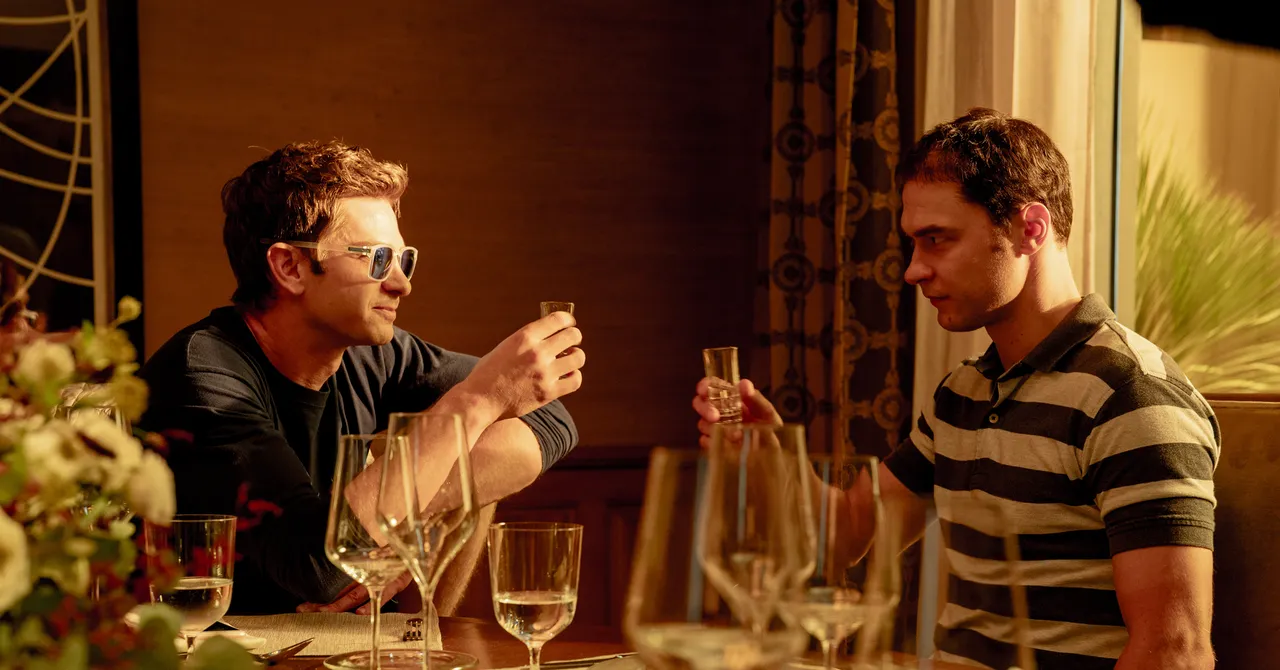
The film portrays OpenAI as a company split between ambition and anxiety, with leadership figures shown as both technologically influential and morally evasive. Andrew Garfield plays Sam Altman as a charismatic, restless executive; Yuri Borisov plays Sutskever as a serious-minded researcher who increasingly worries about the consequences of what the company is building; and other figures in the orbit of the company are rendered as profit-driven or opportunistic.
Guadagnino and writer-producer Simon Rich do not present OpenAI as a neutral laboratory. Instead, the company becomes a symbol of the larger tension running through the AI industry: every claim of safety is tied to a race for dominance, and every breakthrough is a source of both celebration and dread.
In that sense, the movie is closer to a morality play than a procedural. It compresses a sprawling technological rivalry into a series of interpersonal confrontations, all of them underscored by suspicion about whether anyone in the room can truly be trusted with the systems they are creating.
At the premiere, cast members and filmmakers leaned into the film’s uneasy humor, with one leading performer joking that his character is essentially “a person who walks normally,” a line that captured the movie’s fixation on odd posture, status and performance.
Why Sutskever becomes the film’s moral center
Sutskever is depicted as the rare insider willing to push back against the acceleration of the machine. In the movie, he is the person most likely to insist on guardrails, alignment and slowing down, even when the surrounding culture rewards speed and scale.
That framing gives the film a clear internal conflict: one side argues that AI development should continue because it can be made profitable and powerful, while the other warns that technical success does not automatically mean human safety. The character’s function is to dramatize the idea that intelligence alone does not produce wisdom.
The choice to center the story on a researcher rather than a CEO also changes the moral emphasis. Instead of asking how to sell AI to the public, the film asks how a person inside the machine can resist being consumed by it.
Why did the movie arrive with controversy attached?
The film arrived with controversy because its original distributor dropped it after a major commercial deal involving OpenAI, and because its content is highly critical of the AI industry. The project was initially lined up for release through AmazonMGM, but the studio backed away this summer after Amazon announced a massive agreement with OpenAI. Independent distributor Neon later picked up the movie.
That sequence gave the premiere an added layer of intrigue. The New York Film Festival’s artistic director alluded to “the circumstances” surrounding the film when introducing it, a nod to the broader industry sensitivities that now shadow any major cultural work about AI companies.
The distribution shift matters because it suggests that films about artificial intelligence are no longer just artistic exercises. They are increasingly entangled with the business relationships of the very companies they depict. When a studio is doing business with a featured subject, even a work of fiction can become diplomatically complicated.
Timeline of the film’s path to the festival
| Event | What happened | Why it mattered |
|---|---|---|
| Original distribution plan | AmazonMGM was set to release the film. | It positioned the project for a mainstream studio rollout. |
| Amazon-OpenAI deal | Amazon struck a $50 billion agreement with OpenAI. | The studio then distanced itself from the movie. |
| Summer change | AmazonMGM dropped the title. | The film’s release became a flashpoint for industry politics. |
| Neon acquisition | Neon stepped in to distribute the movie. | The film preserved its path to audiences. |
| NYFF premiere | The movie debuted at the New York Film Festival. | It entered the public conversation as an AI-industry critique. |
How does Artificial compare with The Social Network?
It inverts the tone and mythology of The Social Network, replacing polished Silicon Valley mythmaking with a messy black comedy about ego, panic and ethical drift. Both films concern the creation of transformative tech platforms and both feature Andrew Garfield, but they use sharply different methods to interrogate ambition.
David Fincher’s Facebook drama treated its subject with chilly precision, literary dialogue and sleek visual control. Artificial, by contrast, is deliberately less elegant. Its style is rougher, stranger and more openly comic, with a surreal edge that emphasizes the absurdity of the people shaping the AI future.
That difference matters because it changes the emotional effect. The Social Network made its founders seem like tragic young moguls. Artificial turns its tech elites into figures of ridicule, suggesting that the latest generation of platform builders may be no more mature than the very systems they seek to dominate.
Guadagnino’s style in a new register
Guadagnino is known for sensual, visually lush films, but Artificial deliberately strips away glamour. The images are flatter, colder and sometimes intentionally unattractive, creating a visual world that matches the film’s skepticism about the tech elite.
That aesthetic restraint also underscores the satire. The movie is not interested in seducing viewers into admiring its subjects. It wants to expose how ordinary and awkward they can appear when stripped of branding, keynote polish and public-relations language.
In one of the film’s most memorable sequences, a group of programmers celebrates a technical milestone in a scene that is both triumphant and strangely unglamorous. Rather than elevating the moment, the filmmaking makes it feel awkwardly juvenile, as if the triumph itself is a performance for the room rather than a meaningful moral victory.
What is the movie saying about AI safety?
The movie argues that AI safety has become both a genuine crisis and a marketable narrative, often discussed in the same breath as funding, competition and prestige. In the film’s logic, concerns about risk do not slow the industry down; they can actually help validate it by proving the technology is powerful enough to be dangerous.
That is one of the film’s sharpest insights. It shows how alarm can be folded back into corporate strategy. Warning the public about AI risks can make a company appear responsible, transparent and advanced at the same time. Safety, in other words, becomes part of the branding.
This tension gives the movie its unsettling edge. If a technology is dangerous, its creators can use the danger to demonstrate importance. If it is not dangerous, then perhaps it is not powerful enough to matter. The film treats that loop as one of the central contradictions of the current AI boom.
One of the film’s clearest arguments is that, in the race to dominate AI, claims of caution can function as a competitive advantage as much as a moral position.
What the film suggests about alignment
“Alignment” — the idea that AI systems should be built to reflect human goals and values — appears in the movie as a noble but deeply contested ideal. The film suggests that everyone says they want aligned systems, but no one can fully agree on who defines the relevant values, who enforces them or how much commercial sacrifice is required.
That question is at the heart of current AI policy debates. If the technology is moving quickly enough to transform work, information and security systems, then alignment cannot remain a purely technical slogan. It becomes a governance question, a business question and an ethical question all at once.
Artificial insists that the most important argument in AI today is not whether alignment matters, but whether anyone in the industry is prepared to accept a slower path in order to achieve it.
Why the film’s warnings hit a nerve now
The film lands at a moment when real-world AI leaders are increasingly discussing catastrophic risk in public. That includes warnings from former and current researchers who have argued that advanced systems could pose existential dangers within years, not decades.
The article’s source material points to a broader shift in the industry: what once sounded like fringe doomerism is now part of mainstream conversation among major labs and former employees. That does not mean the worst-case predictions are universally accepted. But it does mean the debate has moved from the margins into the center of AI discourse.
In that environment, a film like Artificial feels less like satire from the outside and more like a mirror held up to an industry already nervous about itself. The movie’s warnings may sound exaggerated to casual users, but to people inside the field, they reflect a genuine anxiety about control, competition and the pace of progress.
From research lab to geopolitical contest
The film also places AI inside a larger geopolitical frame. It implies that the contest is not simply between companies, but between nations and blocs of power that want the economic and military advantages that advanced models could deliver.
That framing helps explain the intensity of the race. Once AI becomes tied to national strength, no company wants to fall behind. And once rivals are presumed to be moving ahead, caution can look like weakness.
The result is a strategic trap: every participant says they want safety, but none can easily afford to pause if competitors keep moving. The film transforms that logic into drama, then into dark comedy, then into something uncomfortably close to a warning.
Who comes off worst in the movie?
Pretty much everyone does, although the film is especially hard on the habit of tech leaders turning fear into self-importance. OpenAI executives, rival founders and investors are all portrayed as flawed, and the movie rarely gives any of them the dignity of complexity usually reserved for prestige-drama protagonists.
Elon Musk is rendered as a dominating presence in rooms full of engineers, while Altman is framed as a boyish operator with an appealing but slippery manner. Other industry figures populate the film as anxious enablers, opportunists or true believers.
That universal skepticism is part of what makes the movie funny. It does not tell viewers whom to admire. Instead, it treats the AI boom as a stage on which everyone involved is auditioning for power while insisting they are only there to save the future.
The Chinese investor subplot
One early scene involves a would-be Chinese investor whose interest in the technology is tied to military and surveillance uses, including drones and facial recognition. The sequence reinforces the film’s view that AI is never just about software; it is also about how that software can be applied by states and security services.
This subplot widens the movie’s scope beyond one startup or one executive. It reminds viewers that concerns over AI are not limited to chatbots or productivity tools. The same systems that generate text and images can also be adapted for monitoring, targeting and control.
That dual-use reality is one reason AI regulation has become so difficult. The same underlying model can be pitched as a workplace assistant, a creative tool or a strategic weapon, depending on who is asking and what they want to do with it.
How much should ordinary viewers care?
Ordinary viewers should care because the movie’s central argument is that AI is already embedded in everyday life, even if most people only notice it in emails, schedules and search tools. The film acknowledges that many audiences interact with AI only indirectly, through productivity software or consumer products, but it asks them to consider who controls the systems becoming more central to daily life.
That does not require everyone to believe in the most extreme doomsday scenarios. It does mean recognizing that AI is not a niche technical hobby anymore. It is a commercial, political and cultural force with consequences that extend well beyond Silicon Valley.
The movie also raises a subtler point: if the public treats AI as inevitable and abstract, the companies building it are free to define the boundaries of acceptable risk. A satire like this tries to break that passivity by making the personalities and incentives visible again.
Why the humor matters
The laughs are not incidental. They are part of the critique. By making the AI elite look awkward, vain and oddly childish, the film undermines the myth that only near-geniuses are qualified to steer the future.
That is why the premiere audience’s nervous laughter is so revealing. The film is funny, but it is also asking whether the people entrusted with one of the most consequential technologies in history are, in fact, prepared for the responsibility.
In the end, Artificial seems designed to leave viewers with a disquieting double reaction: amusement at the absurdity of the tech world, and discomfort at the possibility that the absurdity is exactly what the world’s future now depends on.
What happens next?
The movie now moves from festival conversation to wider public debate, and its real test will be whether audiences see it as clever satire, industry provocation or a serious warning. Its reception could help shape how future Hollywood projects approach the AI boom: either as a business story, a thriller, or a broader cultural reckoning.
For the industry it depicts, the film is unlikely to be welcomed. For everyone else, it offers a rare chance to see the AI race reframed not as a triumphalist innovation story, but as a contest full of vanity, confusion and unresolved danger.
That may be the film’s biggest contribution. It turns one of the most hyped technologies of the decade into a question about power, and it does so with enough bite to make the laughter sound uneasy.
| Key element | How the film handles it | Why it stands out |
|---|---|---|
| Sam Altman | Shown as boyishly energetic and persuasive | Frames leadership as charisma mixed with ambiguity |
| Ilya Sutskever | Portrayed as the conscience of the story | Centers the film on safety and moral doubt |
| Elon Musk | Depicted as forceful and domineering | Highlights the personality cult around AI power |
| AI safety | Presented as both real concern and corporate asset | Shows how alarm can become strategy |
| Overall tone | Black comedy with surreal edges | Turns a tech story into a satire of ambition |
Whether viewers come away laughing, unnerved or both, Artificial has already done something notable: it has turned the AI race into a public object of ridicule at a moment when the people inside that race are asking to be taken extremely seriously.
Frequently asked questions
What is Luca Guadagnino’s Artificial about?
It is a dark comedy-drama about OpenAI and the wider AI race, using fictionalized versions of real tech figures to explore ambition, safety fears and the scramble to control artificial intelligence. The film satirizes Silicon Valley while warning about the consequences of unchecked acceleration.
Why did AmazonMGM drop Artificial?
AmazonMGM backed away after Amazon struck a major deal with OpenAI, making the studio’s connection to a critical film about AI politically and commercially awkward. Neon later stepped in to distribute the movie, keeping it on track for release and festival play.
How does Artificial portray Sam Altman and Ilya Sutskever?
It portrays Altman as a charismatic, boyishly restless executive and Sutskever as the more morally uneasy figure pushing for safeguards. The film uses their contrast to dramatize the tension between growth-first AI development and concerns about alignment, restraint and human safety.
Is Artificial a warning about AI dangers?
Yes. The film treats AI safety as a serious issue and suggests that the industry’s leading figures are racing ahead faster than they can justify. It also argues that warnings themselves can become part of corporate branding, which makes the situation even more troubling.
Does Artificial compare to The Social Network?
Yes, but in reverse. While The Social Network portrayed Facebook’s founders with sleek, cool precision, Artificial uses rougher black comedy and satire to make AI executives look awkward, self-important and less heroic. Both films examine tech power, but their attitudes are very different.