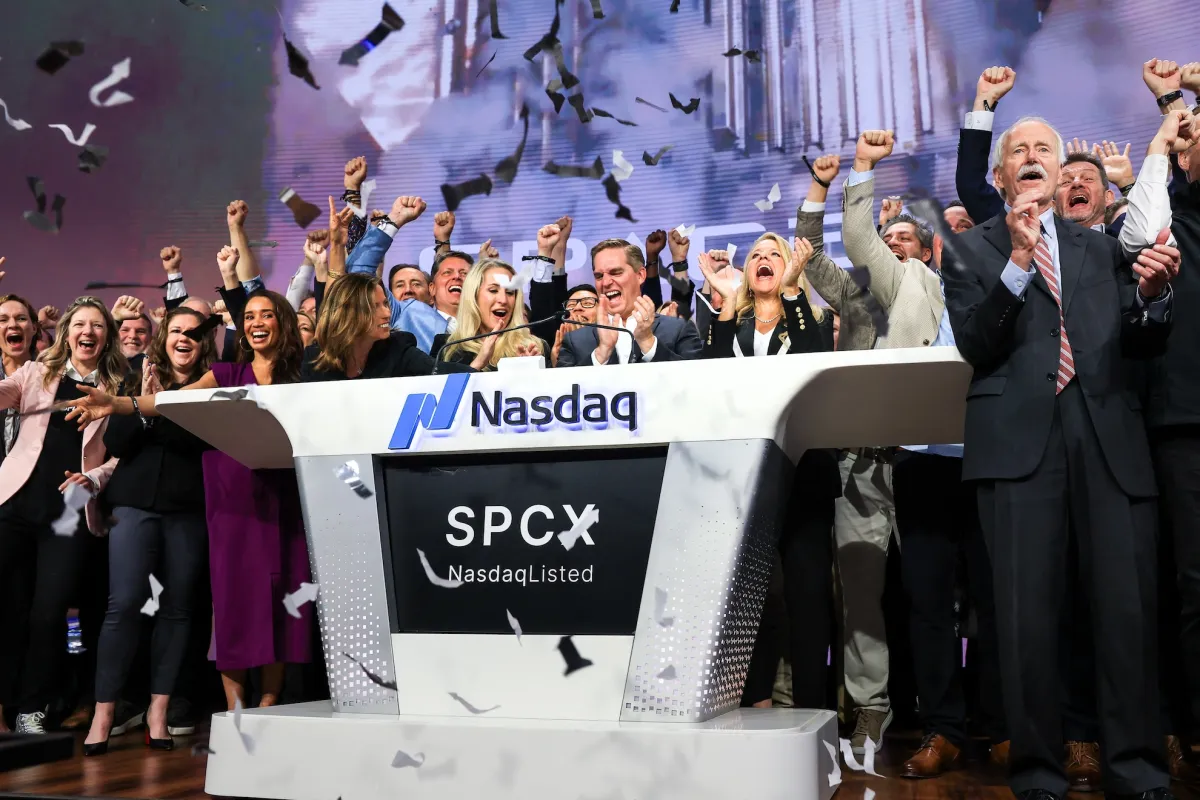
The public markets may be entering a new phase of tech exuberance, and the first big signal is not an artificial intelligence lab at all. SpaceX’s blockbuster debut this week has redrawn the map for investors, founders and competitors alike, setting off speculation that OpenAI and Anthropic could be next in line as private-market giants test the waters for a public listing.
On the latest episode of TechCrunch’s Equity podcast, hosts Kirsten Korosec, Sean O’Kane and Anthony Ha unpacked what they see as a broader shift: a market that once revolved around consumer internet platforms now appears to be tilting toward AI labs, frontier compute and other deeply capital-intensive businesses. The immediate headlines may center on Elon Musk’s new position at the top of the wealth rankings, but the more consequential story could be the ripple effect SpaceX is having on the rest of the startup economy.
From speculative space infrastructure plays to auto companies repurposing battery capacity for data centers, investors and founders are increasingly trying to build businesses around the same force that helped propel SpaceX to the public markets. The result, the panel argued, is a high-stakes test of whether the next generation of giant private companies can survive the scrutiny, constraints and incentives of public ownership.
The IPO moment Silicon Valley has been waiting for
For years, observers have wondered when the long freeze in tech listings would thaw. The pandemic-era boom, the collapse in valuations that followed and the rise of private mega-rounds kept many companies away from Wall Street. But the SpaceX offering has changed the tone. Its scale, valuation and sheer market impact have made it clear that investors are once again willing to underwrite huge bets on dominant tech platforms.
In the view of the Equity hosts, the significance of SpaceX’s debut is not limited to one company or even one founder. It could mark the start of a broader reordering in which the public markets become more comfortable funding companies built around long development cycles, expensive infrastructure and massive compute requirements.
Korosec framed the shift as a change in the composition of tech’s most influential public names. The old shorthand of FAANG — Facebook, Amazon, Apple, Netflix and Google — is no longer enough to describe where the market’s attention and capital are flowing.
Kirsten Korosec said the center of gravity has moved away from the old consumer-tech playbook and toward AI labs, deep-tech infrastructure and other businesses with unusually large capital needs.
That shift matters because it changes what public investors are being asked to fund. Instead of ad-driven social networks or subscription entertainment, the new wave of listings could include companies that burn through extraordinary sums in pursuit of breakthroughs in model development, orbital infrastructure, energy systems and robotics-adjacent applications.
From FAANG to MANGOS: what changed
One of the more striking frames discussed on the podcast was a reinterpretation of tech’s elite club. The original FAANG era captured the rise of consumer internet giants whose businesses scaled quickly and profitably. But today’s market leaders are increasingly a mix of entrenched platforms and frontier technology companies.
Korosec pointed to a revised acronym that better reflects today’s power centers: Meta, Anthropic, NVIDIA, Google, OpenAI and SpaceX. Whether or not that exact lineup sticks, the underlying point is clear. The market’s attention has rotated toward companies that sit at the intersection of AI, infrastructure and long-horizon technological bets.
This matters for several reasons:
- AI labs are now among the most watched private companies in the world.
- Frontier computing and model training require enormous capital expenditures.
- Public markets appear more willing to back “story stocks” tied to future infrastructure.
- Startups in adjacent sectors are raising money off the success of these category leaders.
Netflix, once a signature member of FAANG, is effectively out of the frame. In its place are companies whose business models are either deeply tied to AI development or reliant on the physical infrastructure that makes AI possible.
The editorial takeaway is not just that the acronym has changed. It is that the capital markets themselves are repricing what kind of innovation deserves scale, patience and public backing.
Why OpenAI and Anthropic are suddenly part of the IPO conversation
SpaceX’s public debut has raised a natural question: if one highly prized private company can make it through the gate, who follows? On the podcast, the conversation quickly turned to OpenAI and Anthropic, which have both been the subject of mounting speculation about possible public offerings.
Neither company has fully answered when or how it would go public, but the mere fact that they are being discussed in the same breath as SpaceX speaks volumes. The AI sector has moved beyond experimental hype and into the realm of capital-market strategy. Investors are now thinking not just about product launches and model releases, but also about listing order, valuation ceilings and the timing of a possible market reset.
Ha noted that there is a competitive dimension to this race. If more than one major AI company is headed toward the public markets, timing could become an advantage in its own right. The first company to list may secure a premium valuation, more investor enthusiasm and a stronger narrative. The second may face tougher comparisons and a more skeptical market.
Anthony Ha and his colleagues said the push to go public is increasingly a contest over timing, with some analysts believing there may be only so much investor appetite before valuations begin to cool.
That pressure could shape corporate strategy in subtle ways. Pricing decisions, product messaging, expansion plans and even governance structures may all be influenced by the desire to reach markets before sentiment changes.
How SpaceX is influencing the rest of the startup ecosystem
The most intriguing consequence of the SpaceX IPO, the panel argued, may not be what it says about SpaceX itself. It may be what it encourages other companies to do.
Korosec described a ripple effect across startups chasing ideas that have gained credibility because of SpaceX’s success. If investors now believe orbital data centers, space-based communications or other space-infrastructure projects are more plausible, money will follow. Companies that once struggled to attract attention can now pitch themselves as beneficiaries of a newly validated category.
That dynamic is already visible in companies trying to ride the momentum. Some are using special purpose acquisition companies to reach markets faster. Others are positioning themselves as suppliers, enablers or adjacent bets in an emerging orbital economy.
The pattern is not new. Venture markets have always rewarded narrative spillover from category leaders. But the panel suggested that SpaceX’s effect may be unusually powerful because it combines several things at once: enormous brand recognition, a founder with unmatched market influence and a business model that stretches across space launch, communications and AI-adjacent infrastructure.
The rise of orbital data centers and related bets
One area drawing fresh interest is the idea of data centers in orbit, a concept that once sounded like science fiction but is increasingly being packaged as a serious investment theme. The logic is straightforward: if AI demands more compute, and if terrestrial power, cooling and land constraints tighten, then space starts to look like a possible long-term extension of the data-center stack.
Whether those projects ever become commercially viable remains an open question. But investors do not need immediate profitability to fund them. They only need a credible pathway to future relevance. SpaceX, by demonstrating that a private company can dominate a once-ridiculed category and still command public-market enthusiasm, has made that easier.
The result is a market environment where companies can raise money against a future that is still highly uncertain. Some of these businesses may never go public. Others may never reach scale. Yet they are able to attract capital because they sit inside the same broader story of AI infrastructure expansion and space-enabled computing.
The AI economy is already changing the real economy
One of the more important themes in the discussion was that AI’s influence is no longer limited to software companies. The technology is reshaping industrial planning, energy use and capital allocation in ways that are visible well beyond Silicon Valley.
O’Kane pointed to automakers, including Ford and General Motors, as examples of legacy companies adjusting to the new reality. Instead of simply building vehicles, these companies are looking for ways to monetize unused battery production and storage capacity by serving data centers and energy-hungry infrastructure.
That shift reflects a bigger truth: AI’s rise is not just creating a software boom. It is increasing demand for power, storage, logistics, chips, cooling systems and physical real estate. Companies that can provide those inputs are suddenly part of the AI value chain whether they started there or not.
Sean O’Kane said the economy is already being reshaped by the rush to build AI, even before the long-term winners and losers are known.
The immediate reaction from markets can be revealing. According to the podcast discussion, Ford’s stock moved higher after it disclosed a relatively modest energy-storage effort, underscoring how intensely investors are searching for exposure to the AI buildout. That reaction suggests that even incremental bets on infrastructure can be enough to re-rate a company if the AI narrative is strong enough.
Legacy industry meets frontier demand
That dynamic is especially important because it broadens the impact of AI beyond the handful of companies building foundation models. It brings in utilities, manufacturers, hardware suppliers and transportation firms. The AI boom is therefore not simply a story about chatbots or software subscriptions. It is a capital reallocation event with consequences for industrial policy, electricity demand and supply chains.
There is also a cautionary note embedded in that enthusiasm. History suggests that not every company that pivots toward the hottest trend succeeds. The panel noted that automakers have spent years trying to mimic Tesla-like strategies, often with mixed results. As with many boom cycles, the temptation to chase the narrative can be stronger than the discipline needed to build a durable business.
The strategic risk of copying the winners
Another throughline in the discussion was the danger of imitation. When one company becomes a model for everything from capital structure to product design, the rest of the market often follows too eagerly.
Korosec argued that the drive to copy the playbook of companies like SpaceX and Tesla can lead industry leaders astray. The example is instructive: many automakers have spent years trying to find their own “Tesla killer” or replicate Elon Musk’s cross-sector strategy, only to discover that the original formula is difficult to transplant.
The same risk applies to AI companies. If OpenAI, Anthropic or other large labs try to mirror SpaceX’s public-market approach without adapting to their own economics, governance needs and competitive dynamics, they may find the fit awkward. Public investors will not necessarily reward a borrowed identity unless the underlying business supports it.
In practical terms, that means the AI IPOs ahead may have to decide what kind of companies they want to be:
- Consumer-facing AI product companies with broad user adoption.
- Infrastructure and model-building platforms with huge R&D budgets.
- Hybrid companies that balance software revenue with long-term research spending.
- Public-market stories designed to reassure investors about eventual profitability.
Each path comes with trade-offs. And the more closely these firms resemble SpaceX in narrative terms, the more they may be expected to defend equally ambitious spending and governance choices.
What public markets can absorb — and what they cannot
A central concern running through the discussion is whether the public markets have enough appetite to absorb multiple giant offerings at once. There is only so much capital to go around, and investor enthusiasm does not rise forever.
That scarcity creates an obvious tension. If SpaceX takes the lead and commands an outsized share of attention and money, what happens to the next wave of companies? Could OpenAI and Anthropic face more modest valuations if they wait too long? Would they be better off listing while enthusiasm is high, even if that means accepting imperfect conditions?
These are not trivial questions. The IPO window is often less about whether a company is ready in an operational sense and more about whether the market is ready to pay the desired price. That is especially true in sectors like AI, where revenue growth, compute costs and long-term margins are still being worked out in real time.
For public investors, the challenge is equally acute. They are being asked to price companies whose future scale may be enormous but whose present economics remain uncertain. That makes the current environment ripe for both opportunity and disappointment.
Key takeaways from the current IPO cycle
The emerging picture is one of a market in transition. The SpaceX debut may become the landmark event that normalizes a new generation of giant public listings from companies previously thought too experimental, too expensive or too founder-controlled for Wall Street.
Here are the major takeaways from the current moment:
- SpaceX has become a benchmark for scale, control and investor appetite.
- OpenAI and Anthropic are now being assessed partly through the lens of IPO timing.
- AI infrastructure is reshaping adjacent sectors, including energy and manufacturing.
- Startups in space and orbital computing are benefiting from narrative spillover.
- Public markets appear more open to frontier-tech bets than they have been in years.
The broader implication is that the IPO market is no longer just reopening. It is evolving. The companies preparing to go public are not simply older versions of the SaaS startups that dominated the last decade. They are often more capital-intensive, more politically sensitive and more dependent on long-term infrastructure than the public markets have recently been asked to support.
A market defined by storytelling, capital and control
Part of what makes the current wave so compelling is that it combines all the elements Silicon Valley likes to debate: valuation, control, mission and narrative.
SpaceX has already forced investors to think differently about what a public company can look like when a founder wields extraordinary influence. If OpenAI or Anthropic move toward the public markets, they may have to answer similar questions about governance, structure and long-term strategy.
At the same time, the market is being flooded with adjacent stories. Companies that provide energy storage, data-center power, orbital hardware or space-enabled communications can now anchor their pitches in a much larger and more credible ecosystem. That gives them a capital-raising advantage, even if their own businesses are still early.
What emerges is a feedback loop: successful frontier companies create belief, belief attracts capital, and capital then funds more frontier companies. The cycle can produce major breakthroughs — but it can also fuel overexcitement and misallocation.
What to watch next
The next few months could be decisive in determining whether this becomes a lasting reorientation of public markets or just a particularly intense summer of headlines. Several developments will be worth watching closely.
1. Filing timelines
Any formal movement by OpenAI or Anthropic toward public disclosure will be taken as a sign that the window is really opening. Even preliminary steps could reshape expectations across the sector.
2. Investor reception
The market’s response to SpaceX will likely influence how much risk other companies can take with their own listings. Strong performance could encourage more ambitious IPOs. Weak performance could cool the mood quickly.
3. Secondary effects
Watch for more companies pitching AI-adjacent infrastructure, from energy storage and chips to orbital systems and cooling hardware. The more these companies can connect themselves to the AI buildout, the easier it may be to raise capital.
4. Governance questions
If the next crop of public companies tries to preserve founder control while scaling huge operations, investors will need to decide how much concentration of power they are willing to tolerate.
| Company / Category | Why it matters | Potential market impact |
|---|---|---|
| SpaceX | First major signal of the new IPO cycle | Could set the valuation and governance template for frontier tech listings |
| OpenAI | Leading AI lab under public-market speculation | May face pressure to list before sentiment cools |
| Anthropic | Another highly valued AI lab watching the same window | Could compete on timing and investor narrative |
| Ford / GM | Legacy manufacturers pivoting into energy storage for data centers | Shows how AI demand is affecting industrial sectors |
| Orbital data-center startups | Speculative bets riding SpaceX’s momentum | Could attract capital even before commercial viability is proven |
Bottom line
SpaceX’s public-market debut is more than a headline-grabbing event tied to Elon Musk’s wealth. It may be the opening act in a broader shift that brings AI labs, deep-tech infrastructure and frontier industrial bets into the center of public-market attention.
If the current wave continues, the next era of major tech listings may look less like the consumer internet boom and more like a capital-intensive contest over compute, energy, space and control. Whether that produces sustainable businesses or another cycle of hype will depend on how these companies navigate the transition from private ambition to public scrutiny.
For now, one thing is clear: the IPO market is back on the front page, and it is being rewritten by the companies that are trying to build the future before Wall Street fully understands it.