Updated July 12, 2026 3:49 pm
In short
Community resistance to AI data centers is forcing project delays and political blowback, and the fight is now reaching Congress and state legislatures as lawmakers consider new limits on costs, water use and grid impacts.
- Community resistance is delaying or stopping major AI data center projects.
- Residents are worried about utility bills, water use, noise, and pollution.
- States are passing new rules while Congress debates broader protections.
- Several billion-dollar projects have already been scaled back or blocked.
- The Apple Ireland fight helped preview today’s data center backlash.
Update — July 12, 2026 3:49 pm
The newer source adds that the backlash is now spilling into national politics. Several federal proposals are on the table, including a Democratic bill that would pause new AI data center construction until utility-price and environmental safeguards are in place.
It also says some Republicans are starting to soften their support for the buildout ahead of the midterms, while a separate bipartisan effort would require tech companies to cover their own power costs. Another proposal would push data centers onto energy sources apart from the main grid.
At the state level, the source says lawmakers have already enacted 28 AI data center laws, with examples including Florida limiting cost pass-throughs, Idaho tightening water rules, and Washington ending a tax break.
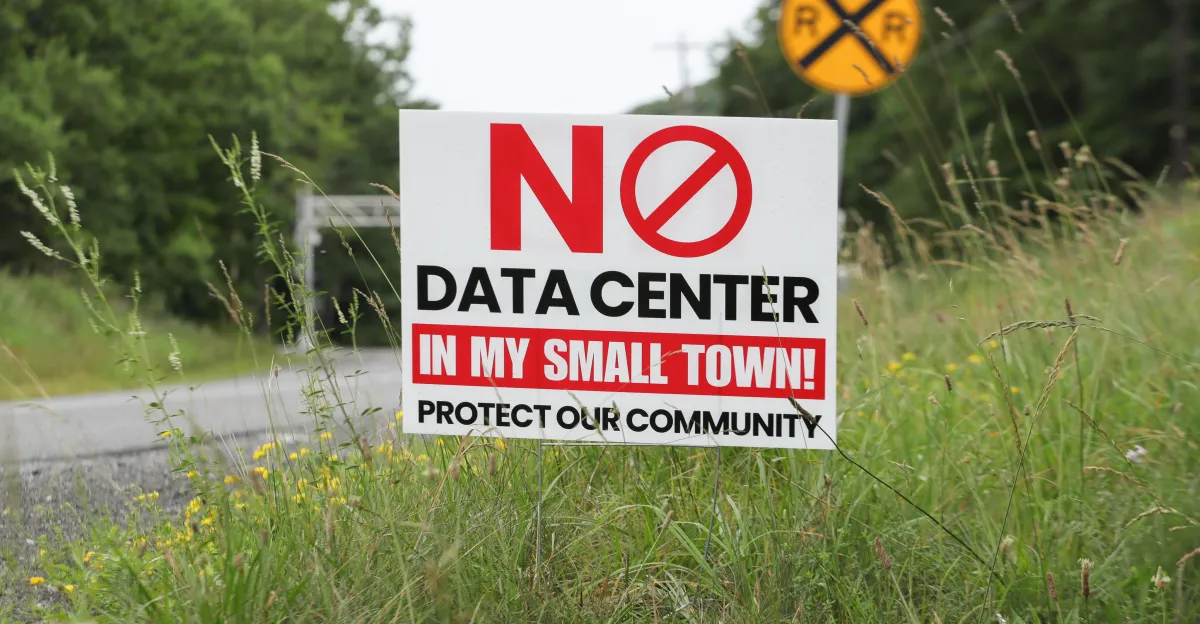
Resistance to AI data centers is spreading fast, and it is starting to change where and how companies build the massive facilities that power artificial intelligence. From Ireland to dozens of U.S. states, residents, regulators, and lawmakers are pushing back over electricity bills, water use, pollution, and land impacts.
The backlash matters because AI infrastructure is no longer a niche planning issue: it is becoming a central fight over power grids, environmental costs, and who gets to bear the burden of the AI economy.
What was once an abstract debate about digital infrastructure has become a local political crisis. Communities that expected promises of jobs and tax revenue are instead asking whether the next generation of hyperscale data centers will raise utility prices, strain water systems, and reshape neighborhoods without adequate oversight.
How the fight against data centers began
The modern opposition movement did not start with generative AI, but with an earlier clash over cloud-era infrastructure in Ireland. In 2015, Apple unveiled plans for a roughly $1 billion data center in Athenry, a rural town that was suddenly asked to host a sprawling campus intended to support Apple services across Europe.
Apple marketed the project as a community-friendly development. The company said the site would include outdoor education space, walking paths, and native tree replanting. It also said the facility would run on renewable energy. On paper, the plan looked like a model for responsible corporate siting.
Local residents saw the risks differently. Their objections centered on possible noise, glare, flooding, traffic, and ecological disruption. Those concerns were enough to push the project into a years-long legal and political fight that became an early blueprint for today’s data center resistance.
Why Apple’s Ireland project became a warning sign
Apple’s Athenry proposal showed that even a wealthy, globally trusted tech company can run into deep local resistance when a data center is large enough to alter the landscape. Planning approval did not end the dispute. Appeals, a court challenge, and the threat of a further Supreme Court battle kept the project in limbo until Apple abandoned the plan in 2018.
That experience now looks prescient. At the time, many policymakers still treated data centers as mostly invisible support infrastructure. Today, the same kind of facilities are seen as major industrial developments with real physical consequences.
Residents in Athenry did not stop the project with one protest or one vote; they used planning objections, court challenges, and sustained pressure until Apple walked away.
The lesson was simple: if communities are organized enough, even a trillion-dollar company can be forced to retreat.
Why AI data centers are drawing new scrutiny in 2026
AI has changed the scale of the data center conversation. The facilities needed to train and serve large models consume far more electricity than the standard cloud centers that came before them. Some are being compared to entire cities in size and to whole states in energy use.
That has turned an already controversial industry into a flash point for utility regulators, environmental groups, and homeowners who live near proposed sites. In many places, the question is no longer whether a data center will be built, but who will pay for the transmission lines, water systems, substations, and additional generation needed to support it.
The U.S. Energy Information Administration has projected that commercial electricity demand will surpass residential use for the first time this year, driven in large part by data center construction and AI workloads. It expects that demand to double again by 2027.
For communities already dealing with expensive utility bills and aging infrastructure, those forecasts have intensified suspicion that the public will subsidize private AI growth.
What residents say is happening on the ground
People living near proposed and existing facilities have raised a familiar set of complaints, but now at a larger scale. Common concerns include:
- higher electricity costs for nearby households and businesses
- pressure on water supplies and concerns about water quality
- noise from cooling equipment and backup generators
- light pollution from round-the-clock industrial lighting
- greenhouse gas emissions tied to power demand
- loss of farmland, habitat, or open land to mega-campuses
In many towns, the debate is also about trust. Residents say they are often told the projects will bring investment and jobs, yet they fear the costs will be borne locally while the benefits flow elsewhere.
How big is the pushback?
The opposition is no longer isolated or symbolic. A growing number of local campaigns are delaying, downsizing, or blocking projects outright, and the scope of the resistance has widened quickly in just a few months.
According to Data Center Watch, a research project backed by the AI security company 10a Labs, activists and residents blocked or delayed at least 75 U.S. projects worth a combined $130 billion from January through March. The same research says the number of active opposition groups more than doubled during that period.
The study reported a jump from 396 active opposition groups at the end of 2025 to 833 by the end of the first quarter of 2026, spanning 49 states. It also said more than 235,000 petition signatures were gathered in the quarter.
Those figures suggest the issue has moved far beyond a few high-profile protests. It is becoming a nationwide organizing effort.
| Key development | Location | What happened | Why it matters |
|---|---|---|---|
| Apple campus fight | Athenry, Ireland | Project delayed by objections and legal challenges before Apple withdrew | Early example of local resistance halting a major tech buildout |
| QTS campus proposal | DeForest, Wisconsin | Blackstone-owned QTS dropped a $12 billion plan after protests | Shows community pressure can alter corporate investment decisions |
| Coastal Zone challenge | Delaware City, Delaware | Regulators found the plan conflicted with state law | Illustrates how environmental and land-use rules can block projects |
| Digital Gateway opposition | Prince William County, Virginia | Opponents helped stop a large QTS-backed proposal | Signals growing pushback even in data-center-heavy regions |
| Project Stratos pressure | Box Elder County, Utah | Residents pushed investor Kevin O’Leary to scale back plans | Shows that even proposed mega-campuses face organized scrutiny |
Which projects have already been delayed or scaled back?
Several large proposals have run into local resistance in 2026, and the list keeps growing. Some plans have been dropped entirely, while others have been narrowed after pushback from residents and regulators.
What happened in Wisconsin, Delaware, Virginia, and Utah?
In Wisconsin, QTS abandoned plans for a $12 billion campus in DeForest after community protests. In Delaware, a proposed 580-acre data center campus in Delaware City encountered a major regulatory barrier when officials determined that state coastal zoning rules prohibit the facility type in that area.
In Virginia, opponents helped derail QTS’s “Digital Gateway” proposal in Prince William County. That project would have spread across about 2,000 acres in a state already grappling with rising energy costs linked to data center expansion.
In Utah, residents also forced a conversation about scale. Kevin O’Leary’s proposed Project Stratos campus, originally described as a 40,000-acre build, came under public pressure to shrink.
Each case is different, but the pattern is the same: local communities are becoming more organized, more skeptical, and more willing to use legal, planning, and political tools to slow development.
What is driving the political response?
The political response is driven by a clash between national AI strategy and local consumer protection. Federal leaders want the United States to outbuild China in AI infrastructure, but many voters are asking whether that race should come at the expense of their water, power, and air quality.
President Donald Trump has treated data centers as a strategic priority and signed an executive order last year aimed at speeding construction. That position aligns with a broader effort to expand U.S. AI compute capacity as quickly as possible.
But the politics are beginning to split. With midterm elections approaching, some Republican candidates are trying to distance themselves from the most data-center-friendly positions in order to avoid voter anger over utility prices and industrial siting.
On the Democratic side, Sen. Bernie Sanders and Rep. Alexandria Ocasio-Cortez have introduced legislation that would pause new AI data center construction until Congress enacts protections against higher electricity prices and environmental harm.
Supporters of a pause argue that the public should not approve a new industrial boom without clear rules ensuring that residents are not left paying the bill.
What Congress is debating
Several competing approaches are moving through federal politics:
- a proposed pause on new AI data centers until stronger consumer and environmental guardrails are adopted
- the Ratepayer Protection Act, which would formalize agreements that large tech firms pay their own energy costs
- the GRID Act, which would require data centers to rely on energy sources separate from the public grid
These proposals reflect very different theories of responsibility. One approach seeks to stop the buildout until the risks are controlled. Another allows the industry to grow, but shifts more of the costs to the companies themselves. A third attempts to shield regular utility customers by separating data center demand from household power supplies.
None of them has yet solved the core issue: AI infrastructure is expanding faster than public policy.
How states are responding
State lawmakers have not waited for Congress. A patchwork of regulations is emerging, and both red and blue states are experimenting with rules that try to limit the fallout from the boom.
Tech Policy Press has reported that 28 state laws tied to AI data centers have already been enacted. Those laws vary, but many focus on the same handful of issues: utility pricing, water use, tax treatment, and local reporting requirements.
- Florida has adopted rules aimed at stopping companies from shifting power costs to residents.
- Idaho has moved to restrict water use tied to AI data centers.
- Washington state eliminated a tax incentive for operators of these facilities.
That patchwork matters because it shows the fight is now happening at every level of government. In some places, officials are trying to welcome investment while limiting harm. In others, they are using zoning and environmental rules to slow the industry down altogether.
How much bigger could the problem get?
The challenge is likely to grow because the most ambitious AI buildouts are still ahead. Large projects continue to surface in regions attractive to developers because of cheap land, access to power, or political support for industrial expansion.
Among the most closely watched proposals are Meta’s $27 billion Hyperion project in Louisiana, Google’s $10 billion Project Mica in Missouri, SpaceXAI’s $20 billion campus in Mississippi, and the $500 billion Stargate buildout planned across the United States.
Even the names of these projects signal scale. They are not ordinary server farms; they are industrial estates measured in billions of dollars, thousands of acres, and enormous power commitments.
That scale is part of why opposition is broadening. A single neighborhood dispute can now become a statewide question about utility capacity, tax policy, and industrial planning.
Why local resistance may matter more than ever
Local resistance matters because it is often the only force capable of slowing projects before they are approved. Once land is acquired, permits are issued, and utility upgrades are underway, stopping a campus becomes far harder.
Residents have learned that the planning process is not merely bureaucratic. It is where industrial development can still be shaped, delayed, or rejected. In many communities, the fight is no longer about saying no to AI altogether. It is about forcing companies to justify their projects in public and absorb a fair share of the costs.
This also explains why the Apple case in Ireland still resonates nearly a decade later. Two activists, using legal channels and public pressure, were able to delay one of the world’s biggest tech companies long enough to make the project uneconomical.
That experience has become a template for communities facing AI-era campuses that are larger, more power-hungry, and potentially more disruptive than the facilities that came before them.
What happens next?
The next phase of the conflict will likely unfold on three fronts: in local zoning hearings, in statehouses, and in Congress. Community groups are expected to keep challenging projects one by one, while lawmakers test whether they can write rules fast enough to keep up with the industry.
At the same time, tech companies will keep arguing that the United States needs more data center capacity to remain competitive in AI. That argument is likely to carry weight in Washington, where national security and economic competition remain powerful talking points.
But in town halls and county planning meetings, the conversation sounds different. Residents want to know whether the benefits are real, whether the utilities can handle the load, and whether their communities will be left with the noise, the costs, and the pollution.
The central lesson of 2026 is that the AI data center boom is no longer just an infrastructure story. It is a political story, a land-use story, and an environmental justice story all at once.
And unlike the early days of cloud computing, the public is now paying close attention.
Timeline of the data center backlash
| Year | Event | Significance |
|---|---|---|
| 2015 | Apple proposes a data center in Athenry, Ireland | Early sign that residents may contest large tech campuses |
| 2016 | Irish planning board approves the site | Legal victory does not end local opposition |
| 2017 | High Court sides with Apple | Appeals keep the project in uncertainty |
| 2018 | Apple abandons the plan | One of the first major data center retreats driven by community resistance |
| 2025-2026 | AI data center opposition spreads across the U.S. | Local resistance becomes a national movement |
| 2026 | States and Congress weigh new rules | Policy fight shifts from local hearings to federal legislation |
For now, the message from communities is consistent: AI may need more data centers, but not every town is willing to host one without a fight.
As the industry races to expand, residents, regulators, and lawmakers are increasingly asking a blunt question that companies can no longer ignore: who should pay for the infrastructure of artificial intelligence?
Frequently asked questions
Why are communities fighting AI data centers?
Communities are fighting AI data centers because they fear the projects will raise electricity bills, strain water supplies, create noise and light pollution, and damage local environments. Many residents also worry that they will bear the costs while large tech companies capture the benefits.
How much opposition is the AI data center industry facing?
The industry is facing significant and growing opposition. A Data Center Watch study said at least 75 projects worth $130 billion were blocked or delayed in the first quarter of 2026, while active opposition groups more than doubled to 833 across 49 states.
What laws are being considered to regulate AI data centers?
Lawmakers are considering several approaches. Some proposals would pause new AI data centers until protections are in place, while others would require companies to pay their own energy costs or separate their power use from the public grid to protect ratepayers.
Which states have already acted on data center rules?
Several states have already moved. Florida adopted rules to prevent costs from being passed to residents, Idaho restricted water use, and Washington removed a tax break for operators. Tech Policy Press says 28 state laws related to AI data centers have been enacted so far.
Did local protests ever stop a major tech data center before the AI boom?
Yes. Apple abandoned a planned data center in Athenry, Ireland, after years of objections, legal challenges, and appeals. That case has become an important early example of how sustained community resistance can derail a large tech infrastructure project.