In short
OpenAI announced new CSAM safety tools for ChatGPT, developers and law enforcement on 2026-11-16. The package includes an image classifier, user warnings, reporting guidance and investigator tools.
- OpenAI launched a CSAM image classifier, ChatGPT warning screens and law-enforcement support.
- The classifier is offered to select companies through the OpenAI API at no cost.
- OpenAI says early testing cut flagged images by 48% while finding the same number of abusive images.
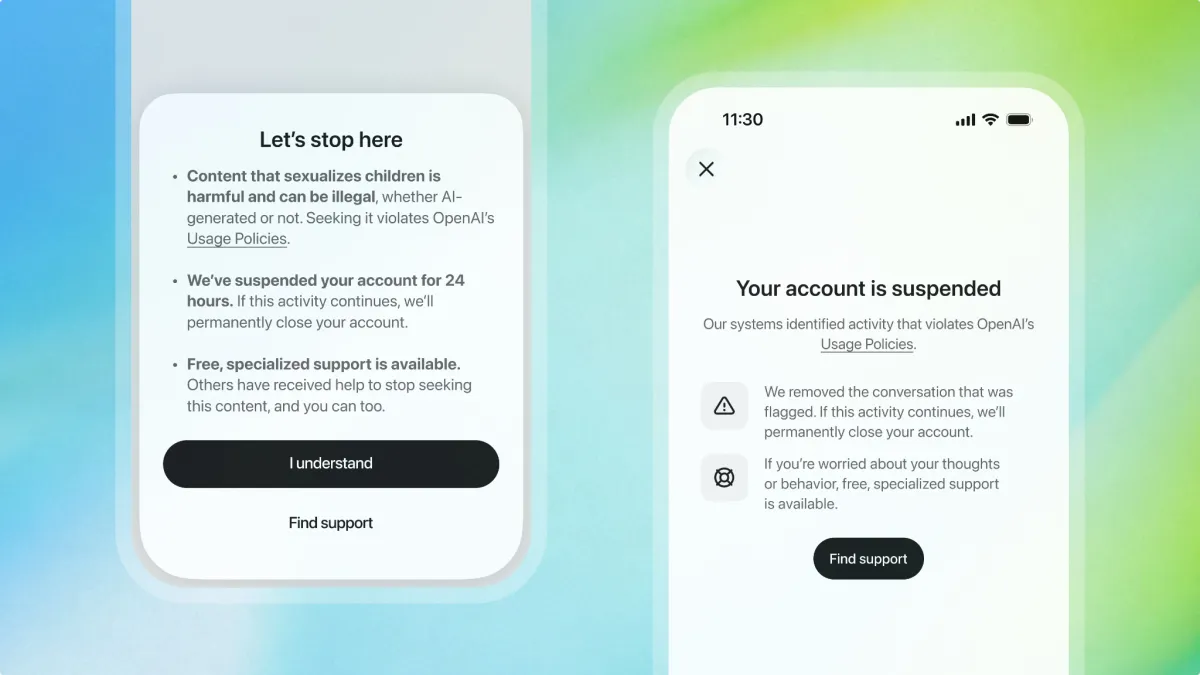
- ChatGPT now issues warnings for prompts that could sexualize children and can suspend accounts for 24 hours.
- TechTimes Vietnam framed the rollout as part of broader scrutiny over AI safety and child-exploitation risks.
OpenAI on 2026-11-16 unveiled a new set of child-safety tools for ChatGPT, its developer products, and law-enforcement users, adding an image classifier, prompt warning screens, and support for investigators as the company tries to curb child sexual abuse material, or CSAM. The rollout matters because OpenAI is betting that stronger detection and reporting tools can reduce harmful content without overwhelming human reviewers or missing abuse.
What OpenAI announced
The company’s package combines product changes, developer guidance, and investigator tooling. According to TechCrunch, OpenAI introduced a classifier that can detect CSAM, including AI-generated images, and is giving selected companies access to it through the OpenAI API at no cost.
The classifier is designed to score previously unseen images by looking for visual abuse signals, then help human reviewers decide what to do next. OpenAI says early testing showed the system cut the number of flagged images by 48% while still finding the same number of abusive images. In that testing, flagged images were also twice as likely to be abusive, which suggests the filter may help reviewers spend time where it is most needed.
OpenAI said it built the classifier with the National Center for Missing and Exploited Children, or NCMEC, and is sharing access more broadly with Tech Coalition and ROOST. The company also published developer guidelines focused on how to prevent, detect and report CSAM, part of an effort to push safer handling of abuse-related content across its platform and third-party products.
How ChatGPT will change for users
ChatGPT users will now encounter warning screens if prompts appear to sexualize children. Those prompts point users toward specialized support, and they can trigger a 24-hour account suspension. Repeated violations can lead to permanent account removal.
That escalation path shows OpenAI trying to intervene before harmful behavior becomes repeated misuse. It also reflects a shift from relying mainly on downstream moderation to using visible friction at the moment a user attempts to generate disallowed content.
"OpenAI says it made several safety changes in the past 12 months, including a safety blueprint, content-guideline updates, model retuning, and a teen version of ChatGPT"
Why it matters
This rollout is significant for three reasons. First, it addresses one of the most serious categories of online abuse: CSAM, which has long required specialist detection and reporting systems. Second, it gives a potential blueprint for how AI companies can build moderation tools that work across chat, image generation, and developer ecosystems. Third, it could reduce the burden on human reviewers by improving precision, a major issue when moderation teams are overwhelmed by large volumes of flagged material.
The stakes are high because AI image generators and chatbots have faced criticism for making it easier to produce sexualized abuse imagery involving minors. A tool that helps identify harmful material more accurately could become a reference point for the rest of the industry, especially if it proves useful beyond OpenAI’s own products.
TechTimes Vietnam framed the announcement as part of broader scrutiny of AI safety and child-exploitation risks. That framing matters: OpenAI is not releasing this in a vacuum, but under increasing pressure from regulators, advocacy groups and critics who argue that AI platforms need clearer guardrails.
Background: how we got here
CSAM is the shorthand for child sexual abuse material, a category that carries both legal and moral urgency. The National Center for Missing and Exploited Children is one of the best-known U.S. clearinghouses for reports involving missing children and exploitation. Its involvement signals that OpenAI is tying its new tools to existing reporting and enforcement channels rather than treating the issue as a purely internal moderation problem.
OpenAI’s move also fits a wider pattern across the AI sector. Developer guidelines and moderation tools have become common ways to reduce harmful content creation and close reporting gaps. But the pressure on AI firms has grown as their systems become capable of generating increasingly realistic images and text, including material that can be used to sexualize minors or facilitate abuse.
The company has also faced lawsuits over alleged harms from its technology, especially involving children. Common Sense Media called OpenAI’s tech an “unacceptable risk” for teens, underscoring the reputational and legal stakes around youth safety. OpenAI says it has already made several safety changes over the past year, including a safety blueprint, content-guideline updates, model retuning and a teen version of ChatGPT.
How the new classifier works
The most technical piece of the announcement is the image classifier. OpenAI says it evaluates previously unseen images using visual abuse signals and produces a score that can help determine whether human moderators should take a closer look. That design is important because CSAM moderation is rarely just about automation; it is about making review more efficient without letting harmful content slip through.
Below is a simplified summary of the rollout based on OpenAI’s announcement and the reporting from TechCrunch:
| Tool | What it does | Who gets it | Notable detail |
|---|---|---|---|
| Image classifier | Scores images for abuse signals | Select companies via API | Free access for selected partners |
| ChatGPT warnings | Flags sexualized-child prompts | ChatGPT users | Can trigger a 24-hour suspension |
| Developer guidelines | Helps prevent, detect, report CSAM | Developers | Some early users adopted child-safety tooling |
| Law-enforcement tools | Supports investigations and analysis | Investigators | Includes dedicated plugins and field guidance |
OpenAI also says the classifier access is being shared with Tech Coalition and ROOST, suggesting the company wants external groups to help widen adoption and shape how the tool is used. That could matter if the goal is not just to build one better model, but to influence the basic workflow for abuse detection across the AI ecosystem.
Law enforcement and investigator support
OpenAI is also offering law-enforcement tools that go beyond consumer moderation. According to TechCrunch, those include dedicated plugins, investigative tools and complex data-analysis features. The company says it is also providing investigator training and a field guide for AI use.
The guidance was developed with Protect Children, the Lucy Faithfull Foundation and Joel Scanlan. That mix suggests OpenAI is trying to ground its law-enforcement materials in specialist child-protection knowledge rather than building them in isolation.
For investigators, the promise is straightforward: better tools for sorting data, finding relevant evidence and understanding AI-related abuse patterns. The risk is equally clear: any such tools need careful governance so they help legitimate investigations without creating new privacy or accuracy problems.
What developers are being asked to do
OpenAI is not only changing its own platform. It is also trying to influence how developers build on top of it.
- Follow new guidance on preventing, detecting and reporting CSAM.
- Use the classifier where appropriate to identify suspicious images.
- Connect reporting workflows to NCMEC when abuse is detected.
- Adopt child-safety tooling earlier in the product design process.
OpenAI says early testing prompted some developers to adopt child-safety tooling and register reporting with NCMEC. If that holds up, it suggests the guidance may do more than inform policy; it may change behavior.
The company has not said how many developers have adopted the tools, and that remains one of the biggest unanswered questions. Adoption will help determine whether the announcement becomes a broader industry standard or remains a set of internal controls with limited reach.
Why it matters for the market and the region
For readers, the market and the broader region of AI development, the announcement is a test of whether safety tooling can scale in real products. If the classifier meaningfully improves precision, AI firms may be able to reduce the cost and strain of manual review. If it fails in practice, companies could face pressure to add more human oversight, slower product launches or stricter external regulation.
There is also a competitive angle. If OpenAI’s approach proves effective, rivals may feel pressure to match it with their own CSAM-detection systems, warning layers and law-enforcement processes. That would raise the baseline for platform safety, but it could also create a race around moderation infrastructure rather than model capability alone.
OpenAI’s move may also influence how trust is judged in the AI sector. Safety claims are often easy to make and hard to verify. A tool that can show fewer false positives while finding the same number of abusive images gives the company a concrete performance metric, even if independent validation is still needed.
What the numbers show
The details released so far are limited, but the metrics OpenAI highlighted are notable:
| Metric | Value | Meaning |
|---|---|---|
| Reduction in flagged images | 48% | Fewer images need review while abuse detection stays level |
| Likelihood of abuse among flagged images | 2x | Flagged content is more concentrated in abusive material |
| Temporary suspension | 24 hours | Penalty for disallowed ChatGPT prompts |
| Safety-change window | 12 months | Period over which OpenAI says it made broader safety updates |
These numbers are useful because they show the company is trying to measure moderation quality, not just announce policy. Still, the most important test will be how these tools perform outside early trials and inside high-volume real-world use.
Where the reporting differs
TechCrunch supplied the most detailed account of the tools, testing claims and enforcement steps. TechTimes Vietnam echoed the announcement and emphasized the broader context of AI safety and child exploitation risks. The two reports do not appear to disagree on the core facts, but they place different weight on the significance of the rollout: TechCrunch focused on product specifics and rollout mechanics, while TechTimes Vietnam framed the news more as part of a larger policy and safety conversation.
That difference matters because the announcement can be read in two ways. On one level, it is a product update with practical moderation features. On another, it is a signal that OpenAI sees child-safety infrastructure as central to its future, not peripheral.
What happens next
Several open questions will determine whether this becomes a meaningful shift in AI moderation or a one-off announcement.
- How broadly the classifier will be adopted beyond the initial select partners.
- Whether the new ChatGPT warnings reduce repeat offending in practice.
- How many developers register with NCMEC after using the new guidelines.
- Whether other AI companies introduce similar CSAM-detection tools.
The next phase will likely be measured less by the announcement itself than by implementation. If OpenAI can show that the classifier truly cuts review burden without missing abuse, it will have a strong case that technical safety tools can meaningfully support child-protection work. If not, the company may face renewed skepticism about whether AI safety controls are keeping pace with the harms the technology can create.
For now, the message is clear: OpenAI is trying to make CSAM detection, reporting and enforcement part of the core machinery of ChatGPT and its developer ecosystem, not an afterthought. The industry will be watching to see whether that model holds up once more developers, more users and more scrutiny are involved.
Frequently asked questions
What did OpenAI announce about CSAM safety tools?
OpenAI announced a package of CSAM safety tools for ChatGPT, developers and law enforcement on 2026-11-16. The rollout includes an image classifier, warning screens for risky prompts, developer reporting guidance and investigator support tools.
How does OpenAI’s new image classifier work?
OpenAI says the classifier scores previously unseen images using visual abuse signals so human reviewers can focus on the most suspicious material. The company says early testing reduced flagged images by 48% while still finding the same number of abusive images.
What happens if a user submits a sexualized-child prompt in ChatGPT?
ChatGPT now shows warning screens for prompts that could sexualize children. Those warnings direct users to specialized support and can trigger a 24-hour account suspension, with repeated violations potentially leading to permanent removal.
Who is OpenAI sharing the tools with?
OpenAI says it is sharing classifier access with selected companies through the OpenAI API at no cost and is also sharing access with Tech Coalition and ROOST. The company says it built the system with NCMEC.
Why does this matter for the AI industry?
The announcement could set a higher baseline for how AI companies detect, report and limit child-sexual-abuse material. If the tools work well in practice, other companies may copy the approach to reduce reviewer workload and improve safety controls.