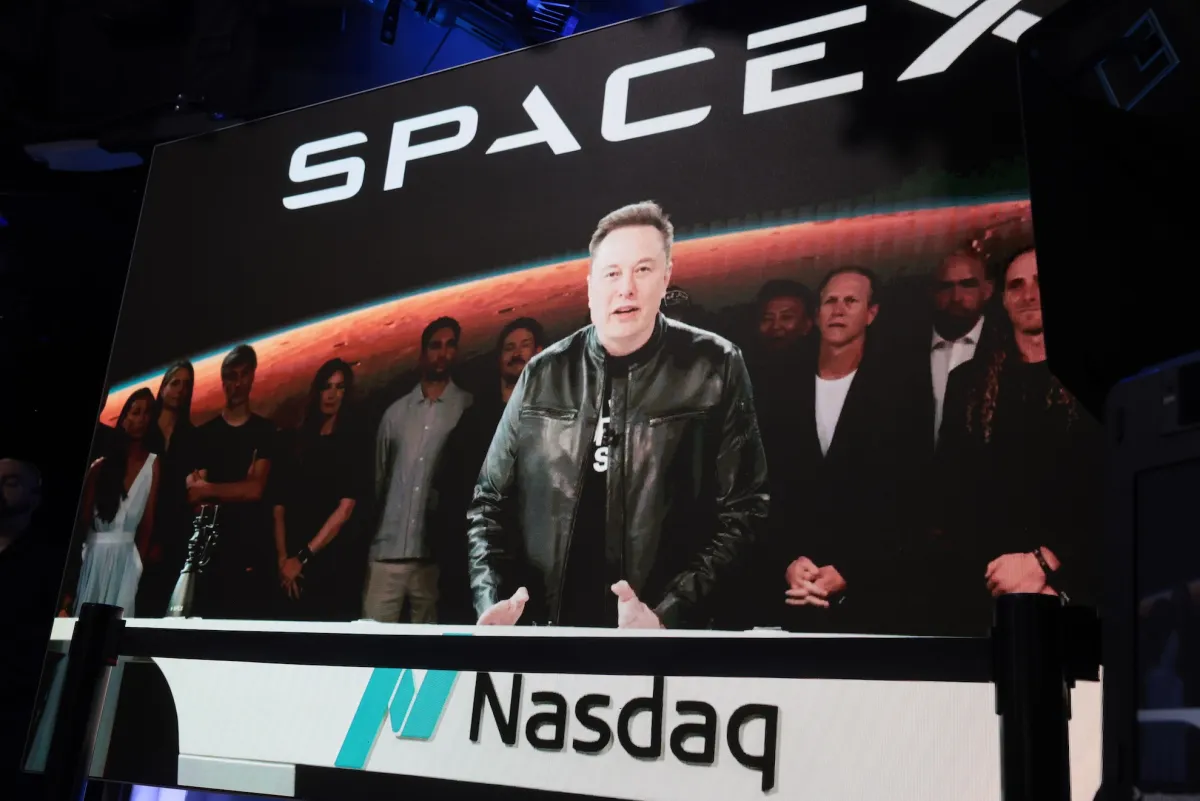
SpaceX has agreed to buy AI coding startup Cursor in a stock transaction valued at $60 billion, a deal that lands just days after the aerospace company’s historic initial public offering and cements Elon Musk’s latest effort to turn SpaceX into far more than a rocket maker.
The acquisition comes less than two months after SpaceX first disclosed a relationship with Cursor, and it arrives at a moment when Musk’s broader AI strategy is being rebuilt under pressure. For SpaceX, the move is meant to strengthen an AI division now tied to xAI, Musk’s separate AI company, which SpaceX merged with earlier this year. For Cursor, the deal offers a powerful backer at a valuation far above the price the startup was expected to fetch in its next funding round.
The transaction underscores how quickly the AI market continues to redraw corporate ambitions. What began as a narrow push into software assistance has become a central pillar of one of the world’s most ambitious private companies — and now a public one. SpaceX has pitched investors on an AI opportunity measured in the tens of trillions of dollars, a number that dwarfs even the size of most traditional tech markets.
What SpaceX is buying
Cursor, founded in 2022 under the name Anysphere, built one of the fastest-growing products in the AI coding category. The startup became known for tools that help developers write, edit and debug software with generative AI. Over the past two years, that market has expanded rapidly as companies race to automate more of the software development workflow.
The company’s rise was already dramatic before the SpaceX offer. Cursor had previously been valued around $29 billion after a wave of fundraising and product momentum. TechCrunch reported earlier this year that the startup was preparing a $2 billion financing round that would have lifted its valuation to roughly $50 billion, with investors including Andreessen Horowitz, Thrive and Nvidia.
Under the terms now announced, SpaceX will acquire Cursor in a stock deal worth $60 billion. The companies said the transaction is expected to close in the third quarter of this year.
Why a stock deal matters
A stock-based acquisition gives SpaceX flexibility at a time when its share price has surged following its market debut. Since going public last Friday, SpaceX’s stock has climbed from its IPO price of $135 to more than $200 in pre-market trading Tuesday, sharply increasing the value of the company’s equity.
That rise made the acquisition easier to justify financially. It also gives SpaceX a new way to absorb a high-growth AI company without spending cash that could otherwise go into launch operations, satellite deployment or its other capital-heavy businesses.
SpaceX has been telling investors that its AI ambitions are meant to open a market worth about $26 trillion, a figure it framed as roughly comparable to the size of the U.S. economy.
The company’s pitch to investors was sweeping. In IPO filings, SpaceX described a total addressable market around $28 trillion, with nearly all of that tied to AI. Its projections included a potential $2.4 trillion AI infrastructure business and an additional $22.7 trillion opportunity in enterprise software applications.
Why Cursor became a strategic target
Cursor’s appeal goes beyond its growth rate. AI coding tools are increasingly seen as one of the most commercially useful applications of large language models because they can deliver clear productivity gains inside a workflow used by millions of developers. The category has become a proving ground for companies trying to convert model performance into recurring revenue.
For SpaceX, buying Cursor may offer a shortcut to capability in a part of AI where product adoption is already proven. Instead of building every tool internally, SpaceX can fold an established startup into its larger software push and use that to accelerate its AI division.
Signs of interest appeared earlier in the year. xAI recruited two of Cursor’s senior engineering leaders, an early signal that the relationship between the companies was deepening. In April, Business Insider reported that xAI planned to rent some of its data center capacity to Cursor, suggesting the two sides were already exploring commercial ties before the acquisition became public.
From partnership to purchase
Those arrangements helped create a path toward the deal now being finalized. The two companies had already begun working together in ways that looked increasingly like integration, including infrastructure sharing and personnel movement. The acquisition now turns that informal alignment into ownership.
Cursor’s own fundraising plans also show how competitive the market had become. The startup was on track to raise another large round, but even that capital was not expected to be enough to make it profitable on its own, according to one source cited by TechCrunch. That assessment reflects a broader reality in AI software: rapid growth can still coexist with punishing compute costs and intense competition.
How xAI’s turmoil shaped the deal
The acquisition also lands during a turbulent period for xAI, the Elon Musk-founded AI company that sits at the center of SpaceX’s software strategy. By the end of March, all 11 of Musk’s co-founders at xAI had left the company. Musk later said publicly that the company had to be rebuilt from the ground up and acknowledged that its first version had not been constructed properly.
The restructuring followed a string of controversies tied to xAI’s Grok chatbot, including behavior that drew widespread criticism. Among the incidents reported over the past year were outputs that included a reference to “MechaHitler” and the generation of sexual deepfakes earlier this year. SpaceX told investors in its IPO documents that such behavior created business risks and legal exposure.
Those issues matter because the AI division was promoted as a centerpiece of SpaceX’s public-market story. The company’s AI effort was not presented as a side project. It was framed as one of the biggest future growth engines in the entire enterprise, making the state of xAI a direct issue for SpaceX shareholders.
Musk said xAI needed to be rebuilt “from the foundations up,” an admission that reinforced how much reorganization was underway even as SpaceX was preparing its IPO.
SpaceX’s AI pitch to investors
SpaceX’s IPO materials made clear that the company’s ambitions extend far beyond space transportation. In the filings and investor conversations around the offering, the company described AI as one of its largest future markets, along with infrastructure and enterprise applications that could run on a satellite-based compute network.
The company’s logic is straightforward: if SpaceX can control communications, transport, and eventually parts of the compute stack needed to run advanced AI systems, it may be able to participate in multiple layers of the AI economy at once. Cursor adds software distribution and developer workflow tools to that mix.
That model depends on execution. SpaceX is still a company with massive engineering, regulatory and operational demands in rockets and satellites. Adding a large AI acquisition raises the stakes because it expands the number of moving parts the company must manage while it remains under intense scrutiny from investors and regulators.
The scale of the bet
The size of the Cursor deal makes clear that SpaceX is not treating AI as a peripheral initiative. A $60 billion valuation would place Cursor among the largest private AI software transactions ever attempted, especially for a company whose core product category is only a few years old.
It also reflects Musk’s willingness to use stock as strategic currency now that SpaceX is public. If the market continues to reward the company’s IPO, SpaceX could have more flexibility to absorb software assets that might have been out of reach in a cash-only transaction.
Timeline of the deal
| Event | Approximate date | Significance |
|---|---|---|
| Cursor founded as Anysphere | 2022 | Startup begins building AI coding tools |
| Cursor joins OpenAI startup accelerator | 2024 | Early validation for the company’s product and team |
| Cursor raises major funding round | June 2025 | Company reaches roughly $29 billion valuation |
| xAI engineers join Cursor and infrastructure talks begin | Early 2026 | Signals tighter operational ties |
| SpaceX announces tie-up with Cursor | April 2026 | Partnership raises speculation about a deeper deal |
| SpaceX goes public | June 2026 | IPO creates stock currency for larger acquisitions |
| SpaceX agrees to acquire Cursor | June 2026 | Deal announced at $60 billion in stock |
| Expected closing | Q3 2026 | Transaction scheduled to be finalized if approvals proceed |
How the valuation compares
The financing environment around Cursor helps explain why SpaceX moved now. The startup’s expected $50 billion funding valuation would already have been extraordinary, but the acquisition values it even higher. That premium suggests SpaceX viewed Cursor not just as a venture-backed software business, but as a strategic asset with importance to its AI roadmap.
Below is a simplified comparison of the numbers that shaped the deal:
| Milestone | Valuation / Deal Value | Notes |
|---|---|---|
| Cursor valuation before SpaceX offer | About $29 billion | After rapid growth and late-2025 financing |
| Planned Cursor funding round | About $50 billion | Expected with backing from major investors |
| SpaceX acquisition value | $60 billion | All-stock purchase agreement |
| SpaceX IPO price | $135 per share | Initial public offering last Friday |
| SpaceX pre-market price Tuesday | Above $200 per share | Sharp post-IPO rise in trading |
What happens next
If the acquisition closes as planned, SpaceX will inherit a high-profile AI coding platform at a time when businesses are aggressively adopting developer tools powered by generative AI. The challenge will be keeping Cursor’s product momentum while integrating it into a much larger and more politically complicated organization.
There are also open questions about how much independence Cursor will retain. Startups bought by giant strategic buyers often face a trade-off: access to resources and distribution on one side, and reduced autonomy on the other. For developers who adopted Cursor because of its nimble pace and focused product design, that transition will be watched closely.
For SpaceX, the acquisition is as much about narrative as it is about technology. The company is trying to convince public investors that its future does not stop at launch pads and orbital hardware. It wants to be seen as a platform company for AI infrastructure, enterprise software and compute.
Why this deal matters for the AI market
The purchase adds to a growing list of signs that AI companies are becoming vertically integrated much faster than earlier waves of software startups. Model developers, chipmakers, cloud providers and application companies are increasingly linking up through acquisitions, infrastructure deals and talent swaps.
In that environment, Cursor’s sale to SpaceX is more than a single transaction. It reflects how the value in AI is shifting toward companies that can combine models, compute, distribution and productized workflows under one roof.
It also shows that the public markets may now be rewarding AI ambition at a scale large enough to enable outsized M&A. For Musk, that reward is arriving just in time to support a bold strategy built around one of the most expensive and capital-intensive companies in the world.
The bigger question
The essential question is whether SpaceX can turn an expensive acquisition into a durable competitive edge. Buying Cursor gives it a foothold in one of the most visible AI software categories, but it does not solve the broader challenge of competing with larger, better-funded AI rivals.
Still, the message from this deal is unmistakable. SpaceX is no longer content to be judged only by rockets, satellites and launch cadence. With Cursor, Musk is betting that the next great frontier for the company may be software written by machines for the people building the future.
And in the post-IPO era, he now has the stock price to help make that bet.
Additional reporting and context based on public disclosures and reporting around SpaceX, Cursor and xAI.