In short
Maple raised $5.3 million in seed funding to expand privacy-preserving AI apps and agents that can handle sensitive data without the company seeing raw user information. The startup is betting that privacy will be a key selling point as AI tools take on more email, file and browser tasks.
- Maple raised $5.3 million in seed funding led by EPIC Ventures.
- The company says its AI keeps user data private even from Maple itself using Trusted Execution Environments.
- Maple Work can control files, apps and browsers, and the company plans a cloud-based agent next.
- The startup says it has grown 60x in the past three months and plans a Series A in early 2027.
Maple raised $5.3 million in seed funding on 2026-11-24 to expand a privacy-preserving AI product line built around chat, desktop automation and agents. The Austin- and San Francisco-based startup says its pitch is simple: companies can use AI on sensitive data without Maple itself being able to see the raw information.
What Maple just raised — and why it matters
The round was oversubscribed and led by EPIC Ventures, with Draper Associates, Planetary VC and Epoch VC also participating, according to TechCrunch. For Maple, the money is meant to accelerate a bet that is becoming more important as AI tools move closer to the center of day-to-day work: if an assistant can read email, touch files and operate a browser, users will increasingly ask who else can see that information.
Maple is trying to answer that concern by making privacy the product, not an afterthought. The company says its AI runs with data handled inside Trusted Execution Environments on U.S.-based servers, and that it cannot access raw user data in transit or at rest.
How does Maple say its privacy model works?
Maple says it routes sensitive information through hardware-backed enclaves designed to limit access even from the operator itself. In practical terms, the startup argues that it can offer AI features while keeping the underlying data outside its direct reach.
Mark Suman, Maple’s co-founder and chief executive, framed that trust model as a technical proof point for prospective customers. “They can look at and verify the code that’s running on our servers,” he told TechCrunch.
Suman also said the company does not have access to data inside the trusted environment. “We actually don’t have access to [the data] while it’s inside the TEE,” he said. “We just simply don’t want access to it.”
What products does Maple sell today?
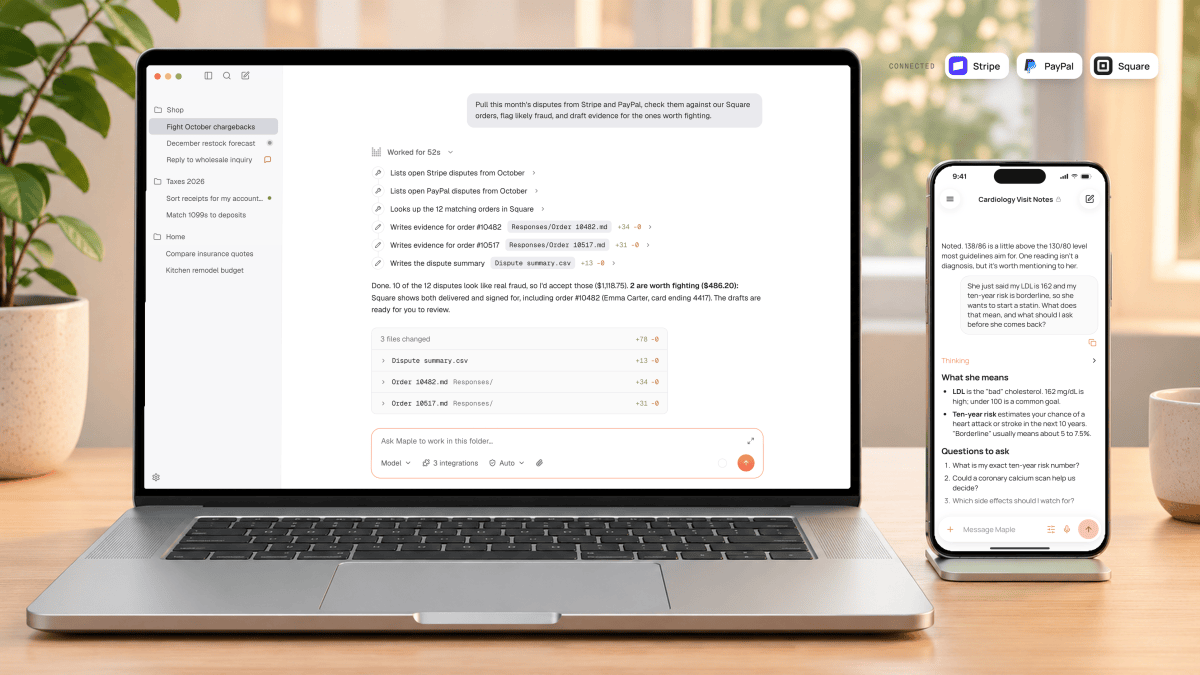
Maple’s current lineup includes a chat app and Maple Work, a newly launched desktop app that can control files, applications and the browser to complete tasks. The product is designed to move beyond text chat and into the kind of hands-on work that turns AI into a workflow tool rather than a conversational novelty.
The desktop app also supports integrations such as Gmail and calendar, and it can spin up a subagent inside other AI apps that support ACP, according to the company. Users can choose among models or switch between quick and more powerful modes, giving them some control over speed versus capability.
Models and modes
Maple says its software uses a mix of open and proprietary models, including DeepSeek, Kimi, GLM, Gemma and GPT OSS. That blend suggests a pragmatic approach: the company is not staking its product on one model family, but on the idea that privacy, workflow access and model choice can be packaged together in a single service.
| Metric | Details |
|---|---|
| Seed funding | $5.3 million |
| Lead investor | EPIC Ventures |
| Other participants | Draper Associates, Planetary VC, Epoch VC |
| Reported growth | 60x over the past three months |
| Subscription tiers | $20/month, $100/month, $200/month |
| Team size | 4 |
Why it matters
Maple’s raise lands in a market where AI agents are increasingly being asked to handle the most sensitive parts of digital work: inboxes, calendars, documents and browser sessions. That convenience is also a risk. If an assistant can make purchases, edit files or coordinate scheduling, businesses want assurances about storage, retention and who can inspect the underlying data.
Maple is aiming directly at that anxiety. If it can show that privacy-preserving infrastructure does not slow agents down too much, it may open a lane for businesses that want automation but are not ready to hand over data to a traditional AI platform. If it cannot, the company may find that privacy alone is not enough to overcome the operational friction of secure enclaves and enterprise due diligence.
The startup’s approach also speaks to a broader shift in the AI market. Early consumer excitement centered on chatbots and text generation. The next phase is about action: tools that can file, send, sort, draft and launch. The more capable those tools become, the sharper the pressure on companies to explain what happens to the data behind the scenes.
Background: how Maple got here
Maple’s current form reflects a series of steps that began before this week’s financing announcement. According to the company’s history as reported by TechCrunch, Anthony Ronning started the predecessor company in 2023 as a privacy-focused fintech. Mark Suman teamed up with Ronning in August 2024, at which point the Maple AI concept took shape. In January, the product became publicly available as a mobile app after that team-up.
The startup now says it has seen 60x growth over the past three months. TechCrunch did not specify the underlying metric, but the scale of the claim helps explain why investors were willing to back an early-stage company focused on a narrowly defined problem. Privacy is hard to deliver convincingly, but if customers are paying attention to it, it can also be a differentiator.
Maple is targeting small businesses first, then enterprise pilots next year. That sequencing matters. Smaller teams can move quickly and may tolerate lighter procurement processes, while larger customers usually demand deeper proof that a system meets internal security standards.
The enterprise hurdle
For enterprise adoption, Maple says SOC 2 compliance and security audits are prerequisites. SOC 2 is a standard many software buyers recognize as a baseline for vendor trust, especially when a product touches customer data, mailboxes or internal documents.
The company also says it does not retain most customer data. When retention is necessary, the data is encrypted. That position may help Maple in sales conversations, but it also raises the bar for operations: customers will likely want to know not only what the startup says, but what independent reviewers can verify.
What Maple is selling to businesses
At a functional level, Maple is packaging several familiar AI trends into one product:
- chat and task completion in a single interface
- desktop-level control over files, apps and browsers
- integrations with email and calendar systems
- model choice across multiple AI back ends
- a privacy claim centered on TEEs and limited data access
That combination gives Maple a clearer business case than a generic chatbot. A company does not buy AI just to ask questions anymore; it buys automation that can reduce repetitive work. Maple is trying to make that automation less risky by building around a data-handling architecture that keeps the vendor at arm’s length.
The strategy may prove especially relevant for organizations that are comfortable with AI in principle but cautious about where data travels. Even when companies are willing to use cloud software, they often want limits on visibility, retention and internal access. Maple is betting that “privacy-preserving” can become a buying criterion, not a legal footnote.
How much traction does Maple claim?
Maple says it has grown 60x in the last three months, a striking figure that suggests strong early adoption or a very small starting base. The company also disclosed subscription pricing: Pro at $20 a month, Max at $100 a month and Max Plus at $200 a month.
Those price points position Maple across both individual power users and teams that need more advanced capability. The top end is particularly notable because it implies customers may pay a premium for speed, model access or more sophisticated automation features.
Still, the company has not publicly disclosed revenue, customer counts or retention. Those are the numbers investors and prospective buyers will likely watch next.
| Timeline | Milestone |
|---|---|
| 2023 | Anthony Ronning started the company that later became Maple AI as a privacy-focused fintech |
| August 2024 | Mark Suman joined Ronning and the Maple AI concept formed |
| January | The product became publicly available as a mobile app |
| 2026-11-24 | TechCrunch reported Maple’s $5.3 million seed round and expansion plans |
What happens next?
Several milestones will determine whether Maple turns an interesting technical pitch into a durable company. The first is execution on security. The company says enterprise expansion depends on SOC 2 compliance and security audits, so the timing of those efforts will affect whether Maple can move beyond small-business users.
The second is product development. Maple says it plans a cloud-based agent that can keep working even when a user’s computer is off. That would broaden its usefulness, but it would also test whether the company can preserve its privacy claims as the agent becomes more autonomous and less tied to a local desktop session.
The third is market validation. Maple plans to target small businesses first and pursue enterprise pilots next year, which means the company will soon have to prove that its privacy posture is not just technically elegant but commercially persuasive.
Finally, there is the financing roadmap. Maple says it plans a Series A in the first half of 2027. By then, investors will likely want clearer evidence of revenue, customer adoption, audit progress and whether the company’s model mix and desktop agent have become a repeatable business rather than a promising experiment.
Who is behind Maple?
The startup says it is based in Austin and San Francisco and operates with a four-person team. That lean structure fits an early-stage company trying to move quickly in a competitive market where model quality, product usability and trust all evolve at the same pace.
For now, Maple’s case rests on a straightforward proposition: AI can be useful only if users trust it enough to let it touch their data. The company’s raise suggests investors are willing to fund that idea. The next test is whether customers will pay for it.
“They can look at and verify the code that’s running on our servers,”
“We actually don’t have access to [the data] while it’s inside the TEE,”
By the numbers
- $5.3 million seed round
- 60x growth over the past three months
- Three subscription tiers: $20, $100 and $200 per month
- Four-person team
- Series A planned for the first half of 2027
Frequently asked questions
What is Maple and what does it do?
Maple is a privacy-focused AI startup that sells chat and desktop automation tools. Its software can control files, apps and browsers, and the company says it is designed so Maple itself cannot see raw user data.
How much funding did Maple raise?
Maple raised $5.3 million in a seed round reported by TechCrunch on 2026-11-24. EPIC Ventures led the round, and Draper Associates, Planetary VC and Epoch VC also took part.
How does Maple claim to protect user privacy?
Maple says it processes data inside Trusted Execution Environments on U.S.-based servers. The company says it cannot access raw user data in transit or at rest, and it does not retain most customer data unless it must, in which case the data is encrypted.
What is Maple Work?
Maple Work is the startup’s newly launched desktop app. It can control files, apps and browsers, and it supports integrations such as Gmail and calendar as part of Maple’s agent-style workflow tools.
When could Maple launch its next major fundraising round?
Maple says it plans a Series A in the first half of 2027. Before then, the company will need to complete SOC 2 compliance, security audits and prove that customers will buy its privacy-first approach.