Updated September 2, 2026 4:26 pm
In short
John Deere’s JD AI assistant is rolling out first to select U.S. users, with broader support planned across digital tools and future versions tailored to turf, construction, roadbuilding and forestry customers.
- JD is in early access for select U.S. customers through John Deere Operations Center.
- The assistant uses farmers’ own field, machine and operational data to answer practical questions.
- John Deere says it does not sell farm data and lets users control third-party sharing.
- The company plans broader access on web, mobile and eventually in-cab displays.
- The launch comes amid long-running farmer concerns about repair rights and data ownership.
Update — September 2, 2026 4:26 pm
John Deere’s updated announcement adds that the JD assistant is only the beginning of a wider AI push. The company now says it plans versions aimed at turf, construction, roadbuilding and forestry customers, extending the tool beyond farming.
The rollout language is also more specific: JD is starting with select U.S. users in Operations Center, then expanding to the web, mobile apps and eventually in-cab tractor displays.
Update — September 1, 2026 7:25 pm
John Deere’s updated announcement says the JD assistant is only the start of a broader plan. The company now says it wants to add versions tailored to turf, construction, roadbuilding and forestry customers as well.
It also restated its rollout path: the chatbot is first appearing for select U.S. users in Operations Center, with later support planned for the web, mobile apps and eventually in-cab tractor displays.
John Deere has begun testing a new AI assistant called JD that pulls from a farm’s own operational data to answer practical questions about equipment, fields and work planning. The company says the tool is designed to help farmers improve decisions and profitability, while adding fresh assurances that it will not sell farm data and will let users control how third parties access it.
The assistant is entering an early-access phase for select U.S. customers through John Deere’s Operations Center, with a wider rollout planned for web, mobile devices and eventually tractor displays. The launch matters because it combines one of agriculture’s most important industrial brands with one of the most closely watched debates in farming: who controls the data generated by modern connected machinery.
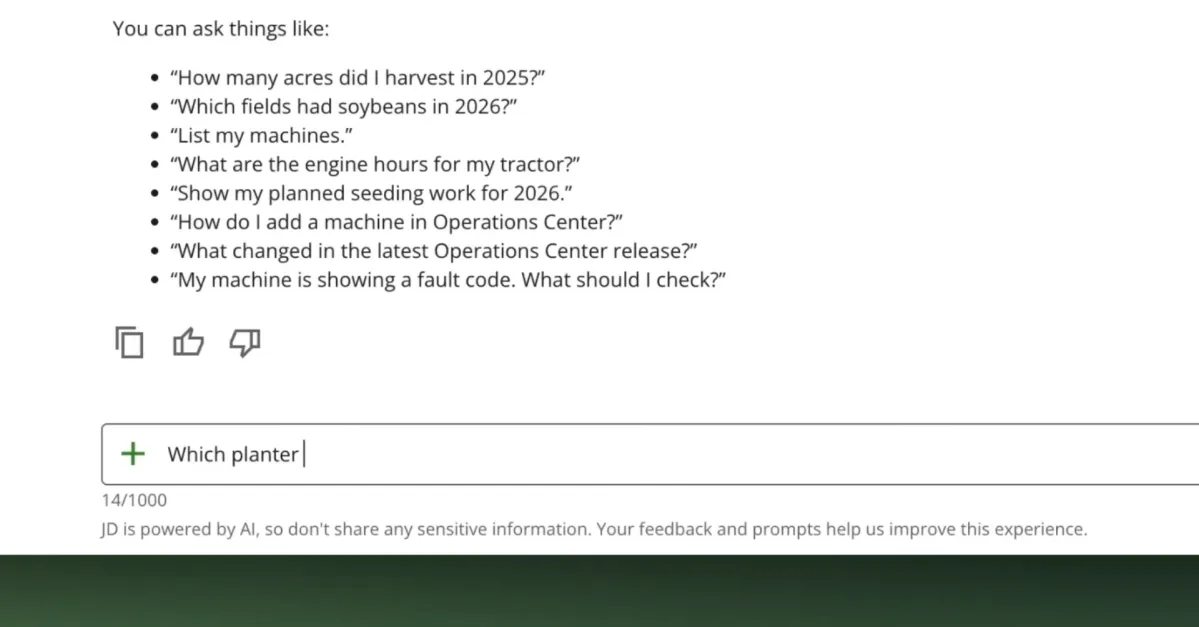
John Deere is pitching the system as a practical advisor rather than a novelty chatbot. The company says JD can draw on a customer’s field, machine and operational records to answer questions about topics such as equipment settings, fuel use and harvest timing, and to surface historical patterns that may help farmers make better decisions.
What John Deere’s new AI assistant is meant to do
JD is intended to work as a digital helper inside the tools farmers already use to manage their operations. According to John Deere, the assistant can respond to questions using a farm’s own data, rather than only general agricultural information.
That distinction is important. Farmers do not just need generic advice about planting or harvesting; they need recommendations grounded in their specific machinery, soil, weather conditions, timing and past performance. John Deere’s pitch is that the assistant can reduce the time spent digging through dashboards, spreadsheets or machine settings by translating data into straightforward guidance.
In practical terms, the company says the AI can help with questions around:
- equipment settings
- fuel consumption
- harvest timing
- best practices based on a farm’s history
- trends that show how operations have performed over time
That makes JD less like a general-purpose chatbot and more like a farm operations interface built on top of an existing digital record of work already happening in the field.
Why this launch is about more than convenience
The new assistant arrives at a sensitive moment for John Deere. The company has spent years facing criticism from farmers and repair advocates over access to diagnostics, software and parts information, as well as broader concerns about how connected equipment handles ownership and control.
That backdrop makes any AI product from the company especially significant. If the assistant is successful, it could become a central point of interaction between farmers and the data produced by tractors, harvesters and other machines. If it falls short on transparency or usefulness, it could deepen long-running distrust around the company’s digital ecosystem.
For Deere, the opportunity is clear: its connected machines generate a large amount of operational data, and AI gives the company a way to convert that raw information into a consumer-facing service. For farmers, the question is whether the tool delivers measurable value without creating another layer of lock-in or data dependence.
The company is presenting the assistant as a way to turn farm data into better decisions, while also promising tighter control over how that data is used and shared.
How JD uses farm data
John Deere says the assistant works by using a customer’s field, machine and operational data to generate answers. That suggests the tool can examine information already collected through connected equipment and Deere’s digital platforms, then use it to tailor responses.
Rather than treating every user the same, the assistant is designed to reflect the specifics of a particular operation. A grower asking about fuel usage, for example, should receive an answer tied to their own machines and work history. A question about harvest timing could be informed by prior seasons, machine performance and operational patterns.
The company has not disclosed which AI model or technology stack powers JD. That omission leaves open questions about whether the assistant is built on a proprietary system, an outside large language model or a combination of tools. For now, Deere is emphasizing the product’s function and data controls rather than the underlying architecture.
What makes farm data different from ordinary business data?
Farm data is different because it is deeply tied to time, location, machinery and weather, and because the same data can influence both day-to-day operations and long-term profitability. A machine setting that improves fuel efficiency in one field may not work in another, which is why personalized analysis can be more valuable than generic advice.
That also means the data has economic value beyond immediate farming decisions. Aggregated and anonymized information can reveal patterns across many operations, giving manufacturers insight into equipment performance, usage trends and service needs. That potential value is exactly why farmers have often been wary about handing over too much control.
What Deere is promising about data privacy and control
Alongside the assistant, John Deere is highlighting a 10-point Farmer Data Commitment that is meant to reassure customers that they remain in charge of their information. The company says it will not sell farm data, will let users decide which third parties can access it, and will allow them to stop that flow at any time.
The commitment also says Deere will use farm data and aggregated, anonymized data to create measurable value for customers, including better machine performance and decision-making insights. Another promise is that Deere will not use farm data for commodity trading or speculation.
These pledges are as much about trust as they are about product design. In a business where connected equipment can generate continuous streams of data, the line between service improvement and data exploitation can be difficult for customers to evaluate. Deere is trying to preempt that concern by putting its controls in writing before broad deployment.
| Commitment area | What Deere says | Why it matters |
|---|---|---|
| Data ownership | Farmers control their farm data | Reinforces user authority over sensitive operational records |
| Data sales | Deere says it does not sell farm data | Addresses a major concern among privacy-conscious customers |
| Third-party sharing | Users can choose which third parties receive data | Gives farmers more control over ecosystem access |
| Service use | Data may be used to improve performance and decision-making | Frames data collection as providing direct operational value |
| Trading/speculation | Deere says it will not use data for commodity speculation | Targets fears that farm intelligence could be used against producers |
How the rollout will work
For now, JD is limited to select U.S. customers as part of an early access program in the John Deere Operations Center. That means the company is testing the assistant with a controlled set of users before deciding how quickly to expand.
John Deere says the assistant will eventually be available more broadly on the web and in mobile apps, with a longer-term plan to place it directly in tractor cabs and other machine displays. If that happens, JD could become a hands-on operational tool that farmers interact with during active work, not just while reviewing data after the fact.
The company also says the assistant will be extended beyond row-crop farming. Deere plans to tailor future versions for customers in turf management, construction, roadbuilding and forestry, signaling that it sees AI as a platform strategy rather than a one-off experiment.
Why start with early access?
Early access is a standard way to reduce risk for a product that touches both business-critical workflows and sensitive data. By limiting the initial audience, Deere can gather feedback, identify weak spots and refine the experience before making larger promises to customers.
It also lets the company test whether farmers find the assistant genuinely useful. In agriculture, new technology tends to succeed only if it saves time, improves yield, lowers input costs or simplifies decision-making. A chatbot that does none of those things will struggle to win trust, no matter how advanced it sounds.
How JD fits into the broader AI push in agriculture
John Deere’s assistant reflects a wider trend in AI: the shift from broad, general-purpose chat tools toward specialized agents embedded inside industry-specific workflows. Agriculture is a natural candidate because farms already generate large datasets from machines, sensors and software platforms.
In that context, AI is less about replacing human judgment and more about compressing the time it takes to interpret operational information. A good assistant could help a farm manager spot inefficiencies, compare seasonal trends or identify when a machine is underperforming before a breakdown becomes costly.
That said, the value of an AI system in agriculture depends heavily on the quality and completeness of the underlying data. If machine records are inconsistent, field data is incomplete or users do not trust the platform enough to keep data flowing, the assistant’s recommendations may be limited.
Could AI change how farm decisions are made?
Yes, if it proves accurate and reliable enough to influence real work. The most promising use cases are likely to be decision support, not automation: helping farmers choose when to harvest, how to tune equipment or where fuel and labor can be saved without sacrificing output.
But the technology also raises a broader issue about dependency. If farmers begin relying on proprietary systems to interpret their own operations, the companies providing those tools may gain more influence over how agricultural businesses run, even if the data itself remains formally under farmer control.
What the launch means for John Deere’s relationship with farmers
This move is as much a trust exercise as a technology launch. Deere is asking customers to believe that it can turn connected equipment into a more useful service layer without crossing the line into overreach.
That is not a simple ask. The company’s history with repair rights and digital access means many farmers will scrutinize the assistant carefully. Some will see a useful step toward better field management. Others may view it as another attempt to deepen Deere’s role inside farm operations.
The company appears aware of that tension. Its emphasis on data control, third-party permissions and non-sale commitments reads like an effort to assure customers that it has learned from past controversy. Whether that assurance is enough will depend on how the assistant performs in real-world use.
Key dates and rollout milestones
Here is a simple timeline of the product’s current status and expected expansion:
| Stage | Details | Status |
|---|---|---|
| Early access | Select U.S. customers can test JD in the Operations Center | Underway |
| Web and mobile expansion | Planned broader access through Deere’s digital platforms | Future rollout |
| In-cab integration | Assistant to appear on tractor and equipment displays | Longer-term plan |
| Industry expansion | Adaptations for turf, construction, roadbuilding and forestry | Planned |
What remains unanswered
Despite the announcement, several important details remain unclear. Deere has not said which AI system powers the assistant, how it handles mistakes, or how much of its output is generated from the customer’s own records versus generalized model behavior.
The company also has not explained how it will measure success during early access, what level of human oversight is built in, or whether the assistant will be able to perform actions beyond answering questions. Those are the kinds of details that will matter if JD evolves from a conversational tool into a true operational partner.
Another open question is whether the assistant will help Deere strengthen its customer relationships or simply give the company a new interface for existing services. In either case, the tool is a sign that agricultural equipment makers increasingly see AI as the next layer of competition in a connected farm economy.
The bottom line
John Deere’s JD assistant is an early example of how industrial AI may take shape in agriculture: not as a flashy consumer chatbot, but as a domain-specific tool that turns operational data into advice. Its success will depend on whether farmers find it accurate, useful and genuinely respectful of their control over data.
For Deere, the project is also a test of credibility. The company is not just launching software; it is trying to show that AI can be introduced into farming without repeating the distrust that has shadowed connected equipment for years. If the tool works as promised, it could become a model for how AI enters heavy industry. If it does not, it may reinforce the view that farmers should remain cautious about who gets access to their data.
Frequently asked questions
What is John Deere’s JD AI assistant?
John Deere’s JD AI assistant is a farm-focused digital tool that answers questions using a customer’s own field, machine and operational data. It is designed to help farmers make better decisions about equipment settings, fuel use, harvest timing and other daily management tasks.
Who can use the JD AI assistant right now?
The assistant is currently available only to select U.S. customers in an early access program through the John Deere Operations Center. Deere says it plans to expand access later to web, mobile apps and eventually in-cab equipment displays.
Does John Deere sell farm data?
John Deere says it does not sell farm data. The company’s Farmer Data Commitment also says users can control third-party sharing, turn off data flows at any time and decide which outside companies can access their information.
How is JD different from a regular chatbot?
JD is different because it is built to use farm-specific records instead of only general internet-style answers. That means it can give responses tailored to a particular operation, such as machine performance trends, fuel usage patterns or timing decisions based on historical data.
Why is this AI launch important for farmers?
This AI launch is important because it could turn connected farm data into a practical tool for saving time and improving decisions, but it also raises familiar concerns about privacy, data ownership and how much influence equipment makers should have over farm operations.