In short
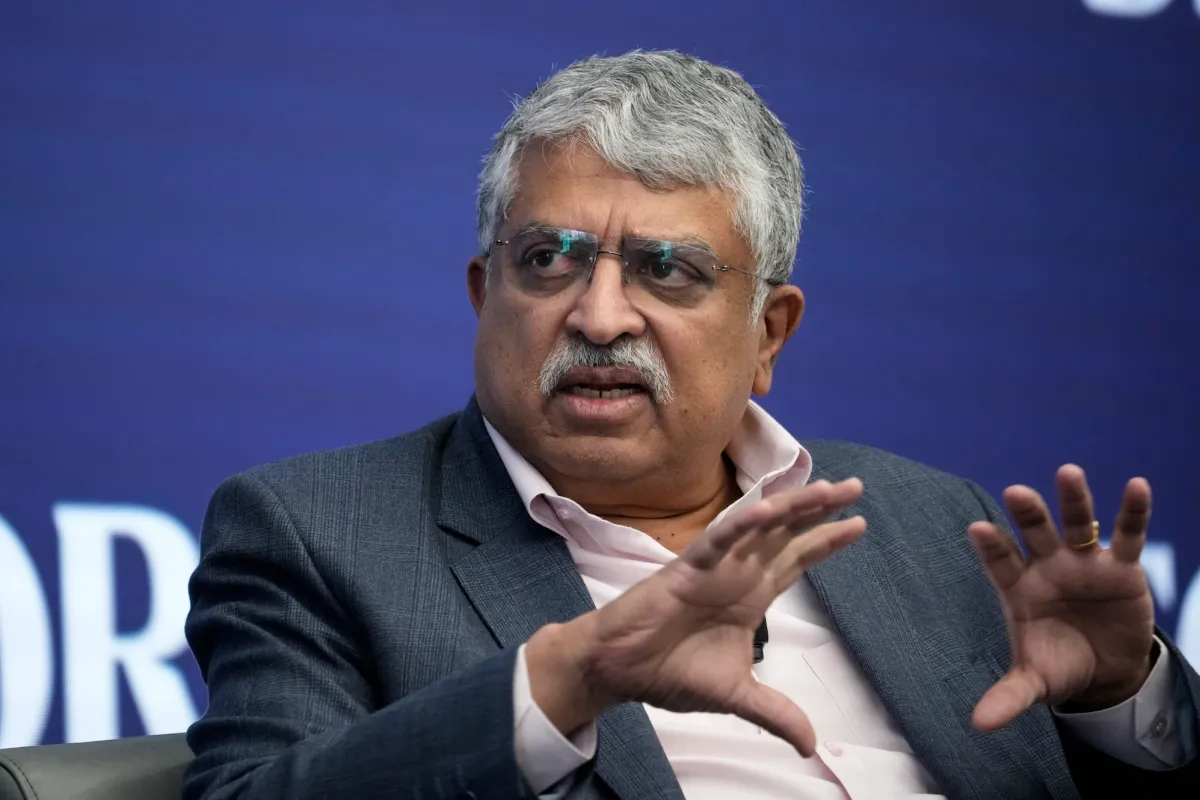
Nandan Nilekani is stepping down as a general partner at Fundamentum Partnership, but he will remain an anchor investor, adviser and mentor as the firm pursues a third fund of about $200 million. The move comes as Fundamentum deepens its focus on consumer tech, fintech and AI and leans more on Indian capital.
- Nandan Nilekani is leaving Fundamentum’s GP role but staying closely involved as anchor investor and mentor.
- Fundamentum is targeting about $200 million for its third fund and plans to back 8 to 10 startups.
- The firm sees the strongest AI opportunities in application-layer products for finance, content and vernacular markets.
- Fundamentum says roughly half of the new fund will come from international investors and half from Indian capital.
Nandan Nilekani, one of India’s most influential technology figures and the co-founder of Infosys, is stepping away from his day-to-day title as a general partner at Fundamentum Partnership just as the venture firm prepares to raise a third fund of about $200 million. The move marks a notable transition for a firm Nilekani helped launch nearly a decade ago, but by all accounts it does not signal a retreat from the company he helped build.
Instead, Nilekani will remain closely involved as Fundamentum’s anchor investor, adviser and mentor to founders in the portfolio, according to co-founder Sanjeev Aggarwal. The change comes as Fundamentum broadens its leadership team, sharpens its investment thesis around consumer technology, fintech and AI, and leans more heavily on a maturing pool of Indian capital to support its next fund.
The shift reflects both a generational handoff and a larger transformation in India’s venture landscape. In the years since Fundamentum was founded, the country has developed a deeper bench of domestic institutional money, family offices and founder-led wealth, making it possible for local venture firms to raise capital at home in a way that was far more difficult in the past.
Nilekani’s role changes, but his influence remains
Fundamentum’s leadership says Nilekani’s departure from the general partner title is largely administrative rather than operational. Aggarwal described it as a change in designation, not in commitment, emphasizing that Nilekani will continue to offer strategic input and help guide founders across the firm’s portfolio.
Aggarwal said Nilekani would remain an integral part of the firm and continue doing what he has always done best: mentoring the entrepreneurs Fundamentum backs and providing counsel on the larger direction of the business.
That distinction matters because Nilekani has never been a passive name on a venture fund letterhead. Over the years, his reputation as a builder of public digital systems and his standing in India’s tech community have made him a powerful draw for founders and investors alike. At 71, he remains one of the country’s most recognizable technology leaders, with a career that spans enterprise software, identity infrastructure, digital payments and startup investing.
As Infosys co-founder, Nilekani helped shape India’s modern IT services industry. Later, as a public-sector reformer, he played a central role in creating Aadhaar, the biometric identity system used by more than a billion residents. He has also been one of the strongest public advocates for India’s digital public infrastructure, particularly the Unified Payments Interface, better known as UPI, which has become one of the world’s most widely used real-time payment rails.
He has also backed the Open Network for Digital Commerce, or ONDC, an initiative designed to make India’s online commerce ecosystem more interoperable and less dominated by closed platforms. That broader policy and infrastructure background gives Nilekani a different kind of relevance in venture capital: not just as an investor, but as a strategic thinker with rare insight into how digital systems are built and adopted at scale.
What Fundamentum is raising now
Fundamentum’s third fund is targeting roughly $200 million, and the firm is already putting money to work even before announcing a first close. Aggarwal said the fundraising process is expected to stretch over the next 12 to 18 months, giving the firm a long runway to assemble its investor base and deploy capital.
The new vehicle will focus on eight to ten startups, with initial checks of about ₹100 crore, or approximately $10.5 million, each. That makes the fund squarely oriented toward larger seed-to-Series B style bets, rather than spraying small investments across a wide portfolio.
The firm’s priorities are clear: consumer technology, fintech and AI applications. Aggarwal has said Fundamentum believes India’s most compelling AI opportunities are not necessarily in building the underlying frontier models themselves, but in creating products and services that sit on top of those models.
That view is significant because it places Fundamentum on the side of application-layer AI rather than the expensive model-building race that has defined much of the U.S. and Chinese markets. In India, where capital efficiency and local-language reach matter greatly, the firm sees a long list of opportunities in financial services, content and vernacular consumer products.
Why application-layer AI matters in India
Global AI development has increasingly split into two camps. On one side are the companies building large models that require huge data sets, expensive training runs and massive compute budgets. On the other are startups using those models to build practical products for specific markets and use cases.
Fundamentum’s thesis suggests that India’s edge may lie in the second category. With a huge consumer market, diverse languages and a growing digital infrastructure base, the country may be especially fertile ground for startups that can use existing AI systems to solve localized problems more efficiently than model labs chasing technical frontiers.
In that sense, the firm is betting that the greatest near-term value in India will come from businesses that make AI useful, not necessarily from businesses that make AI bigger.
A broader leadership reshuffle inside Fundamentum
Nilekani’s move comes alongside a wider reorganization of the firm’s senior investment group. Fund III will be led not only by Aggarwal, but also by Prateek Jain, who has been with the firm since its launch in 2017, fintech investor Mayank Kachhwaha, who joined ahead of Fund II, and chief financial officer Sanjay Chaturvedi, who has spent nearly a decade with the firm.
The expansion of the leadership bench suggests a more institutional structure for the firm as it matures. Instead of relying heavily on a small founding group, Fundamentum is positioning itself as a broader platform with multiple decision-makers and a deeper operating rhythm.
That also gives the firm more continuity as Nilekani transitions away from the GP title and as the venture market in India becomes increasingly competitive. For startups seeking large early-stage checks, it can be as important to know who will support them after the initial investment as it is to know who writes the first one.
Timeline of Fundamentum’s evolution
Fundamentum’s current fundraising effort is the latest chapter in a decade-long story that began with a belief that India needed more locally rooted growth-stage capital.
| Year | Milestone | Significance |
|---|---|---|
| 2017 | Fundamentum is founded by Nandan Nilekani and Sanjeev Aggarwal | Launches a new India-focused growth investment platform |
| 2017-2021 | Fund I invests across startups including Spinny, PharmEasy and Kuku FM | Establishes the firm’s presence in consumer and digital businesses |
| 2021-2025 | Fund II expands the portfolio and shifts toward follow-on support | Deepens exposure to existing winners and portfolio scaling |
| 2026 | Fund III targets about $200 million | Marks a new phase with broader leadership and a stronger AI focus |
What the fund has backed so far
Across its first two funds, Fundamentum has made 17 investments. The portfolio includes a mix of consumer and internet businesses that mirror the firm’s view of India’s digital economy.
- Spinny, the used-car marketplace
- PharmEasy, the online pharmacy platform
- Kuku FM, an audio storytelling and content service
- AppsForBharat, which developed the Sri Mandir devotional app
These companies point to a common theme: the firm has tended to back products designed for large Indian consumer segments, often in markets where digital adoption is still deepening and where platform design and trust are critical to scale.
Aggarwal said the first fund has already returned about half of the capital it raised to investors, while the second fund is currently concentrated on follow-on investments. That is often a sign that a venture firm is moving into a more mature phase, where it balances fresh bets with the need to support existing winners through later rounds.
How the investor base is changing
One of the most revealing parts of Fundamentum’s third-fund story is not the amount it hopes to raise, but where that money is expected to come from. Aggarwal said the firm expects about half of the capital to arrive from international investors, with the remainder coming from Indian institutions, family offices, founders and the firm’s partners.
That mix underscores a major shift in the country’s venture ecosystem. A decade ago, many India-focused funds were still heavily dependent on U.S. capital. Today, domestic investors are far more active, and local money is increasingly willing to back venture funds that invest in Indian startups.
Aggarwal contrasted the current environment with the one he saw when Helion Venture Partners was launched in the mid-2000s, saying Indian venture firms then had to rely almost entirely on American backers. In recent years, he said, local interest has strengthened enough that firms can now be built with domestic capital.
This change matters because it reduces dependence on foreign LPs, gives Indian institutions a larger role in shaping startup finance and creates a stronger internal cycle of capital, entrepreneurship and reinvestment.
Why domestic capital matters for Indian VC
- It creates more stable funding sources for local venture firms.
- It broadens ownership of innovation beyond overseas investors.
- It helps build a self-sustaining ecosystem where successful founders can become backers.
- It can improve alignment between investors and the realities of Indian market demand.
For a country with an increasingly sophisticated startup scene, those advantages are more than symbolic. They shape what gets funded, how long firms can wait for returns and how much confidence investors have in India as a long-term growth market.
A separate venture path for Ashish Kumar
The leadership change at Fundamentum also comes after the departure of general partner Ashish Kumar, who has started his own AI-focused venture firm, Fundamentum Frontier Advisors, or F2A. Nilekani is also an anchor investor in that vehicle.
According to Aggarwal, F2A is fully separate from Fundamentum and has no operational ties to Fund III. Kumar is not part of the new fund’s management or investment process.
The split appears to reflect the growing specialization within venture capital, particularly around AI. As more firms reposition themselves around machine learning and related software opportunities, partners often branch out to pursue distinct strategies or tighter themes.
In this case, however, the existence of a separate AI-focused fund does not appear to change Fundamentum’s own direction. If anything, it highlights how broad the AI opportunity set has become, even within the same network of investors.
What this means for India’s startup market
Fundamentum’s new fund arrives at a moment when India’s startup ecosystem is still recalibrating after years of boom, correction and renewed focus on sustainable growth. Investors have become more selective, founders are under pressure to show efficient capital deployment, and large funds are increasingly expected to offer more than money.
That is where Nilekani’s continued presence, even without the GP title, could remain especially valuable. For founders, his combination of public-sector experience, credibility in deep-tech infrastructure and long history with India’s digital transformation gives him a perspective that few venture investors can match.
For the market, the fund’s emphasis on AI applications is another sign that India’s role in the AI economy may differ from the model-making race elsewhere. Rather than trying to mirror the largest U.S. or Chinese players, Indian startups may be better positioned to build services that are cheaper, more localized and more tightly integrated with everyday use cases.
That approach may also be more compatible with India’s funding environment. Large-scale model training is expensive and uncertain, while application businesses can often reach revenue faster and serve a broader range of customers. For investors focused on risk-adjusted returns, that distinction is important.
The bigger picture: a founder-investor becomes a mentor-investor
Nilekani’s transition from GP to anchor investor is also emblematic of a broader pattern in tech and venture capital. As firms mature, founders often shift from active management into advisory or stewardship roles, while new generations take on the day-to-day work of sourcing, diligence and portfolio management.
In this case, the move appears designed to preserve continuity while making room for the next phase of the firm’s leadership. It allows Fundamentum to retain the value of Nilekani’s reputation and experience without requiring him to remain in a formal operating role.
For a venture firm that was built in part on the credibility and networks of its founders, that balance may prove ideal. The brand remains associated with one of India’s best-known technology visionaries, but the firm’s execution is increasingly carried by a broader team.
That evolution may be especially important as India’s startup market becomes more selective about where it places its bets. The firms that win will likely be those that combine deep local knowledge, strong founder relationships, patient capital and enough flexibility to adapt to changing market conditions.
Looking ahead to Fund III
Fundamentum has not yet announced a first close for Fund III, but the firm’s willingness to begin deploying capital suggests it is already behaving like a live investment platform rather than one in waiting. Over the coming months, the fund is likely to continue building around a small number of high-conviction investments in consumer internet, fintech and AI-enabled services.
The fact that Nilekani’s largest-ever commitment to a venture fund is being made through this vehicle also signals confidence in the firm’s next chapter. While the exact amount has not been disclosed, the size of the pledge suggests the former GP remains materially invested in the firm’s success.
If Fund III raises the full $200 million target, it will likely give Fundamentum enough scale to remain a meaningful player in India’s growth-stage market. More importantly, it may help define what a locally funded, locally guided venture platform looks like in the next phase of India’s tech economy.
For now, the central message is straightforward: Nandan Nilekani is changing roles, not exiting the room. Fundamentum is entering a new phase, but it is doing so with one of India’s most influential technologists still very much in the picture.
Key facts at a glance
| Item | Details |
|---|---|
| Firm | Fundamentum Partnership |
| Co-founders | Nandan Nilekani and Sanjeev Aggarwal |
| New fund target | About $200 million |
| Expected portfolio size | 8 to 10 startups |
| Typical initial check | ₹100 crore, or about $10.5 million |
| Primary sectors | Consumer tech, fintech and AI products |
| Nilekani’s new role | Anchor investor, adviser and mentor |
| Capital mix | Roughly half international, half Indian investors |
As India’s startup economy matures, the transition at Fundamentum may prove to be less about one man stepping back and more about a venture firm stepping forward into a more diversified, locally supported future.