In short
Anthropic has launched Claude Tag in research preview, a Slack-based AI teammate that can persist in channels, remember context, and help with tasks. The feature reflects a broader push in enterprise AI toward memory, permissions, and workplace-aware assistants.
- Claude Tag is a new Slack integration that keeps a persistent Claude presence in channels.
- Anthropic says the feature can learn context over time and operate within admin-set permissions.
- The assistant has task mode for assigned work and ambient mode for proactive updates.
- The launch puts Anthropic in competition with Microsoft, Snowflake, Databricks and Glean on enterprise context.
- The product is currently in research preview for Claude Enterprise and Claude Team customers.
Anthropic is taking another step toward turning Claude from a chat companion into something closer to a full-time coworker. The company has introduced Claude Tag, a research preview that lets teams summon an always-available Claude directly inside Slack, where it can follow channel activity, keep track of context over time, and help move work forward without requiring each request to start from scratch.
The feature is designed for Claude Enterprise and Claude Team customers and extends Anthropic’s existing Slack presence. Instead of relying only on direct messages or one-off mentions, Claude Tag gives organizations a persistent AI identity in a channel, one that can observe discussions, remember prior work within approved boundaries, and respond when asked to take on tasks or surface relevant information.
Anthropic is betting that the next phase of enterprise AI will be defined less by isolated prompts and more by memory, continuity, and organizational context. The company’s pitch is simple but ambitious: if an AI can stay present in the flow of work, learn from ongoing conversations, and operate with permissioned access to the right parts of a company’s knowledge base, it becomes more useful than a tool that only answers questions on demand.
What Claude Tag changes in Slack
Slack has already become one of the most important distribution channels for enterprise AI assistants, and Anthropic’s latest move builds on that trend. Users could previously invoke Claude through direct messages or mention it in a channel for help with summaries, drafting, brainstorming, or other tasks. The company also offers Claude Code in Slack, which can route programming work from a thread to a fuller coding environment on the web before posting progress back into the conversation.
Claude Tag is different because it is meant to persist. Rather than treating each interaction as separate, the new feature is built around the idea that Claude can remain attached to a channel, watch the conversation unfold, and accumulate relevant context as the work progresses. Anthropic says that when Claude follows a channel over time, it can learn more about the team’s work and use permitted access to gather facts from other parts of the organization.
That persistent memory is central to the product’s appeal. In many workplaces, the hardest part of using AI is not getting a quick answer. It is making sure the system understands the broader context: what has already been discussed, which decisions have been made, which documents matter, and who owns what. Claude Tag is meant to reduce that friction by behaving less like a standalone chatbot and more like a participant in the team’s operating rhythm.
How the new system is supposed to work
Anthropic says each Claude instance in Slack is scoped to the channels and permissions set by system administrators. That means company IT or workspace admins decide which tools Claude can use, what information it can access, and where it is allowed to operate. The company is emphasizing that this is not a free-roaming agent wandering across the business. Instead, every deployment is supposed to be constrained by admin-defined boundaries.
The scoping matters because Anthropic is trying to balance usefulness with enterprise controls. A Claude instance used in one area of the business should not accidentally carry its memory into another. In practice, that means a Claude configured for legal workflows should not seed its observations into an engineering channel, and vice versa. Anthropic says those guardrails are part of the design so that teams can preserve both privacy and relevance.
That same permission structure also applies to the knowledge Claude can pull in from across the company. If a workspace administrator allows it, Claude Tag can search other channels or tools to retrieve facts that help answer a question or complete a task. In effect, the system is built to make Claude smarter in a narrow, workplace-specific way, without requiring employees to repeatedly restate the same background information.
One identity, shared by the team
One of the more notable aspects of Claude Tag is that everyone in a given Slack channel sees the same Claude presence. Anthropic says this creates a shared, continuous AI identity that any team member can pick up at any point. If one employee asks Claude to draft a summary or gather context, another person in the thread can review what happened and continue the work without restarting the process.
That continuity is likely to appeal to teams that work asynchronously or across time zones. Instead of a series of isolated interactions that disappear into chat history, Claude Tag is intended to function more like a durable collaborator whose work product remains visible to everyone in the conversation.
Task mode and ambient mode
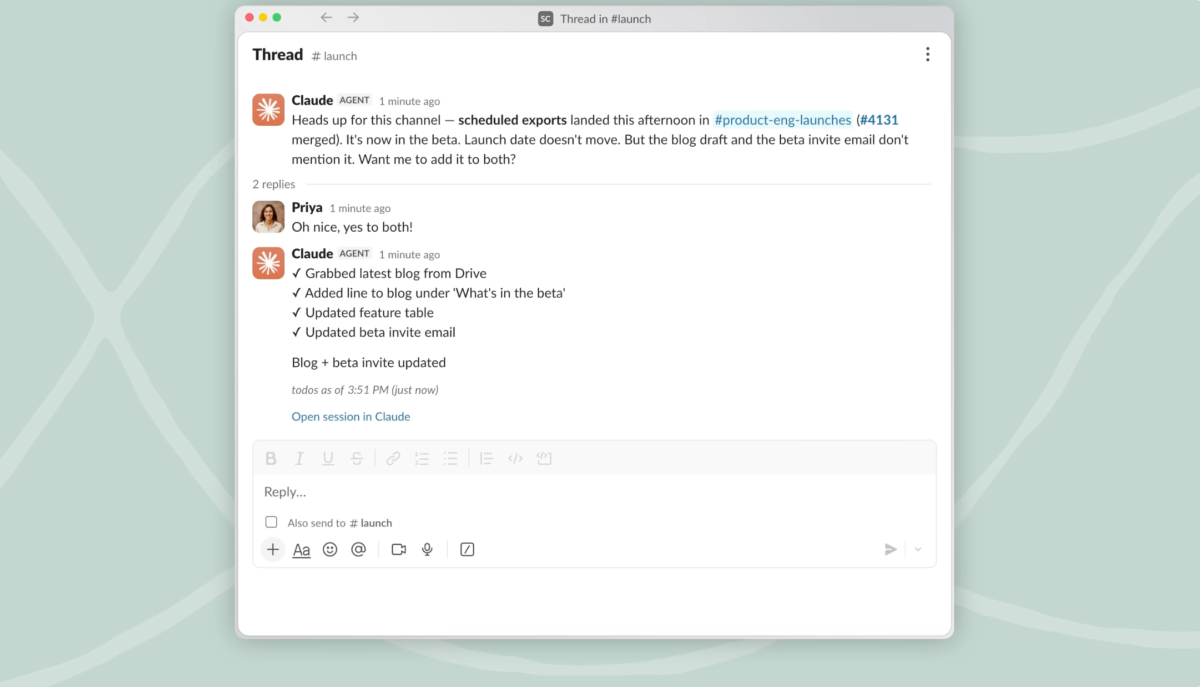
Claude Tag has two main operating styles. In task mode, a user can assign a specific job and Claude will break it into stages, work through the steps using the tools it can access, and report its output directly in the Slack thread. That makes it easier to hand over multi-step work such as collecting information, drafting text, or organizing follow-up actions.
The more novel part is ambient mode. In that mode, Claude is meant to jump into conversations on its own when it sees something worth flagging, whether that means surfacing a potentially important update from elsewhere in the organization, nudging a team about a forgotten action item, or following up on a thread that has gone quiet. Anthropic’s framing suggests a future where AI does not just answer requests, but actively helps manage the flow of work.
Anthropic says Claude is designed to follow along with a channel so it can learn more about the work being done, and—if granted permission—pull in relevant facts from elsewhere in the organization.
The company also says the goal is to make the experience feel like collaborating with a real colleague, except one that can produce work in the open with more context than before.
That language reflects a broader shift in how AI companies are positioning enterprise tools. The promise is no longer simply that a model can draft an email faster or summarize a meeting note. The pitch now is that the model can behave like a durable digital teammate with memory, judgment boundaries, and the ability to keep projects moving.
Why context has become the enterprise battleground
Anthropic’s new product arrives at a time when the AI market is increasingly focused on context rather than raw model capability alone. Large language models have become better at generating text, code, and structured outputs, but enterprises still face a persistent obstacle: a model is only as useful as the information it can safely and reliably access.
In a corporate environment, context usually includes internal documents, message histories, project records, data repositories, and informal knowledge that lives inside team chat. Without that background, an AI assistant may sound competent while still missing the specifics that matter. With it, the assistant can offer more actionable help, reduce repetitive explanations, and fit more naturally into day-to-day work.
That is why persistence and memory are now such valuable product features. Companies are increasingly trying to build systems that do not merely answer questions but understand the structure of a business: who is working on what, where the relevant information lives, and how different teams relate to one another. Claude Tag is Anthropic’s latest attempt to turn that idea into a practical workflow product.
Anthropic is not alone in this race
Anthropic’s move also reflects a wider competition among enterprise AI vendors to own the intelligence layer between employees and company data. Microsoft has been pushing similar ideas through Copilot and its Graph and Work IQ capabilities, which are designed to bring organizational context into AI interactions. The company’s strategy is to make its assistant more useful by connecting it to the systems people already use.
Other infrastructure and data platform companies are pursuing the same goal from different angles. Snowflake and Databricks have been positioning their platforms as foundational layers that contain the institutional knowledge agents need to be effective. Glean, meanwhile, is focused on building an intelligence layer that understands company context and sits between the model and enterprise information sources.
The competition is no longer about who has the flashiest demo. It is about who can make AI reliable enough to handle real work inside an organization. That means better permissions, better retrieval, better memory, and a clearer understanding of how tasks move through a company.
Why Slack matters so much
Slack is an especially important battleground because it is where a large share of knowledge work already happens. Decisions are debated there, documents are shared there, tasks are assigned there, and many businesses use it as the de facto operating system for cross-functional communication. Embedding an AI assistant into that environment gives vendors direct access to the work stream.
For Anthropic, that makes Slack a logical place to test whether Claude can evolve into a more ambient presence. A model that lives in a separate interface must rely on users to remember to open it, ask the right question, and then manually bring its output back into the conversation. An assistant embedded in Slack can appear where the work is already happening.
That matters for adoption as well as utility. The more friction there is between a worker and an AI tool, the less likely that tool is to become part of daily habit. By placing Claude inside a shared team space, Anthropic is trying to make the assistant feel less like a separate app and more like part of the team’s existing communication fabric.
The enterprise AI stack is getting more layered
Claude Tag also highlights how enterprise AI products are becoming increasingly layered. The model itself is only one piece of the stack. Around it are the permissions system, the data connectors, the workflow logic, the shared memory, and the interfaces through which teams interact with the assistant.
That layered architecture is reflected in the way vendors are talking about the market. The emphasis is shifting toward the systems that make AI practical in real companies. In that world, success depends on whether the assistant can safely read the right channels, remember the right context, and work inside the rules of the organization.
It also suggests that the future of enterprise AI may look less like a single universal chatbot and more like a set of specialized, permissioned agents distributed across the business. A legal assistant may need one memory boundary, a sales assistant another, and an engineering assistant another. Claude Tag’s scoping approach is consistent with that direction.
| Feature | What it does | Enterprise relevance |
|---|---|---|
| Claude Tag in Slack | Places a persistent Claude identity inside channels | Creates continuity across team conversations |
| Admin-scoped permissions | Limits tools, channels, and data access | Helps reduce privacy and security risk |
| Task mode | Breaks work into stages and posts progress in-thread | Supports multi-step workflow automation |
| Ambient mode | Proactively joins threads and flags updates | Acts more like an active teammate |
| Shared channel identity | Lets anyone in the channel continue the conversation | Improves collaboration and reduces duplication |
What businesses will likely test first
For early customers, Claude Tag is likely to be most useful in departments where work is highly collaborative and heavily contextual. Legal teams may use it to keep track of requests, drafts, and precedent discussions. Engineering groups may try it for code-related coordination and issue tracking. Operations and project management teams may find value in its ability to summarize, monitor, and follow up on ongoing threads.
Marketing and communications teams could also use it to track campaign work or gather cross-functional updates, while support and customer-facing organizations may find the persistent context useful for summarizing recurring issues and escalating unresolved tasks. In each case, the appeal is the same: fewer repeated explanations and less time spent reconstructing the background of a conversation.
Still, the real test will be whether Claude Tag can remain useful without becoming noisy. An assistant that chimes in too often or flags too many trivial issues could quickly become intrusive. Anthropic will need to prove that ambient assistance adds value without overwhelming the channel.
Questions enterprises will ask before deploying it
- Which channels can Claude observe, and who controls those permissions?
- How does the system separate memories between different teams or functions?
- What data sources can Claude access outside Slack, if any?
- How visible are Claude’s actions to admins and channel members?
- Can the assistant be turned down from ambient mode if a team prefers only on-demand help?
Competitive pressure is rising around AI memory and agentic work
Anthropic’s launch should also be read in the context of a broader shift toward agents that can work continuously rather than respond episodically. In consumer AI, that trend has shown up as assistants with longer memory or more autonomy. In enterprise software, it is showing up as systems that can track projects, fetch background data, and participate in the ongoing management of work.
Memory is central to that evolution. A useful assistant must know not only what was said in the current prompt but also what the team discussed yesterday, what the project owner asked last week, and what documents contain the authoritative answer. Claude Tag appears designed to make that kind of persistence practical within Slack, where much of that information already lives.
At the same time, the enterprise market is becoming more skeptical and more selective. Businesses want evidence that AI tools can improve productivity, reduce repetitive work, and maintain governance standards. They are less interested in generic chatbot novelty than in systems that can be embedded into established workflows without creating new compliance headaches.
What Anthropic is signaling with this launch
Anthropic has been positioning Claude as a model family that can be trusted in professional environments, and Claude Tag reinforces that strategy. Rather than making a broad consumer splash, the company is leaning into the idea that Claude is best when it is grounded in real work, with strict permissions and durable context.
The company’s framing also reveals where it thinks enterprise AI is headed next. The future it is describing is not a model sitting off to the side waiting for a prompt. It is a model embedded in the place where work happens, capable of following the thread, remembering what matters, and stepping in when needed.
That vision will appeal to organizations that are already comfortable using AI for drafting and summarization but want something more embedded and collaborative. If Anthropic can prove that Claude Tag genuinely helps teams move faster without compromising control, it could become a meaningful differentiator in the crowded enterprise AI market.
For now, though, the product is still in research preview, which means companies will be evaluating its real-world utility, reliability, and governance model before committing more broadly. The promise is compelling: one Claude identity per channel, one shared memory of the work, and one AI teammate that stays present long enough to become useful.
Key facts at a glance
| Item | Details |
|---|---|
| Product name | Claude Tag |
| Status | Research preview |
| Availability | Slack integration for Claude Enterprise and Claude Team customers |
| Main function | Persistent AI assistant in Slack channels with memory and context |
| Core modes | Task mode and ambient mode |
| Admin controls | Tool access, channel scope, and information permissions |
| Competitive landscape | Microsoft, Snowflake, Databricks, and Glean are all pursuing context-aware enterprise AI |
Timeline of Claude in Slack
| Stage | What Anthropic offered |
|---|---|
| Earlier Slack integrations | Users could DM @Claude or mention it in channels for help on demand |
| Claude Code in Slack | Coding-related requests could be routed into web-based sessions and updated in thread |
| Claude Tag preview | Persistent Claude identity, channel memory, task execution, and ambient participation |
Bottom line
Claude Tag is Anthropic’s latest attempt to make enterprise AI feel less like a utility and more like a working colleague. By anchoring Claude inside Slack, giving it persistent context, and restricting it through admin-controlled permissions, the company is trying to solve one of the hardest problems in workplace AI: how to make a model useful over time without losing control of the environment it operates in.
The product is still early, but it points to an increasingly important contest in enterprise software. The winners may be the companies that can give AI enough memory to be helpful, enough access to be useful, and enough guardrails to be trusted.