Updated July 16, 2026 1:56 pm
In short
Reelful’s AI app turns camera-roll photos and videos into short social clips, is in a16z’s Speedrun program, and is planning Android and web releases alongside paid bundles and subscriptions.
- Reelful is an iOS app that automates short-form video creation from a user’s camera roll.
- The startup uses AI to script, voice, and assemble videos for social platforms like TikTok and Instagram Reels.
- Founder Kate Deyneka, a former Snapchat machine learning engineer, says the app is aimed first at busy founders and business owners.
- Reelful offers credit bundles and subscriptions, with Android and web versions planned later.
Update — July 16, 2026 1:56 pm
Reelful is now participating in a16z’s Speedrun program, a new detail that was not included in our original article.
The company also says it plans to move beyond iPhone users later on, with Android and web versions in the works.
TechCrunch also added pricing: video bundles cost $15 for five clips, $43 for 15, or $90 for 33, while subscriptions start at $25 per month for 10 videos and rise to $50 for 25 or $100 for 60.
Update — July 15, 2026 4:53 pm
Reelful is now in a16z’s Speedrun program, a new detail that was not included in our original story.
The company also says it will eventually expand beyond iOS, with Android and web versions planned for a future release.
TechCrunch added pricing details: users can buy bundles of five videos for $15, 15 videos for $43, or 33 videos for $90. Subscription plans start at $25 a month for 10 videos, with higher tiers at $50 for 25 videos and $100 for 60 videos.
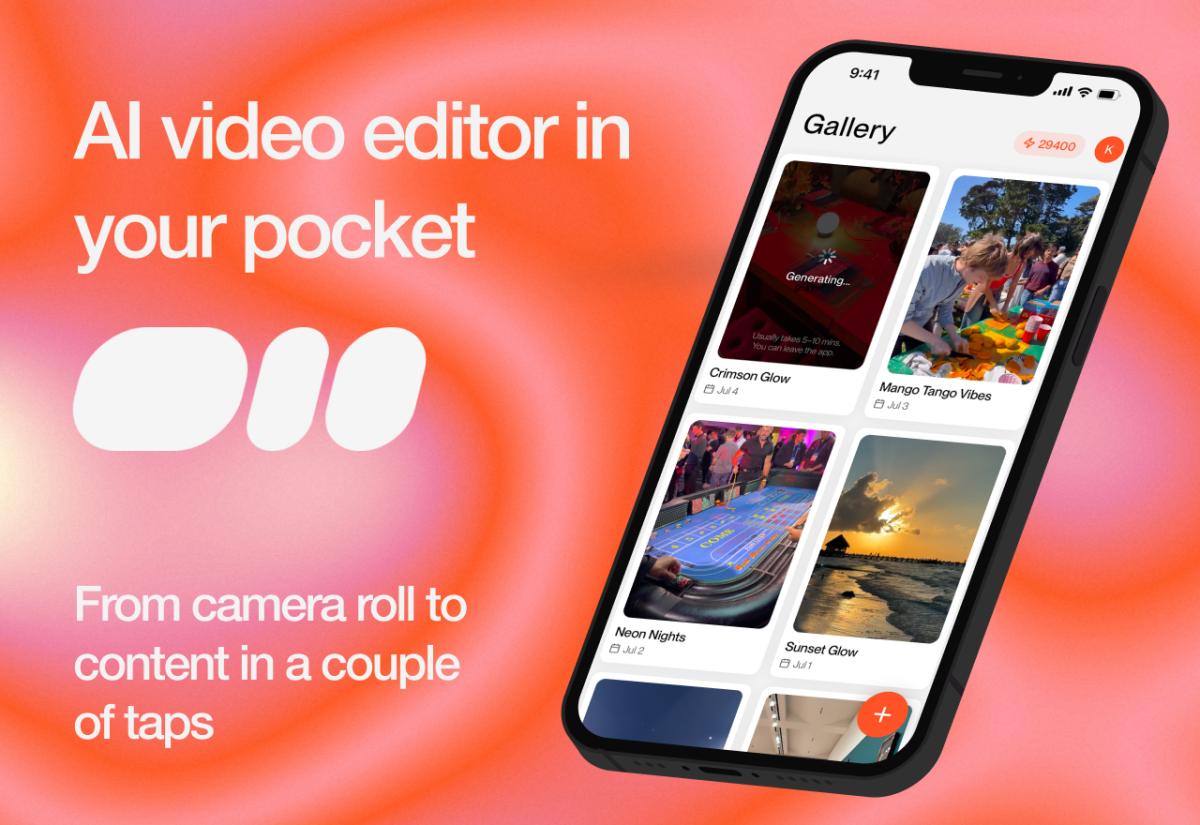
Reelful has launched a new iOS app that uses AI to turn photos and video clips from a user’s camera roll into short-form social videos ready for TikTok, Instagram Reels, and YouTube Shorts. The startup is aiming at creators, founders, and small businesses that want to publish more often without spending hours on editing.
The launch matters because it highlights how quickly video creation is shifting from manual editing software toward AI systems that can plan, script, voice, and assemble content with minimal human effort. Reelful joins a crowded but fast-growing category of AI video tools that are trying to make content production feel more like messaging an assistant than working in a timeline editor.
What Reelful does and why it is different
Reelful is designed to automate the most time-consuming parts of making short-form video. Instead of importing clips into editing software, arranging shots, adding transitions, recording a voiceover, and polishing captions by hand, users feed the app a prompt, a set of media files, and a voice sample. The app then builds the draft on its own.
That places Reelful in the emerging class of AI “agent” products that do not just generate text or images, but actively carry out multi-step creative tasks on behalf of the user. For many people, the appeal is not novelty. It is speed.
Reelful’s creator, Kate Deyneka, a former Snapchat machine learning engineer who worked on video and image models, says the product grew out of a simple problem: a lot of people have interesting lives, footage, and ideas, but not enough time to package them into videos worth posting.
Deyneka said in an interview that she sees Reelful as a way to help busy founders and professionals build an online presence and personal brand without getting stuck in the editing process.
How Reelful works
Reelful’s workflow is built to be quick and conversational. A user starts by describing the kind of video they want to make, such as a travel recap, a product demonstration, or an event highlight. From there, the app asks for a short voice recording and access to selected photos and videos from the camera roll.
Once those inputs are in place, the app attempts to handle the rest: it organizes the story, writes a script, generates a voiceover, and composes the final cut with music, captions, and sound effects.
The result is meant to look like the kind of polished, mobile-friendly clip that performs well on social platforms. Users can also keep refining the draft after it is generated by chatting with the app and asking for changes such as a different soundtrack, a rewritten script, or other adjustments.
Core workflow at a glance
- Users enter a prompt describing the video they want.
- They record a 30-second sample to create a voice clone.
- They choose photos and clips from their camera roll.
- Reelful scripts, voices, edits, and assembles the video.
- Users can continue editing through chat-based commands.
Why this startup is targeting founders and business owners first
Reelful is not trying to win over every type of creator at once. For now, the startup is focusing on founders, entrepreneurs, and business owners who need a steady stream of content to stay visible online.
Deyneka argues that this audience is especially well suited to automation because it often has plenty of raw material already on hand — event footage, product clips, client transformations, customer interviews, and behind-the-scenes moments — but lacks the time or staff to turn that material into social-ready content.
That use case is especially relevant for early-stage founders, who may be building a company, meeting customers, and traveling to events at the same time. Reelful’s pitch is that those people should be able to capture content during the day and have a finished post by the time they get home.
Deyneka described the ideal scenario as someone recording a short interview or event recap, uploading it while driving back from the venue, and finding a finished video waiting later that evening.
That kind of promise is central to the company’s positioning. The app is not just selling editing assistance; it is selling time back to users whose schedules make traditional content workflows unrealistic.
How does the AI transform still photos into video?
Reelful can animate still images into short AI-generated video clips, giving a user’s camera roll more motion and cinematic energy. In the example shared by the company, a simple photo of someone cutting a mango can be turned into a moving clip that appears to show the action continuing on screen.
That feature reflects a broader trend in generative media: AI tools are increasingly trying to bridge the gap between static and dynamic content. For social media, where motion often drives engagement, that capability can make even older or less polished media usable in a fresh format.
To maintain transparency, Reelful adds a watermark to videos generated by AI. That matters as platforms and users alike become more sensitive to synthetic media and the need to clearly identify it.
How Reelful fits into the wider AI video boom
Reelful is launching into a market that is already crowded with AI video products, but also still expanding quickly. Startups such as Opus Clip and Captions have shown that there is real demand for tools that simplify repurposing, editing, and publishing video.
The larger industry shift is even more important than any single app. Video production has historically required a mix of software skill, creative judgment, and a significant time investment. AI is steadily lowering that barrier by handling repetitive tasks and, in some cases, generating nearly complete drafts from simple instructions.
For startups, that opens two opportunities. First, they can sell productivity to creators and businesses. Second, they can reshape how people think about content creation altogether, making it more habitual and less technical.
Reelful’s arrival also underscores a broader change in startup language. Companies once marketed editing automation; now they increasingly frame their products as agents that can “do” the work, not merely assist with it.
Where Reelful sits in the market
Below is a snapshot of the product’s positioning compared with the general AI video editing trend.
| Category | Reelful approach | Why it matters |
|---|---|---|
| Primary device | iOS only at launch | Starts where many creators already capture content |
| Input method | Prompt + camera roll + voice sample | Reduces the need for manual editing steps |
| Output | Short-form social videos | Matches TikTok, Reels, and Shorts formats |
| Editing model | AI-generated draft with chat-based revisions | Makes editing more conversational and automated |
| Target user | Founders and business owners | Focuses on people with content needs but limited time |
Who founded Reelful?
Reelful was founded by Kate Deyneka, a machine learning engineer who previously worked at Snapchat on video and image models. Her background is significant because it suggests the company’s technology is being built by someone who has already worked on the core problems behind visual AI products.
That experience also gives Reelful a practical product angle. Rather than treating AI video as a novelty, the startup appears to be approaching it as an infrastructure problem: how to make content generation reliable, useful, and frictionless enough for everyday use.
Reelful is currently part of a16z’s Speedrun program, which is aimed at helping early-stage startups move quickly through product development and growth. Participation in that program also signals that the company is trying to position itself within a highly competitive but investor-friendly corner of consumer AI.
What pricing options does Reelful offer?
Reelful uses a mix of one-time purchases and subscriptions, giving users multiple ways to pay depending on how often they create videos. The pricing structure is fairly straightforward and clearly designed to appeal to both occasional and heavier users.
The company’s current plans are as follows:
- 5 videos for $15
- 15 videos for $43
- 33 videos for $90
- Creator plan: $25 per month for 10 videos
- Pro plan: $50 per month for 25 videos
- Studio plan: $100 per month for 60 videos
The variety suggests the company is still testing how users want to buy AI-generated video capacity. Credits may appeal to occasional creators, while subscriptions are likely aimed at businesses and professionals that need a more predictable publishing cadence.
Why this matters for creators and small businesses
Short-form video has become one of the most important formats in digital marketing and personal branding. But the format’s popularity has also raised the pressure to produce content regularly, which can be difficult for individuals and small teams that do not have dedicated editors.
Reelful’s pitch is that it turns an existing stash of photos and clips into something publishable without requiring users to learn a more complex creative tool. That could make a difference for business owners who know they need to post, but routinely stall at the editing stage.
For local businesses, consultants, founders, and creators, the appeal is obvious: social content can help drive discovery, trust, and engagement. The problem is not necessarily a lack of material. It is the friction between having material and having a finished post.
By automating that gap, Reelful is trying to convert dormant footage into marketing output. That is a small technical idea with potentially large practical value.
Potential beneficiaries
- Startup founders documenting launches, travel, and events
- Small businesses showcasing products or transformations
- Solo creators trying to post more consistently
- Agencies or teams producing repeatable social content
What are the limitations and questions around AI-generated social video?
Reelful’s automation may save time, but it also raises the same questions that follow many generative AI products: how much creative control users want to surrender, how accurate the system’s edits will be, and how audiences will respond to synthetic-looking content.
There is also the issue of authenticity. Social platforms reward speed and consistency, but they also reward content that feels personal and real. Reelful’s watermark helps signal that AI was involved, yet the broader challenge remains: users may want automation without losing their own voice.
The app’s chat-based editing may help on that front by giving users a way to override the default output. Still, the more an app handles on its own, the more important it becomes for users to understand what the machine is doing, why it chose certain clips, and how much creative judgment has been embedded into the final result.
Those tensions are likely to define the next phase of AI content tools. Products that merely save time may not be enough. The winners may be the ones that balance automation with enough control to keep creators confident in the output.
Timeline: Reelful’s launch in context
Reelful’s debut fits into a larger sequence of developments in consumer AI and creator tools. Here is a simplified timeline of the product story so far.
| Timeframe | Event | Significance |
|---|---|---|
| Before launch | Kate Deyneka leaves Snapchat | Brings ML and visual AI experience to a new startup |
| Startup phase | Reelful joins a16z’s Speedrun program | Receives early-stage startup support and visibility |
| Launch | Reelful debuts on iOS | Brings AI video generation to mobile users |
| Next steps | Android and web versions planned | Could broaden access beyond Apple devices |
What comes next for Reelful?
For now, Reelful is available only on iOS, but Deyneka says Android and web versions are planned for the future. That expansion will matter if the company wants to move beyond an early adopter audience and reach a wider range of creators and business users.
Cross-platform support will also be important if Reelful wants to become part of a workflow rather than just a novelty download. Many small businesses and solo creators work across devices, and web access could make it easier to upload assets, review drafts, and publish at scale.
Long term, the startup’s success will likely depend on whether users feel the app consistently produces videos that are good enough to publish with little extra work. In a market where attention is scarce and social feeds move fast, the value proposition is simple: make content creation fast enough that people actually do it.
That is the bet behind Reelful. If the app can make posting feel effortless, it may tap into a strong and growing demand among people who already have the raw ingredients for content — they just need a machine to turn them into something shareable.
Frequently asked questions
What is Reelful?
Reelful is an AI video editor for iPhone that turns photos and video clips from a camera roll into short-form social videos. Users provide a prompt, a voice sample, and selected media, and the app generates a polished draft for platforms like TikTok, Instagram Reels, and YouTube Shorts.
How does Reelful create videos automatically?
Reelful creates videos by asking users to describe the story they want to tell, then using AI to plan the edit, write a script, generate a voiceover, and combine captions, music, and sound effects. It can also animate still photos into moving clips and lets users revise the result through chat.
Who is Reelful for?
Reelful is mainly aimed at founders, business owners, and other busy creators who need to post social content regularly but do not have time for manual editing. The company says it is especially useful for people who already have footage from events, interviews, product demos, or customer transformations.
How much does Reelful cost?
Reelful sells both one-time video bundles and subscriptions. Credit packs start at $15 for five videos, while monthly plans range from $25 for 10 videos to $100 for 60 videos, depending on how much content a user wants to generate.
Is Reelful available on Android or web?
Not yet. Reelful is currently available only on iOS, but the company says Android and web versions are planned for the future as it tries to broaden access beyond Apple devices.