In short
Google has launched Gemini 4 Hydrogen in Search worldwide, saying the new model improves how AI search handles complex queries, multi-step workflows and visual responses. The rollout is part of a broader push to make Search faster, cheaper and more useful for everyday users and developers.
- Google says Gemini 4 Hydrogen is now rolling out worldwide in Search.
- The company says Hydrogen is 2.5x faster than Gemini 3.8 Flash.
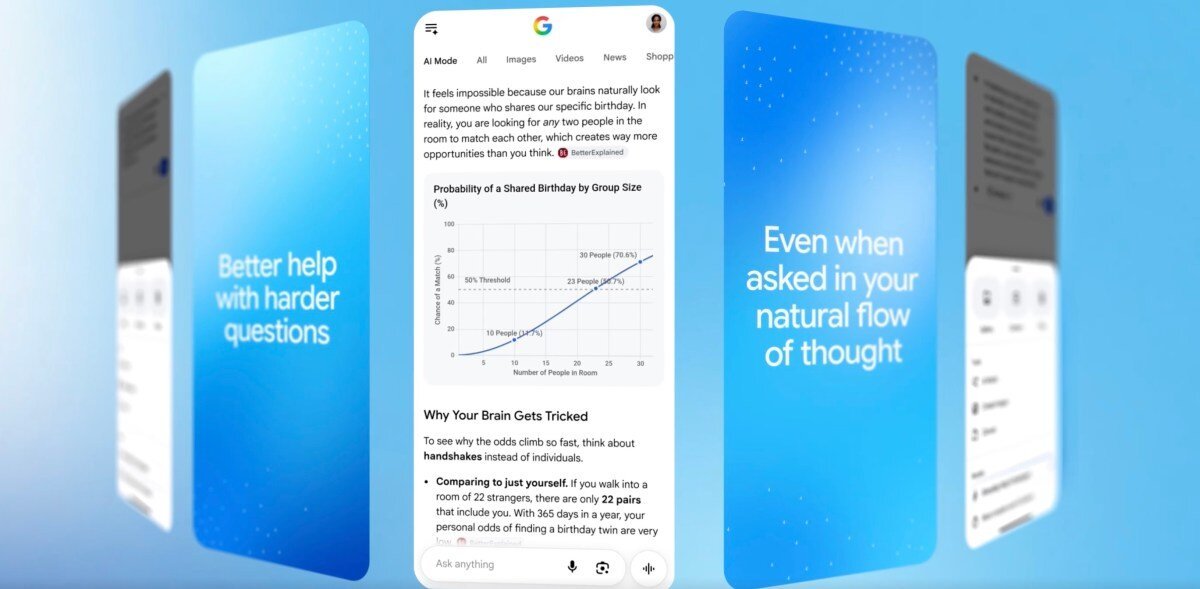
- AI Mode will show more images, structured responses and comparison tables.
- Hydrogen can be paired with Gemini 4 Carbon and Argon in multi-model workflows.
- Google is also rolling Hydrogen out to AI Studio, the Gemini API and the Gemini App.
Google has rolled out Gemini 4 Hydrogen worldwide in Search on 2026-11-12, using the new model to improve how Search handles complex, multi-part and typo-heavy queries. The update matters because Google is trying to make AI-powered search answers faster, cheaper and more useful at global scale while broadening the kinds of results people see.
What Google changed in Search
According to TechCrunch, Google says Gemini 4 Hydrogen is now powering a worldwide Search rollout for all users. The company presents the model as its biggest Search model improvement yet, and it is built to execute quickly across agentic multi-step workflows.
In practical terms, Google is aiming to improve the system’s ability to understand what a person actually wants when the query is messy, specific or packed with multiple parts. The company says Search can now better handle those harder questions, while also producing more helpful links and visual responses.
Google’s AI Mode is also getting broader language support, with answers improving across the multiple languages Google already supports. The Search experience itself is being tuned so that the fan-out query technique surfaces more related sites, while AI Mode shows more images, structured responses, comparison tables and custom tools.
Why it matters
This update is not just a model swap. It suggests Google is pushing Search deeper into a hybrid system where speed, cost and breadth matter as much as raw reasoning power.
That shift matters for users because many real searches are not clean one-question prompts. They are fragmented, technical, location-specific or full of spelling errors. Google is betting that a faster model can make those searches feel more responsive without requiring the most expensive reasoning setup every time.
It also matters for publishers and the broader search market. If AI Mode answers become more visual, more structured and more self-contained, users may spend less time moving through standard blue-link results. At the same time, Google’s fan-out system is designed to surface more related sites, which could reshape how traffic is distributed across the web.
For competitors, the rollout is a signal that Google is not standing still in AI search. The company is trying to make generative search feel faster and more precise while keeping it integrated with the product billions of people already use.
How does Gemini 4 Hydrogen fit into Google’s AI strategy?
Gemini 4 Hydrogen appears to be Google’s faster, cheaper option for situations where top-end reasoning is not needed. That positioning is important: instead of using the most capable model for every task, Google is carving out a role for a lighter-weight system that can still handle a wide range of search and productivity demands.
TechCrunch reports that Google says Hydrogen runs 2.5x faster than Gemini 3.8 Flash. The company also says Hydrogen beats Gemini 4 Argon on the Artificial Analysis Intelligence Index at the default high thinking level.
Those claims point to a familiar trade-off in AI products: speed versus depth. Google’s answer here is not to choose one over the other, but to deploy different Gemini 4 variants for different needs.
Four thinking levels for different jobs
Hydrogen offers four thinking levels: low, medium, high default and xhigh. That structure suggests Google wants to let the model scale up or down depending on the complexity of the request.
The model is also said to be capable of everyday coding, testing and code-change verification tasks. That broadens its use beyond Search and makes it more relevant for developers and product teams using Google’s AI tools.
What changed for AI Mode and results pages?
Google’s AI Mode is getting a more visual and structured response style. TechCrunch reports that users should see more images, more comparison tables and more custom tools inside AI Mode responses.
That matters because the format of an answer can be as important as the answer itself. A better comparison table can help a user decide between products, places or technical options faster than a plain paragraph. More visual responses may also make Search feel more immediate for shopping, planning and research queries.
The fan-out query system is part of that change. Fan-out breaks one search prompt into several subqueries, broadening the range of results. Google says Hydrogen improves this process by surfacing more related sites.
In other words, the company is trying to make search both broader and more usable: more underlying web coverage, but packaged in a way that feels concise and AI-assisted.
By the numbers
| Metric | What Google says | Why it matters |
|---|---|---|
| 2.5x faster | Hydrogen versus Gemini 3.8 Flash | Suggests Google is prioritising speed for search and workflow use |
| No. 5 | Hydrogen’s rank on Agent Arena | Shows the model is competitive on deep research and codebase tasks |
| 4 | Thinking levels available in Hydrogen | Indicates the model can scale from lighter to heavier reasoning |
| 2026-11-12 | Rollout date reported by TechCrunch | Marks the start of the global Search deployment |
What is the model good at?
Hydrogen is positioned as a model for fast execution across agentic multi-step workflows. That makes it relevant to tasks where an AI system needs to do several things in sequence rather than generate a single response.
Google also says the model can handle everyday coding, testing and code-change verification. Those are practical, workaday tasks rather than frontier research demonstrations, which reinforces the idea that Hydrogen is meant to be useful in day-to-day products.
The model is also reported to rank No. 5 on Agent Arena for deep research, data analysis and broad codebase navigation. That ranking suggests it can perform beyond simple Q&A, even if Google is marketing it as the faster option for many cases.
How Google is using multiple Gemini models together
Hydrogen can be paired with Gemini 4 Carbon and Gemini 4 Argon in multi-model workflows. That means Google is not treating the new model as a stand-alone system, but as one part of a layered stack.
This is a notable design choice. Rather than asking one model to do everything, Google appears to be building an environment where one model can handle speed-sensitive tasks while another handles heavier reasoning when needed.
Background: how Google got here
Google has been steadily adding generative AI features to Search and AI Mode to improve query understanding and responses. The company’s broader effort has been to make search engines less dependent on exact keyword matching and more capable of interpreting intent.
That history matters because the Hydrogen rollout extends a trend already visible in Google Search: users increasingly get answers assembled from a mix of web results, AI interpretation and structured presentation. The latest update pushes that model further by improving the system’s handling of complex questions and broadening the response formats users see.
The fan-out approach also fits into that same evolution. By splitting a prompt into multiple related searches, Google can cast a wider net across the web while still presenting a single, polished answer experience.
Timeline of the rollout
TechCrunch reports the key milestones of the launch on the same day Google made the move public.
- 2026-11-12: TechCrunch reports Google unveiling Gemini 4 Hydrogen for Search.
- 2026-11-12: Google says the rollout begins for Search users globally.
Beyond Search: where Hydrogen is appearing next
The Search rollout is only part of the story. Google is also rolling Hydrogen out to AI Studio, the Gemini API, the Gemini App and paid AI Pro/Ultra users in Antigravity, according to TechCrunch.
That wider deployment shows Google wants the model to matter across both consumer-facing products and developer tools. Search is the headline use case, but the company is also putting Hydrogen into places where developers and paid users can test it directly.
That could help Google gather feedback quickly on how the model performs outside Search and whether its speed-focused positioning holds up in real-world use.
What happens next
The most immediate question is how fast the global rollout reaches every region and whether availability looks the same everywhere. Google says the rollout reaches all Search users globally, but the exact timing of full local availability is still an open question.
Another issue is verification. Google has shared performance claims, including the 2.5x speed figure and the Artificial Analysis Intelligence Index result, but TechCrunch notes the broader question of whether the company will publish independent benchmark validation remains open.
There is also a product question: how often will users see more images, structured responses and comparison tables in AI Mode? If those elements become more common, the search experience could shift noticeably toward richer answer blocks and fewer purely link-based results.
For publishers, the key thing to watch is traffic impact. Improved fan-out and more self-contained responses could change how often users click through to sites, even if Google says it is surfacing more related sources.
What to watch in the coming weeks
- Whether Google releases more detail on Hydrogen’s rollout by region.
- Whether independent testing confirms Google’s speed and benchmark claims.
- How often AI Mode shows structured responses and comparison tables.
- Whether publishers report traffic changes tied to fan-out and visual answers.
The bigger competitive picture
Google’s move underscores how central Search has become to the AI race. The company is using Gemini not just to improve chatbot-style products, but to rethink the core search experience that drives much of its business.
By making Hydrogen faster and cheaper for cases that do not require the heaviest reasoning, Google is trying to make AI search more efficient at scale. That may be the most important part of the announcement: not simply that Search gets smarter, but that it gets smarter in a way designed to be practical for everyday use.
If Google can keep response quality high while cutting latency and cost, it strengthens the case for AI-generated search answers as a default part of the product. If not, the company risks adding complexity without enough user benefit. The rollout of Gemini 4 Hydrogen is, in that sense, both a product update and a test of Google’s wider AI search strategy.
“biggest model improvement to Search yet”
Frequently asked questions
What is Gemini 4 Hydrogen in Google Search?
Gemini 4 Hydrogen is Google’s newly released model for Search, and Google says it improves how the product handles complex, multi-part and typo-heavy queries. It is also positioned as a faster, cheaper option for tasks that do not require the most advanced reasoning.
How does Gemini 4 Hydrogen change AI Mode?
It makes AI Mode more visual and structured, according to TechCrunch’s reporting on Google’s launch. Users should see more images, comparison tables, custom tools and improved responses across the languages Google already supports.
Why is Google using a faster model for Search?
Google appears to be balancing cost, speed and usefulness. Hydrogen is designed for fast execution across multi-step workflows, so it can power everyday search tasks without always relying on the heaviest model in the Gemini lineup.
Will Gemini 4 Hydrogen be available outside Search?
Yes. TechCrunch reports that Google is also rolling Hydrogen out to AI Studio, the Gemini API, the Gemini App and paid AI Pro/Ultra users in Antigravity, expanding its use beyond Search.