Updated August 11, 2026 12:25 pm
In short
Discovered Materials says it is now showcasing hundreds of generated materials, benchmarking frontier models on the task, and aiming to patent chip-related breakthroughs within the next year.
- Discovered Materials raised $9 million in seed funding led by Lightspeed India Partners.
- The startup uses AI agents plus physics simulations to search for semiconductor materials that reduce chip heat.
- It released a new benchmark, the Material Discovery Bench, to track frontier model performance on discovery tasks.
- The company plans to patent useful materials or manufacturing processes and license them to chipmakers.
- AI-driven materials discovery remains promising, but lab validation and manufacturing are still major bottlenecks.
Update — August 11, 2026 12:25 pm
Discovered Materials said it has now released examples of hundreds of newly generated materials and launched a benchmark, Material Discovery Bench, to test how frontier AI models handle the search process.
The startup also said it has already found several candidates that match properties of materials used by major chipmakers, though it is still holding back the specifics.
Looking ahead, co-founder Advaith Sridhar said the company wants to have materials worth patenting within about a year, likely around GPU use or the manufacturing process itself.
Update — August 10, 2026 3:24 pm
Discovered Materials also said it has published examples of hundreds of new materials and launched a benchmark called Material Discovery Bench to measure how frontier models perform on the task.
The company added that it hopes to have materials worthy of patenting within the next year, and that any eventual IP would likely cover either use in GPUs or the process for making chips from the substances.
More broadly, the startup says the hard part is no longer just generating candidates, but filtering, synthesizing, and validating them in the lab.
Discovered Materials, a newly launched materials startup, says it has raised a $9 million seed round to use AI agents and physics models to hunt for semiconductor materials that can help chips run cooler. The company’s goal is to tackle one of the AI era’s biggest hidden costs: the heat and power demand created by ever-denser, ever-hotter processors.
The San Francisco-area startup, which emerged from Y Combinator, is betting that a focused search for better chip materials could eventually yield patentable breakthroughs with real commercial value for GPU makers and other semiconductor companies.
Why chip heat has become such a valuable target
AI chips are pushing data centers harder than almost any other computing workload, and the result is a simple physical problem: more computation means more electricity, which means more heat. That heat has to be removed through elaborate cooling systems, which increases costs, complicates infrastructure, and limits how far the industry can scale.
That is why materials science has become an attractive frontier for startups and large labs alike. If engineers can find substances that move heat away faster, tolerate more thermal stress, or improve the efficiency of a chip’s package and interconnects, they could reduce the burden on the entire data center stack.
Discovered Materials is trying to accelerate that search with software. Instead of relying only on traditional trial-and-error lab work, the company uses AI systems to generate candidate materials, then checks those candidates with physics-based simulation before any promising result moves deeper into experimentation.
What did Discovered Materials raise, and who backed it?
The company said it closed a $9 million seed round led by Lightspeed India Partners. Peak XV Partners also participated, along with several well-known angel investors including Paul Graham, Gokul Rajaram, and Thariq Shihipar.
For a startup at this stage, the cap table is notable not just for the amount raised, but for the mix of investors who are willing to back a highly technical search problem. The funding suggests that some venture firms see a path to defensible intellectual property in materials discovery, even if commercialization may take time.
| Key detail | Information |
|---|---|
| Company | Discovered Materials |
| Founded by | Advaith Sridhar and Akash Ramdas |
| Recent funding | $9 million seed round |
| Lead investor | Lightspeed India Partners |
| Other investors | Peak XV Partners, Paul Graham, Gokul Rajaram, Thariq Shihipar |
| Primary focus | Materials for cooler, more efficient semiconductor chips |
| Core workflow | AI agents plus physics simulations and lab validation |
How does the company use AI agents to search for new materials?
Discovered Materials uses a two-step pipeline: AI agents first produce candidate materials, then scientific models evaluate whether those candidates appear physically plausible and useful. The company says it relies on Anthropic models inside a custom framework to generate leads, while its in-house physics models run simulations to test them.
In practical terms, the agents are acting like tireless research assistants. Instead of a scientist manually trying a handful of ideas each day, the software can explore thousands of possibilities around the clock, narrowing a very large search space into a smaller set of potentially viable options.
Co-founder Advaith Sridhar said that during Akash Ramdas’s doctoral work, the pace of material exploration was far slower, limited to only a few dozen guesses per day. With agentic software running continuously in the cloud, he said the team can now generate thousands of candidate ideas daily and direct them toward specific research paths.
Why combine AI generation with physics modeling?
Because in materials science, a plausible idea is not the same as a useful one. A candidate might look promising in simulation, but fail when it comes to manufacturability, electrical performance, stability, or cost.
The company’s system is designed to catch those failures earlier. By screening candidates with physics models before spending time and money in the lab, Discovered Materials hopes to avoid the common trap of producing elegant but impractical concepts.
Who founded Discovered Materials?
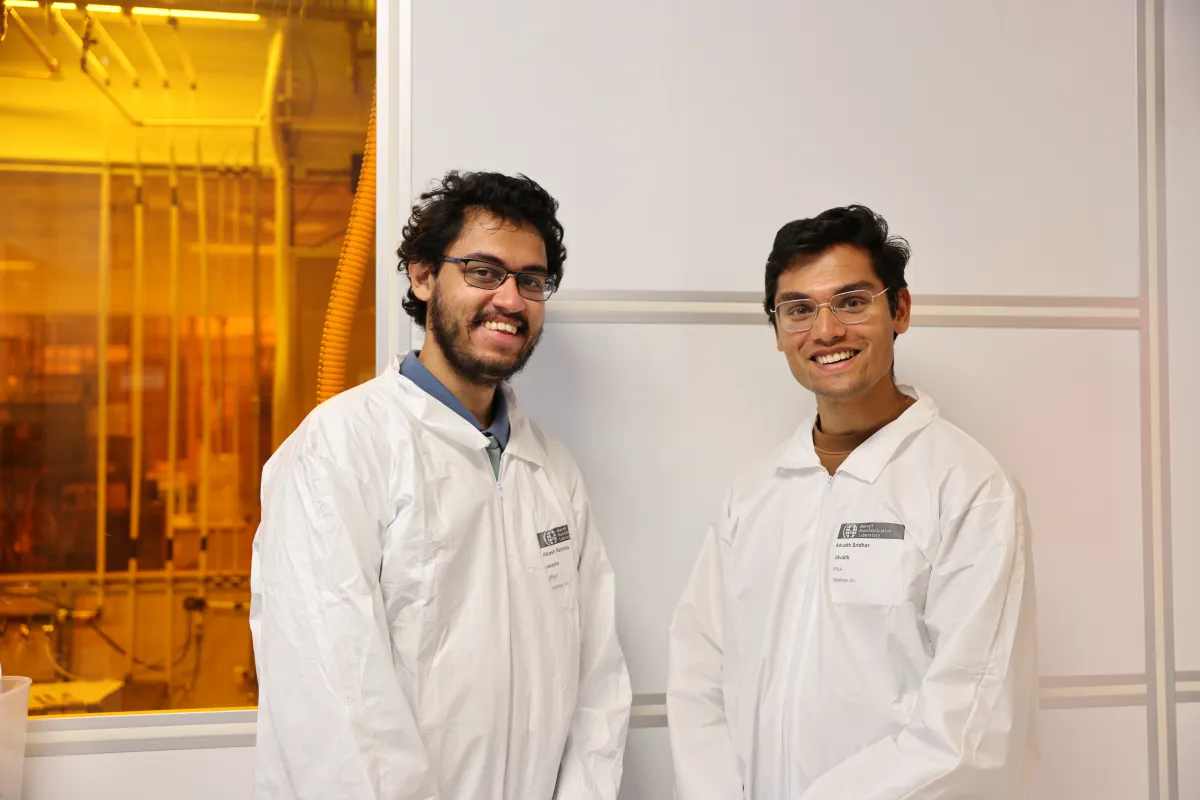
Discovered Materials was founded by Advaith Sridhar and Akash Ramdas, two technologists with complementary backgrounds. Ramdas earned a PhD in materials science from Stanford, giving the company deep domain knowledge on the research side. Sridhar previously worked on agents at Persona AI and Luma Labs, giving him direct experience with the tooling the startup now wants to apply to science.
That combination matters because materials discovery has historically depended on specialized scientific intuition and slow experimental iteration. A startup trying to automate part of that workflow needs both strong chemistry or materials expertise and strong software engineering around agents, models, and data pipelines.
According to Sridhar, the difference between the old workflow and the new one is scale: what once required careful manual guessing can now be run continuously by cloud-based agents that keep exploring research directions without stopping.
Why is the company focusing on thermal materials for semiconductors?
Discovered Materials is narrowing its attention to thermal problems in chips because the company believes that a tightly defined use case gives it a better chance of producing practical results. Rather than trying to solve materials discovery across every industry at once, it is concentrating on one of the semiconductor sector’s most urgent pain points.
Heat is not just an inconvenience for chipmakers. It affects performance, lifespan, packaging, power efficiency, and the density of compute that can be deployed in a data center. For AI hardware, where workloads are expensive and power hungry, every improvement in thermal behavior can have outsized economic value.
The startup says it has already identified several materials with properties comparable to those used by major chipmakers, although it is not disclosing the specific details yet. That is a typical early-stage move in a potentially patentable field, especially when a company expects to license discoveries rather than manufacture chips itself.
What makes semiconductor materials so hard to optimize?
Because the trade-offs are relentless. A material that transfers heat well may be difficult to produce at scale. One that is cheap to fabricate may fail under electrical stress. Another may look promising in simulation but prove unstable in real-world conditions.
Hemant Mohapatra, the Lightspeed partner who led the investment, described the problem as a constant back-and-forth among atomic-level constraints. In his view, a material only becomes commercially useful if several requirements line up at once: thermal behavior, manufacturability, and electrical performance must all clear the bar together.
How big is the opportunity for AI in materials science?
The opportunity is large, but the industry is still waiting for a breakout commercial success. AI has already helped researchers identify promising compounds and candidate molecules, yet relatively few discoveries have become major products at scale.
In pharmaceuticals, Insilico Medicine’s Rentosertib is often cited as a landmark because it became the first drug discovered using generative AI to reach Phase II clinical testing. Materials science has also produced intriguing results, including rare-earth-free magnets from MatNex and semiconductor candidates explored by Panasonic and Citrine Informatics. But those advances have not yet translated into mass deployment.
That gap between scientific promise and industrial adoption is exactly where many startups hope to build durable businesses. If an AI system can reliably find better candidates faster, it can help generate intellectual property, partner with manufacturers, and potentially shorten the time it takes to move from lab result to licensed technology.
Why investors think the market may still be early
Mohapatra argues that model quality will keep improving and that the basic act of predicting novel substances may eventually become more common. He believes the harder challenge is not finding enough candidates, but filtering them correctly and manufacturing them reliably once they are found.
That distinction matters for investors. If candidate generation becomes commoditized, the advantage will shift toward teams with deep domain expertise, proprietary datasets, and the ability to validate discoveries in the lab faster than competitors.
What happens after a promising material is found?
Discovered Materials says its commercial strategy is to patent either the use of a material in GPUs or the process used to make chips from that material, then license those rights to chipmakers. In other words, it wants to become an upstream IP company rather than a chip manufacturer.
The startup hopes to have new materials worth patenting within the next year. That is an ambitious timeline in a field where experimental confirmation, manufacturing feasibility, and partnerships with industrial customers often take much longer.
Even if the company identifies a strong candidate, there is still a long road ahead. The most difficult stage may be not discovery, but synthesis. Mohapatra said the real bottleneck is often figuring out how to filter the enormous universe of possibilities and then actually make the winning material in a usable form.
What are the biggest obstacles to commercialization?
The biggest obstacle is that materials science cannot be fully digitized. AI can help narrow the field, but it cannot eliminate wet-lab work, manufacturing constraints, or the need for iterative validation.
That means the pace of progress will still be governed by physical reality. A software model can produce thousands of options quickly, but each one has to survive the slower, more expensive world of lab experiments and process engineering.
- Manufacturing limits: A strong candidate may be hard to produce consistently.
- Electrical trade-offs: Better thermal performance can come with worse electronic behavior.
- Scale-up challenges: Results that work in a lab may fail in production.
- Validation time: Wet-lab testing remains essential and cannot be rushed indefinitely.
Ramdas acknowledged that reality directly, saying the process still requires hands-on lab work and that this part of the workflow cannot simply be accelerated away by software.
How does Discovered Materials compare with other startups?
Discovered Materials is entering a field that already includes companies such as MatNex, SandboxAQ, and CuspAI, all of which are exploring versions of AI-assisted materials discovery. The difference, the startup argues, is its narrower focus on thermal materials for semiconductors.
That focus may prove important. Broad discovery platforms can be difficult to commercialize because they cover too much ground. By concentrating on a problem with immediate economic importance for the semiconductor industry, Discovered Materials is trying to increase the odds that at least some of its discoveries map cleanly to customer demand.
At the same time, specialization can be limiting. A company that focuses too tightly on one category of materials may find its addressable market smaller than that of a general platform. The startup appears willing to accept that trade-off in exchange for a sharper wedge into a crowded research market.
What the funding says about the AI materials race
The new financing underscores how much investor interest remains in applying AI to hard scientific problems. After the first wave of generative AI tools for text and coding, venture capital has increasingly moved toward applied science, where software can help compress discovery cycles and create proprietary data advantages.
That does not mean the winners will be obvious. Many startups in this category will likely struggle to prove that AI meaningfully outperforms conventional research workflows. Others may generate interesting results but fail to find a direct commercial route to market. Still, the amount of capital flowing into this space suggests investors believe the payoff could be substantial if a company finds the right technical and business model combination.
Discovered Materials is positioning itself for that outcome by pairing AI with a real-world lab loop. The startup’s pitch is not simply that AI can imagine materials faster, but that the company can move from idea generation to simulation to validation quickly enough to create patentable assets before rivals do.
Timeline of Discovered Materials’ early development
| Timeframe | Event | Why it matters |
|---|---|---|
| Before launch | Ramdas completes a Stanford PhD in materials science | Builds scientific depth for the startup’s research focus |
| Before launch | Sridhar works on agents at Persona AI and Luma Labs | Gives the company practical AI-agent experience |
| After launch | The company emerges from Y Combinator | Signals early validation from a major startup accelerator |
| Recent | Closes a $9 million seed round | Provides capital to expand research and validation |
| Today | Releases hundreds of material examples and the Material Discovery Bench | Shows the company is trying to benchmark frontier models in this domain |
| Next 12 months | Seeks materials worth patenting | Defines the startup’s near-term commercial milestone |
Why the company’s benchmark matters
Discovered Materials also released a benchmark called the Material Discovery Bench, which is intended to measure how frontier models handle this scientific challenge. Benchmarks matter because they can turn a fuzzy research claim into something more concrete and comparable.
If the benchmark gains traction, it could help researchers evaluate which models are genuinely useful for discovery tasks and which are merely generating plausible-looking outputs. In that sense, the benchmark is not just a marketing asset; it could become part of the startup’s data moat if the company can keep extending and refining it.
It also signals a broader trend in AI: the rise of task-specific evaluation suites that try to measure how well models perform in narrow but economically important domains. For materials discovery, where the cost of false positives is high, such a benchmark could become a useful reference point for the industry.
What should the industry watch next?
The key question is whether Discovered Materials can turn simulations and candidate generation into validated materials that semiconductor companies actually want to license. If it can, the startup may offer one of the clearest examples yet of AI-driven discovery creating value in a hard science domain.
Watch for three signals over the next year: whether the company can disclose patentable materials, whether any partner or customer emerges from the chip industry, and whether its benchmark becomes a meaningful reference for scientific AI tools.
For now, the story is less about a finished product than about a strategy: use AI agents to search more broadly, use physics to filter more intelligently, and use the lab to prove what matters. In a field defined by bottlenecks, that may be enough to attract the next round of attention — and, the company hopes, the next breakthrough.
Frequently asked questions
What does Discovered Materials do?
Discovered Materials uses AI agents and physics simulations to search for new semiconductor materials, with a focus on reducing heat and improving efficiency in chips used for AI workloads.
How much funding did Discovered Materials raise?
Discovered Materials raised $9 million in a seed round. Lightspeed India Partners led the financing, and Peak XV Partners plus several angel investors also participated.
Why is chip heat such a big problem?
Chip heat is a major problem because AI workloads consume large amounts of power, which creates thermal stress, raises cooling costs, and can limit how densely data centers can deploy compute hardware.
How does the startup use AI in its research process?
The startup uses Anthropic models inside a custom system to propose candidate materials, then applies in-house physics models to simulate and verify whether those candidates are likely to be useful.
Will Discovered Materials make chips itself?
No, the company’s stated plan is to patent promising materials or the process for using them in GPUs and then license those rights to chipmakers rather than manufacture chips directly.