In short
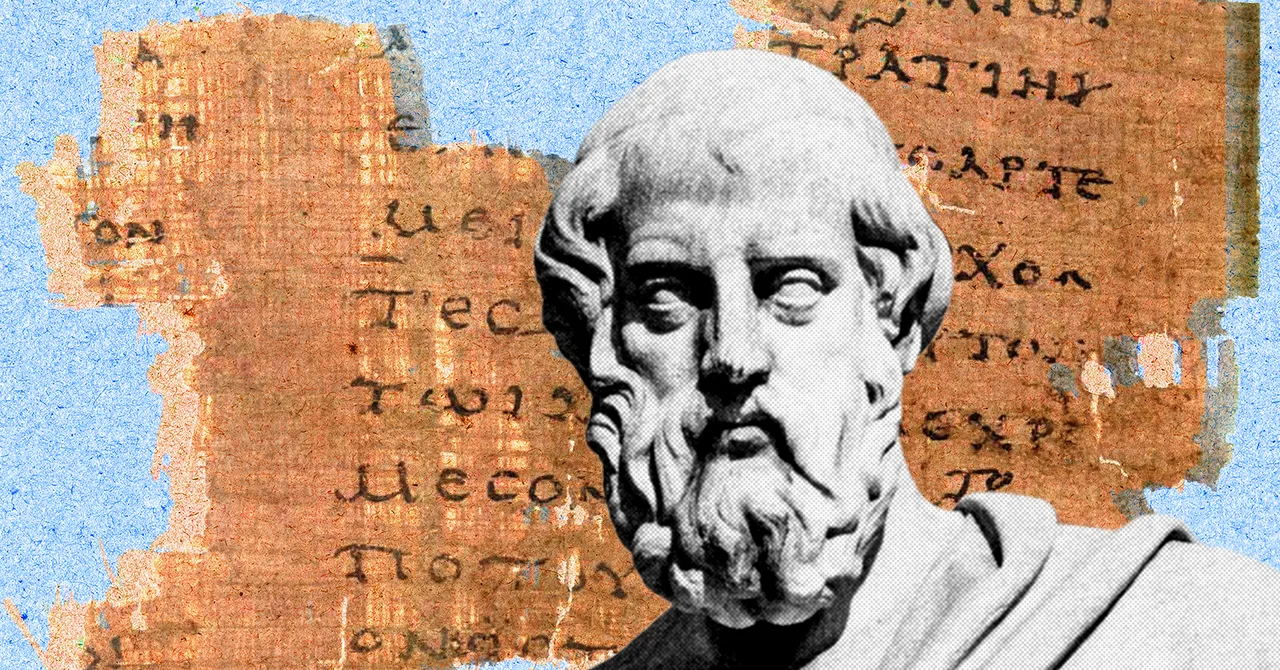
Apollo is a new AI chatbot designed to help scholars restore damaged Ancient Greek papyrus fragments. Built from about 600 million historical Greek words, it will offer probable reconstructions while keeping human experts in control.
- Apollo is an AI chatbot built specifically for Ancient Greek restoration.
- The model was trained on roughly 600 million historical Greek words.
- It will be free for academics and is meant to speed up papyrus reconstruction.
- Researchers say human oversight remains essential to avoid historical errors.
- The same approach could eventually be adapted to Latin, Egyptian, and other fields.
A new AI chatbot called Apollo is being launched to help scholars read and restore damaged Ancient Greek papyrus fragments, using a model trained on roughly 600 million historical Greek words. The tool matters because it could speed up a painstaking academic process that has traditionally depended on a tiny pool of experts and years of manual reconstruction.
On Wednesday, the Austrian Academy of Science is set to unveil what it describes as the first advanced large language model built specifically for Ancient Greek, created with French AI company Mistral and technology services firm Sail Reply. The system is designed to help researchers identify, date, and reconstruct battered texts more quickly, while still leaving final interpretation in human hands.
The announcement adds a new chapter to the growing use of artificial intelligence in the humanities, where researchers are increasingly testing whether large language models can help sort, restore, and contextualize vast historical archives that would otherwise take lifetimes to process.
What Apollo is and why it matters
Apollo is an AI model tailored to Ancient Greek rather than modern conversational use. Its developers say the system can suggest plausible missing words or phrases in damaged texts, making it easier for academics to work through fragmentary papyri, inscriptions, and manuscripts that have long resisted complete restoration.
That focus matters because ancient Greek writing typically lacks spaces between words, and many surviving documents are badly deteriorated. Before any reconstruction can begin, a scholar usually has to determine the word breaks, estimate the date, identify the likely dialect or register, and then compare likely readings against historical context and reference texts.
By handling much of that preliminary sorting, Apollo is meant to move scholars from labor-intensive transcription work toward higher-level historical analysis.
How Apollo was trained
According to the Austrian Academy of Science, Apollo was trained on about 600 million words of historical Greek material gathered from manuscripts, papyri, and inscriptions. That corpus gives the model a large statistical base to draw on when predicting what text is most likely missing from a damaged source.
The project was developed in collaboration with Mistral and Sail Reply, combining classical scholarship with modern machine-learning infrastructure. The result is being positioned as a domain-specific language model rather than a general-purpose chatbot.
Researchers involved in the project say the model compresses a level of specialized knowledge that used to sit in the heads of a very small number of classicists and papyrologists. One partner involved in the effort described the ability to unlock this material with AI as something that would have seemed impossible only a year earlier.
Why ancient Greek is such a hard problem
Ancient Greek fragments are difficult because they are often incomplete, context-dependent, and written in forms that vary by time and region. A successful reconstruction usually requires not just language ability, but deep knowledge of history, literature, epigraphy, and the social circumstances in which a text was produced.
That is one reason the field has long depended on a relatively small number of experts. As one University College London classicist noted, there are only a handful of people anywhere in the world who can consistently combine the right historical and linguistic knowledge needed for this work.
Apollo is designed to reduce that bottleneck by making the first pass at probable readings and letting scholars refine the output.
What makes the model different?
Unlike a generic chatbot, Apollo is built to respond differently depending on the text it sees. If the fragment appears to reflect Homeric language, the model can lean toward Homeric Greek. If it encounters a Doric inscription, it can adapt to that dialect instead.
That contextual sensitivity is central to its usefulness. Ancient texts are not interchangeable, and a model that ignores genre, dialect, and period would be of limited scholarly value.
Anna Dolganov, a historian and papyrologist at the Austrian Academy of Science, said the system is intended to incorporate that kind of expertise directly into its predictions.
Dolganov said the model can recognize when a fragment resembles Homer and when it appears to be an inscription written in Doric, allowing it to narrow the likely wording in a way that reflects the source material rather than forcing a one-size-fits-all reading.
How will scholars actually use Apollo?
Apollo will be made available to academics through a chatbot-style interface, free of charge. The goal is not to replace philologists but to give them a faster way to search, compare, and test plausible restorations across a large and scattered body of material.
In practical terms, that could mean:
- identifying fragments relevant to a scholar’s specialty more quickly
- suggesting likely restorations for missing words or passages
- helping researchers compare alternatives before committing to a reading
- surfacing connections across documents that would be hard to spot manually
For many academics, the value is not that Apollo will solve every fragment, but that it can shorten the time between discovery and interpretation.
How does this change papyrology?
It changes the workflow more than the discipline itself. Researchers say the model can take over some of the repetitive work of restoration, leaving humans to judge whether a proposed reading makes sense historically and linguistically.
That could be especially useful for archives containing huge volumes of mundane material: private letters, property agreements, tax records, and administrative papers. These documents may not be glamorous, but they often hold the clearest clues about everyday life in antiquity.
Armand D’Angour of the University of Oxford, which holds the world’s largest ancient papyrus collection, said the system could substantially speed up the process by offering a small number of plausible options for each damaged gap.
D’Angour said that if a machine could present a few likely words for a missing passage, it would save scholars considerable time and help them focus more quickly on the historical implications of a text.
What Apollo is unlikely to do
Despite the excitement, researchers say Apollo is not likely to rewrite the broad narrative of the ancient world. Much of what survives in papyrus collections is routine rather than dramatic, and the model is unlikely to uncover a sudden cache of long-lost masterpieces.
Experts cautioned that while people might imagine a flood of newly recovered Sophocles plays or other literary treasures, that is not the realistic expectation. The more probable outcome is a steady stream of smaller but still valuable discoveries that sharpen existing historical understanding.
Those details could still matter a great deal. Even modest improvements in restoration can confirm scholarly hypotheses, refine timelines, or add nuance to what historians think they know about ancient administration, culture, and daily life.
Why human oversight still matters
The developers and academic users of Apollo are emphasizing caution. Large language models are statistical systems, which means they can generate plausible but incorrect answers if they are left unchecked. In historical work, that risk is especially serious because a wrong restoration can distort the record.
To reduce that danger, Apollo is built to offer multiple options rather than a single definitive answer. Scholars can then evaluate the suggestions, compare them with the context of the fragment, and decide which reading is most defensible.
Dolganov warned that the model should support expert judgment, not replace it. She stressed that if historians become overly dependent on AI-generated transcriptions or interpretations, the integrity of the field could suffer.
That caution reflects a broader debate across academia about the proper role of generative AI. In fields built on evidence, nuance, and source criticism, the value of speed has to be balanced against the danger of error.
Could the same approach be used elsewhere?
Yes. If Apollo performs well, its creators say the same method could be adapted to other ancient languages such as Latin or Egyptian, and potentially to other scholarly fields with large bodies of structured source material.
The basic idea is simple: train a model on a large, carefully curated corpus, then use it to index, classify, and suggest likely completions for incomplete records. In disciplines overwhelmed by documents, that could become a general-purpose research accelerator.
That broader ambition fits a larger pattern in AI research, where models are increasingly being used not only to converse or generate text but also to solve specialized scientific and academic problems. Recent examples include AI-assisted progress in mathematics and biology, underscoring how deeply the technology is spreading into technical domains.
How Apollo fits into the wider AI boom
Apollo is part of a wave of domain-specific AI tools that are reshaping how experts handle knowledge-heavy work. In this case, the target is not a consumer market but the archives, libraries, and museums that preserve the ancient world.
That makes the launch notable for two reasons. First, it shows that large language models can be applied to languages far outside everyday use. Second, it demonstrates that historians and classicists are no longer watching AI from the sidelines; they are beginning to design tools around it.
While most AI attention still centers on chatbots, coding assistants, and search products, Apollo highlights a quieter but potentially important frontier: using machine learning to recover knowledge that has been partially lost for centuries.
Timeline of the Apollo project
| Stage | What happened | Why it matters |
|---|---|---|
| Corpus building | Researchers assembled roughly 600 million words of historical Greek text. | Gives the model enough material to learn patterns across periods, genres, and dialects. |
| Model development | Austrian Academy of Science worked with Mistral and Sail Reply. | Combines classicist expertise with modern AI engineering. |
| Launch | The model is scheduled for public academic release on Wednesday. | Allows scholars to test the tool through a chatbot interface. |
| Future expansion | Developers say the approach could be adapted to Latin, Egyptian, and other corpora. | Points to a broader future for AI in the humanities. |
What scholars are hoping to gain
For classicists and papyrologists, the promise of Apollo is not automation for its own sake. It is the possibility of scaling a very slow craft without losing the judgment that makes the craft credible.
Researchers hope the system will help them focus on the bigger questions: what these documents reveal about governance, trade, family life, religion, labor, and identity in the ancient Mediterranean world.
In that sense, Apollo is less about replacing expertise than amplifying it. The fragments remain broken, the reconstructions remain provisional, and the final interpretation still belongs to people. But if the model performs as intended, scholars may be able to spend far less time guessing at missing letters and far more time explaining what those texts mean.
Key facts at a glance
- Launch date: Wednesday, Sept. 24, 2026
- Institution: Austrian Academy of Science
- Partners: Mistral and Sail Reply
- Training data: About 600 million historical Greek words
- Access: Free for academics through a chatbot interface
- Primary purpose: Restore and interpret damaged Ancient Greek papyri and inscriptions
For a field built on fragments, Apollo represents an attempt to make the fragmentary a little less forbidding. It will not solve the ancient world, but it may help scholars read more of what survives.
Frequently asked questions
What is Apollo in Ancient Greek research?
Apollo is an AI chatbot designed to help scholars restore damaged Ancient Greek texts. It suggests likely missing words or phrases from papyri, manuscripts, and inscriptions, while leaving final judgments to human experts.
Who created the Ancient Greek AI model Apollo?
Apollo was developed by the Austrian Academy of Science in partnership with French AI lab Mistral and technology services firm Sail Reply. The project combines classical scholarship with modern large language model techniques.
How will scholars use Apollo?
Scholars will use Apollo through a free chatbot interface to identify relevant fragments, compare possible restorations, and test plausible readings. The tool is intended to speed up early-stage reconstruction, not replace expert interpretation.
Can Apollo fully restore damaged papyri?
No, Apollo cannot fully recover every fragment, especially heavily damaged or ambiguous texts. It is designed to propose the most likely options based on statistical patterns, with scholars deciding which reading is historically and linguistically sound.
Will Apollo be used for other ancient languages?
Yes, that is the long-term hope. Developers say the same approach could be adapted to Latin, Egyptian, and other disciplines that rely on large historical corpora and careful text restoration.