In short
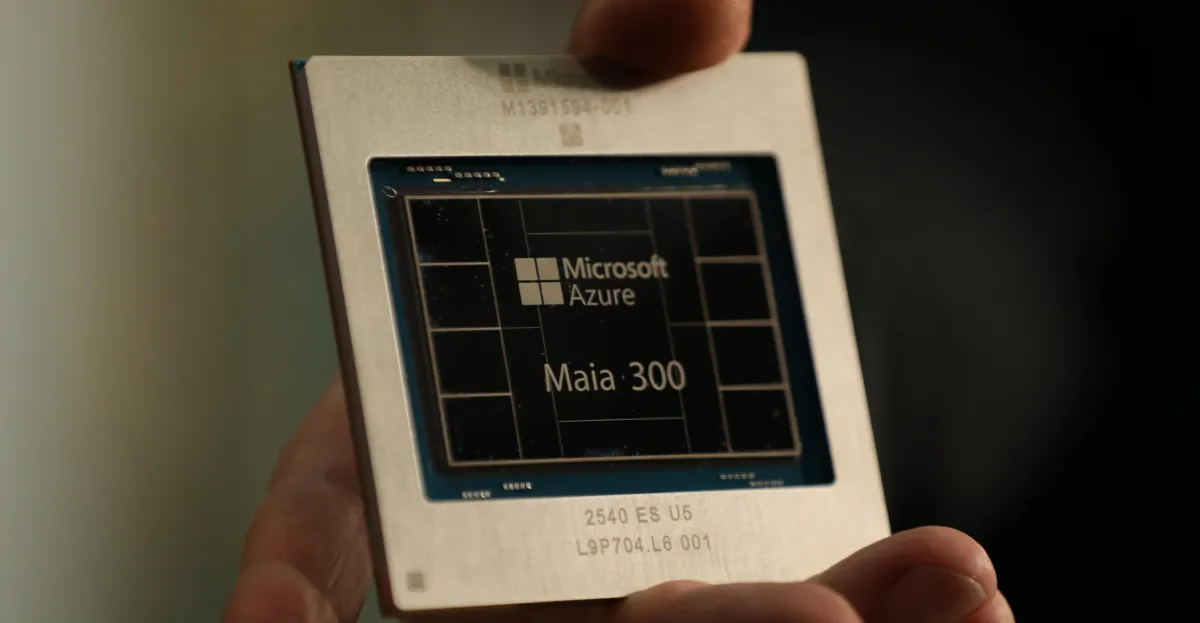
Microsoft unveiled Maia 300, its third-generation in-house AI chip, and said it will begin rolling out to production workloads in 2027. The chip is designed to make Microsoft more efficient at AI inference while reducing reliance on Nvidia and AMD.
- Microsoft says Maia 300 will become its primary AI inference system starting in 2027.
- The chip is built to improve tokens per megawatt and reduce the cost of AI workloads.
- Maia 300 uses a chiplet design built on TSMC’s N2P process node.
- Microsoft sees custom silicon as central to its long-term AI and Azure strategy.
Microsoft has unveiled Maia 300, its third-generation in-house AI chip, and says it will begin rolling the accelerator into production workloads in 2027. The company is positioning the chip as the backbone of its own AI services, a shift that could reduce its dependence on Nvidia and AMD while improving the efficiency of cloud-based inference at scale.
The announcement matters because Microsoft is no longer treating custom silicon as a side project. Maia 300 is designed to be the company’s primary inference system for Microsoft products and services, a role that places it at the center of the firm’s broader AI strategy as model sizes, reasoning demands, and agentic workloads continue to grow.
Microsoft says the new chip is built to handle the next wave of AI use cases more efficiently than its current hardware, including long-context reasoning, low-latency conversational systems, and multi-step agent workflows. The company also says Maia 300 is engineered to deliver higher throughput and better energy efficiency than GPU-based systems, a crucial metric as AI infrastructure costs keep rising.
What Microsoft announced
Microsoft said Maia 300 will begin rolling out to production AI workloads in 2027. The chip is intended to serve as the company’s main inference platform for its cloud and product ecosystem, rather than as a niche accelerator used only for a handful of internal tasks.
According to Microsoft, Maia 300 is a major step up from Maia 200, which was only introduced in January and is already in use across several high-profile services, including Microsoft Copilot, GitHub Copilot, Microsoft Foundry, and Microsoft’s own AI models. The company describes Maia 200 as its strongest-performing AI infrastructure in real-world service measurements, but says the new chip is designed for a more demanding generation of workloads.
Scott Guthrie, Microsoft’s cloud chief, said the company expects Maia 300 to produce significantly more tokens per megawatt than leading GPU-based systems and to deliver multiple times the rack-scale throughput of Maia 200 in its largest configuration.
That framing reveals the strategic goal: Microsoft wants to lower the cost of every AI answer, summary, recommendation, or agent action running through Azure and its consumer and enterprise products. If the company can do that using its own chips, it gains more control over performance, pricing, and supply.
Why this chip matters for Microsoft’s AI business
Maia 300 is important because inference — the process of running trained AI models to generate outputs — is where AI services increasingly spend their money. Training gets the headlines, but inference is what powers everyday interactions in chatbots, copilots, search experiences, coding assistants, and business automation tools.
As AI products become more conversational and more agent-like, they tend to require longer context windows, more steps per request, and heavier memory movement. That makes hardware efficiency a competitive advantage. Microsoft appears to be betting that it can build a custom system that better matches its actual workloads than one-size-fits-all GPUs alone.
Just as importantly, in-house chips can help Microsoft reduce exposure to the tight supply dynamics and pricing power of outside semiconductor vendors. Nvidia remains dominant in AI accelerators, while AMD has been trying to win more cloud share. But Microsoft’s latest move signals that the company wants more independence in the long run.
How does Maia 300 differ from Maia 200?
Maia 300 is a broader system-level redesign, while Maia 200 is Microsoft’s earlier production chip already deployed in some live services. Microsoft says the new version is built for emerging AI workloads that demand greater efficiency and more sustained performance, especially in scenarios where models must reason through multiple steps rather than return a quick one-shot response.
Microsoft also says Maia 300 uses a new chiplet architecture that separates compute, memory controller, and input/output functions. The company argues that this division lets each part of the chip use the most appropriate manufacturing approach, increasing the amount of silicon devoted to actual compute performance.
In practical terms, that design philosophy aims to improve the ratio of useful work to energy consumed. For cloud providers, that ratio is one of the most important measures in AI infrastructure because it affects operating cost, capacity planning, and long-term margins.
| Maia generation | Announcement timing | Deployment status | Primary role | Key design goal |
|---|---|---|---|---|
| Maia 200 | January 2026 | Already in production | Current AI workloads across Microsoft | Proven real-world performance |
| Maia 300 | October 2026 | Rolling out in 2027 | Primary AI inference system | Higher efficiency and larger-scale reasoning |
| GPU-based systems | Ongoing | Widely used today | General AI training and inference | Broad ecosystem and flexibility |
How Microsoft plans to use Maia 300
Microsoft says Maia 300 will support the AI products and services that increasingly define its cloud business. That includes customer-facing copilots, developer tools, Microsoft’s internal model efforts, and enterprise services delivered through Azure.
The company’s cloud division is making a broader push toward large-scale custom silicon deployment. Guthrie said Microsoft expects to scale the Maia family into multi-gigawatt installations starting in 2027, a sign that the program is not meant to remain a small, experimental hardware effort.
That scale matters because even modest efficiency gains can translate into major savings when multiplied across huge data center fleets. For Microsoft, a better chip is not just about speed. It is about reducing the energy and capital required to support ever-growing AI demand.
- Lower cost per AI token generated
- Higher throughput per rack in data centers
- Better performance for long-context models
- Improved support for real-time conversational AI
- Greater independence from third-party GPU supply
What kind of AI workloads is Maia 300 built for?
Maia 300 is built for the kinds of jobs that are becoming more common as AI products mature: extended reasoning, rapid back-and-forth chat, and agentic tasks that unfold over many steps. Microsoft says those workloads require a system designed around sustained inference rather than peak benchmark performance alone.
This distinction is important. Early AI chip competition often centered on raw training power and conventional benchmark numbers. But the market is shifting. As more companies deploy AI features into consumer apps and enterprise platforms, the decisive question is whether the hardware can keep costs down while handling massive volumes of real user traffic.
Microsoft is effectively arguing that its own services need a specialized architecture to meet that challenge. If the company is right, Maia 300 could become central to the economics of Microsoft’s AI portfolio.
Why chiplets matter
Microsoft’s use of chiplets is one of the clearest clues about how the company is trying to win on efficiency. Rather than building one monolithic piece of silicon, the Maia 300 design breaks the system into functional blocks that can be optimized separately.
The company says the approach increases the portion of the chip dedicated to compute and lets each subsystem use the process technology that suits it best. In a mature data center environment, that kind of design can help balance performance, heat, cost, and manufacturability.
The Maia 300 architecture is built on TSMC’s N2P process node, underscoring Microsoft’s reliance on the leading-edge foundry ecosystem even as it pursues more independence from GPU vendors. In other words, Microsoft is not leaving the semiconductor supply chain behind — it is trying to gain more control within it.
How does Maia 300 fit into Microsoft’s competition with Nvidia, Google, and Amazon?
Maia 300 is Microsoft’s answer to a broader race among hyperscale cloud providers to reduce dependence on Nvidia and optimize AI infrastructure for their own products. Amazon has been pushing its own Trainium and Inferentia chips, Google has long developed TPUs, and Microsoft is now making a stronger, more public case for Maia as a strategic platform.
The competitive stakes are high. AI infrastructure is becoming one of the most expensive and strategically important parts of the cloud business. Whoever can deliver the best blend of performance, availability, and cost efficiency will have an advantage in winning enterprise AI workloads and internal product deployment.
For Microsoft, this is also about differentiation. If Azure can offer AI services powered by hardware tailored to Microsoft’s own software stack, it may be able to better optimize latency, throughput, and user experience than generic deployments based solely on external chips.
Mustafa Suleyman, Microsoft AI’s chief executive, said the company believes it has to work across the entire technology stack, including silicon, because the scale of modern AI requires a platform Microsoft can own and co-design with its models.
That is a telling statement. Microsoft is no longer presenting chips as support infrastructure. It is treating hardware as a strategic layer that can shape the behavior and economics of its AI products just as much as the models themselves.
What the efficiency numbers suggest
Microsoft says Maia 300 should deliver 40 percent more tokens per megawatt than leading GPU-based systems. It also says that in a full 96-accelerator setup, the chip can reach up to seven times the rack-scale token throughput of Maia 200.
Those claims are significant, but they should be understood as Microsoft’s own performance expectations rather than independent benchmark results. Still, the metrics Microsoft chose are revealing. Tokens per megawatt speak directly to operating cost and energy efficiency, while rack-scale throughput reflects how well the chip performs when deployed in the dense, real-world environments of a data center.
If Microsoft’s numbers hold up in practice, Maia 300 could improve both profitability and capacity. That would matter not only for Microsoft’s own products, but also for the cloud customers building AI applications on Azure.
| Performance claim | What Microsoft says | Why it matters |
|---|---|---|
| Tokens per megawatt | 40% higher than leading GPU-based systems | Indicates better energy efficiency and lower operating cost |
| Rack-scale throughput | Up to 7x Maia 200 in a 96-accelerator configuration | Shows the benefits of large-scale deployment |
| Production deployment | Expected to begin in 2027 | Suggests Microsoft is planning a long-term infrastructure transition |
Why Microsoft’s own models are part of the picture
Microsoft says Maia 300 is also intended to support its own AI model development, which is part of the company’s broader ambition to compete more directly with model leaders such as Google DeepMind, OpenAI, and Anthropic. That competition is not only about the best research or the smartest assistant. It is also about having the infrastructure to run those models efficiently at scale.
The company’s leadership appears to believe that model quality and hardware design must advance together. By co-designing chips with its internal models, Microsoft hopes to create a tighter feedback loop between AI researchers and hardware engineers. The result, in theory, is better performance on the workloads Microsoft cares about most.
This also reflects a broader trend in the AI industry. The companies building the most advanced systems increasingly want ownership of the entire stack, from models to cloud to chips, because each layer affects cost and capability. Microsoft’s Maia push shows that it wants a seat at every level of that stack.
What comes next for Microsoft’s chip strategy?
Microsoft’s roadmap suggests that Maia 300 is not the endpoint but a waypoint in a much larger plan. The company is already deploying Maia 200 in live services, and it is laying out a path toward far larger deployments beginning in 2027.
If those plans stay on track, Microsoft could enter the next phase of the AI infrastructure race with a much more mature in-house hardware portfolio. That would give it more leverage in pricing, more flexibility in capacity management, and potentially stronger performance for the AI products that now define much of its growth story.
There are still real questions to answer. Microsoft will need to prove that Maia 300 can deliver the efficiency gains it promises under actual production loads. It will also need to show that custom silicon can keep pace with rapidly changing model architectures and software demands.
But the direction is clear. Microsoft is no longer simply buying the best chips available. It is building its own path toward AI infrastructure control, and Maia 300 is the company’s strongest signal yet that it wants to make that path central to Azure and to its product future.
Timeline: Microsoft’s Maia chip program
The Maia line has moved quickly, with the company accelerating from first-generation development to a multi-chip strategy in less than two years.
| Date | Milestone | Significance |
|---|---|---|
| January 2026 | Maia 200 announced | Microsoft’s first major production AI chip enters the picture |
| Throughout 2026 | Maia 200 deployed across Copilot and other services | Shows Microsoft can use custom silicon in live products |
| October 2026 | Maia 300 unveiled | Signals a more ambitious, system-level AI hardware strategy |
| 2027 | Production rollout of Maia 300 begins | Marks the start of Microsoft’s broader internal chip transition |
Bottom line
Microsoft’s Maia 300 is more than a new processor. It is a statement that the company wants to own the infrastructure behind its AI ambitions, from inference and conversational tools to multi-step agent systems and internal model work. If the chip performs as Microsoft expects, it could reduce dependence on Nvidia and AMD while reshaping how Microsoft delivers AI at cloud scale.
Frequently asked questions
What is Microsoft’s Maia 300 chip?
Microsoft’s Maia 300 chip is the company’s third-generation in-house AI accelerator, designed to run AI inference workloads more efficiently inside Azure and Microsoft products. Microsoft says it is built for reasoning-heavy, low-latency, and agentic AI tasks.
When will Maia 300 be used in production?
Microsoft says Maia 300 will start rolling out to production AI workloads in 2027. The company plans to scale the Maia family into multi-gigawatt deployments from that point, making it a core part of its AI infrastructure.
How is Maia 300 different from Nvidia GPUs?
Maia 300 is optimized specifically for Microsoft’s AI inference needs, while Nvidia GPUs are general-purpose accelerators used across many customers and workloads. Microsoft says Maia 300 should deliver better efficiency per megawatt and higher rack-scale throughput for its own services.
Why is Microsoft building its own AI chips?
Microsoft is building its own AI chips to reduce cost, improve efficiency, and gain more control over the hardware behind its cloud and AI products. Custom silicon also helps the company reduce reliance on external suppliers like Nvidia and AMD.