In short
Trump’s push to rename AI as “super intelligence” is being echoed by several major Silicon Valley figures, including Musk, Benioff, Huang and Nadella. The shift highlights how closely Big Tech is aligning itself with the Trump administration in its second term.
- Trump’s preferred term “super intelligence” is being adopted by several high-profile tech leaders.
- Musk, Benioff, Huang and Nadella have each echoed or advanced the rebrand in different ways.
- The language shift reflects Silicon Valley’s effort to stay close to political power in Trump’s second term.
- AI remains the dominant public term, so the rebrand is more political signal than common usage change.
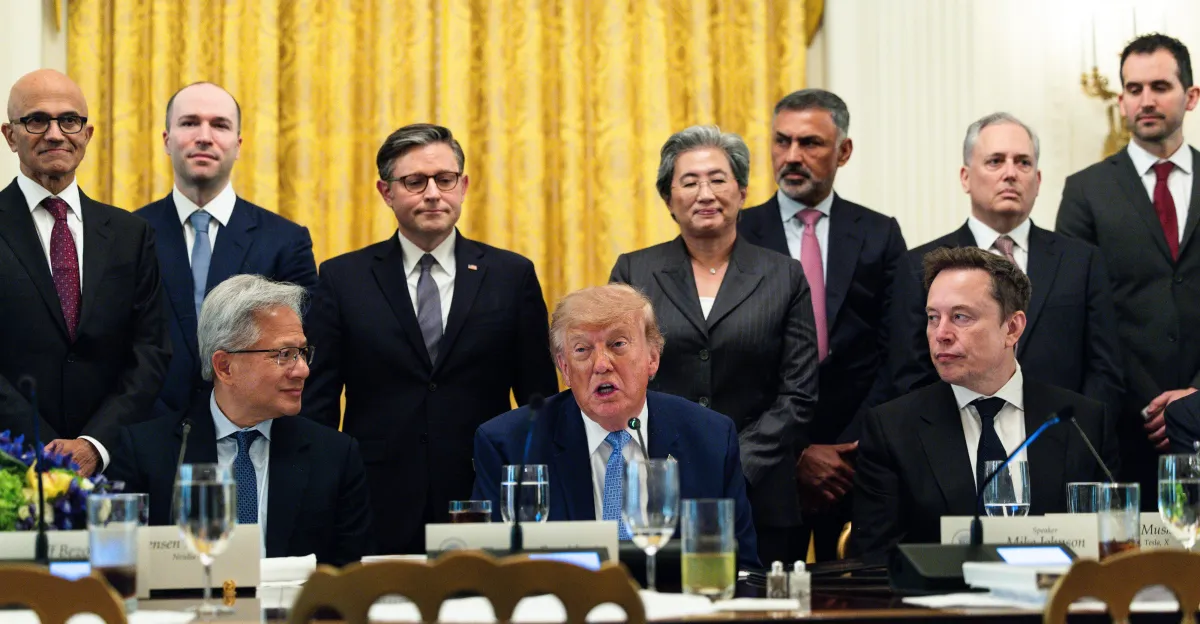
President Donald Trump’s effort to replace “artificial intelligence” with the term “super intelligence” is gaining traction among some of Silicon Valley’s most powerful executives. Elon Musk, Marc Benioff, Jensen Huang and, most recently, Satya Nadella have all started echoing the White House’s preferred language, giving the branding push an unexpected boost.
The shift matters because it is more than a semantic fight. It signals how major technology leaders are positioning themselves in Trump’s second term, and it shows how quickly political pressure can shape the language used by companies that build and sell the technology at the center of the current boom.
How the ‘super intelligence’ rebrand took hold
Trump’s attempt to rename AI did not begin as a grassroots industry movement. It started with a political message from the White House, followed by a wave of highly visible endorsements from executives with enormous influence over the AI ecosystem.
The president has framed “super intelligence” as a more accurate and more desirable term than artificial intelligence. He has also made clear, in his own combative style, that he expects compliance from the companies and executives in his orbit. The result has been a public language shift from a handful of the most prominent figures in technology.
The adoption has not been universal. Most people outside the industry continue to use “AI,” and many researchers, journalists and companies still prefer the long-established term. But the willingness of a few top leaders to mirror the White House has been enough to make the rebrand a notable political and industry story.
Why are executives using Trump’s preferred term?
They are doing it partly to align with power. In Trump’s second term, several major tech leaders appear keen to avoid conflict with the administration and preserve access, influence and business stability.
The language change also functions as a signal. By adopting the president’s terminology, executives are showing that they are willing to meet the government on its own rhetorical turf, even when the terminology is widely viewed as awkward or artificial.
That dynamic is especially striking because Silicon Valley’s relationship with Trump was far more adversarial during his first term. This time, many of the sector’s biggest names have moved quickly to accommodate him.
Who has backed the new branding so far?
Several of the biggest names in the tech industry have either directly repeated Trump’s terminology or endorsed initiatives that use it. The list includes Elon Musk, Marc Benioff, Nvidia chief executive Jensen Huang and Microsoft chief executive Satya Nadella.
Each case has its own context, but together they suggest a broader pattern: prominent industry figures are increasingly comfortable speaking in ways that reinforce the administration’s message on AI.
| Executive | Company | Observed response | Why it matters |
|---|---|---|---|
| Elon Musk | SpaceX / xAI | Moved quickly to support the rebrand | Signals early alignment from one of Trump’s most influential tech allies |
| Marc Benioff | Salesforce | Echoed the new terminology shortly after Trump’s announcement | Shows how fast a major enterprise software leader can adapt its language |
| Jensen Huang | Nvidia | Attended the White House summit and later used the new phrasing | Nvidia sits at the center of the AI hardware boom |
| Satya Nadella | Microsoft | Repeated “super intelligence” in a post about safety | Microsoft is one of the most important AI platforms and cloud providers |
What did Musk, Benioff and Huang do?
Elon Musk was first to move into step with the White House, unsurprisingly given his close ties to Trump and his own long-standing involvement in AI branding and messaging. He reportedly indicated that SpaceXAI would be renamed SpaceXSI, a symbolic gesture that underscored the rapid political realignment inside tech.
Marc Benioff followed with his own quick response after Trump’s comments. The Salesforce chief suggested that AIForce would become SIForce, making the point that one of the industry’s most prominent enterprise leaders was also willing to embrace the new vocabulary.
Jensen Huang’s response was more strategic but no less significant. He attended the White House summit where the executive order tied to the government’s terminology shift was unveiled. Huang has also voiced skepticism about some of the more alarmist claims surrounding AI risk, which has put him broadly in sync with the administration’s rhetoric.
When Nvidia later pledged $1 billion to scientific advancement, the company also folded “super intelligence research” into its announcement. That language was notable not just because of the amount of money involved, but because Nvidia occupies a central role in the global AI supply chain. Its chips power much of the current wave of model training and deployment.
Huang has argued that the dangers of AI are often overstated, a view that places him closer to the Trump administration’s public framing than many critics of the technology.
How did Satya Nadella join the chorus?
Satya Nadella became the latest major executive to adopt the White House’s preferred wording. In a post about the need for an “emergency brake” on advanced systems, the Microsoft chief repeatedly referred to the technology as “super intelligence.”
That choice stood out because Microsoft has been one of the most influential companies in the AI era, both through its partnership with OpenAI and through the integration of AI into its own products and cloud services. Nadella’s wording therefore carries more weight than a casual phrase choice would at a smaller company.
His post also showed the balancing act many executives are trying to perform: sounding cautious about the technology’s power while still using the administration’s preferred language. In effect, the language itself has become part of the relationship management.
Why does this language shift matter to the tech industry?
This matters because the words leaders choose shape how policy, markets and the public think about the technology. “Artificial intelligence” has been the standard term for decades, encompassing everything from machine learning tools to large language models. “Super intelligence,” by contrast, implies a more dramatic, more futuristic and potentially more dangerous leap in capability.
That makes the rebrand politically useful. It suggests a more advanced and more consequential form of technology while also giving the president a way to define the debate on his own terms.
For companies, the stakes are practical as well as rhetorical. The terminology they use can influence regulatory discussions, investor perception and how closely they are seen as aligned with the government.
What is the difference between AI and super intelligence?
AI is the broad, established term for software systems that perform tasks associated with human intelligence, from pattern recognition to language generation. Super intelligence usually refers to a hypothetical system that would surpass human intelligence across nearly every domain.
In other words, AI is the present-day umbrella term, while super intelligence describes an extreme future state that many experts consider speculative. That is one reason the rebranding effort has drawn skepticism outside Trump’s immediate circle.
Why is Silicon Valley moving toward Trump now?
Silicon Valley is moving toward Trump now because the industry’s biggest players have strong incentives to stay close to political power. In a sector shaped by regulation, procurement, antitrust pressure and public scrutiny, relationship management can matter as much as product strategy.
During Trump’s first term, many tech leaders were openly hostile or at least heavily critical. During his second term, the tone has shifted noticeably. The change is not limited to AI terminology; it reflects a broader effort by business leaders to avoid becoming targets and to secure favorable treatment where possible.
That dynamic is especially visible in AI, where the government can influence everything from export controls and infrastructure development to federal procurement and safety standards. If a company wants access, influence or a seat at the table, language becomes part of the negotiation.
What does the White House get from this?
The White House gets validation. Each time a major executive repeats Trump’s wording, it makes the branding effort look less like a personal obsession and more like a viable political frame.
That matters in Washington because language helps define the policy battlefield. If the administration can persuade key industry figures to talk about “super intelligence,” it can also shape the assumptions that underpin future rules, hearings and public messaging.
Even if the broader public keeps saying AI, the White House can still claim momentum inside the sector that matters most for lobbying, investment and implementation.
What are the limits of the rebrand?
The rebrand has obvious limits. It has not displaced AI in common usage, and it is unlikely to do so any time soon. The existing term is deeply embedded in journalism, academia, business and everyday conversation.
There is also a credibility issue. Many researchers and analysts would argue that “super intelligence” describes an eventual theoretical threshold, not the everyday systems now being deployed across consumer and enterprise products.
For that reason, the current shift may be better understood as a political signal than a genuine linguistic replacement. The most important audience may not be the general public at all, but regulators, investors and the small circle of power brokers shaping AI policy.
Timeline: how the terminology shift unfolded
The progression from presidential declaration to executive adoption happened quickly. The following timeline shows how the story developed.
| Moment | What happened | Significance |
|---|---|---|
| Trump announces the rebrand | The White House pushes “super intelligence” as the preferred term | Sets the political framing for the campaign |
| Musk and Benioff respond | Both executives quickly echo the new wording in company-related naming examples | Shows early industry compliance |
| Huang attends the summit | Nvidia’s chief joins the White House AI gathering | Places a key infrastructure company near the center of the message |
| Nvidia commits $1 billion | The company links part of the pledge to super intelligence research | Gives the new terminology corporate legitimacy |
| Nadella posts on AI safety | The Microsoft chief repeatedly uses “super intelligence” | Confirms the phrase is spreading beyond the earliest adopters |
What happens next?
The most likely outcome is not a full replacement of AI, but a split in usage. Trump and his allies may continue pushing “super intelligence” in official settings, while the rest of the world largely sticks with AI.
Still, the fact that so many influential executives have echoed the new phrasing suggests that the effort is not merely symbolic. It reveals a tech industry that is increasingly willing to adapt itself to the politics of the moment, especially when the stakes involve access to power and influence over the next phase of AI policy.
If the trend continues, the rebrand may become less about changing what the technology is called in daily life and more about signaling who is inside the room when the rules are written.
How should readers interpret the ‘super intelligence’ push?
Readers should interpret it as a political branding campaign with real industry buy-in, but limited public penetration. The phrase may be more important as a signal of alignment between the White House and Big Tech than as a practical replacement for “artificial intelligence.”
That said, the speed of adoption by high-profile executives is a reminder that in today’s AI race, the battle over language is inseparable from the battle over power.
Frequently asked questions
What is Trump trying to rename AI to?
Trump is trying to replace the term “artificial intelligence” with “super intelligence.” The White House is presenting the phrase as a more accurate label, and several influential tech executives have already started using it in public remarks and company messaging.
Which tech leaders have backed the super intelligence term?
Elon Musk, Marc Benioff, Jensen Huang and Satya Nadella have all used or echoed the wording. Their responses range from symbolic company renaming jokes to formal public posts that repeat the administration’s preferred language.
Why are companies adopting Trump’s wording?
Companies are adopting Trump’s wording because it signals alignment with the administration and helps avoid friction with a White House that can influence regulation, procurement and broader AI policy. The phrasing is as much political as it is technical.
Is “super intelligence” replacing AI in common use?
No, “super intelligence” is not replacing AI in everyday language. Most people, companies, journalists and researchers still use AI, and the new term is better understood as a political branding effort than a genuine industry standard.
What does Nvidia’s involvement mean?
Nvidia’s involvement matters because the company is central to the AI hardware supply chain. When Jensen Huang or Nvidia uses the new terminology, it lends the White House campaign more credibility and helps normalize the phrase among industry leaders.

![Three men seated on stage discussing at Human[X] event, with branded backdrop and one holding a notepad.](https://superintelligencenews.com/wp-content/uploads/2026/10/superintelligencenews.com-voice-ai-voice-ai.jpg)