In short
Ambi, founded by former Plaud executive Peter Mo, has raised $26 million to build an AI assistant that listens in the background and offers real-time help. The startup is launching apps on Apple devices while also planning a desktop app and dedicated hardware, but privacy concerns around ambient recording remain central.
- Ambi raised $26 million in funding led by Luminous Ventures and Huaqin.
- The startup’s assistant is designed to listen in the background and offer real-time suggestions during meetings and work.
- Ambi already has apps for iPhone, Mac and Apple Watch, and it plans a desktop app plus dedicated hardware.
- Privacy and disclosure are major issues because ambient capture can affect people who have not consented to being recorded.
Ambi, an AI startup led by former Plaud executive Peter Mo, has raised $26 million to build software and hardware that can listen in the background and surface useful context in real time. The funding underscores investor confidence in always-on AI assistants even as privacy questions around ambient recording continue to intensify.
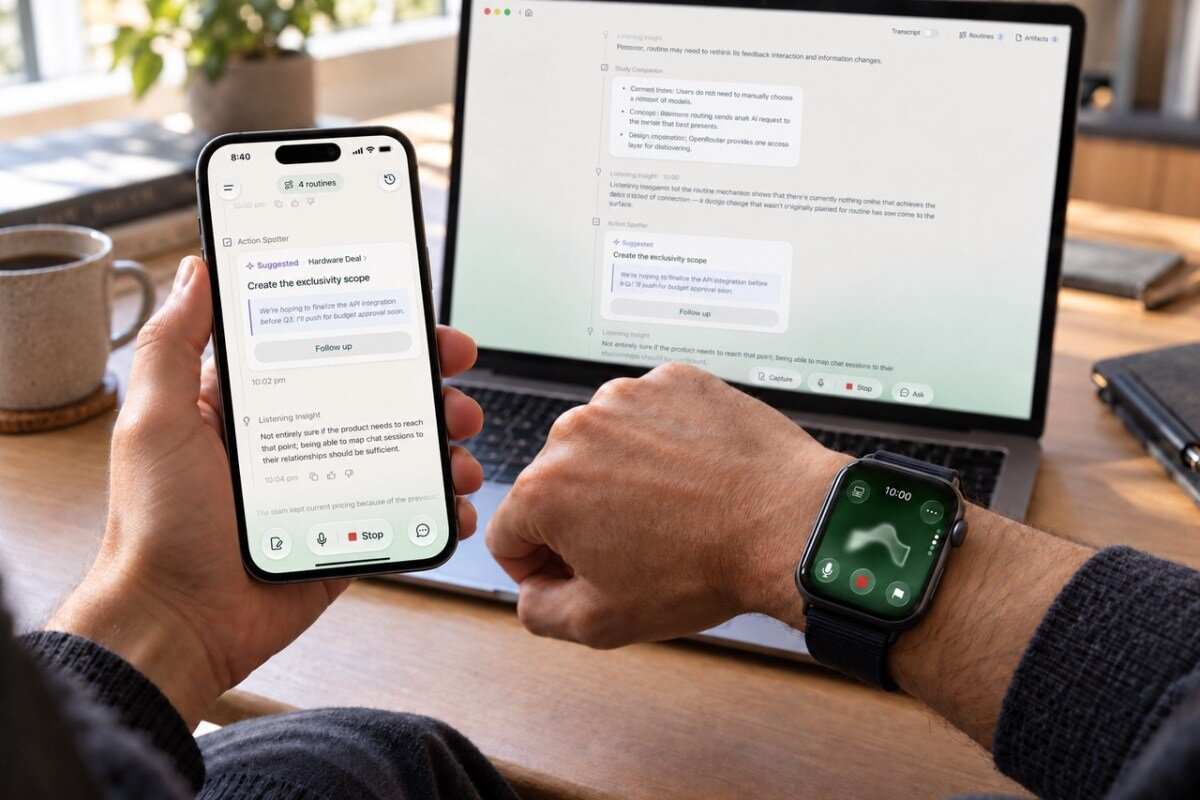
The company said the money came from multiple rounds led by Luminous Ventures and Original Design Manufacturer (ODM) Huaqin, and that it is already shipping apps for iPhone, Mac and Apple Watch. Ambi’s pitch is simple but ambitious: instead of waiting until after a meeting ends, its agent should help while the conversation is still happening.
What Ambi is building
Ambi is developing an AI assistant designed to capture context throughout the day and turn that information into timely suggestions, reminders and task help. The startup wants the system to understand not just what a user says in a meeting, but also the broader context around that person’s work.
That includes calendar entries, prior meetings, internal knowledge sources and selected web data. The company says the assistant can use that context to surface relevant information while a meeting is underway, rather than generating output only after the call has been processed.
The product currently works across Apple devices, with apps for the iPhone, Mac and Apple Watch. In practical terms, the tools function like note-takers and productivity helpers, but users can choose to keep them listening beyond specific meetings so they can capture more of the day’s context.
How is Ambi different from standard meeting note-takers?
Ambi says the biggest difference is timing. Most meeting assistants summarize conversations after the fact, then integrate with other tools to automate follow-up work. Ambi wants to begin the work sooner, using live signals from the meeting itself to make the assistant more proactive.
That shift matters because it changes the role of the AI agent from a passive recorder to a live participant of sorts. The startup is betting that users will value faster, more personalized support enough to allow the system to collect a richer stream of data.
Mo told TechCrunch that the current model of intelligence is too tied to the screen and too dependent on delayed processing. He said Ambi is meant to make AI available “anytime and anywhere,” rather than only after recording uploads and cloud processing are complete.
Why investors are backing ambient AI now
Investors are pouring money into AI products that rely on more context because personalization is becoming one of the most competitive battlegrounds in consumer and workplace software. The logic is that the more an assistant knows about the user’s routine, work patterns and priorities, the more valuable its recommendations become.
That thesis has driven interest in tools that listen, watch or record interactions in order to build a deeper memory of a person’s day. For startups, the opportunity is large: a useful always-on assistant could become central to how people work, plan and communicate.
Ambi’s backers include Luminous Ventures, known for prior investments in companies such as Meituan and Unitree Robotics, as well as Huaqin, which has a hardware manufacturing background. That mix suggests the startup may be aiming for more than software alone.
What does the $26 million fund?
The capital is expected to support product development, hiring and expansion across both software and hardware. Ambi currently has more than 50 employees spread across San Francisco, Beijing, Shanghai and Shenzhen, and it is actively recruiting AI engineers and go-to-market staff.
The funding also gives the company runway to refine its speech recognition models and build out the infrastructure needed for always-on capture, cross-device continuity and future hardware manufacturing.
| Key item | Details |
|---|---|
| Company | Ambi |
| Founder/CEO | Peter Mo, former Plaud executive |
| New funding | $26 million |
| Lead investors | Luminous Ventures, Huaqin |
| Current apps | iPhone, Mac, Apple Watch |
| Team size | More than 50 employees |
| Offices | San Francisco, Beijing, Shanghai, Shenzhen |
| Planned hardware | Device with screen, speaker, camera and microphones |
How does Ambi handle privacy concerns?
Ambi says ambient capture is turned off by default and can be disabled at any time. The company also says it does not store recordings of users and that its data is encrypted, though it has not publicly detailed exactly what type of encryption it uses.
Even so, the privacy burden does not disappear simply because the software is opt-in or because data is secured after collection. When a device or app listens in the background, people nearby may not know they are being recorded unless the user makes that clear.
That is one of the most sensitive issues facing the category. The industry has already seen disputes and lawsuits over products that captured conversations without clear consent from everyone involved. At the same time, broader consumer familiarity with speech transcription and AI summaries has lowered the barrier to adoption, even as public concern persists.
Mo acknowledged that disclosure remains a challenge for the whole sector, saying users must tell others when ambient capture is active and that the industry has not solved the problem of making that disclosure automatic or universal.
Why privacy is such a hard problem for ambient AI
Ambient AI is difficult because its value depends on context, and context often comes from collecting more data than people expect. The more useful the assistant becomes, the more closely it approaches continuous monitoring, which raises consent, disclosure and data-minimization questions.
That tension sits at the heart of Ambi’s strategy. To deliver real-time intelligence, the company needs to collect enough information to understand the user’s day. But the act of collecting that information can unsettle the people around the user, especially in meetings, offices or shared spaces.
The problem is not limited to one startup. Apple’s recent Voice Intelligence features, which can transcribe speech continuously, have also revived concerns about how much ambient audio is being processed and how clearly those experiences are signaled to other people.
What hardware Ambi plans to launch
Ambi is not stopping at apps. The startup says it is developing its own device, and the plan is for that product to include a screen, speaker, camera and microphones.
That combination points to a more complete personal assistant, one that can see, hear and display information in one package. In other words, Ambi appears to be moving toward a dedicated AI companion rather than a simple meeting recorder.
The company has not disclosed a launch date for the hardware, but the product direction suggests it wants tighter control over how data is captured and how the assistant is presented to the user. Hardware could also help the startup differentiate itself in a market where many software note-takers already compete on transcription quality and integrations.
How the planned device fits the company’s strategy
The device would extend Ambi’s logic beyond the laptop or phone and into the physical environment itself. By combining audio, visual and display capabilities, the company could make the assistant more responsive while also binding users more closely to its ecosystem.
That could be attractive for users who want one persistent assistant across meetings, desk work and mobile life. It also adds more complexity around privacy, product design and the social norms of being recorded in everyday settings.
Where Ambi fits in the crowded AI assistant market
Ambi is entering a market that is quickly filling up with products promising to remember more, summarize faster and automate more of the workday. Some tools are focused on meetings, others on personal memory, and others on context-aware task management.
Products such as Littlebird and Minimi already offer forms of ambient capture or personal memory. Meanwhile, larger platform companies are also pushing assistants deeper into productivity workflows, making it harder for newcomers to stand out on features alone.
Ambi’s advantage may lie in combining live meeting support, all-day context and future hardware under one umbrella. If it works, the company could position itself as a layer of intelligence that follows the user from call to desktop to device.
What this funding round signals about the AI market
The raise highlights a broader shift in the AI industry: companies are increasingly competing on how much real-world context their systems can gather. Raw model capability still matters, but more startups are betting that memory, personalization and agentic behavior will matter more to users.
It also shows that investors remain willing to fund consumer-facing AI even when the products create thorny trade-offs. Privacy criticism has not slowed the momentum around always-on assistants, in part because the potential upside—fewer missed tasks, faster decisions and more personalized recommendations—is compelling enough to justify experimentation.
At the same time, companies like Ambi will likely face a trust test. If users do not understand when and where capture is happening, or if the people around them feel blindsided, adoption could stall. That makes disclosure and transparency not just legal or ethical necessities, but product requirements.
Timeline of Ambi’s expansion
The startup’s growth is moving on several tracks at once: software, hardware, hiring and market expansion. The following timeline captures the main milestones and next steps described by the company.
| Stage | What happened | Status |
|---|---|---|
| Founding phase | Peter Mo, formerly of Plaud, began building Ambi | Completed |
| Fundraising | The company raised $26 million across multiple rounds | Completed |
| Consumer apps | Apps launched for iPhone, Mac and Apple Watch | Underway |
| Desktop expansion | A desktop app is planned to store work context and memories | Planned |
| Hardware launch | Dedicated device with screen, speaker, camera and microphones | Planned |
What happens next for Ambi?
Ambi’s next phase will likely determine whether it becomes a breakout product or another ambitious entrant in a crowded category. The company must prove that people want a device or app that listens continuously, while also convincing users that it can do so responsibly.
Its short-term priorities are clear: keep improving the quality of real-time suggestions, expand the desktop experience, prepare for hardware and hire enough specialized talent to support those ambitions. Just as important, it will need to communicate clearly about what is being captured, where it is stored and how others are supposed to know when recording is active.
For now, the raise gives Ambi the resources to pursue a more integrated vision of AI assistance. Whether that vision becomes widely adopted may depend on a question the industry still has not answered: how much context are people willing to trade for convenience?
- Ambi raised $26 million to build an AI assistant that listens in the background and offers real-time help.
- The startup’s apps are available on iPhone, Mac and Apple Watch, with a desktop app and hardware device planned.
- Privacy remains a central challenge because ambient capture can affect people who have not consented to being recorded.
- The company is positioning itself as a proactive, cross-device assistant rather than a post-meeting note-taker.
In summary: former Plaud executive Peter Mo’s Ambi has secured major funding to push AI assistance beyond meeting summaries and into always-on, real-time support. The opportunity is large, but so are the privacy and disclosure concerns that come with background listening.
Frequently asked questions
What is Ambi?
Ambi is an AI startup building an assistant that can listen in the background and use that context to provide real-time suggestions, reminders and task help. The company is led by former Plaud executive Peter Mo and is targeting both software and hardware experiences.
How much funding did Ambi raise?
Ambi raised $26 million across multiple funding rounds. The financing was led by Luminous Ventures and Huaqin, and it is intended to support product development, hiring and the company’s expansion into new devices and desktop software.
How does Ambi’s AI assistant work?
Ambi’s AI assistant works by combining ambient audio capture with contextual data such as calendars, meetings, knowledge bases and web information. The goal is to surface useful information while a meeting is happening, rather than waiting until after it ends.
What privacy protections does Ambi offer?
Ambi says ambient capture is off by default, can be turned off at any time and does not involve storing user recordings. The company also says data is encrypted, although it has not publicly specified the exact encryption method.
Will Ambi release its own hardware?
Yes, Ambi says it plans to launch a dedicated device with a screen, speaker, camera and microphones. The hardware is intended to capture context and display information, extending the assistant beyond apps on phones, Macs and wearables.