Updated October 2, 2026 5:54 pm
In short
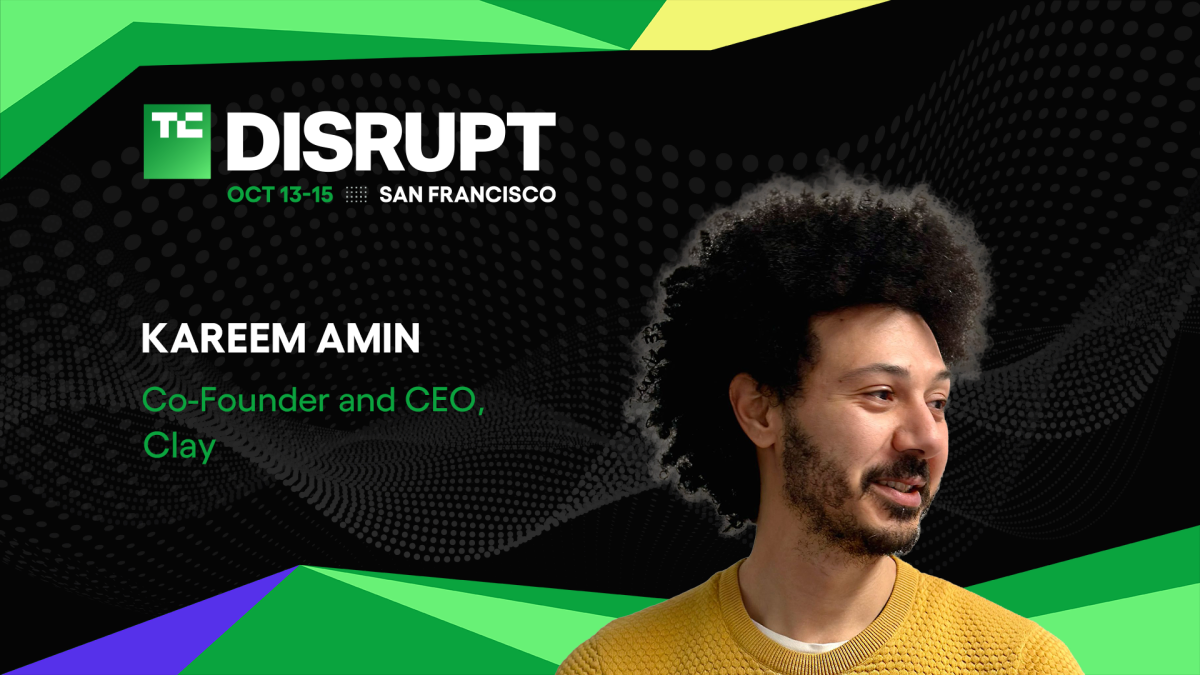
Clay’s Kareem Amin will discuss how AI created the GTM engineer role at Disrupt 2026, with Clay now also backing the category through a $1 million training scholarship fund.
- AI is creating a new GTM engineer role in startup growth teams.
- Clay helped coin and define the category in 2023.
- The company says about 100 GTM engineering jobs appear each month.
- Clay has raised major funding and reached a $7.1 billion valuation.
- Amin will discuss the role at TechCrunch Disrupt 2026 in San Francisco.
Update — October 2, 2026 5:54 pm
Clay says it is putting real money behind the GTM engineer trend. In September, the company announced a $1 million scholarship fund to help train people for the role.
The updated source also adds more context around Amin’s background and the Disrupt session itself, including that he previously led product at The Wall Street Journal, co-founded Frame, and will speak at a track featuring 200+ sessions at Moscone West in San Francisco.
Clay co-founder and CEO Kareem Amin will take the AI Stage at TechCrunch Disrupt 2026 to explain why the “GTM engineer” has become one of tech’s newest job categories and what that shift means for sales, marketing and startup growth. The session matters because AI is no longer just speeding up go-to-market work — it is reshaping who does that work and how companies build revenue systems.
Two years ago, the term barely registered outside a small circle of operators. Today, job posts, startup teams and growth leaders increasingly treat GTM engineering as a real discipline, not just a catchy label. Amin’s appearance at Disrupt in San Francisco will give attendees a closer look at how that change happened, why it matters now, and what AI-native growth operations may look like in the next wave of tech companies.
Why the GTM engineer is becoming a real job category
The short answer is that AI has made it possible to automate much of the repetitive, cross-functional work that used to define go-to-market execution. Instead of splitting tasks across researchers, data specialists, SDRs, operations teams and multiple software tools, companies are increasingly building systems that can do more of that work in one place.
Traditional go-to-market teams spend a large share of their time identifying prospects, enriching contact data, qualifying leads, personalizing messaging and moving information between apps. GTM engineers use AI, data pipelines and automation to turn those once-manual steps into repeatable workflows.
That shift is significant for founders and revenue leaders because it changes the basic question behind growth hiring. The old approach was often to add more people to a broken process. The new approach is to redesign the process itself so a smaller team can operate with more speed, more precision and less manual labor.
How AI changed the go-to-market stack
AI has made the modern GTM stack less fragmented by giving teams a single layer for research, enrichment, personalization and outreach orchestration. In practical terms, that means a team can collect prospect information, generate account intelligence, create tailored messages and trigger campaigns without stitching together as many disconnected systems.
That does not eliminate the need for strategy or human oversight. Instead, it shifts the value toward people who can design the system, define the inputs and maintain the workflow. In other words, the job changes from doing individual tasks to building the engine that carries them out.
What a GTM engineer actually does
A GTM engineer builds and manages automated revenue workflows rather than handling each outbound or operations task manually. The role blends technical thinking with commercial goals, which is why it sits at the intersection of sales, marketing, data and operations.
Clay, the company Amin co-founded, helped popularize the term in 2023. Since then, the idea has spread quickly enough that the company says roughly 100 GTM engineering job listings are appearing each month. Among the companies hiring for such roles are Cursor, Lovable and Webflow, a sign that the title is moving beyond early adopter circles.
For a startup, the appeal is obvious: GTM engineering can reduce operational drag, improve targeting and create a more scalable sales process. For a larger company, it offers a way to modernize revenue operations without depending on an ever-growing patchwork of tools and manual coordination.
Clay’s view, as reflected in its GTM engineering guidance, is that these practitioners are not simply running tasks faster. They are constructing systems that let revenue teams operate in a fundamentally different way.
How the role differs from traditional RevOps
Revenue operations has long focused on process consistency, data quality and alignment across sales and marketing. GTM engineering takes that ambition further by using automation and AI to build the workflows themselves, not just manage them.
The distinction is subtle but important. RevOps often coordinates the machinery of growth. GTM engineering helps design and automate the machinery. In many organizations, the two functions may overlap, but the rise of GTM engineering suggests that more companies now want people who can also write, connect or automate the systems behind the pipeline.
Clay’s path to the GTM engineer moment
Clay did not begin as a sales technology company. It started in Brooklyn in 2017 with a broader mission: to put programming-like capabilities into the hands of more people. The original product acted like a spreadsheet that could connect data and automate work without requiring users to write code.
That idea found a natural audience among sales teams, growth operators and agencies trying to find and reach customers more efficiently. As those users adopted the product for go-to-market work, Clay followed them into that market and evolved into infrastructure for modern revenue teams.
Today, the company provides tools that let teams access data, run agentic workflows and launch campaigns. Its OpenAI-powered agent, Claygent, is designed to automate research and outreach for sales, marketing and recruiting use cases. The product evolution mirrors the broader industry move toward AI systems that act less like static software and more like active assistants.
Why does this matter for startups and growth teams?
It matters because the economics of growth are changing. AI is not just helping teams move faster; it is altering how companies decide where to spend time, headcount and budget. That makes the GTM engineer role especially relevant for founders trying to do more with lean teams and for larger companies trying to rework outdated workflows.
Amin’s Disrupt session is positioned as a practical discussion about how AI-native go-to-market systems are being built and why the category is gaining traction. For attendees, the appeal is less about a trendy title and more about a new operating model for revenue.
- AI can automate prospect research and data enrichment.
- Personalization can happen at greater scale without fully manual effort.
- Workflows can move across fewer tools and fewer handoffs.
- Teams may prioritize system design over task execution.
What is Clay betting on with GTM engineering?
Clay is betting that GTM engineering will become as important to modern growth teams as product engineering is to software teams. The company’s strategy suggests that the next generation of revenue operations will be built around systems, not just software subscriptions or headcount.
That bet has been supported by strong business momentum. In February, TechCrunch reported that Clay had tripled annual recurring revenue to $100 million in a year and had launched an employee tender offer at a $5 billion valuation. In September, the company announced a $115 million Series D round at a $7.1 billion valuation.
Those numbers matter because they show investors are rewarding the company’s push into AI-driven revenue infrastructure. They also suggest that the market sees real commercial demand for tools that help companies automate and orchestrate growth work.
| Milestone | Date | Why it matters |
|---|---|---|
| Clay founded in Brooklyn | 2017 | Company begins as a no-code style productivity tool |
| GTM engineer term introduced by Clay | 2023 | New language for AI-enabled revenue operations |
| ARR reaches $100 million | February 2026 | Signals rapid adoption and product-market fit |
| Series D at $7.1 billion valuation | September 2026 | Shows investor confidence in the category |
| Disrupt 2026 AI Stage session | October 13-15, 2026 | Public spotlight on the role and its future |
Who is Kareem Amin?
Kareem Amin is the co-founder and CEO of Clay, and his background bridges product leadership and startup building. Before Clay, he served as vice president of product at The Wall Street Journal and co-founded the collaboration startup Frame, which was acquired by Sailthru in 2012.
That background helps explain why Amin has been able to frame Clay’s evolution in terms of product access, not just sales automation. His early goal was to bring programming-like power to more users. AI later expanded that concept into a more specific business use case: helping GTM teams build systems that automate research, enrichment and outreach without depending on traditional engineering resources for every workflow.
Amin’s career has moved from media product leadership to startup building, and now to helping define how AI can restructure growth operations.
How Clay is helping define the category
Clay is not just observing the rise of the GTM engineer; it is actively shaping the conversation. The company’s guides, products and hiring trends have all helped normalize the term inside the startup ecosystem.
Its scholarship fund, announced in September, is another sign of that effort. Clay said it would commit $1 million to train GTM engineers, which suggests the company sees an emerging talent pipeline as central to the role’s long-term adoption.
That investment also reflects a familiar pattern in tech: when a new category appears, the companies closest to it often try to define the language, the tooling and the educational pathway around it. Clay appears intent on doing all three.
Why training matters
Training matters because new job categories only scale when people know how to do them well. If GTM engineering is going to become a durable function, companies will need practitioners who understand data systems, AI workflows, sales motion design and the practical needs of revenue teams.
The scholarship fund indicates that Clay expects demand to outpace supply. It also suggests the company is trying to shape the role before it becomes diluted by vague job descriptions or inconsistent expectations.
What attendees can expect at Disrupt 2026
Disrupt 2026 will feature more than 200 sessions across six industry stages, roundtables and breakouts. The event, scheduled for October 13-15 at Moscone West in San Francisco, is expected to draw more than 10,000 founders, investors, operators and tech leaders, along with 250-plus speakers and more than 300 exhibiting startups.
Amin’s session, titled “The GTM Engineer: How AI Created Tech’s Next Big Job Category,” will appear on the AI Stage. The talk is likely to focus on how AI has changed the old go-to-market stack, what tools and workflows are defining the new model, and how teams should think about hiring in this environment.
Beyond the session itself, the event is built around networking, dealmaking and matchmaking, which makes it a useful place for founders and operators who are actively rethinking growth. The GTM engineering conversation will likely resonate with attendees who are trying to decide whether to expand headcount, buy more software or redesign the process entirely.
How could GTM engineering change startup hiring?
It could change startup hiring by shifting demand away from narrow task specialists and toward operators who can build, connect and manage AI-driven systems. That does not mean the end of sales or marketing roles. It means those functions may require a different mix of technical fluency and process design.
In the short term, that may create a hybrid profile: someone who understands customer acquisition, workflow automation and the practical limits of AI. In the longer term, it could create a standard role inside fast-growing startups, much like growth marketing or revenue operations became standard in earlier eras.
The broader implication is that AI is not only changing what software can do. It is also changing how companies organize people around revenue. For founders, that could mean lower operating friction. For workers, it could mean a new path into the commercial side of tech for those with technical and analytical skills.
Why this session is worth watching
This session is worth watching because it offers an early look at a role that may become common before many companies fully understand it. The GTM engineer is still an emerging title, but the forces behind it — automation, AI, data and workflow design — are already reshaping the way startups go to market.
Amin is one of the people most directly associated with defining that shift. As both founder and operator, he can speak to the business case, the product story and the organizational changes that come with it. That makes his Disrupt appearance more than a marketing moment; it is a window into how AI is changing the structure of growth itself.
For companies deciding whether to hire more people or build smarter systems, the answer increasingly may be both. The difference is that the smartest teams are now using AI to decide what work should be done by humans, what should be automated and where a new kind of engineer can create leverage.
Key facts at a glance
| Item | Details |
|---|---|
| Speaker | Kareem Amin, co-founder and CEO of Clay |
| Session title | The GTM Engineer: How AI Created Tech’s Next Big Job Category |
| Event | TechCrunch Disrupt 2026 |
| Dates | October 13-15, 2026 |
| Location | Moscone West, San Francisco |
| Expected attendance | More than 10,000 participants |
| Clay valuation | $7.1 billion after September 2026 Series D |
As AI continues to spread through enterprise software and startup workflows, the GTM engineer may be one of the clearest examples of a job created by the technology itself. Amin’s Disrupt session will help explain whether that role is a passing label or the start of a new standard in how companies grow.
Frequently asked questions
What is a GTM engineer?
A GTM engineer is a go-to-market specialist who builds automated revenue workflows using AI, data and automation tools. Instead of manually handling prospect research, enrichment and outreach, the role focuses on designing the systems that run those tasks at scale.
Why is the GTM engineer role growing now?
The GTM engineer role is growing now because AI has made it easier to automate repetitive sales and marketing work. Companies can increasingly combine research, personalization and workflow automation in ways that once required several people and multiple tools.
What will Kareem Amin talk about at Disrupt 2026?
Kareem Amin will discuss how AI created the GTM engineer category and how that role is changing the way companies approach sales, marketing and growth. His session will focus on the practical meaning of AI-native go-to-market operations.
How is Clay connected to GTM engineering?
Clay is closely connected to GTM engineering because it coined the term in 2023 and built products around it. The company now provides infrastructure for AI-driven revenue workflows and says it is actively training more people for the role.
When and where is TechCrunch Disrupt 2026?
TechCrunch Disrupt 2026 takes place October 13-15, 2026, at Moscone West in San Francisco. The event will feature more than 200 sessions, 250-plus speakers and more than 300 exhibiting startups.