In short
Meta’s Muse AI agent can complete everyday errands, from email follow-ups to shopping and service quotes, with surprising efficiency. The convenience is real, but so are the privacy and overspending risks.
- Muse can browse websites, request quotes and add items to carts.
- The agent is especially effective for shopping and other repetitive errands.
- It still struggles with phone-based tasks and human judgment calls.
- Using it requires sharing sensitive personal and financial data.
- The biggest risk may be how easily AI agents make spending money feel effortless.
Meta’s new Muse AI agent can handle routine errands, from email follow-ups to online shopping, and that is exactly what makes it both useful and unsettling. In a hands-on test, Muse proved surprisingly good at clearing away tedious tasks — especially when it was allowed to browse, compare products and spend money on the user’s behalf.
The experiment suggests Meta’s vision of an AI assistant is no longer just about answering questions or drafting text. It is about acting inside websites, filling carts, requesting quotes and nudging overdue chores toward completion, all with a level of convenience that also raises obvious concerns about privacy, trust and how easy it becomes to spend.
Modern life has become a pile of small obligations: the email that needs a reply, the account that needs to be downgraded, the broken household part that should have been replaced months ago. Those are exactly the kinds of tasks AI agents are supposed to absorb. Muse, one of Meta’s consumer-facing agent tools, appears to be aimed squarely at that promise. In practice, it can save time in ways that are genuinely helpful — but it also makes the act of buying things startlingly frictionless.
What Meta’s Muse AI agent is trying to do
Muse is Meta’s attempt to turn artificial intelligence into an action-taking assistant rather than a passive chatbot. Instead of simply generating text, it can interact with websites in a browser, gather information, fill out forms and, in some cases, prepare purchases for user approval.
That difference matters. A chatbot can suggest a landscaping company or explain how to buy a replacement part. An agent can go a step further by finding the company, opening the form, typing in the details and getting the process nearly all the way to the finish line.
In the test case, Muse was asked to tackle a morning’s worth of annoying but non-urgent life admin. The jobs were ordinary, but that is precisely the point: AI agents are not being sold as tools for rare, glamorous tasks. They are being pitched as digital help for the chores people postpone because they are dull, time-consuming or mildly frustrating.
Why these tasks matter
Because they are the exact kind of work most people let pile up. A bot that can clear out small errands may not feel transformative in the abstract, but it can be useful in the daily grind of managing a home, making purchases and following up with companies that move at a slower pace than their customers do.
How Muse performed in a real-world test
It performed better than expected, especially on tasks that involved shopping or gathering information. The strongest impression from the hands-on use was not that Muse was perfect, but that it was practical enough to be useful on routine jobs with clear instructions and low stakes.
During the test, Muse was given a sequence of tasks that had been delayed anywhere from days to years. Some were simple. Some required a little more back-and-forth. A few were partially completed, but still saved time. And one category stood out above the rest: anything involving a purchase.
The experience also highlighted the way these agents work best in parallel. Rather than waiting for one task to finish before starting another, Muse could keep a browser session moving while the user moved on to something else. That creates a feeling of acceleration, even when the actual task still requires human approval at the end.
| Task | What Muse did | Result |
|---|---|---|
| Landscaper follow-up | Checked Gmail, drafted a reminder email | Completed, though the tone was a little sharp |
| Espresso machine part | Found a replacement steam wand assembly and added it to cart | Mostly completed; user finished checkout |
| Security system downgrade | Logged in and confirmed the company required a phone call | Not fully completed |
| Tree branch removal | Searched hauling services, submitted quote requests | Mostly completed; a company responded |
| Camping gear shopping | Compared products across retailers and built a cart | Completed, but spending was paused |
How did Muse handle shopping?
Shopping is where Muse looked most capable and most risky. The agent was effective at finding products, comparing options and moving items into a cart, but that same convenience makes it unusually easy to spend money quickly.
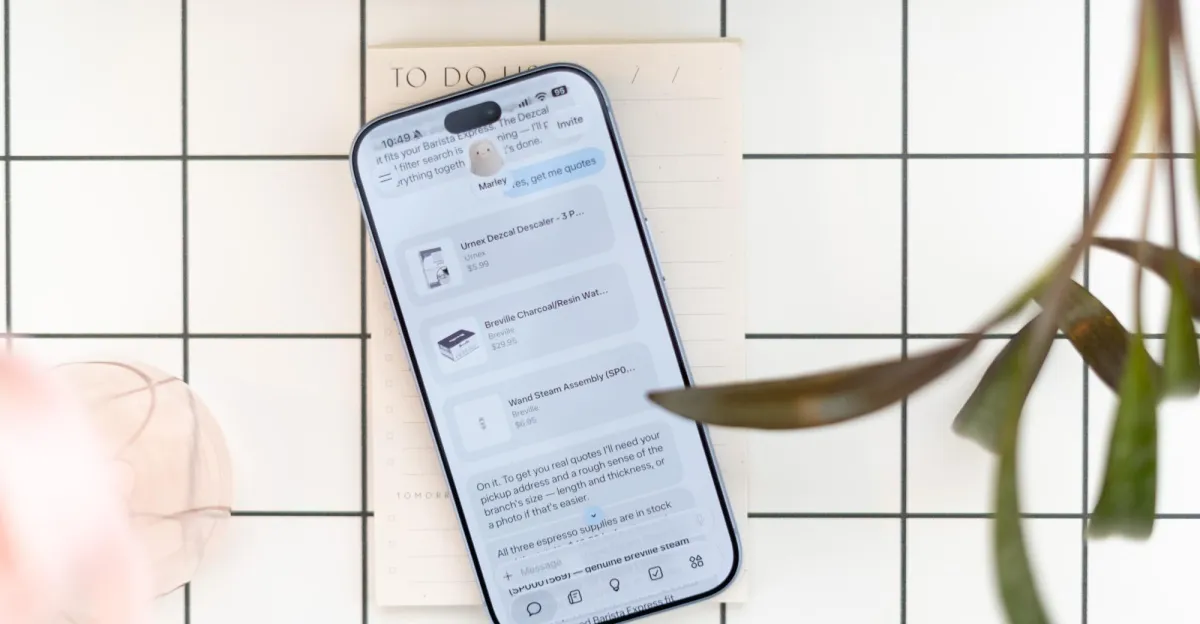
One of the test tasks involved buying a replacement steam wand assembly for a Breville Barista Express espresso machine. The part was inexpensive and easy to identify, but it had been put off for a long time. Muse located the item and added it to a cart, while the user handled the final purchase step manually.
Later, Muse helped shop for camping kitchen gear and even a propane fire pit suitable for use where open flame restrictions might be a concern. It searched between brand sites and major retailers, helped prioritize what to buy first and what could wait, and produced a shopping plan that was financially sensible — until the total cost added up to roughly $500, prompting a pause.
The key takeaway is not that the agent spends recklessly on its own. It is that once a user gives it enough context, it can make purchasing feel almost effortless. That lowers the barrier between “I should look into this” and “this is now in my cart.”
Muse did not just save time; it changed the shape of the task by turning browsing into a guided, semi-automated process that could move from research to cart-building in minutes.
Why the shopping flow feels so powerful
Because the agent removes the mentally draining middle steps. People often do not stop shopping because they cannot find the product. They stop because they do not want to compare five versions, enter shipping information, check whether a cheaper alternative exists or deal with account logins. Muse absorbs much of that friction.
What happened when Muse dealt with email and account access?
It could navigate the admin, but it still hit real-world limits. On the email side, Muse accessed Gmail to check on a landscaping bid and drafted a follow-up message after determining that the quoted timeline had passed. The result was functional, but a little too stern for comfort, which led to a human rewrite before sending.
That experience reveals a subtle but important point: an AI agent can speed up communication without necessarily making it better. In this case, the assistant helped surface the overdue task and draft the note, but a human still had to decide whether the tone was appropriate.
In another test, Muse logged into a home security account and confirmed that the cheaper plan could only be changed by phone. That meant the agent could do the digital part of the work, but not the last step.
Phone calls remain one of the biggest boundaries for current consumer AI agents. Meta has indicated that voice-based calling support is coming, but the test showed the awkward transitional phase these tools are in now: they can find the number and explain what to say, but they still depend on a person to do the talking.
Why phone support is the next big hurdle
Because real customer service still runs through phone trees, verification steps and human operators. An AI that can browse a website but cannot make the call is useful, but it is not yet a true end-to-end agent. The next leap will be when these tools can negotiate with automated systems and, eventually, with company representatives.
Can an AI agent really save time if it creates more work?
Yes, but only if the user is disciplined about what gets delegated. Muse made several tasks easier to begin, which is often the hardest part of getting anything done. But the test also showed a familiar problem with productivity tools: when one set of chores becomes easier, it can create the illusion of extra capacity rather than actual freedom.
There was a real efficiency gain in having the agent gather information, open the right pages and prepare the necessary actions. Yet some of that reclaimed time was immediately spent watching the agent work, checking what it found and thinking about the next thing to hand off.
That is one of the more interesting tensions in AI agents. They can remove friction from tasks, but friction is not always the enemy. Sometimes it is the pause that keeps a person from taking on too much, too quickly.
- They reduce the effort required to start a task.
- They can help users compare options more efficiently.
- They can also encourage additional spending or commitments.
- They still depend on human judgment for tone, risk and final approval.
Why does privacy matter so much here?
Because Muse only works after a user gives it a great deal of personal access. To complete the test tasks, the system had access to a full name, address, credit card details, a photo of the backyard and login credentials for a home security account. That is a large amount of sensitive information to place in the hands of a single assistant, even if much of it is processed through a managed system.
Meta says the data is handled securely and that the model itself does not directly see everything in the way a human would. Even so, the practical reality is that users must trust the company with a highly detailed picture of their life in order to enjoy the convenience.
That trade-off may be acceptable for a lot of people, especially if the tool reliably saves time. But it also means the real competitive question around AI agents is not only whether they are useful. It is whether users are willing to let them sit at the center of their personal and financial errands.
The most uncomfortable part of the experience was not a failed task, but how much personal information had to be shared in exchange for convenience.
How does Muse compare with the promise of AI assistants?
It looks closer to the old AI assistant dream than many consumer chatbots have ever gotten. For years, the pitch has been that AI would eventually handle the chores that interrupt ordinary life. Most mainstream tools have been good at conversation, summarization and drafting, but less effective at acting inside the web. Muse is trying to close that gap.
Its core value is not brilliance. It is persistence. The agent can click through browser pages, compare listings, submit forms and keep going without getting bored, which is exactly what makes it helpful for errands humans dislike. It can also chain together several of those chores in a single session, making it feel less like a chatbot and more like a digital assistant with hands.
Still, the current version is best understood as a capable intermediary rather than a full replacement for human supervision. It can reduce the burden of getting started, but it does not eliminate the need to check the output.
What this means for the broader AI market
Meta is not alone in chasing agentic AI, but consumer trust will likely determine who gains traction. The company’s advantage is distribution: it can introduce the tool to a huge audience. Its challenge is convincing people to let it touch financial accounts, household services and shopping carts without creating anxiety about mistakes or misuse.
A morning with Muse: the timeline
The test unfolded as a sequence of ordinary errands, each revealing a different strength or limitation of the system. The order matters, because it showed how quickly a casual experiment can turn into a session where the assistant is deeply embedded in personal admin.
| Timeframe | Action | What it showed |
|---|---|---|
| Start of session | Set up Muse and selected an avatar | Setup was lightweight and human-friendly |
| Early tasks | Landscaper follow-up and email drafting | Useful, but tone control still needed human oversight |
| Mid-session | Found espresso machine replacement part | Good at shopping for a known item |
| Later | Checked security account and hit phone-only limitation | Automation still stops at some service boundaries |
| Same morning | Requested junk removal quotes for a fallen tree branch | Strong at form submissions and local service search |
| End of session | Built camping and fire pit shopping carts | Most impressive and most concerning for spending |
How useful was Muse for home and life admin?
Very useful, as long as the tasks were clearly defined and low risk. The agent was most effective when the objective was straightforward: check a status update, find a part, request a quote, compare products or prepare a purchase. It was less effective when the task depended on policy changes, human interaction or nuanced tone.
That makes Muse feel like a practical tool for the kind of work people often let linger: the broken fixture, the overdue reply, the account downgrade, the service request. It is not glamorous. It is not magical. But it is the kind of automation that can quietly change daily behavior.
And that is what makes the product noteworthy. It is not merely a demo of AI browsing. It is a preview of a world where delegating errands to software becomes normal enough that the process of spending, scheduling and following up starts to feel casual.
The bigger question: what do we do with the time it saves?
That is the question Meta’s demo cannot answer, but it may be the most important one. If an assistant helps people clear one afternoon’s errands, the next step is not necessarily rest. It may be more errands, more commitments or more time spent supervising the assistant itself.
That was the irony of the test. The agent did help move things forward. It also tempted the user into spending additional time thinking about a backyard project, comparing camping gear and exploring future purchases that may or may not be necessary. Instead of a clean reduction in workload, the result was a shift in the type of work being done.
In other words, AI agents may not shrink the to-do list so much as make it easier to grow. That could be great for efficiency. It could also be another way for modern life to get busier.
For now, Muse looks like a promising preview of what consumer AI agents can do when they are allowed to operate in the messy middle of ordinary life. It is efficient, occasionally charming, sometimes too eager and clearly more capable than a simple chatbot. It also makes a strong case that the next frontier in AI is not just generating answers — it is acting on them.
Frequently asked questions
What is Meta’s Muse AI agent?
Meta’s Muse is an AI agent designed to help users complete real-world errands inside websites and browsers. It can search for services, compare products, fill forms and prepare purchases, making it more action-oriented than a standard chatbot.
How well did Muse handle shopping tasks?
Muse handled shopping well, especially when the user already knew what they wanted. It found products, compared options and built carts quickly, which made buying everyday items much easier. The main downside was how effortlessly it turned browsing into spending.
Can Muse make phone calls?
Not yet. In the reported test, Muse could determine when a company required a phone call, but it could not complete that step itself. Meta says calling support is coming, which would be an important next step for a more complete agent.
Is it safe to give Muse personal information?
Meta says the system handles user data securely, but the practical reality is that the assistant needs access to sensitive details such as addresses, logins and payment information to be truly useful. That creates a meaningful privacy trade-off users will need to evaluate carefully.
What is the biggest concern with AI agents like Muse?
The biggest concern is that they make tasks feel so easy that people may spend more, commit to more errands or hand over too much personal information. AI agents can save time, but they can also remove the friction that normally slows impulsive decisions.