Updated September 15, 2026 5:54 pm
In short
Daydream’s new Apple Intelligence-powered fashion search tools now require iOS 27 with Siri AI, and the company says it has more than 1.5 million shoppers using a catalog spanning 325-plus retailers and 10,000 brands.
- Daydream can now analyze saved outfit photos in Photos and return shoppable matches or similar styles.
- The app also adds Siri-powered voice and text search without requiring users to open Daydream first.
- The features rely on iOS 27 developer tools and Siri AI, making Apple’s ecosystem central to the experience.
- Daydream says its Style Passport helps personalize results using size, brand, style and budget preferences.
- The company is positioning these updates as a step toward a broader shopping agent vision.
Update — September 15, 2026 5:54 pm
Daydream says its app is free to download on iOS, and the company now says users need an iPhone running iOS 27 with Siri AI enabled to use either of the new features.
The company also disclosed more details about its business: it says more than 1.5 million shoppers use Daydream, with inventory drawn from over 325 retailers and 10,000 brands, including Anthropologie, Gucci, J.Crew, Reformation, Uniqlo and Nordstrom.
Bornstein also argued the features are meant to go beyond one-off search tools, saying Daydream is aiming to build a shopping agent that can understand style across different parts of a user’s life.
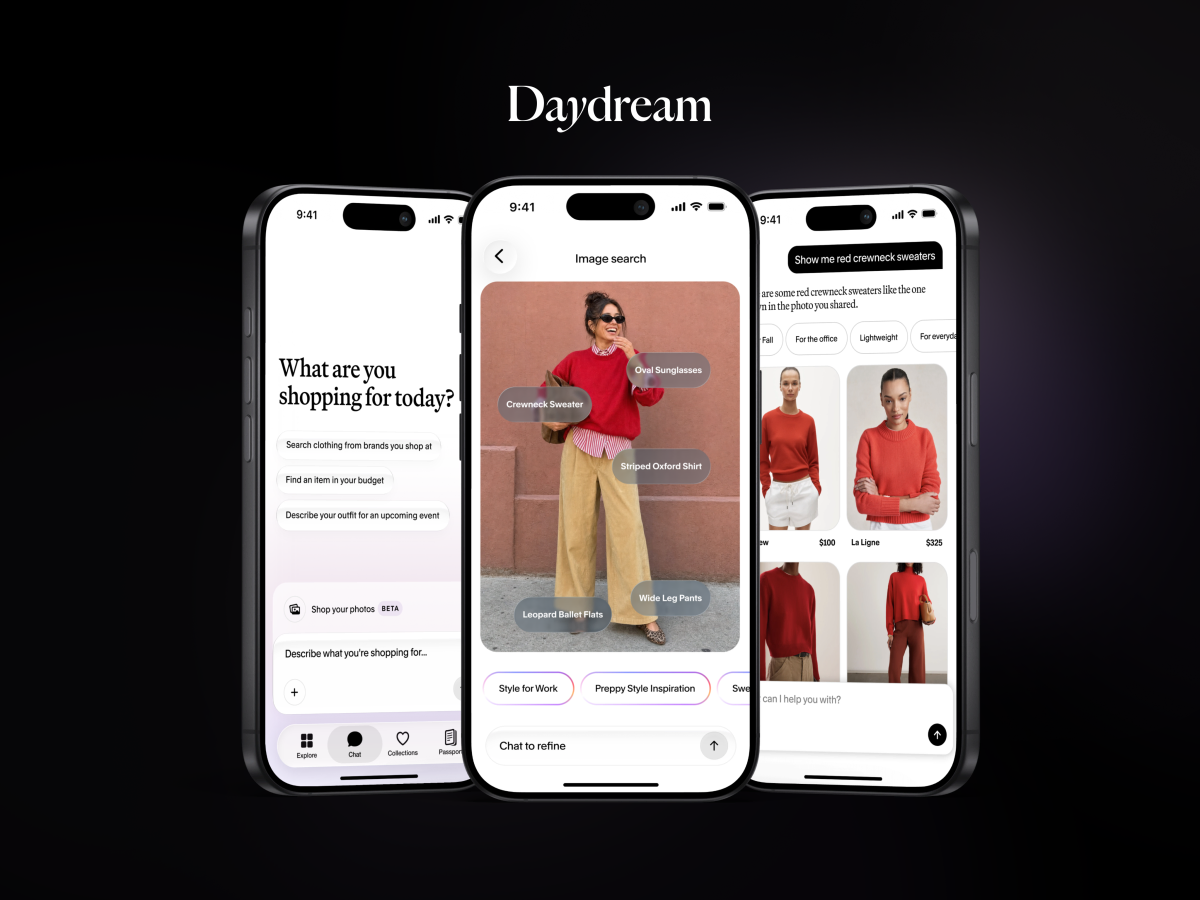
Daydream has launched two iPhone features that let shoppers turn saved outfit photos into product matches and search for clothes through Siri without opening the app. The rollout, built with Apple’s newly released iOS 27 developer tools, deepens Daydream’s push to make fashion shopping feel more conversational, visual, and personalized.
The fashion discovery app says the update can analyze images already stored in a user’s Photos library, identify individual garments and accessories, and return shoppable alternatives from a catalog of roughly 3 million items. It also adds a Siri-based search experience that allows people to ask for outfit ideas by voice or text and receive personalized results tied to their style profile.
The launch matters because it shows how quickly shopping apps are adapting to Apple’s new on-device intelligence tools — and how companies in retail search are trying to compete on context rather than just inventory. For Daydream, the features are also a step toward a broader ambition: becoming a true shopping agent that understands a customer’s taste well enough to assist across multiple moments in daily life.
What Daydream launched and why it matters
Daydream’s new features are designed to make fashion discovery start wherever inspiration already appears: in a camera roll, in a screenshot, or in a spoken request to Siri. Rather than forcing users to begin with category filters or keyword searches, the app now uses Apple Intelligence-style capabilities to interpret the object in front of the user and then convert that image or query into shopping results.
That approach reflects a broader shift in e-commerce: consumers increasingly want shopping tools to understand intent, not just match terms. A saved Instagram screenshot of an outfit, for example, can become the starting point for a search for a coat, a pair of trousers, a handbag, or shoes that resemble what is visible in the picture.
Daydream says the system can also return the exact item if it is still available. If it is not, the app surfaces lookalikes and closely related alternatives from its retail network. That distinction — between exact match and style match — is one of the key reasons fashion discovery is becoming a major AI use case.
How the new image search works
The image-based feature uses Apple’s image-context tools in iOS 27 to inspect photos saved on the iPhone. Once a user selects a picture from their Photos app, Daydream breaks the image into recognizable components and identifies the pieces that matter for shopping, such as a sweater, pants, boots, or jewelry.
From there, the app searches its product catalog for items that resemble or directly match the clothing in the image. Daydream says its inventory includes about 3 million products, giving the app a wide base to generate results from multiple retailers and brands.
In practical terms, that means a screenshot from Pinterest or Instagram no longer has to sit idle in a camera roll. It can become a shopping prompt that translates visual inspiration into a set of purchasable items, filtered through Daydream’s fashion-focused catalog.
What happens if the exact item is gone?
If the original item is no longer available, Daydream shifts from direct matching to style matching. The app will not simply return an empty result set; instead, it looks for nearby alternatives that preserve the overall look, silhouette, or aesthetic of the original piece.
That fallback is especially important in fashion, where many products are seasonal, limited-run, or sold out quickly. A useful fashion tool must be able to handle unavailable inventory without losing the user’s intent.
Julie Bornstein, Daydream’s co-founder and chief executive, said the app can also recognize requests that modify a look rather than simply replicate it, such as wanting the same sweater in a different color.
Bornstein’s point underscores a key difference between generic visual search and a domain-specific shopping tool. In fashion, people often want variants rather than duplicates: the same blazer in navy, the same dress in a different length, or the same shoes in a lower heel. Daydream is positioning itself around that kind of nuanced behavior.
How Siri search changes the shopping flow
The second feature adds a Siri-powered way to search Daydream using natural language. Instead of opening the app and typing into a search bar, users can ask Siri to find clothing and accessories on their behalf.
Daydream says the query can be spoken or typed through Siri, and the app will produce personalized results based on the user’s preferences. The example the company gives is a prompt like: search for a blazer suitable for a board meeting on Monday.
That may sound simple, but it matters because it moves shopping from an app-centered experience to a more ambient one. In other words, the request can happen in the middle of a routine task, without breaking the flow to open a separate app.
Why personal data makes the answers better
Daydream says the results become more tailored when users complete its “Style Passport,” a setup process that captures details including size, favored brands, aesthetic preferences, and price range. That profile helps the system narrow results to items that are more likely to fit both physically and stylistically.
The company’s logic is straightforward: a fashion recommendation is only as good as its understanding of the shopper. A search for “cool blazer” means something different depending on body type, workplace dress code, budget, and taste. The more a system knows, the more useful it can be — at least in theory.
That personalization also places Daydream in the growing class of AI shopping products trying to move beyond generic recommendations toward individualized assistance. The goal is not just to show products, but to show the right products in the right context.
| Feature | What it does | Why it matters | Requirements |
|---|---|---|---|
| Photos-based outfit search | Analyzes saved outfit images and returns shoppable matches | Turns screenshots and camera-roll inspiration into buying options | iPhone with iOS 27, Siri AI enabled, Daydream app installed |
| Siri fashion search | Lets users ask for products by voice or text through Siri | Removes the need to open the app first | iOS 27, Siri AI enabled, Daydream app installed |
| Style Passport | Stores size, brand, style, and budget preferences | Makes results more personalized and relevant | User setup inside Daydream |
| Product matching | Finds exact items or similar alternatives | Helps when products are sold out or discontinued | Access to Daydream’s retail catalog |
Why Apple’s iOS 27 tools are important for shopping apps
Apple’s iOS 27 developer tools give third-party apps a new layer of on-device intelligence to build around, and Daydream is among the early fashion-focused adopters. By using Apple’s built-in capabilities, the app can make image and voice interactions feel more native to the iPhone experience.
This matters for two reasons. First, it lowers friction for users who already rely on Photos and Siri as default tools. Second, it gives developers a new way to interpret user intent without requiring people to manually describe what they see or want.
For shopping apps, that could be a meaningful competitive edge. The better an app can bridge the gap between inspiration and purchase, the more likely it is to become part of a user’s habit loop. Fashion, in particular, is a category where visual cues dominate and where quick response time can influence conversion.
What makes fashion harder than generic product search?
Fashion is harder because style is subjective, inventory changes constantly, and the same look can be interpreted in many ways. A product search engine can return a black blazer, but a fashion discovery tool has to understand cut, drape, occasion, and aesthetic fit.
Daydream argues that its specialization in apparel gives it an advantage over broader search tools. The company says many visual search systems fall short because they are not built with fashion expertise and therefore can produce results that feel inaccurate, untrustworthy, or not directly shoppable.
That criticism goes to the heart of the category. Users do not just want a similar image; they want useful results from credible brands, with a path to purchase that feels aligned with the original inspiration.
Bornstein has said that generic visual search often misses the mark in fashion, surfacing unrelated brands or non-shoppable images instead of results that match the look and can actually be bought.
How Daydream fits into the AI shopping race
Daydream is not alone in trying to reinvent product discovery with AI. Larger companies such as Google and Amazon have also been building smarter shopping experiences, while smaller startups including Onton and Alta are pushing into similar territory.
The competitive question is no longer whether AI can help people shop. It can. The more important question is which company can deliver the most relevant answer with the least amount of effort — especially in categories like fashion, where users often start with a vague idea and then refine it through conversation.
Daydream is betting that a fashion-specific model, paired with personalized user data and Apple’s new device-level intelligence tools, can outperform broader shopping systems. The company’s case is that expertise matters as much as the underlying technology.
Comparing Daydream’s angle with larger rivals
Big tech platforms have scale, but Daydream is leaning into specialization. That distinction is likely to matter as AI shopping matures.
- Google and Amazon can search enormous product inventories, but they serve many categories at once.
- Daydream focuses on fashion, where nuance and styling context are central.
- Smaller startups may be faster to experiment, but they often lack the same breadth of retail relationships.
In that environment, a narrow but deep product offering can sometimes outperform a broad but generic one. Daydream is trying to prove that theory in a category where discovery is highly visual and brand-sensitive.
What is Daydream’s bigger long-term plan?
Daydream says the new features are only an early step toward a shopping agent that can understand a person’s style well enough to help across different surfaces in daily life. The company’s long-term vision is not just search, but continuous assistance.
That could mean helping a user identify an outfit from a photo, recommend a matching jacket through Siri, and later suggest complementary accessories based on the same style profile. In the company’s telling, the app should eventually be able to follow the customer across moments and contexts, not just within a single search session.
The phrase “shopping agent” is increasingly common in AI circles, but in fashion it has a very specific meaning: a system that can interpret taste, not merely transaction history. If Daydream succeeds, it could become more like a personal stylist than a catalog browser.
Why on-device intelligence could be the next battleground
On-device intelligence is appealing because it can make experiences faster, more private, and more seamlessly integrated with the phone itself. For shopping, that combination may be especially valuable when users are reacting to visual inspiration in real time.
Daydream says it plans to keep going deeper into on-device intelligence. That suggests the company sees Apple’s ecosystem not just as a distribution channel, but as a foundation for future product design.
The move also reflects a wider industry trend: more AI features are being built into the operating system and less into standalone prompts. As a result, the best shopping tools may be the ones that feel invisible until the moment they are needed.
What Daydream’s current scale says about its position
Daydream says its app has more than 1.5 million shoppers using the platform, with access to products from more than 325 retailers and 10,000 brands. Its retail partners include labels and stores such as Anthropologie, Dolce & Gabbana, Uniqlo, J.Crew, Reformation, Gucci, and Nordstrom.
Those numbers suggest the company has already built meaningful traction for a relatively young fashion app. Its product mix spans accessible basics and luxury labels, which may help it appeal to users with very different shopping budgets and style preferences.
A broad retailer network is also important for AI search quality. The more inventory and brand diversity a platform has, the better its chances of finding both exact matches and good substitutes when the original item is unavailable.
| Metric | Daydream reported figure | Why it matters |
|---|---|---|
| Shoppers | More than 1.5 million | Signals user adoption and product-market fit |
| Product catalog | About 3 million items | Expands the odds of useful visual and text matches |
| Retailers | More than 325 | Provides broad shopping coverage |
| Brands | 10,000+ | Increases style diversity and search relevance |
How this could change everyday shopping behavior
The strongest case for Daydream’s update is that it reduces the distance between seeing something and buying something similar. In the past, that process often required a user to save the image, remember it later, and manually search for the look in a separate app or browser window.
Now, the workflow is shorter. A saved photo, a spoken Siri request, or a quick description can become a shopping query almost immediately. For consumers, that is less work. For retailers, it could mean more impulse-driven discovery from already interested users.
It also reflects a subtle change in consumer expectations. Shoppers increasingly assume that AI should understand images, context, and intent together. If a tool cannot do all three, users may move on to one that can.
Why this is more than a convenience update
This is more than a convenience update because it signals where fashion commerce is heading: toward assistant-led, context-aware buying. The future of shopping may be less about browsing endless grids and more about asking for what you want in the most natural way possible.
For Daydream, the challenge now is execution. It will need to make sure the Apple-powered features feel accurate, fast, and useful enough to change user habits. In fashion, novelty is easy; utility is what keeps people coming back.
What happens next for Daydream?
Daydream appears to be setting the stage for a more ambitious platform built around style memory and conversational shopping. The company’s immediate priority is likely to prove that the new Apple-powered features are not just demos, but everyday tools that help people discover products they actually buy.
If adoption grows, the app could become a model for how retailers and shopping apps use on-device AI to reduce friction. If it does not, the update may still offer an early look at how fashion discovery is likely to evolve across Apple’s ecosystem and beyond.
Either way, the move puts Daydream in a more competitive position inside a fast-moving market. The app is no longer just a place to browse fashion products. It is trying to become the interface between inspiration and purchase.
That is a big ambition, but one that fits the direction of the technology. As AI becomes more embedded in smartphones, the apps that win may be the ones that understand not just what users say, but what they see — and what they mean when they say it.
Frequently asked questions
What did Daydream launch with Apple Intelligence?
Daydream launched two new iPhone features: one that turns saved outfit photos into shoppable results, and another that lets users search for clothing and accessories through Siri without opening the app.
How does Daydream’s photo search work?
Daydream analyzes images saved in the iPhone Photos app, identifies items such as sweaters, pants, shoes, or accessories, and then matches them to products in its catalog. If the exact item is unavailable, it shows similar alternatives.
Do users need iOS 27 to use the new features?
Yes. Daydream says the features require an iPhone running iOS 27 with Siri AI enabled, plus the Daydream app installed. The app itself is free to download on iOS devices.
What is Daydream’s Style Passport?
Daydream’s Style Passport is a profile that captures size, preferred brands, style preferences and budget. The company says it helps the app return more personalized fashion recommendations.
Why is Daydream’s update important?
It is important because it shows how fashion apps are using new on-device AI tools to shrink the gap between inspiration and purchase. The update also pushes Daydream closer to its goal of becoming a shopping agent.