In short
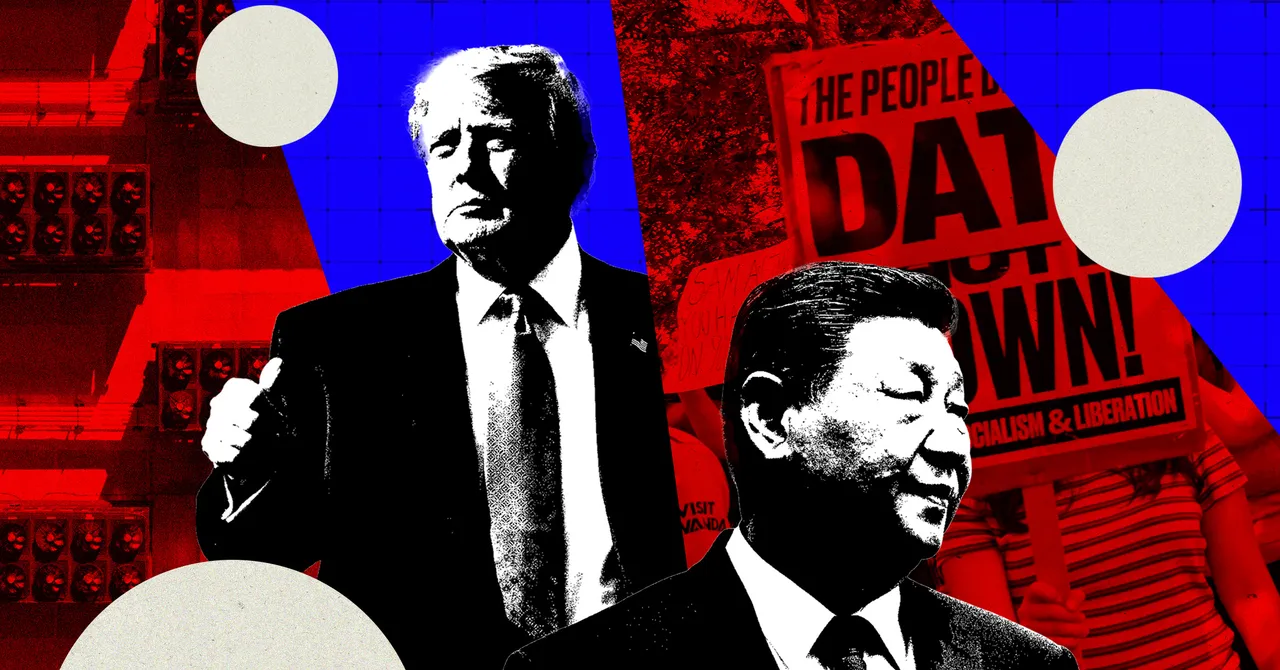
Claims that China is fueling the data center backlash are gaining traction in politics and on social media, but analysts say the evidence is thin. The real opposition appears to be driven mostly by domestic concerns over power, water, cost, and local disruption.
- Public opposition to new data centers has surged as the AI boom expands.
- X and some politicians have amplified claims that China is behind the backlash.
- Researchers say most of the resistance still appears to be homegrown.
- The issue is becoming a major election-year and state-policy fight.
- The data center debate now sits at the intersection of AI, energy, and local politics.
Claims that China is behind America’s growing backlash against data centers are spreading through politics and tech circles, but the evidence remains thin. The latest wave of blame-shifting matters because opposition to AI infrastructure is becoming a major 2026 campaign issue just as voters, regulators, and state lawmakers push back on the rapid buildout.
The argument that foreign influence is driving anger over data centers has been amplified by X, right-wing commentators, and even President Donald Trump, yet researchers and analysts say most of the resistance is still homegrown and rooted in real concerns about power use, water demand, and local disruption.
Data centers have become one of the most politically charged pieces of the artificial intelligence boom. Once treated as a behind-the-scenes necessity, they are now a visible symbol of the costs of AI expansion, and the backlash is forcing politicians to choose between cheering the industry and answering voters who do not want it in their neighborhoods.
Why the data center fight is becoming a political problem
The backlash has intensified fast. Polling cited in recent reporting suggests opposition to new data centers has surged this year, with as many as three-quarters of Americans now saying they would oppose one being built near them. That is a dramatic rise from last year and reflects the way data centers have shifted from a technical issue into a public one.
Politicians who once leaned into the industry are now recalibrating. Governors in both major parties, including figures such as Texas Gov. Greg Abbott and Pennsylvania Gov. Josh Shapiro, have begun sounding more cautious as the midterm elections draw closer. Their change in tone is less about abandoning AI entirely than about showing voters they understand local frustration.
At the federal level, the issue is equally awkward. President Trump has been a forceful supporter of data center expansion, but even that has not stopped some of his allies from searching for a bigger explanation for the anger. For them, the easiest answer is not that people dislike noisy, resource-hungry infrastructure. It is that an outside adversary is stirring the pot.
How did China become the preferred explanation?
China became the preferred explanation because it offers a politically convenient villain. Instead of acknowledging that many Americans have legitimate environmental and community concerns, pro-data center figures can frame the backlash as a manipulation campaign from abroad.
That storyline has surfaced repeatedly over the past several months. In the spring, reports from conservative policy groups were used by lawmakers and pundits to accuse the Chinese Communist Party of helping seed anti-data center sentiment in the United States. In June, OpenAI said it had banned a cluster of accounts it believed were tied to the Chinese government and were testing narratives related to AI infrastructure.
The most visible burst of attention came in late August, when X said it had found 200 accounts linked to China that were amplifying anti-data center messages on the platform. The company’s disclosure triggered a fresh wave of headlines and social posts alleging that Beijing was secretly fueling American resistance.
Supporters of the foreign-interference theory have used the X report to argue that the backlash is being manipulated from abroad, but analysts say that claim has far less support than the volume of attention it received.
President Trump quickly picked up the theme on Truth Social, warning that China would welcome anti-data-center activism and urging support for more construction. His post fit neatly into a broader political habit: when infrastructure, industry, or technology faces public resistance, China is often invoked as a catch-all explanation.
What evidence supports the China claims?
Very little public evidence has emerged to support the idea that Chinese influence is driving the data center backlash. Experts who study online manipulation say the cases cited so far look more like opportunistic engagement with an already existing grievance than a coordinated campaign that created the grievance itself.
That distinction matters. If foreign actors are amplifying anger that already exists, they are not necessarily the source of the anger. They are taking advantage of it.
In OpenAI’s June disclosure, the company said the account cluster it identified appeared to be exploiting the data center issue rather than manufacturing it from scratch. That is a key point because it undercuts the more dramatic public claims that the opposition is primarily a product of Chinese meddling.
There is also a scale problem. X said it removed 200 accounts tied to China, but the platform also said those accounts were part of a much larger 200,000-account bot operation. Put differently, the anti-data center accounts were a tiny subset of a much broader enforcement action.
| Event | When | What happened | Why it mattered |
|---|---|---|---|
| Rising public opposition | 2025-2026 | Polling showed Americans increasingly opposed to nearby data centers | Turned an industry issue into a political liability |
| OpenAI account action | June 2026 | Company said it banned accounts linked to Chinese government activity | Fueled claims of foreign influence on AI infrastructure debates |
| X account disclosure | Late August 2026 | X said it found 200 China-linked accounts pushing anti-data-center content | Triggered a new round of headlines and political messaging |
| Midterm pressure builds | Fall 2026 | Politicians begin rethinking how openly they support data centers | Shows the backlash is becoming an election-year issue |
What analysts say is actually driving the backlash
Researchers tracking online discourse say the most convincing explanation remains the simplest one: people are reacting to local costs and risks. Data centers can consume large amounts of electricity, require significant water for cooling, and bring construction, traffic, and land-use conflicts to communities that often feel excluded from the decision-making process.
Graphika, a social media analytics company that has been monitoring data center sentiment, has said that most of the opposition it has seen appears to be domestic. The company’s intelligence vice president, Tyler Williams, said this week that there is still little evidence of a substantial foreign operation behind the backlash.
That aligns with the broader political context. Data centers are visible reminders of the AI economy’s uneven benefits. Companies, utilities, landowners, and tech investors stand to gain; nearby residents may get higher utility bills, more industrial traffic, and the feeling that major decisions were made without them.
Environmental objections also remain central. Critics worry about emissions from powering new facilities, the strain on local grids, and the use of water in places already facing drought or scarcity. Those are not abstract concerns. They are practical, local, and easy to mobilize around.
Why the China story is so appealing to tech boosters
The China narrative gives boosters a way to recast skepticism as disinformation rather than democratic pushback. If opposition is foreign-influenced, then the industry does not have to answer as directly for its own environmental footprint, labor implications, or role in accelerating AI demand.
It also fits into a broader political framework on the right, where China is frequently invoked as the source of American weakness, division, or policy confusion. In that environment, a complex local fight over zoning and infrastructure can be reimagined as an episode in great-power competition.
That framing can be especially attractive to people who already see AI infrastructure as a strategic necessity. If data centers are part of a national race, then local opposition can be portrayed as not just inconvenient but unpatriotic.
How does the online debate shape the real-world fight?
The online debate matters because it can influence what legislators, governors, and regulators believe is happening on the ground. A social-media story that frames opposition as foreign manipulation can give elected officials cover to keep approving projects while claiming they are defending the public interest.
But the same digital platforms also expose how widespread the resistance has become. Anti-data-center sentiment is not confined to activist circles. It is now visible in local news coverage, statehouse debates, neighborhood organizing, and candidate messaging.
That makes the China argument both louder and weaker at the same time. Louder, because it can be repeated endlessly by politicians and influencers. Weaker, because the more people talk about data centers, the easier it is to see that the objections are rooted in everyday concerns, not in a hidden foreign conspiracy.
Alice-like simplifications of a complicated policy fight may be politically useful, but analysts say they do little to explain why communities across the country are turning against the infrastructure.
Who benefits from the foreign-interference narrative?
Several groups benefit, even if for different reasons. Data center operators benefit because the narrative reframes opposition as illegitimate. Politicians who support AI expansion benefit because they can sidestep difficult local tradeoffs. And partisan commentators benefit because China remains one of the most reliable attention engines in American politics.
There is also a reputational advantage for the broader tech ecosystem. If the backlash is foreign-sparked, then companies can argue that the public is being manipulated rather than genuinely dissatisfied. That matters at a moment when AI companies are spending billions on infrastructure and need political goodwill to keep building.
But there is a risk in overusing the China explanation. If every domestic backlash is blamed on a foreign adversary, officials may stop listening to the actual complaints from residents and local governments. That could deepen the distrust that made the issue politically explosive in the first place.
What the data center backlash means for the AI boom
The fight over data centers is becoming one of the clearest tests of whether the AI boom can keep scaling without a political revolt. The industry needs more power, more land, more water, more permits, and more public tolerance. Those are all harder to secure when the facilities themselves are now a source of resentment.
For AI companies, that means the challenge is no longer just chips, talent, and models. It is also permitting, grid capacity, water access, and community trust. As the physical footprint of AI expands, the industry is colliding with the realities of energy policy and local democracy.
That collision is what makes the current backlash so significant. It is not simply a communications problem. It is a governance problem.
How states and cities are responding
State lawmakers are preparing a larger wave of data-center legislation heading into the next legislative year, according to recent reporting. That suggests the backlash is no longer a collection of isolated fights but part of a broader policy reckoning.
Local officials, meanwhile, are under pressure from both sides. Pro-growth advocates warn that blocking data centers could cost jobs and investment. Opponents say communities should not be asked to shoulder environmental and infrastructure burdens for projects that often promise more than they deliver locally.
- Some states are considering stricter permitting rules for new facilities.
- Others are debating utility-rate protections for residential customers.
- Local governments are reviewing zoning, water, and land-use standards.
- Advocates are pushing for more transparency around tax deals and power agreements.
How credible is the China allegation, really?
The allegation is not impossible, but the public record so far does not support the more dramatic version of the story. There may be foreign accounts or bot networks engaging with the issue, but that is very different from proving that China created the backlash or even meaningfully shaped it.
That is why many researchers are urging caution. Online influence campaigns often succeed best when they latch onto arguments that already resonate. In this case, that means the controversy around data centers predated the foreign-linked accounts that later appeared to participate in it.
One of the clearest indications of that reality is how quickly the issue caught fire without needing outside help. When communities are worried about power demand, water use, and opaque deals between companies and public officials, a foreign bot is not necessary to produce outrage.
What happens next?
The immediate future of the data center debate will likely be shaped by three forces: election politics, state legislation, and the AI industry’s need to keep expanding. Each makes the story more volatile.
Politicians will continue trying to separate themselves from unpopular projects while still signaling support for innovation. Tech leaders will keep insisting that the facilities are essential. And critics will keep asking why they should absorb the costs of a boom whose benefits often flow elsewhere.
That is why the China narrative is likely to persist even if the evidence remains weak. It is emotionally satisfying, politically useful, and simple to repeat. But for now, the more grounded explanation is also the more persuasive one: Americans are not turning against data centers because a foreign power told them to. They are turning against them because the projects are landing in their communities, and many people do not like what they see.
Background: The bigger story behind the backlash
The battle over data centers is really a battle over who gets to absorb the costs of AI. Big technology firms want scale. Utilities want certainty. Politicians want growth. Residents want a say.
Those competing interests are now colliding in public, which is why the argument has spread far beyond the tech press. It touches climate policy, energy policy, local taxation, labor, elections, and national security. That gives the issue unusual staying power.
It also helps explain why blame travels so easily. When an infrastructure fight becomes this broad, every side is tempted to simplify. For some, China is the simplest villain. For others, the tech industry itself is the problem. For many residents, the answer is even more basic: they just do not want another massive data center in their backyard.
As the 2026 election cycle heats up, that sentiment is likely to matter more than any account purge or social-media theory. The real test for data center boosters will not be whether they can win an argument about foreign influence. It will be whether they can persuade voters that the AI buildout is worth the costs on the ground.
Frequently asked questions
Is China really behind the backlash against data centers?
No clear evidence shows that China is driving the backlash against data centers. Analysts say some foreign-linked accounts may have amplified existing complaints, but the underlying opposition appears mostly domestic and rooted in local concerns about energy, water, and land use.
Why are data centers so unpopular right now?
Data centers are unpopular because many communities see them as noisy, power-hungry, water-intensive projects that can raise local concerns without delivering obvious neighborhood benefits. Polling suggests opposition has risen sharply as residents connect data centers to the AI boom.
What did X claim about anti-data center accounts?
X said it identified 200 accounts linked to China that were promoting anti-data center messaging. The platform’s disclosure triggered headlines, but the number was small compared with a much larger bot operation it said it had also uncovered.
How are politicians responding to the data center debate?
Politicians are becoming more cautious about publicly backing data centers as the backlash grows. Some governors and lawmakers who previously supported the projects are now trying to signal that they understand voters’ concerns ahead of the midterms.
What does this mean for the AI industry?
It means the AI industry now faces a political and infrastructure problem, not just a technology problem. As more facilities are proposed, companies may have to deal with stricter permitting, stronger local opposition, and greater scrutiny over environmental and community impacts.