Updated September 1, 2026 1:24 pm
In short
Circleback has launched a free tier with unlimited transcription and 30-day history, while paid plans now start at $15 a month billed annually, and the company says it remains profitable with ARR of more than $1 million per employee.
- Circleback introduced a free tier with unlimited transcription and 30-day history.
- Paid plans now start at $14 per month, down from the previous entry price.
- The startup says the change is meant to reduce user drop-off and drive product-led growth.
- Circleback says it is profitable, has eight employees, and is not rushing to raise more money.
- Competition in the meeting-note market is rising as more AI and productivity apps add similar tools.
Update — September 1, 2026 1:24 pm
Circleback’s new paid pricing starts at $15 a month when billed annually, a small step up from the $14 figure previously reported.
The updated source also clarifies that the company’s revenue metric is annual recurring revenue per employee, not run-rate revenue, putting the figure at more than $1 million per person across a team of eight.
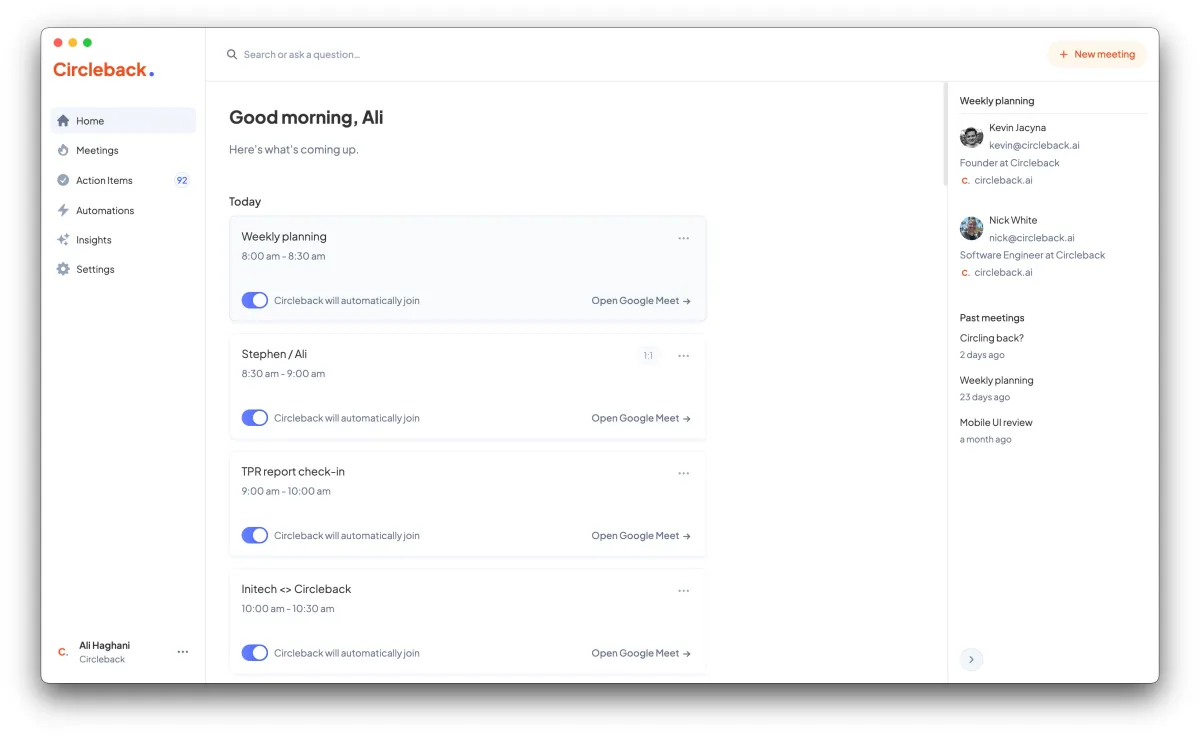
Circleback, the Y Combinator-backed meeting note-taker, has introduced a free plan in a bid to widen adoption as competition intensifies across the fast-growing AI meeting assistant market. The startup is offering unlimited transcription at no cost, but limits users to 30 days of meeting history, while paid plans now start at $14 a month when billed annually.
The move arrives as more productivity apps add note-taking features and dedicated rivals such as Granola, Read AI and Fireflies continue to attract funding and users. For Circleback, the new tier is both a growth tactic and a response to a market where users increasingly expect to try before they buy.
Why Circleback is changing its pricing now
Circleback says the free tier is designed to solve a simple problem: too many potential customers were dropping off before they had enough time to understand the product.
Before this change, the company did not offer any permanent free option. Its plans began at $20.83 per month, a price point that may have been hard to justify for people still comparing it with other AI note-takers or testing newly added meeting tools inside broader productivity platforms.
According to the company, the old trial structure created a meaningful barrier to adoption. By opening access more broadly, Circleback expects more users to experience the product deeply enough to convert later.
“If we just open the gates and allow more people to use the product, that’s gonna bring Circleback in front of more people,” co-founder Ali Haghani said. “Then we’re very good at making the product good and monetizing those users.”
The company is framing the free tier not as a discounting move, but as a marketing strategy that replaces paid ads. Circleback says it does not spend on Google or Meta advertising, so broader product access becomes its main customer-acquisition channel.
What the free plan includes
The new plan is more generous than a typical trial, but it is still clearly designed to push serious users toward paid subscriptions.
Free users can record meetings, transcribe an unlimited number of calls, query transcripts with AI, and use Circleback’s mobile and Apple Watch apps. The plan also includes integrations with Linear and Slack, two tools often used by product and engineering teams.
However, several of the more advanced features remain behind the paywall. Users who want complete integrations, unlimited meeting history, and full API and MCP access will need one of the paid plans.
How the free tier compares with paid access
The free option gives people a low-risk way to test Circleback, while paid tiers are aimed at heavier users and teams that need deeper workflow integration.
| Plan | Cost | Main features | Limitations |
|---|---|---|---|
| Free | $0 | Unlimited transcription, meeting recording, AI transcript search, mobile and Apple Watch apps, Linear and Slack integrations | 30-day history only, limited access to integrations and advanced developer tools |
| Paid plans | From $14/month billed annually | Unlimited meeting history, all integrations, full API access, MCP access | Requires subscription |
The company’s new pricing is also lower than its previous starting rate, signaling a broader push to make the product easier to adopt in a crowded category.
What makes the meeting note-taker market so crowded?
The meeting-notetaker category has become one of the most competitive corners of the AI productivity market because the value proposition is easy to explain and increasingly easy to replicate.
In the past few weeks alone, the space has seen fresh moves from companies that already had adjacent products. Wispr, known for dictation software, launched its own note-taker and scheduling tool. Calendly, best known for booking meetings, also added a similar feature set to its platform.
At the same time, stand-alone players continue to raise large sums and build recognizable brands. Granola, Read AI and Fireflies have all secured significant funding, giving them the resources to market aggressively and expand product capabilities.
That has made user acquisition harder for newer or smaller entrants. When several products can record meetings, generate summaries and surface action items, the battle often shifts from features to trust, convenience and pricing.
How Circleback is trying to stand out
Circleback is betting that generous free access, combined with a polished product and a focus on workflow integrations, can help it compete against better-funded rivals.
The startup is positioning itself as a practical assistant for users who need transcript search, app integrations and cross-device access. By including mobile and Apple Watch support, it is also aiming to serve professionals who move between meetings and devices throughout the day.
The inclusion of Linear and Slack integrations in the free plan is notable because those tools are common inside startups and software teams, which are often early adopters of AI note-taking products.
- Unlimited transcription can encourage broad trial usage.
- 30-day history creates a natural reason to upgrade.
- Workflow integrations increase usefulness for teams.
- Mobile and wearable access broaden day-to-day use.
Who built Circleback, and how big is the company?
Circleback was founded in 2023 by Ali Haghani and Kevin Jacyna. The company later raised $2.5 million in 2024 and has operated profitably since that funding round, according to its own statements.
Circleback says it now has eight employees and generates more than $1 million in annualized revenue per employee. That figure would imply run-rate revenue of about $8 million, if the number holds steady across the team.
For a startup with a small staff, that kind of revenue efficiency is a strong signal in a market that often rewards lean operations. It also helps explain why the company says it does not feel pressure to raise capital immediately.
Haghani said the startup has been consistently able to take customers from much larger competitors and believes market demand for better note-taking tools is still rising.
He added that if the company later finds a problem that can only be solved with more capital, it would be open to fundraising. For now, though, Circleback says it sees no major bottleneck that would force a new round.
Why the company is not rushing to fundraise
Circleback’s stance on funding reflects a broader shift among some AI startups: raise when necessary, not simply because the market is receptive.
The company says investor interest exists, but management does not view fundraising as urgent. That choice suggests confidence in the current business model and an emphasis on keeping the operation efficient rather than scaling headcount quickly.
In a sector where many companies are burning capital to win attention, Circleback is emphasizing profitability, product-led growth and disciplined spending. The free tier fits that strategy because it expands awareness without adding traditional ad costs.
That said, the company’s competitive environment remains intense. As more productivity platforms package meeting intelligence into broader offerings, Circleback will need to prove that it can retain users after the first few sessions and turn interest into durable subscriptions.
How the new plan fits into the wider AI productivity race
The free tier is not just a pricing change. It is also a sign of how quickly the AI productivity market has matured from novelty to utility.
Early in the category’s life, many users were willing to pay for experimental tools that promised automatic summaries and searchable transcripts. Now, those capabilities are becoming expected features across products rather than premium extras.
That shift usually forces startups into one of two paths: either bundle with larger platforms or differentiate through workflow depth, design quality and switching costs. Circleback appears to be choosing the second path.
By giving away core functionality while reserving historical depth, advanced integrations and developer access for paid tiers, the startup is creating a familiar freemium funnel. The challenge will be making the free experience valuable enough to attract users without undercutting the incentive to upgrade.
What users should watch next
For customers, the immediate question is whether the free plan is good enough to replace current tools or simply useful as a test drive.
For Circleback, the more important test is whether the new tier increases signups, improves retention and converts a larger share of users into paid subscribers. If it does, the startup may prove that freemium still works in one of AI’s most crowded product categories.
If it does not, the company could face the same pressure confronting many point-solution AI startups: growing fast enough to matter while avoiding a race to the bottom on price.
Key facts at a glance
| Item | Details |
|---|---|
| Company | Circleback |
| Founded | 2023 |
| Founders | Ali Haghani and Kevin Jacyna |
| Funding | $2.5 million raised in 2024 |
| Team size | 8 employees |
| Claimed revenue efficiency | Over $1 million per employee in run-rate revenue |
| New free tier | Unlimited transcription, 30-day history |
| Starting paid price | $14 per month, billed annually |
Circleback’s new pricing strategy highlights a simple reality in AI software: in a crowded market, access can be as important as innovation. The startup is now counting on a free plan to widen its reach, sharpen its competitive edge and turn more curious users into paying customers.
Frequently asked questions
What is Circleback's new free tier?
Circleback's new free tier is a no-cost plan that lets users record meetings, transcribe an unlimited number of calls, query transcripts with AI, and use mobile and Apple Watch apps. The main restriction is that meeting history is limited to the last 30 days.
How much do Circleback's paid plans cost now?
Circleback's paid plans now start at $14 per month when billed annually. That replaces the company's previous pricing, which started at $20.83 per month before the free tier was introduced.
Why did Circleback add a free plan?
Circleback says it added the free plan because too many users were dropping off during the trial process. The company believes broader free access will bring more people into the product and improve conversion to paid subscriptions later.
Is Circleback raising more funding soon?
Circleback is not actively seeking a new funding round right now. The company says it has investor interest but does not see an immediate need to raise because it believes its current growth path is not constrained by capital.
How crowded is the AI meeting note-taker market?
The market is increasingly crowded because both stand-alone startups and larger productivity companies are adding similar features. Recent moves from Wispr and Calendly, along with funded rivals like Granola, Read AI and Fireflies, have intensified the competition.