In short
Physical AI is drawing major investment, but robotics remains stuck on data, simulation and reliability problems that prevent broad commercial deployment. Industry leaders say the sector is progressing, yet still lacks a true ChatGPT-level breakthrough.
- Physical AI is attracting billions, but commercial robotics is still limited by poor data and inconsistent reliability.
- Autonomous vehicle companies are leading much of the tooling and data infrastructure for robot learning.
- Startups are increasingly focusing on narrow verticals such as excavation, solar farms and industrial deployment.
- Foxglove launched a new data-search product built on Nvidia’s Cosmos world model.
- Experts disagree on whether robotics will have a single ChatGPT moment or a slower Apple II-style adoption curve.
Physical AI startups are attracting huge amounts of capital, but the sector is still struggling with a basic problem: robots are getting better at moving, yet not good enough at doing useful work reliably. That gap was on display this week as investors, founders and engineers gathered to debate whether robotics is finally moving beyond its “GPT-2 era.”
The discussion matters because robotics is one of venture capital’s hottest themes, with billions flowing into companies trying to bring the large-language-model playbook into the physical world. But while the promise is enormous, the technology remains uneven, the data problem is severe, and the path from impressive demos to profitable deployment is still unclear.
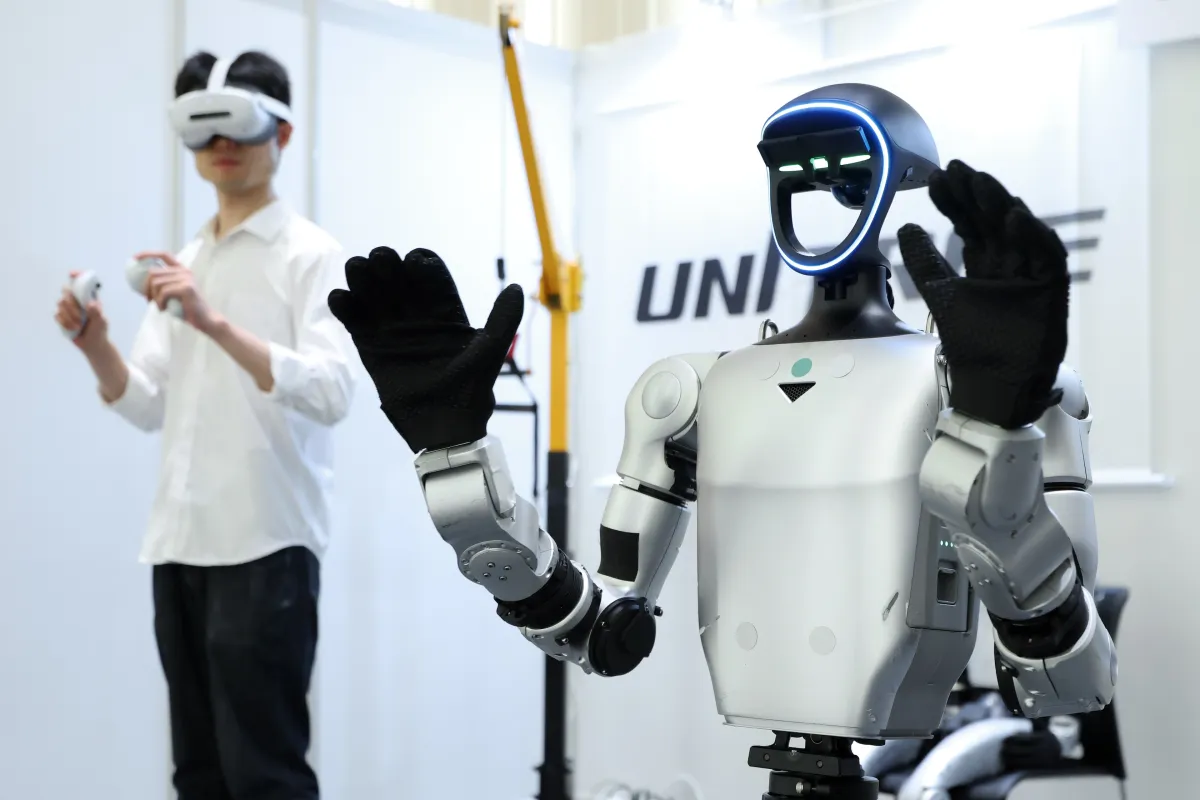
That tension has become especially visible after the dramatic debut — and recent retreat — of Unitree, China’s leading robot maker. The company surged to an estimated $66 billion valuation following its listing on China’s Nasdaq-like market, only to lose nearly half that value days later. The market reaction underscored the same question that robotics engineers have been asking for months: can machines that look increasingly capable actually perform commercially valuable tasks well enough, often enough, and cheaply enough to justify the hype?
The robotics boom is running into a data wall
The sector’s biggest obstacle is not hardware alone. It is data.
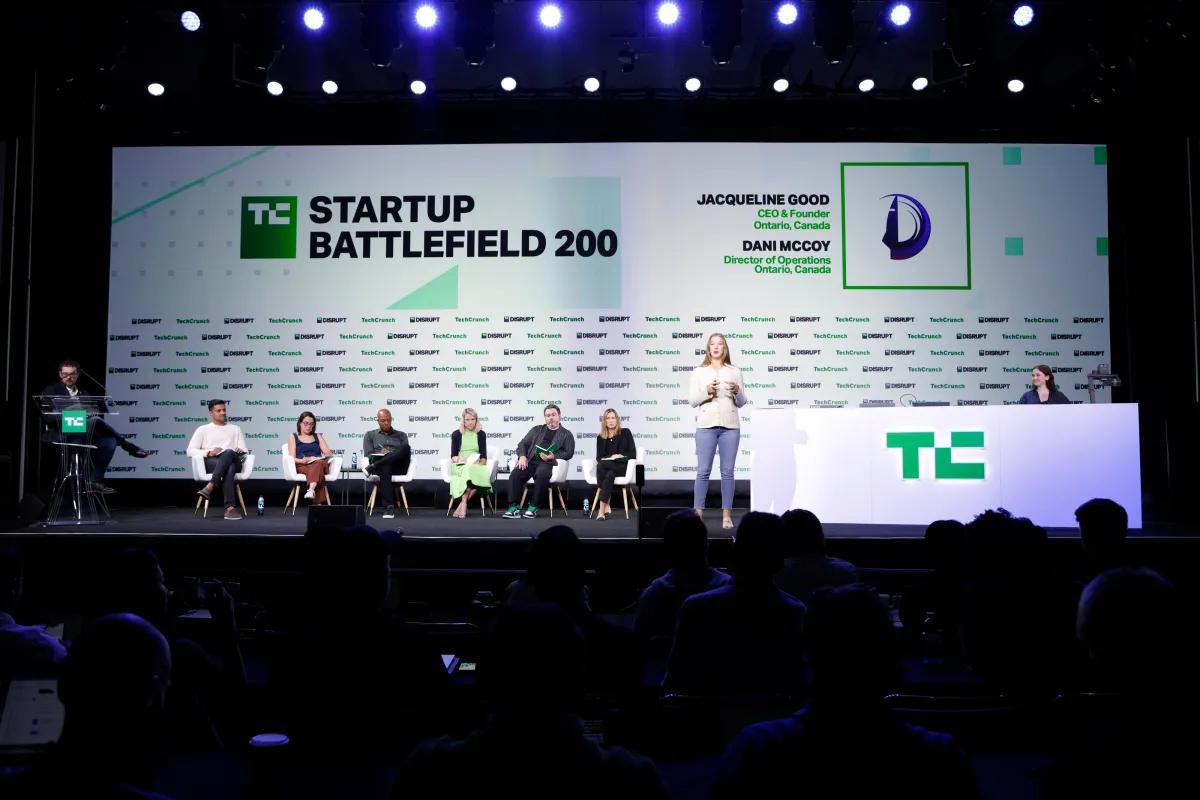
At the Actuate conference last week, a show focused on building AI “brains” for robots, the scale of the industry’s ambitions was easy to see. Foxglove, the organizer and a developer platform for physical AI teams, said attendance had tripled since the event launched in 2023, reaching 1,500 participants this year. Booths, talks and hallway conversations reflected an industry that has moved beyond experimentation and into a race to industrialize robot learning.
Yet the same gathering also made clear how far the field still has to go. One exhibitor, Avala, advertised a solution to what it called the “robotics data crisis,” a blunt acknowledgment that high-quality training data remains scarce, expensive and hard to standardize.
That shortage is holding back generalized robots — machines that can be dropped into different environments and asked to do many kinds of tasks. For now, those systems are still largely aspirational. Even narrower approaches, where robots learn to perform one specific job through end-to-end training, have not consistently produced products that can operate with the reliability businesses require.
Why is robotics still in its early stage?
Robotics is still early because the industry has not yet solved the equivalent of the data-and-scale problem that transformed generative AI. Founders are experimenting with more diverse data sets, altered training methods and new reinforcement-learning setups, but no approach has yet delivered a broadly useful embodied model at large scale.
Harry Mellsop, founder of simulation startup Antioch, framed the sector as being in the same rough developmental phase that OpenAI’s GPT-2 represented before ChatGPT changed the public conversation around AI. The implication is clear: the field may have proof that the technology can work in principle, but it still lacks the data volume, compute and refinement needed for a true breakout.
One reason the analogy resonates is that robotic learning is not just about language or prediction. Physical systems need to understand space, motion, contact, timing and failure states in a messy world. That requires far more than text data, and often more than the kinds of simulated environments that robotics teams have relied on for years.
Another challenge is compute. Mellsop argued that the next leap will demand more processing power, including GPUs suited to high-fidelity rendering and ray tracing for simulation environments. In other words, the industry may need both better data and more expensive infrastructure before it can train systems robust enough for the real world.
How do robot builders get more useful data?
The answer, at least for now, is by combining real-world deployment with simulation, specialized tooling and tighter feedback loops.
That is why much of the most practical progress in robotics has come from sectors where machine operation can be observed and logged at scale, especially autonomous vehicles. Cars generate large quantities of relevant sensor data, and the core task — avoiding collisions — is narrower than the broad manipulation problems faced by humanoid robots and general-purpose machines.
Foxglove’s own roots reflect that lineage. The company was founded by former employees of Cruise, General Motors’ former self-driving unit, and much of the physical-AI tool stack being assembled today has similar origins in the autonomous vehicle world.
That overlap is helping vehicle-focused companies extend their ambitions. Tesla is already trying to carry its autonomy work into the humanoid category with Optimus. Meanwhile, Wayve, which has focused on AV technology, has launched a robotics lab aimed at humanoid form factors, and Uber has also opened a robotics lab as part of its broader R&D strategy.
Alex Kendall, CEO of Wayve, said the company believes robot development should begin in vehicles because the data and infrastructure lessons are transferable, even if the final models need to be adapted for different embodiments.
Kendall’s view is that the core stack — the tools for managing data, simulating environments and running machine-learning operations — will likely be shared across robotics form factors. But he also noted that the world models used in simulation and post-training will need to differ depending on the robot’s body and task.
He argued that teams should not rush to lock themselves into a single hardware design too early, since sensors and components are improving quickly and the right long-term architecture may need to remain flexible.
What are the biggest robotics bets right now?
The biggest bets are on vertical applications where a robot can do one job well enough to be deployed now, even if it is not yet a true generalist.
That divide has created two broad camps in the market. One camp is chasing broad, humanoid-purpose systems. The other is focused on narrow commercial use cases where robots can earn revenue and generate field data immediately.
Examples of the latter are already in the market:
- Gritt is deploying robots for solar farm work.
- Agility is shipping industrial robots into operational settings.
- Bedrock is running autonomous excavation systems.
These companies may not look as futuristic as humanoid robot labs, but they are addressing the immediate business problem: customers will pay for reliability in a defined environment long before they pay for a promise of universal capability.
Théophile Gervet, CEO of Genesis AI, said the market should be realistic about the limits of a “brain first” strategy. Genesis raised a $105 million seed round this year and is pursuing a vertically integrated humanoid approach, pairing hardware and AI development rather than treating them separately.
Gervet argued that it is still too early in the cycle for companies to rely on a pure software-brain approach, and said co-designing the machine and the intelligence layer is a better path at this stage.
He also cautioned against building a broadly general robot that cannot perform even basic tasks with high enough success rates to satisfy paying customers.
His central point was that generalization is not valuable if performance is too weak to deploy. At the same time, he warned that companies narrowing their focus too early could be outpaced by rivals training on more advanced model stacks.
Why vertical robotics is winning deployments
Vertical robotics is winning deployments because it creates a practical feedback loop: the robot earns money, collects useful data and improves on the job.
That loop is especially important because task-specific data, while narrow, is real. It captures the edge cases, failure modes and physical constraints that matter in production. For a company trying to build an intelligence layer across multiple machines, those deployment logs may prove more valuable than a larger but less relevant synthetic dataset.
Bedrock CTO Kevin Peterson described excavation as an entry point into what he called “manipulation in the wild.” The company is starting with a specific construction workflow, but the long-term goal is a broader intelligence layer that can extend across more than one type of machine.
This phased approach reflects a growing conviction across the industry that there may be no shortcut around domain specialization. The immediate money is in solving one job well. The long-term ambition is to use that job to unlock a more general robotic model later.
The robotics data crisis is becoming a product category
The shortage of useful training data is now big enough that infrastructure itself has become a startup opportunity.
Foxglove announced a new product this week built on Nvidia’s Cosmos open-weight world model. The tool is designed to let engineers search dense robotics data using natural-language queries, making it easier to build evaluations and simulations from large quantities of visual and lidar input.
That matters because robotics teams are drowning in sensor information. Cameras, depth sensors and lidar systems generate enormous streams of data, and turning that raw material into something actionable is slow and expensive. Better indexing and search can shorten the time between a bug appearing in the field and a team understanding how to fix it.
In practice, this means faster debugging, quicker iteration and more effective model training. For companies in a capital-intensive field, those improvements can make a meaningful difference in burn rate and product readiness.
The emergence of this tooling ecosystem also signals a broader maturity shift. In the same way that the rise of foundation models created demand for prompt tooling, vector databases and evaluation products, physical AI is now spawning its own set of infrastructure vendors aimed at data curation, simulation and deployment management.
What would a ChatGPT moment for robotics look like?
It would look less like a viral demo and more like a robot that ordinary users can buy, trust and use every day.
That question is now central to the industry, especially after OpenAI chief executive Sam Altman suggested recently that a robotics breakthrough may be only a few years away. But leaders in the field do not all agree on what the defining moment would be — or whether it will resemble ChatGPT at all.
For Kendall, the answer is not another investor frenzy. He pointed out that the largest robot fleet in the world is still consumer vacuum cleaners, which hints at how limited today’s adoption remains. His version of a breakthrough would be “eyes-off” autonomy in a car for less than $1,000 worth of hardware, a threshold he believes would be both economically meaningful and consumer-facing.
That benchmark also lines up with Wayve’s business strategy. The company is licensing models to automakers in the hope of delivering a scalable autonomy stack, and Kendall sees that market as a potential multibillion-dollar opportunity that could help create a more general embodied AI platform over time.
Kendall said a true turning point would be low-cost autonomy that consumers could trust, not simply a system that excites venture capital.
Gervet’s definition is different. He believes the real milestone will be when a robot can be spoken to in plain language and consistently perform common manipulation tasks — opening a laptop, clearing a table, pushing or pulling objects — with roughly 80% or better reliability right out of the box.
That, he suggested, would feel closer to the ChatGPT experience: immediately understandable, generally useful and good enough to change expectations.
Foxglove chief executive Adrian Macneil offered the sharpest correction to the ChatGPT comparison. In his view, robotics may never get a single software-style “moment” because the distribution problem is fundamentally different.
Macneil argued that ChatGPT became a phenomenon because it spread from zero to millions of users in a very short time, while robotics must deal with physical manufacturing, installation, maintenance and real-world deployment — all of which are slower and harder to scale.
He said a more appropriate benchmark might be the Apple II or IBM PC era in personal computing: not a sudden explosion of universal adoption, but the arrival of a product category that people can actually bring home and use for something fun and useful.
What the Unitree rout says about the market
The Unitree episode shows that robotics valuations can move faster than robotics capabilities.
On paper, the company’s public-market debut looked like a confirmation of investor enthusiasm for embodied AI. The subsequent drop in value served as a reminder that market excitement does not automatically translate into lasting confidence in product readiness or profit potential.
That disconnect is exactly what the industry is trying to close. The robots themselves are improving physically, but many analysts and operators still believe the field is missing the decision-making layer that turns movement into value creation.
Until that changes, the sector may continue to oscillate between optimism and skepticism. Every promising demo can push valuations higher. Every missed expectation can pull them back down.
Key milestones to watch
The next phase of physical AI will likely be measured by deployment, not rhetoric. The most important milestones are likely to be practical, repeatable and visible in the field.
| Milestone | Why it matters | Current status |
|---|---|---|
| Reliable manipulation | Enables robots to complete common tasks with usable accuracy | Still below commercial expectations in most settings |
| Large-scale deployment data | Improves training and reduces edge-case failures | Mostly concentrated in vehicles and narrow verticals |
| Affordable autonomy | Could unlock consumer and fleet adoption | Not yet broadly available at the target price point |
| Searchable robotics data stacks | Helps engineers debug and iterate faster | Emerging now as a product category |
| General-purpose embodied AI | Represents the long-term ambition of the sector | Still in early development |
The bigger picture for AI investors
The excitement around physical AI is real, but the market is still separating infrastructure from outcome.
Investors are funding companies that build the tools for simulation, model training, evaluation and deployment because those picks-and-shovels businesses may generate value before fully general robots arrive. At the same time, startups focused on a single industrial task can show revenue and data advantages sooner than those betting on universal humanoids.
This creates a two-track market. One track is about the future architecture of intelligence in the physical world. The other is about near-term commercial survival.
The result is a robotics ecosystem that increasingly resembles early frontier AI: huge ambition, expensive infrastructure, competing theories of progress and no guarantee that the first widely hyped approach will be the one that works.
For now, the field remains somewhere between demo and deployment. The robots are improving. The business models are emerging. But the industry still needs a breakthrough in learning, data and trust before it can claim a moment as transformative as the launch of ChatGPT.
Until then, physical AI may be less about a single event and more about a steady sequence of hard-won milestones — one robot, one data set and one useful job at a time.
Frequently asked questions
What is physical AI in robotics?
Physical AI is the effort to apply machine-learning techniques, including foundation-model methods, to robots and other embodied systems. It focuses on teaching machines to perceive, reason and act in the physical world, rather than only generating text or images.
Why are robotics startups being compared to the GPT-2 era?
They are being compared to the GPT-2 era because the technology is promising but not yet mature. The industry has compelling demos and strong investor interest, but it still lacks the data, compute and reliability needed for a broadly useful breakthrough.
Why are autonomous vehicle companies important to physical AI?
Autonomous vehicle companies are important because they have years of experience collecting sensor data, building simulation tools and managing machine-learning operations. That know-how is being reused as robotics teams try to train systems for manipulation and general embodiment.
Will robotics have a ChatGPT moment?
A single ChatGPT-style moment is possible, but many industry leaders think robotics will scale more slowly. They point to manufacturing, installation and real-world deployment as barriers that make physical products harder to distribute than software.
What is the biggest obstacle to general-purpose robots?
The biggest obstacle is the lack of high-quality training data for real-world manipulation. Robots still struggle to perform many tasks reliably enough to satisfy customers, which makes it hard to build a general-purpose system that can be deployed at scale.