In short
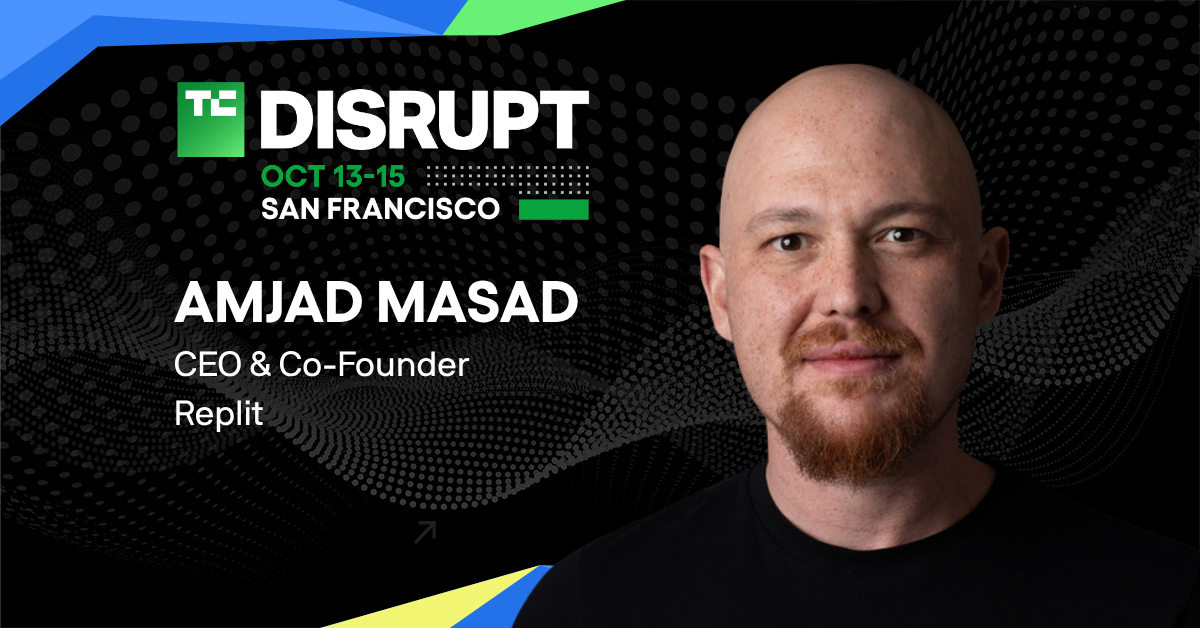
Replit CEO and co-founder Amjad Masad will speak at TechCrunch Disrupt 2026, where he is expected to discuss how AI coding is changing programming and startup building. The appearance comes as Replit’s revenue and valuation have surged sharply.
- Amjad Masad will appear on the Disrupt Stage at TechCrunch Disrupt 2026 in San Francisco.
- Replit’s growth has accelerated rapidly, with a reported $9 billion valuation and a much higher revenue run-rate than in 2024.
- The session is expected to focus on the future of programming, entrepreneurship, and AI-assisted software creation.
- TechCrunch Disrupt 2026 runs October 13–15 at Moscone West and will feature more than 10,000 attendees.
- The event underscores how AI coding has become a central topic for startups and investors.
Replit CEO and co-founder Amjad Masad will appear on the Disrupt Stage at TechCrunch Disrupt 2026 in San Francisco, where he is expected to discuss how AI is changing programming, product creation, and startup building. The conversation comes as Replit’s growth accelerates sharply, making Masad one of the clearest voices on the future of software in the AI era.
Masad’s appearance matters because Replit has become a prominent example of how generative AI is lowering the barrier to building software while also raising new questions about quality, speed, jobs, and the sustainability of AI-first companies.
TechCrunch says the event will run October 13–15 at Moscone West and will bring together more than 10,000 founders, investors, and technologists across six stages. For attendees tracking where software development is heading, Masad’s session is positioned as one of the marquee discussions on the program.
Why Masad’s Disrupt appearance matters
Masad is not just another AI executive taking a conference stage; he leads one of the companies most closely associated with the shift from coding as a specialized craft to coding as a broadly accessible activity. Replit’s platform is designed to help users create software in the browser, and its AI tools have made that process even more approachable for beginners and faster for professionals.
That places Masad at the center of a bigger industry debate: is AI making programming more productive for trained engineers, or is it opening the door for entirely new classes of creators who can build usable products without deep technical knowledge?
The answer, increasingly, is both. AI can speed up routine tasks, generate working code, and help people prototype ideas quickly. But it can also introduce problems around maintainability, correctness, and overreliance on tools that may not fully understand the broader architecture of a product.
Replit’s pitch has evolved beyond rapid prototyping, with the company aiming to help users move from idea to complete software rather than stopping at a rough demo.
What Replit has become in the AI era
Replit was founded a decade ago, long before the current generative AI boom transformed how developers work. In its early years, the company was associated with collaborative browser-based coding. More recently, it has become one of the best-known names in AI-assisted software creation, reflecting the way the market has shifted toward tools that can generate, explain, and refine code in real time.
The company’s recent growth underscores that transition. TechCrunch reports that Replit’s current annualized revenue run-rate is approaching $1 billion, a dramatic leap from the $2.8 million in reported revenue it posted in 2024. That difference reflects not only product adoption, but also the speed with which demand for AI-enabled development tools has intensified.
In practical terms, Replit now occupies a space where it can serve hobbyists, founders, and professional engineers alike. For a solo entrepreneur, it can shorten the time between an idea and a functional app. For a software team, it can reduce the friction involved in scaffolding, debugging, and iterating on features.
This broad appeal is part of why the company has attracted strong investor attention. Earlier this year, Replit reportedly reached a $9 billion valuation, only six months after being valued at $3 billion. Such a rapid increase reflects the market’s belief that AI-native development tools could become core infrastructure for a large portion of software creation.
How AI is changing programming
AI is changing programming by making code generation, explanation, and iteration available to far more people than before. That shift is not eliminating software engineering; rather, it is changing the entry point and the pace at which products can be built.
For years, writing software required a steep learning curve. A developer needed to master syntax, tooling, version control, deployment, debugging, and project structure. AI tools do not remove all of that complexity, but they can abstract much of it away, especially in the early stages of a project.
That has several consequences:
- Lower barriers to entry: Nontechnical founders can test ideas without hiring a full engineering team immediately.
- Faster iteration: Experienced developers can automate repetitive work and focus on higher-level design.
- More experimentation: Teams can build and discard ideas more quickly, which may accelerate innovation.
- New risk profile: Bugs, security flaws, and hidden technical debt can spread faster if users trust AI output too much.
That last point is important. As AI tools become more capable, there is a temptation to treat them as near-complete substitutes for engineering judgment. In reality, the most successful AI coding platforms are likely to be the ones that combine generation with strong review, testing, and deployment workflows.
What Masad is likely to address on stage
Masad’s conversation at Disrupt is expected to go beyond company milestones and into the broader future of programming. His remarks will likely touch on how software is built, who gets to build it, and how AI changes the economics of startup creation.
One likely theme is the idea that startups can now move from concept to product more quickly than ever before. That changes the earliest phase of company-building, where speed and experimentation matter enormously. It also means founders may be able to validate ideas with real users before spending heavily on engineering headcount.
Another likely topic is whether AI tools can help users build not just prototypes, but full applications with real durability. That distinction matters. A prototype can impress investors or test a hypothesis. A production-ready system must survive scale, user error, changing requirements, and the day-to-day realities of maintenance.
For Replit, that challenge is central to its positioning. The company does not want to be seen merely as a novelty generator for weekend projects. It wants to be a platform that supports working software, whether that software is created by first-time builders or seasoned teams.
Why this is more than a product story
This is more than a story about one startup because it reflects a larger shift in the software industry. If AI makes it dramatically easier to produce code, then the economics of development, hiring, and product strategy all begin to change. That has implications for enterprises, investors, and the next generation of founders.
It also raises a strategic question for the entire market: if the cost of building a first version falls, what becomes the real moat? The answer may increasingly be distribution, domain expertise, trust, and the ability to turn a rough version into a reliable product customers keep using.
Replit’s valuation surge in context
Replit’s rise from a $3 billion valuation to a $9 billion one in roughly half a year is notable not just because of the numbers, but because it demonstrates how quickly investor conviction can swing around AI infrastructure companies. In the current market, companies tied to the developer workflow have become especially attractive because they sit close to revenue and product usage.
At the same time, valuations can be difficult to interpret in a fast-moving technology cycle. Investor enthusiasm can remain strong while growth is still being proven at scale. The key question is not merely whether the product is exciting, but whether the company can translate momentum into durable business performance.
TechCrunch notes that Replit’s current run-rate is on track toward an annual revenue pace near $1 billion. If sustained, that would represent a major step change from the company’s recent reported revenue and would help justify the market’s optimism. But run-rate figures are projections, not guarantees, and the startup still needs to show it can maintain demand, expand usage, and defend its position as competitors crowd the field.
| Milestone | What happened | Why it matters |
|---|---|---|
| 2016 | Replit was founded by Amjad Masad and his co-founders. | Established the company before the generative AI wave reshaped coding tools. |
| 2024 | Reported revenue was $2.8 million. | Shows how far the company has climbed in a short period. |
| Early 2026 | Replit reportedly reached a $9 billion valuation. | Signals investor confidence in AI-assisted software creation. |
| October 13–15, 2026 | Masad appears at TechCrunch Disrupt 2026 in San Francisco. | Places Replit at the center of the startup conversation about AI and programming. |
How TechCrunch Disrupt is framing the AI startup conversation
TechCrunch Disrupt 2026 is being positioned as a broad survey of the startup ecosystem in the AI era, not just a showcase for one company. Alongside Masad’s session, the event will spread across six stages that each address a different piece of the modern startup stack.
The Builders Stage is set to feature venture capital and corporate development perspectives aimed at founders trying to make practical decisions about scaling. The AI Stage will focus on issues such as the so-called SaaS disruption, career shifts, and security challenges. The Smart Systems Stage will cover infrastructure, and the Real World AI Stage will examine how these tools are affecting the physical world.
That structure reflects the way AI has moved from a niche technical topic to an organizing force across the startup economy. What was once discussed primarily by researchers and model builders is now shaping product design, pricing, hiring, and investor expectations.
For attendees, the value of Disrupt lies in that cross-section of perspectives. Founders can hear from operators, investors, and technologists in one place, while the broader industry gets a snapshot of where the market is heading next.
Why the startup world is watching the coding stack
The startup world is watching the coding stack because software is the foundation of so many businesses, and anything that changes how software is created will ripple outward into every sector. If AI enables smaller teams to build more ambitious products, the competitive landscape changes quickly.
That can be good news for founders, especially those without large initial budgets. A small team armed with the right tools may now be able to produce a much more compelling first product than would have been possible only a few years ago.
But the same trend creates pressure on existing companies. If development becomes faster and easier, then features that used to take months may take days. That compresses competitive cycles and makes it harder for incumbents to rely on slow-moving product development as a defense.
There is also an employment question. As AI handles more routine coding tasks, developers may spend less time on boilerplate and more time on architecture, integration, and oversight. That could increase productivity, but it may also change which skills are most valuable in the labor market.
What founders should take from Replit’s moment
Founders should take from Replit’s moment that the market is rewarding tools that make creation easier, faster, and more accessible. But the lesson is not simply to attach AI to an existing product and expect a valuation jump. The stronger signal is that AI works best when it changes the user’s workflow in a meaningful way.
In Replit’s case, the workflow is software development itself. That is one of the most attractive places to apply AI because the gains can be both visible and measurable. If a tool helps someone ship an app faster, the value proposition is easy to understand. If it also helps them learn, debug, and maintain that app, the long-term relationship with the product can deepen.
That is likely why investors have responded so forcefully. They are not just betting on a tool; they are betting on a platform that may sit at the center of a new generation of software creation.
The main risks ahead
Even with strong momentum, Replit faces real challenges. AI coding platforms can attract competition quickly, especially from companies with deep pockets, large distribution channels, or existing developer ecosystems. The market is still young, and it remains unclear where the strongest long-term economic moats will emerge.
There is also the possibility of user fatigue if AI-generated output creates more cleanup work than expected. Developers are willing to adopt tools that save time, but they are not likely to stick with systems that require constant correction or create hidden reliability problems.
For that reason, the companies that win this category may be those that combine generation with trust: clear explanations, strong guardrails, testing workflows, and the ability to support users from the first line of code all the way to deployment.
How to read the broader market signal
The broader market signal is that AI coding is no longer a side trend. It is becoming a core category within the AI economy, alongside model providers, developer tools, and enterprise workflow products. Replit’s growth is one of the clearest examples of how quickly that category can expand once product-market fit and investor enthusiasm align.
That does not guarantee a straight line upward. Fast-growing startups often go through periods where adoption outpaces operational maturity. For Replit and similar companies, the hard part may be transitioning from a breakout product to a lasting platform with durable retention, pricing power, and technical credibility.
Still, the timing of Masad’s Disrupt appearance is ideal for a conference focused on what comes next. The startup ecosystem is asking how AI changes building, hiring, scaling, and even the definition of entrepreneurship itself. Replit is one of the companies most closely tied to those questions.
Event details and what attendees can expect
TechCrunch says Disrupt 2026 will take place at Moscone West in San Francisco from October 13 through October 15. The event is expected to bring together more than 10,000 people from across the startup ecosystem, including founders, investors, and technologists.
Masad’s session will be one of the featured discussions on the Disrupt Stage, and the company says the broader lineup will span multiple stages focused on building companies, AI, infrastructure, and real-world applications. The event is also offering promotional ticket pricing ahead of the deadline mentioned by TechCrunch.
For readers following the AI startup race, the headline takeaway is simple: Replit’s CEO is set to use one of the industry’s biggest stages to talk about where programming is going next, at a moment when his company is growing fast enough to make that conversation especially relevant.
Timeline: Replit and Disrupt 2026
Here is a concise look at the key moments surrounding the announcement and the company’s recent momentum.
| Date | Development | Context |
|---|---|---|
| 2016 | Replit is founded | Browser-based coding becomes the company’s starting point |
| 2024 | Reported revenue of $2.8 million | Baseline for later growth comparisons |
| Early 2026 | $9 billion valuation | Investors price in AI-assisted development’s future |
| August 24, 2026 | Disrupt appearance announced | Masad joins the lineup for the October event |
| October 13–15, 2026 | TechCrunch Disrupt 2026 | Masad speaks in San Francisco at Moscone West |
Ultimately, Masad’s Disrupt appearance is about more than a conference slot. It is a marker of how central AI-assisted programming has become to the startup conversation — and how quickly a company like Replit can move from niche developer tool to one of the sector’s most closely watched platforms.
As the AI era continues to reshape how software is built, the most important question may no longer be whether AI can write code. It is whether the next generation of companies can turn that capability into dependable, scalable, and commercially durable products.
Frequently asked questions
When will Amjad Masad speak at TechCrunch Disrupt 2026?
Amjad Masad is scheduled to appear during TechCrunch Disrupt 2026, which runs from October 13 to October 15 in San Francisco. TechCrunch says he will take the stage on the Disrupt agenda at Moscone West, though the announcement does not specify a more precise time slot.
Why is Replit getting so much attention now?
Replit is getting attention because its AI-powered development tools have made it much easier for people to build software quickly, and investors have responded with major valuation gains. TechCrunch says the company’s annualized revenue run-rate is approaching $1 billion, a sharp rise from reported 2024 revenue of $2.8 million.
What will Masad likely discuss at Disrupt?
Masad will likely discuss the future of programming, the role of AI in software creation, and how Replit helps users move from idea to finished product. The conversation is expected to explore what AI means for founders, professional developers, and the startup economy more broadly.
How big is TechCrunch Disrupt 2026 expected to be?
TechCrunch says Disrupt 2026 will bring together more than 10,000 founders, investors, and technologists. The event will take place at Moscone West in San Francisco and will span six stages covering startups, AI, infrastructure, and real-world applications.
What does Replit’s growth say about the AI coding market?
Replit’s growth suggests that AI coding is becoming a major category in software development rather than a niche experiment. The company’s rapid valuation gains and rising revenue run-rate indicate strong demand for tools that help both beginners and experienced developers build faster.