Updated August 21, 2026 7:54 pm
In short
Google is expanding its Preferred Sources tool to publisher websites while also adding new ways for readers to customize Discover and Google News on Android.
- Google is letting publishers embed a Preferred Sources button on their own sites.
- Readers can mark outlets they trust, which may boost those publishers in Search, Discover and Google News.
- The move is aimed at offsetting traffic losses tied to AI-driven search experiences.
- Google says preferred sources can double the likelihood of a click when available.
- Discover and Google News are also getting deeper personalization controls.
Update — August 21, 2026 7:54 pm
Google also said readers will soon be able to fine-tune Discover using natural-language prompts in the Google app. Users will tap the three-dot menu in the feed and describe, in plain words, what they want to see more or less of.
Android users are also getting another personalization option: the ability to tailor the audio daily briefings in Google News.
Update — August 20, 2026 10:55 pm
Google also said readers will soon be able to fine-tune their Discover feed using plain language prompts in the Google app. The company says users will tap a three-dot menu and type what they want to see more or less of, with changes applied quickly.
In addition, Android users will be able to personalize the audio daily briefings in Google News, adding another layer of control beyond Search and Discover.
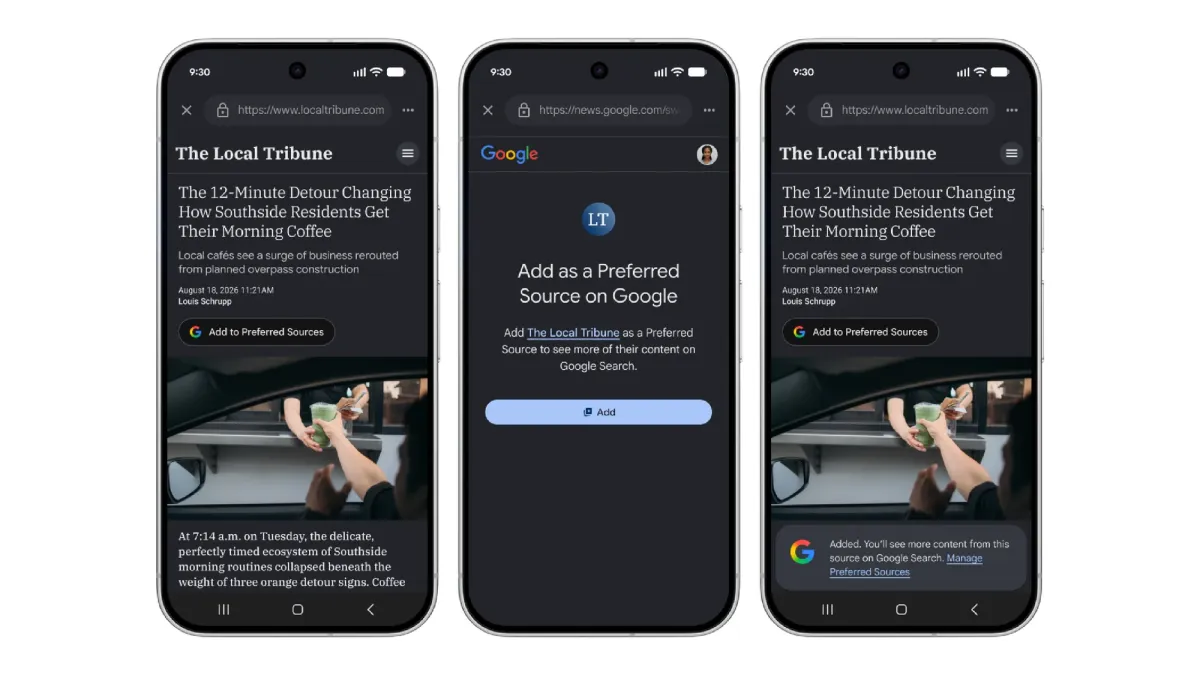
Google is giving publishers a new way to fight AI-era traffic losses by letting readers mark a site as a preferred source directly on the publisher’s own website. The new button is designed to help those outlets surface more often in Search, Discover and Google News, making it easier for audiences to keep finding the publications they already trust.
The move, announced Thursday, lands as publishers increasingly blame AI-powered search products and summaries for weakening referral traffic. Google says the feature is meant to direct more readers toward familiar outlets, while also giving users more control over the news sources they see.
What Google announced and why it matters
Google’s latest update expands its “Preferred Sources” system beyond the company’s own products and into publisher websites. Instead of requiring readers to hunt through Google’s settings, the new button can be embedded on a publisher’s site, allowing visitors to indicate that they want that outlet highlighted more often in Google’s surfaces.
That matters because the web’s traffic economy has changed sharply. As more people get answers from AI summaries, AI chat interfaces and zero-click search experiences, many publishers have seen fewer visits from Google. For outlets that rely on advertising, subscriptions or both, even small declines in referral traffic can be costly.
Google is pitching the feature as a way to restore some of that visibility by aligning search results and news recommendations more closely with audience preference. In practical terms, the company is telling readers: if you value this publication, tell us, and we will try to show it more often.
How does the new Preferred Sources button work?
The new button works by letting readers save a publisher as a favored outlet from within that site, then use that preference across Google’s products. Once a source is selected, Google says it can influence what appears in Search, Discover and Google News.
Before this launch, the Preferred Sources feature was already available in a limited form. Google introduced it in May for its AI experiences, including AI Mode and AI Overviews, and it had also appeared in Top Stories. The new addition makes the process easier for publishers to promote because the choice can now be presented where readers are already engaged: on the publisher’s own page.
To add a publication manually, users can still go to Google’s source preferences page and search for a publisher by name or website. The new button simply removes friction and makes the action more visible.
Why publishers may care
Google says preferred sources can increase the odds that people click through to a site. The company has previously said that users are twice as likely to click on a preferred source when that option is available. For publishers trying to protect audience reach, that kind of lift is meaningful.
The timing is also important. Google’s AI features have become more prominent in everyday search behavior, and many publishers worry that generated answers reduce the need for users to visit the original page. By surfacing a source preference, Google is effectively acknowledging that the relationship between search and publishing has changed—and that the company needs to offer tools that keep publishers in the loop.
Google says the new tools are meant to make it easier for readers to find outlets they already know and trust, while helping publishers recover some of the visibility they have lost as AI features reshape how people discover news.
What changed from the first Preferred Sources rollout?
The biggest change is location and convenience. Earlier versions of the feature lived inside Google’s own interfaces. The new button moves that action closer to the publisher, which could make it more likely that readers will actually use it.
Google’s May launch focused on AI Mode, AI Overviews and Top Stories. Thursday’s announcement broadens the concept by making it a publisher-facing tool that can be embedded on websites. That makes the feature less like a buried settings option and more like a lightweight audience-building prompt.
The company has not said whether it will rank preferred sources with a fixed formula or how heavily the signal will weigh against other search factors. But the strategic intent is clear: Google wants to preserve trust in its search and news products at a moment when AI-generated answers are changing user habits.
How much traction has Preferred Sources already gained?
Google says more than 345,000 unique sources had already been selected by users by the time of the May rollout. That figure suggests there is real interest in source-level control, especially among news readers who want to hear from familiar outlets instead of generic summary pages.
The number is also a sign that Google sees source preference as more than a niche feature. If readers are willing to opt in at scale, the company can use those signals to personalize search and news recommendations without relying only on broad topical ranking systems.
| Feature | What it does | Where it works | Why it matters |
|---|---|---|---|
| Preferred Sources button | Lets readers mark a publisher as favored | Publisher websites | Can increase visibility in Google surfaces |
| Preferred Sources page | Manual source selection by name or website | Google source preferences page | Gives users direct control over source choice |
| Discover customization | Users describe what they want more or less of | Google app | Adjusts feed content in real time |
| Audio briefings | Users tailor daily news audio | Google News on Android | Expands personalization beyond text feeds |
Why is Google expanding personalization now?
Google is expanding personalization now because the company is under pressure to make AI-driven discovery feel less detached from the open web. As search results become more answer-like, publishers worry that the click-through relationship that sustained the web for decades is weakening.
Preferred Sources is one way to soften that tension. Rather than forcing publishers to compete only on generic ranking signals, the feature gives loyal readers a more direct route to influence what Google shows them.
There is also a competitive angle. Social platforms have spent the past year introducing feed controls that let users refine recommendations with more precision. Google appears to be following that same logic: if people can shape their feeds elsewhere, they should be able to do the same in Search, Discover and news.
How does Discover fit into the broader strategy?
Discover is becoming a central part of Google’s personalization push, and the company is now adding natural-language controls to that feed. Soon, readers will be able to tap a three-dot menu and type in plain language what they want to see more or less of. Google says the feed will adjust in near real time.
That matters because Discover has long functioned as a high-volume distribution channel for publishers. If users can better tune the feed to their interests, Google can potentially keep them engaged longer while also making recommendations feel less generic.
For publishers, the change is a double-edged sword. Better personalization could help loyal audiences find their favorite outlets. But it also means Google will have even more power to decide which topics and publishers get attention.
What else is Google changing in news personalization?
Google is also bringing custom audio briefings to Android users in the Google News app. That means listeners will be able to shape their daily news summaries in ways that match their interests, adding another layer of control across the company’s news ecosystem.
The broader pattern is easy to see: Google is moving from one-size-fits-all content delivery to user-defined feeds and briefings. The company is not just recommending news; it is letting users help set the editorial priorities of its algorithms.
That shift may help Google defend its role as a traffic gateway at a time when AI assistants and conversational search tools threaten to bypass publishers entirely.
How publishers can encourage readers to use Preferred Sources
Publishers that want to benefit from the feature will likely need to make source selection visible and easy to understand. Google’s new button should help, but the value depends on whether readers recognize why marking a source matters.
Common tactics may include:
- placing a Preferred Sources prompt near article links or newsletters
- explaining that the choice can influence Google Search, Discover and Google News
- encouraging loyal readers to save the site during major coverage moments
- pairing the button with trust-focused messaging about original reporting and expertise
The best-case scenario for publishers is that source preference becomes a habit, similar to following a channel or subscribing to alerts. If readers do that at scale, preferred-source signals could become a durable counterweight to AI-driven traffic erosion.
What are the limits of Google’s fix?
Preferred Sources is not a cure for the structural changes AI has brought to search and publishing. It is a tool, not a reversal. If users increasingly get enough information from summaries, they may still click less often than they once did.
And while a preference signal can help loyal readers rediscover a publication, it does not guarantee broad visibility. Smaller outlets, newer brands and niche publishers may still struggle to compete against established names with larger followings.
Still, the feature is notable because it shows Google responding directly to the criticism that AI search has diverted attention away from original reporting. Rather than deny the problem, the company is offering a mechanism that nudges readers back toward the source.
Timeline: Google’s source preference rollout
Here is a simple timeline of the feature’s evolution so far:
| Date | Development | Significance |
|---|---|---|
| May 2026 | Preferred Sources launched in Google’s AI experiences and Top Stories | Introduced user-level source selection |
| May 2026 | Google said 345,000+ unique sources had been selected | Showed early user adoption |
| August 2026 | Google added an embeddable Preferred Sources button for publishers | Made the feature easier to promote on publisher sites |
| Soon after launch | Discover will allow natural-language feed tuning and Google News will add audio customization on Android | Expanded personalization across more products |
Why this matters for the wider web
This update is bigger than a single button. It is part of a broader struggle over who controls discovery online: publishers, users or the platforms that mediate both.
For years, publishers optimized for Google’s ranking systems because search traffic was a lifeline. Now, with AI tools answering more questions directly, the old bargain is under strain. Google’s new feature suggests the company understands that it cannot simply replace links with summaries and expect publishers to absorb the loss quietly.
By giving audiences a way to signal loyalty to specific outlets, Google is trying to make its products feel more like a gateway to the open web and less like a closed answer engine. Whether that satisfies publishers will depend on whether the resulting traffic is meaningful enough to offset the decline they are already experiencing.
For now, the company is betting that user choice can help repair some of the damage. Publishers, meanwhile, will be watching closely to see whether a favorite-source badge translates into real visits, real readership and real revenue.
In the fast-moving fight over AI and online traffic, that may be as close as Google gets to admitting the web’s old distribution rules no longer work the way they used to.
Frequently asked questions
What is Google’s Preferred Sources feature?
Google’s Preferred Sources feature lets readers mark a publisher as a trusted source so that outlet can appear more often in Google Search, Discover and Google News. The new update also lets publishers place a button on their own websites to make that choice easier.
How can readers add a publisher as a preferred source?
Readers can add a publisher as a preferred source by visiting Google’s source preferences page and searching for the outlet by name or website. With the new update, publishers can also embed a button on their own sites to streamline the process.
Why is Google launching this now?
Google is launching it now because AI-powered search features have changed how people consume news and reduced traffic to publishers. The company is trying to give audiences a simple way to keep seeing sites they trust while helping publishers regain visibility.
Does Preferred Sources guarantee more traffic for publishers?
No, Preferred Sources does not guarantee more traffic for publishers. It is designed to improve the odds that loyal readers will see and click on a publication more often, but overall traffic still depends on user behavior, ranking signals and competition from other sources.
What other personalization features is Google adding?
Google is also adding natural-language customization to Discover and allowing Android users to personalize audio daily briefings in the Google News app. These changes are part of a broader push to let users fine-tune what they see and hear across Google’s products.