Updated August 19, 2026 11:53 am
In short
Musk’s failed FAA push and a string of major outages have left the agency leaning harder on Palantir’s systems even as delays, disruptions and staffing shortages worsen.
- Palantir has become deeply embedded in FAA systems as the agency pursues a costly modernization drive.
- Controllers argue the FAA’s biggest problem is still understaffing, not a lack of AI tools.
- Recent outages and delays have intensified scrutiny of the agency’s technology and hiring plans.
- The One Big Beautiful Bill set aside $12.5 billion for FAA overhaul, but none of it directly funds personnel.
Update — August 19, 2026 11:53 am
The updated reporting adds that the Minneapolis outage shut down radar and communications for about two hours and affected roughly 330,000 square miles of airspace across nine states.
It also broadens the picture beyond Minnesota: the article now says 2025 was the worst year for flight delays in more than a decade, with nearly 1.7 million disruptions and tarmac delays up 64% from the year before.
And while the FAA has new modernization money, the source says none of the $12.5 billion is going to staffing, despite controller complaints that the agency’s biggest problem remains a shortage of people.
Update — August 18, 2026 2:54 pm
The Minneapolis outage affected roughly 330,000 square miles of airspace across nine states and lasted about two hours, according to the updated source.
The new reporting also adds that the recent FAA disruptions are part of a wider pattern: delays, diversions and cancellations made 2025 the worst year for flight delays in more than a decade, with about 1.7 million disruptions and tarmac delays up 64% from 2024.
It also says none of the $12.5 billion in new FAA modernization funding is slated for staffing, even though controllers say personnel shortages are the agency’s biggest problem.
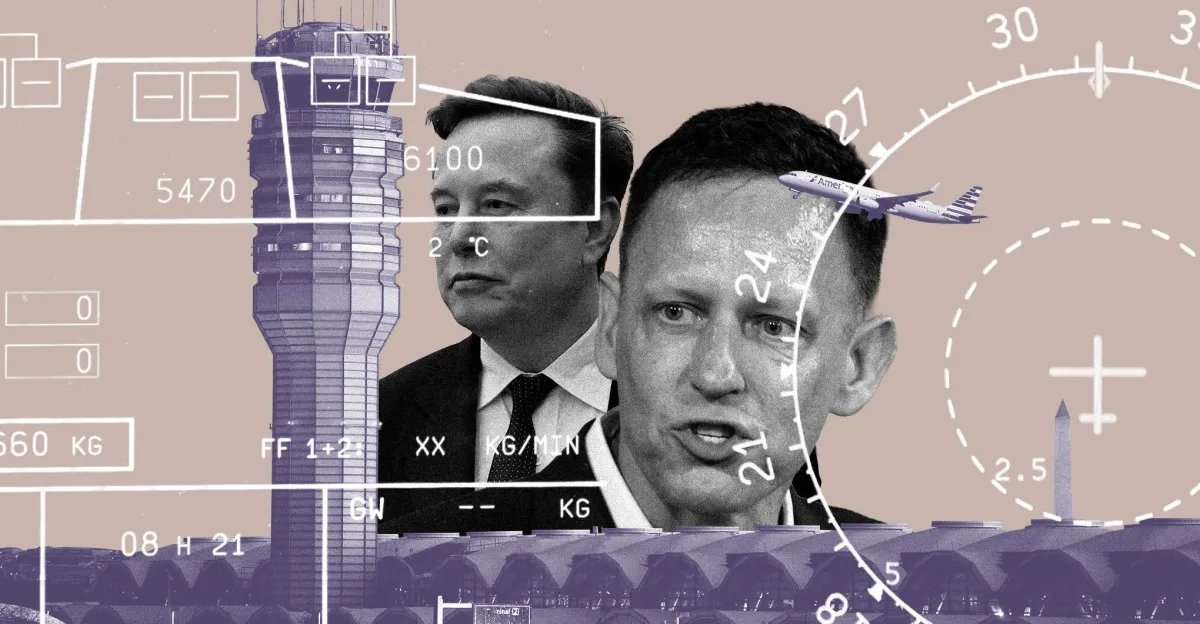
The Trump administration’s push to modernize U.S. air traffic control has instead accelerated Palantir’s rise inside the Federal Aviation Administration, even as the system continues to suffer outages, staffing shortages and record disruption. The result is a growing divide between promised AI-driven fixes and the urgent day-to-day problems facing controllers and passengers.
That tension came into sharp focus in August, when radar and communications failures disrupted more than 1,100 flights in the Minneapolis area and, days earlier, a missed radio transmission during a presidential helicopter departure nearly created a dangerous runway conflict near Washington, D.C.
What is happening at the FAA?
The FAA is trying to rebuild a fragile air traffic control network while relying increasingly on Palantir, the data analytics company co-founded by Peter Thiel, to handle major parts of its digital infrastructure. At the same time, air traffic controllers say the agency is still not fixing the core problem they confront every day: too few people covering too much traffic on outdated equipment.
The administration says it wants a safer, smarter aviation system. But so far, the most visible winners have been contractors positioned to sell software, not the front-line workers who keep aircraft moving safely through congested skies.
| Key event | Date | Why it matters |
|---|---|---|
| Minneapolis radar and communications outage | Aug. 6, 2026 | Disrupted more than 1,100 flights across a large multi-state airspace region |
| Missed radio transmission near Reagan National | Aug. 4, 2026 | Highlighted how equipment failures can create safety risks around a presidential movement |
| Trump administration invites Musk/DOGE to overhaul FAA | February 2025 | Marked the start of the administration’s promised air traffic modernization drive |
| One Big Beautiful Bill funding | July 2025 | Authorized $12.5 billion for FAA overhaul, including about $5 billion for software |
| FAA staffing target revised downward | May 2026 | Agency said AI and scheduling changes could allow it to operate with fewer controllers |
How did the FAA modernisation effort shift toward Palantir?
It shifted because the administration’s first attempt at a dramatic overhaul did not deliver the operational improvements it promised. Instead of leading a government technology reset, Elon Musk’s Department of Government Efficiency became associated with cuts, confusion and missed deadlines.
Transportation Secretary Sean Duffy brought Musk and DOGE into the FAA last year with the stated goal of speeding up modernization. Musk then publicly promised rapid safety improvements to the air traffic control system. But according to the reporting and the agency’s own trajectory, that promise was never translated into meaningful technical progress.
Rather than buying or deploying major new systems, DOGE is said to have helped push out hundreds of FAA employees, including maintenance technicians at multiple air traffic control centers. The agency also did not emerge with a new telecom backbone or a Starlink-led communications replacement, despite the speculation and public signaling around those ideas.
Musk’s role, as described by people inside the system and the reporting around it, was less about building a new FAA and more about tearing into the old one without delivering a workable replacement.
That vacuum created room for another tech power center to step in: Palantir. The company was already embedded in the FAA’s data environment before the 2026 outage sequence, and that integration made it a natural beneficiary once federal money for modernization started flowing.
Why is Palantir so well positioned?
Palantir is well positioned because it already sits inside the FAA’s digital architecture. Once a company becomes the backbone for data integration, analytics and workflow management, future contracts often favor that same vendor, even if it lacks direct domain experience in air traffic operations.
The company’s technology has been woven into more of the federal government during Trump’s second term, and that expansion is especially evident in aviation. The FAA began using Palantir’s Foundry platform in 2024, during the Biden administration. Since then, much of the agency’s data and a significant share of its technical stack have flowed through Palantir systems.
That kind of deep integration matters because government agencies often buy around existing infrastructure. If a vendor already owns the data schema, the analytics layer and the operating framework, new software competitions can become de facto extensions of the original relationship.
What contracts has Palantir won?
Palantir has picked up several important FAA deals, including no-bid awards for AI-based runway collision avoidance software and for adding AI capabilities to the FAA grants system. The grants platform is especially important because it helps distribute funding for airport and air traffic control improvements, including support for smaller airports that can receive as much as 95 percent of project costs through federal grants.
The FAA later sought an “ontology-driven” Foundry operating system to support AI integration across the agency, a requirement that played directly to Palantir’s proprietary strengths. In practical terms, the contract language was tailored around Palantir’s own technology stack.
Palantir was also named one of the finalists for the FAA’s $875 million SMART airspace contract, a major effort to use AI to improve traffic flow and anticipate disruptions before they cascade into delays. Even though Palantir ultimately lost that competition, its presence in the field underscored how much the procurement landscape had already shifted in its direction.
Who beat Palantir for SMART?
A Boston startup called Air Space Intelligence won the SMART contract. Its leadership includes several former Palantir employees, which shows how closely the aviation AI market is now tied to Palantir’s ecosystem even when the company itself does not win the final award.
- Dan Rickert, vice president of operations
- Steph Starsia, head of U.S. operations
- Connor Ryan, growth lead
- Tate Krasner, chief of staff
The company declined to comment directly and referred questions to FAA media relations.
What do controllers say is really broken?
Controllers say the biggest problem is staffing, not software. They argue that unless the FAA adds enough trained personnel to cover control rooms, towers and en-route facilities, new systems will only paper over deeper vulnerabilities.
That concern is not theoretical. Controllers across the country report punishing schedules, chronic understaffing and elevated stress. Many facilities already rely on overtime-heavy rosters, with some employees working 10-hour days, six days a week, for weeks at a time.
One veteran controller said the agency would rather publicize large technology contracts than confront labor shortages directly. Another described the current environment as politically attractive for leadership because big software deals are easier to tout than difficult workforce reforms.
According to one longtime FAA employee, pay and staffing should be addressed before the agency pours more attention into AI products that may not be ready for real-world operations.
Controllers also point out that even apparently minor absences can have outsized effects when the workforce is already stretched thin. In an understaffed facility, the loss of one or two people can eliminate a substantial share of that shift’s functional coverage.
How bad has the disruption become?
It has become severe enough that 2025 was the worst year for flight delays in more than a decade, according to the U.S. Public Interest Research Group. The organization estimated that one in four flights was delayed, diverted or canceled, amounting to nearly 1.7 million disruptions.
The data also point to stress beyond delays. Tarmac holds, where passengers remain on board a grounded plane, rose by 64 percent compared with 2024. Meanwhile, an estimated 2.4 million checked bags were lost or damaged on domestic flights.
Those figures help explain why even a temporary communication loss in a single air traffic sector can ripple across the national network. Aviation is highly interdependent: one failure in a major region can knock schedules off balance far beyond the immediate area.
Recent incidents that exposed the strain
- On Aug. 6, the Minneapolis Air Route Traffic Control Center lost radar and communications for roughly two hours.
- That outage affected more than 1,100 flights across a nine-state region.
- Two days earlier, a radio failure during a presidential helicopter departure created a close-call situation near Reagan National Airport.
- On Aug. 7, thunderstorms triggered about 9,000 delays and 2,000 cancellations in the Northeast.
Transportation Secretary Duffy suggested in a social media post that controllers calling in sick was a major driver of the delays. That claim angered many controllers, who say it obscures the scale of the existing staffing crisis.
How much money is going to software versus people?
A lot more is going to software. The July 2025 One Big Beautiful Bill authorized $12.5 billion for a full FAA air traffic control overhaul, and about $5 billion of that is earmarked for software upgrades. But none of the package goes directly to personnel.
That matters because the FAA’s staffing issues are not small. The agency has acknowledged that it needs more controllers, yet its normal 2026 budget contains only $239 million in new money for hiring initiatives.
| Funding area | Amount | Use |
|---|---|---|
| Total FAA overhaul funding | $12.5 billion | Broad modernization program |
| Software upgrades | About $5 billion | AI tools, integration systems and digital modernization |
| Personnel funding in new package | $0 | No direct funding for additional controllers |
| 2026 staffing budget increase | $239 million | Hiring initiatives and related support |
That funding split has fueled skepticism among controllers and aviation safety experts who argue that sophisticated software cannot compensate for understaffed operations. In their view, the FAA is trying to automate around a labor shortage without solving the shortage itself.
What is Palantir doing across the federal government?
Palantir has become one of the most influential federal contractors in the country, and not only at the FAA. Under Trump’s second administration, it has expanded across agencies with unusual speed, supporting everything from defense and law enforcement to health administration and tax data analysis.
The company crossed $1 billion in federal contracts in 2025 and is projected to pass $1.5 billion in 2026, placing it among the 100 largest government contractors in the United States. That scale reflects both strong demand for its products and a political environment that favors centralized data platforms.
Among the projects associated with the company:
- A military targeting platform used in operational settings abroad
- A mapping tool designed to help immigration agents generate targets in real time
- A search system at the Department of Health and Human Services that DOGE used to identify grants tied to diversity, equity and inclusion initiatives
- A reported effort to build an IRS database with Americans’ financial information
Each of those programs has drawn scrutiny from lawmakers and oversight groups concerned about privacy, accuracy, legality or all three. Yet the company’s footprint has continued to widen.
Why are aviation workers uneasy about AI-driven reform?
They are uneasy because the promised fixes focus on systems that are still unproven in one of the most safety-critical domains in government. Controllers and aviation specialists note that AI tools may help with analytics, scheduling or data visualization, but that does not automatically translate into better on-the-ground safety.
Palantir’s tools are built around data integration and decision support. That makes them attractive to agencies that want to make sense of complex information streams. But air traffic control is not just a data problem; it is also a human coordination problem, a training problem and a staffing problem.
One controller quoted in the reporting said they had not even heard of some of the modernization programs being discussed. That disconnect suggests a wide gulf between executive-level planning and the operational reality inside towers and control centers.
The only visible upgrade, according to one controller, was a newer screen attached to the same old hardware.
That kind of incremental improvement may help around the margins. It does not amount to the kind of deep modernization that would restore confidence after repeated outages, congestion and near-miss events.
Can AI really reduce the need for controllers?
Not in the near term, according to people who work inside the system. The FAA’s revised staffing target, issued in May, suggests it may eventually need fewer active controllers than originally planned, dropping the target from 14,633 to 12,563. The agency has said AI and better scheduling can help support that lower number.
Controllers do not buy it. They say many facilities are already running on stretched schedules, with little buffer for absences, illness or training backlogs. If anything, they argue, AI should be used to support staffing decisions rather than justify reducing headcount before the system stabilizes.
The risk is that automation becomes a substitute for investment in labor. If the FAA overestimates how much software can do, it could embed fragility into the system rather than remove it.
Why training remains a bottleneck
Training is a major reason staffing shortages persist. Roughly 30 percent of candidates do not finish the pipeline, and it can take up to three years for a recruit to become a fully certified controller.
That makes every hiring push slow to bear fruit. Even successful campaigns that attract thousands of applicants do not immediately increase operational capacity. The bottleneck lies not in interest, but in training throughput, certification and retention.
What role did the “Level Up Your Career” campaign play?
The campaign was an effort to attract gamers into the controller pipeline, a symbolic sign that the FAA was searching for unconventional recruitment channels. Duffy said it drew about 2,000 applications and called the result a major success.
Still, the underlying numbers show why the campaign alone cannot solve the problem. At a time when many control centers are already short-handed, the agency needs not just applicants but qualified, retained and fully certified employees.
The recruitment effort may help over time. But it does not address immediate burnout, overtime fatigue or the pressure that comes from running essential infrastructure with too few people.
What do aviation safety experts say?
Even experts who are sympathetic to modernization efforts say the government has a lot of work ahead. Hassan Shahidi, who leads the Flight Safety Foundation, said the administration is at least undertaking a broad set of improvements, including replacing copper wire, refurbishing and replacing radars, and focusing on implementation rather than slogans.
That perspective matters because the FAA has historically struggled to deliver large-scale infrastructure upgrades. Aviation systems age slowly and fail unevenly, so political momentum does not always translate into operational change.
Shahidi’s comments suggest some cautious optimism about the scale of activity. But they do not answer the central concern raised by controllers: whether the current mix of technology procurement and workforce neglect can actually produce safer skies.
What happens next?
The next phase will likely determine whether the modernization drive is remembered as a genuine reform effort or as another government contracting boom. If Palantir and similar companies continue to win major FAA work, they may shape how the agency manages its data, predicts congestion and allocates resources for years to come.
But if the agency does not solve staffing, training and burnout, the technology may only sit on top of an unstable foundation. Controllers say they want better tools, but not at the expense of the workforce needed to use them.
The stakes are high because the FAA is not dealing with a theoretical challenge. It is operating under repeated outages, recurring weather disruptions, old hardware and workforce shortages that can turn small glitches into national delays. Any modernization plan that ignores those realities risks repeating the same failures with new software labels attached.
For now, the clearest conclusion is that the FAA’s modernization story is no longer just about aviation. It is also about how political power, contractor influence and AI policy intersect inside the federal government — and about who profits when a public system is declared broken.
Frequently asked questions
Why is Palantir getting more FAA work?
Palantir is getting more FAA work because its Foundry platform is already embedded in the agency’s data systems, making it a natural candidate for new AI and integration contracts. That existing technical footprint gives it an advantage over rivals, even in areas where it lacks deep air traffic control experience.
What went wrong with Elon Musk’s FAA effort?
Elon Musk’s FAA effort fell short because it did not deliver major system upgrades, did not meaningfully modernize FAA communications, and coincided with employee cuts rather than new operational capacity. The promised rapid safety improvements never materialized, leaving the agency still dependent on old infrastructure.
Is the FAA spending more on software than staffing?
Yes. The major 2025 funding package included about $5 billion for software and $12.5 billion overall for modernization, but no direct money for personnel. The FAA’s separate 2026 budget adds only $239 million for hiring initiatives, which controllers say is far too little.
Will AI reduce the need for air traffic controllers?
Not in the near term, according to controllers and aviation workers who say staffing shortages are too severe for AI to replace human labor safely. The FAA has lowered its staffing target and pointed to automation, but front-line workers argue that training and retention remain the real bottlenecks.
How serious are the FAA’s current disruptions?
They are very serious. Recent outages in Minneapolis, a close-call event near Reagan National, and widespread weather-related delays have underscored how fragile the system is. In 2025, flight disruptions reached their worst level in more than a decade, with nearly 1.7 million interruptions nationwide.