In short
SpaceX disclosed $329 million in Tesla Megapack purchases so far in 2026, with the batteries likely supporting xAI data centers. The filings highlight how Musk’s companies are increasingly trading hardware, capital and infrastructure among themselves to accelerate AI expansion.
- SpaceX reported $329 million in Tesla Megapack purchases so far in 2026.
- The batteries are likely being used to stabilize xAI data center power demand.
- Musk’s business network is increasingly intertwined through related-party transactions.
- Megapacks help AI facilities handle sharp power spikes and avoid demand charges.
- The purchases show that AI scaling depends heavily on energy storage and grid management.
SpaceX has spent $329 million on Tesla Megapacks so far in 2026, including $295 million in the second quarter alone, underscoring how Elon Musk’s companies are increasingly financing and supplying one another as the billionaire expands his artificial intelligence infrastructure.
The spending matters because it offers a rare look inside the power strategy behind Musk’s AI ambitions: SpaceX appears to be buying large-scale batteries that can help support xAI data centers, where electricity demand is volatile, expensive and rising fast.
In a Tuesday earnings report, SpaceX disclosed the purchases as part of its related-party transactions, adding another layer to the web of deals connecting Musk’s business empire. Tesla makes the Megapack battery systems. SpaceX is led by Musk and is the largest shareholder-controlled company in the group. xAI, Musk’s artificial intelligence startup, has been folded more tightly into that network after acquiring X in 2025 and later being acquired by SpaceX earlier this year.
The new figures suggest that Musk’s companies are not simply coexisting; they are increasingly functioning as a shared industrial platform for AI, energy storage and compute-heavy operations.
What SpaceX bought and why it matters
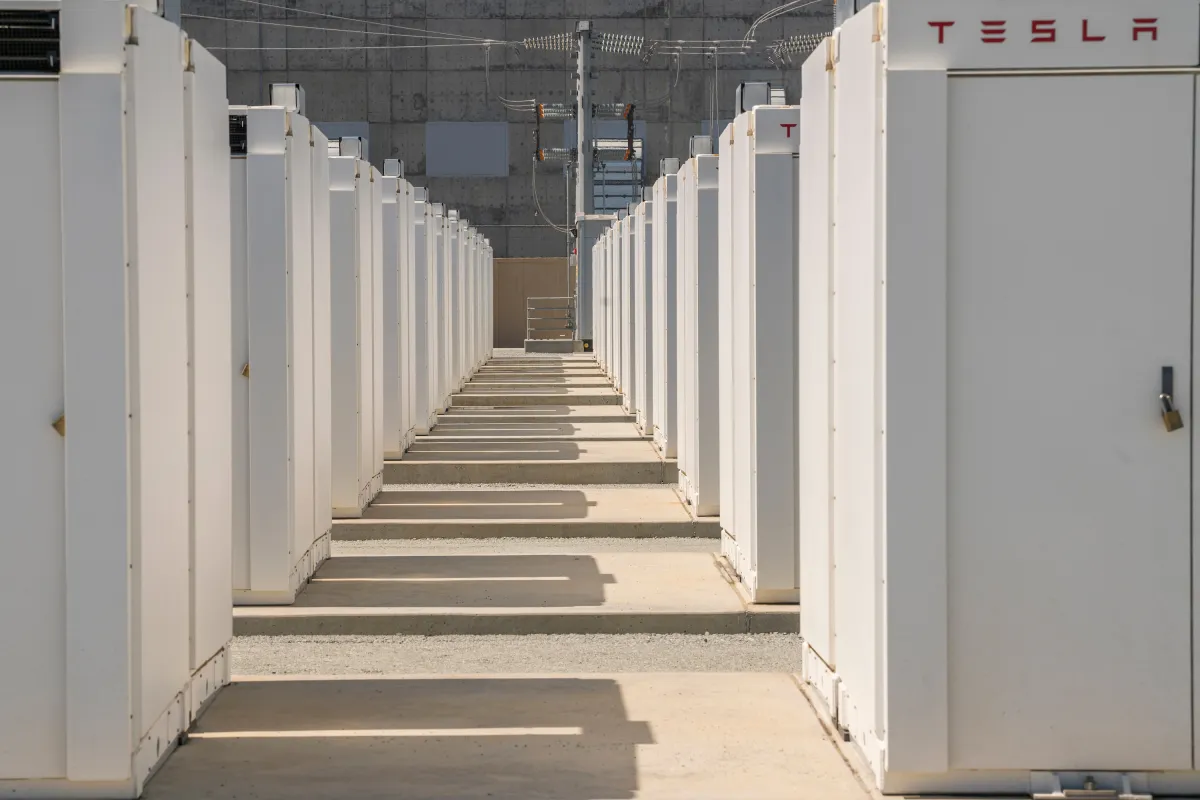
SpaceX’s latest filing shows that the company has become a major buyer of Tesla’s utility-scale battery systems. The Megapack is designed for grid-scale energy storage, and in the context of AI, it is valuable for a different reason: keeping data centers stable during rapid swings in power demand.
AI training clusters and inference systems do not consume electricity at a constant rate. Instead, their demand rises and falls depending on workload, model size, scheduling and the number of GPUs drawing power at any given moment. Those peaks can trigger higher utility charges, strain on-site power systems or interruptions if backup systems are not prepared.
Megapacks help smooth that volatility. They can release substantial power immediately, bridging gaps between generators and servers, and they can also buffer spikes that would otherwise force a site to overbuild fossil-fuel generation or pay steep demand charges.
For a company running large AI facilities, that can mean the difference between a site that scales efficiently and one that becomes a constant power-management problem.
How the Musk ecosystem is tied together
The purchases are the latest sign that Musk’s corporate network has become deeply intertwined across sectors.
SpaceX is not only a space launch company; it has also become a financial and operational anchor within Musk’s broader business portfolio. Tesla remains the most visible supplier in this case, but xAI is the likely end user. Earlier in the year, before xAI was absorbed into SpaceX, the AI company had already spent heavily on the same batteries for its own data centers.
That pattern suggests a recurring internal arrangement: one Musk company builds or acquires the AI infrastructure, another supplies the power systems, and another may provide the data-center demand that justifies the spending.
Industry filings indicate that SpaceX’s Megapack purchases are likely tied to xAI’s data centers, where large battery systems can support erratic power loads and reduce dependence on local grid capacity.
The arrangement is notable not just for the scale of the transactions, but for what it says about the consolidation of Musk’s ventures. xAI acquired X in 2025, then SpaceX acquired xAI earlier this year, bringing the AI operation more directly under the same corporate roof as the rocket company. The result is a structure in which capital, hardware and energy infrastructure are increasingly moving inside the same orbit.
Why AI data centers need batteries
AI data centers are unlike conventional enterprise server rooms. They are designed around dense clusters of graphics processing units, or GPUs, which can draw immense amounts of electricity in bursts. That creates a problem for operators: the site may need far more power at certain moments than it uses a few minutes later.
That volatility can be expensive. Utilities often charge large customers based on peak demand, not just total energy consumed. If a data center briefly draws too much power, the billing consequences can linger for months. On-site generators can help, but they are not always fast enough or efficient enough to handle every surge.
Batteries fill the gap.
They can respond in under a second, providing emergency backup and load balancing before generators ramp up or the grid catches up. In practical terms, that means a site can run more smoothly, avoid some utility penalties and reduce the risk that a sudden spike will knock systems offline.
This is especially important for AI operations that must stay online continuously. Training large models can take days or weeks, and inference workloads may serve millions of users with little tolerance for downtime.
What Megapacks do better than generators alone
Megapacks are useful because they can do more than act as a last-resort backup. They can actively manage demand, allowing operators to draw power from storage during brief surges and recharge when loads ease.
That gives them two financial benefits:
- They help avoid demand charges tied to short spikes in usage.
- They reduce the need to oversize diesel or gas generators for rare peak events.
For AI companies, those advantages can be significant. A data center may not always need more total energy; it needs more flexible energy. Batteries offer that flexibility.
SpaceX’s Tesla purchases are growing quickly
The latest quarter’s spending marks a sharp rise. SpaceX reported $295 million in Tesla Megapack purchases in the second quarter, bringing the year-to-date total to $329 million.
That compares with xAI’s earlier buying behavior, which included $430 million in Megapack purchases for data centers before the company was absorbed into SpaceX. In the first quarter of this year, xAI bought just $34 million worth of the equipment, showing how quickly the scale of deployment has expanded.
The numbers point to a strategy that is no longer experimental. Musk’s AI stack appears to be entering a more capital-intensive phase, one that requires not only chips and software but also large-scale power buffering and facility engineering.
| Company | Period | Reported Megapack Purchases | Context |
|---|---|---|---|
| SpaceX | Q2 2026 | $295 million | Largest single-quarter disclosure in the report |
| SpaceX | Year to date 2026 | $329 million | Total Tesla Megapack spend so far this year |
| xAI | Q1 2026 | $34 million | Early-year purchasing before SpaceX acquisition |
| xAI | Pre-acquisition total | $430 million | Earlier Megapack spending for data centers |
| SpaceX | As of Dec. 2025 | $131 million in Cybertrucks | Separate related-party vehicle purchase disclosed in filings |
How does this fit with xAI’s power strategy?
It fits as one part of a broader, mixed-energy approach that still leans heavily on natural gas.
xAI has drawn scrutiny for using dozens of unpermitted turbines at a Mississippi site near its Colossus data center project. Those turbines are evidence of an aggressive strategy to secure immediate electricity where grid capacity or permitting timelines may be limiting. Batteries do not replace that approach, but they complement it.
In a data center that is scaling fast, natural gas generators may provide bulk power, while batteries can stabilize output, absorb short spikes and protect equipment from sudden interruptions.
That combination reflects a broader truth about the AI infrastructure race: companies are not choosing between clean and dirty power so much as stitching together whatever mix can keep GPUs fed with electricity around the clock.
Why batteries still matter even with gas generation
Gas turbines and generators take time to ramp up. Batteries do not. That is the key difference.
When a chip cluster suddenly demands more power, a battery can respond instantly, buying time for other systems to catch up. It can also help a site avoid relying on generators for every small fluctuation, which can improve efficiency and reduce wear on equipment.
In practice, that makes battery storage a critical part of modern AI infrastructure even when companies are already using fossil-fuel generation.
The significance of related-party deals
Transactions between affiliated companies are common in large conglomerates, but they invite scrutiny when the same person controls both sides of the deal.
In Musk’s case, the interconnectedness is unusually visible. Tesla sells Megapacks. SpaceX buys them. xAI likely uses them. And all of it is connected to a broader plan to build enormous compute capacity across companies whose ownership and leadership overlap.
That can create operational advantages. Internal customers may move faster than outside buyers, with less friction in procurement and product planning. But it also raises questions about valuation, governance and whether one company is effectively subsidizing the strategy of another.
SpaceX’s regulatory filings provide some transparency, but they do not answer every question about where the batteries are installed, how they are financed, or how those arrangements are priced internally beyond the stated purchase amounts.
What this says about Musk’s AI ambitions
The Megapack purchases are a sign that Musk’s AI business is no longer just about models, chatbots or talent recruitment. It is increasingly about physical infrastructure.
That infrastructure includes land, energy supply, backup generation, batteries, chips and data-center cooling. Each layer adds complexity and cost, but each is necessary if xAI wants to compete at scale with better-capitalized rivals.
By moving energy storage spending into SpaceX, Musk may also be concentrating the capital burden inside a company with a very different funding profile than a startup. SpaceX has long been one of the world’s most valuable private companies, and its balance sheet can support large, strategic purchases that might be harder for a young AI company to finance alone.
In other words, the Tesla Megapack buying spree is not just a purchase story. It is a window into how Musk is using one empire to bootstrap another.
Timeline of the key developments
The relationship among Musk’s companies has evolved quickly over the past two years, with ownership and purchasing patterns shifting as AI infrastructure needs accelerated.
| Date/Period | Event | Why it matters |
|---|---|---|
| 2025 | xAI acquires X | Brings Musk’s AI and social platform closer together |
| Earlier in 2026 | SpaceX acquires xAI | Moves the AI company under SpaceX’s umbrella |
| Q1 2026 | xAI reports $34 million in Megapack purchases | Shows early-year battery spending for data centers |
| Q2 2026 | SpaceX reports $295 million in Megapack purchases | Signals a major acceleration in storage deployment |
| 2026 year to date | SpaceX totals $329 million in Megapack purchases | Confirms the scale of Tesla equipment flowing into the network |
What investors and competitors should watch next
Investors will likely pay attention to whether this spending continues through the rest of 2026 and whether SpaceX discloses more detail about where the batteries are being installed. If the pattern holds, it would suggest that the AI infrastructure buildout is still in an expansion phase rather than a one-time procurement cycle.
Competitors should note something else: AI infrastructure is becoming a power-and-hardware race as much as a software race. Companies that cannot secure energy storage, generation and grid access may struggle to scale models even if they have strong research teams.
For Tesla, the purchases highlight a potentially valuable internal customer base for its industrial battery business. For SpaceX and xAI, they reveal a growing dependence on physical systems that make AI possible in the first place.
Bottom line
SpaceX’s $329 million in Megapack purchases this year shows that Musk’s companies are increasingly building AI infrastructure together, with Tesla supplying batteries that likely support xAI data centers. The spending underscores the scale of the power challenge behind modern AI and the unusual way Musk is financing that challenge across his own corporate network.
Frequently asked questions
Why is SpaceX buying Tesla Megapacks?
SpaceX is likely buying Tesla Megapacks to support xAI data centers that need fast, flexible power storage. The batteries can smooth electricity spikes, provide near-instant backup and reduce utility costs tied to peak demand.
How much did SpaceX spend on Tesla Megapacks in 2026?
SpaceX spent $329 million on Tesla Megapacks so far in 2026, including $295 million in the second quarter alone. The filings show the company sharply accelerated battery purchases during the year.
How do Megapacks help AI data centers?
Megapacks help AI data centers by delivering power instantly when GPU workloads surge. They can absorb short spikes, prevent outages, reduce pressure on generators and lower the risk of costly demand charges from utilities.
What does this mean for xAI?
It means xAI’s infrastructure is likely being supported by a much larger Musk-controlled corporate network. The battery spending suggests that xAI’s data centers are scaling quickly and require substantial power-management equipment.
Are batteries replacing natural gas at xAI sites?
No, batteries are not replacing natural gas entirely. xAI has still leaned heavily on gas generation, but batteries add crucial stability and backup support, making them a complementary part of the power strategy.