Updated July 24, 2026 12:55 pm
In short
Conservative opposition to Florida data centers is part of a much larger nationwide backlash, with new polling showing broad public resistance and fresh signs of a Republican split over how aggressively to promote AI infrastructure.
- Conservative residents in Florida are organizing against hyperscale data centers, not just liberal activists.
- The backlash blends local concerns like noise and utility costs with partisan fears about China and AI surveillance.
- Republican leaders, including gubernatorial hopeful Byron Donalds, are facing pushback from their own base over support for data center growth.
- More than 20 Florida counties and municipalities have considered or approved moratoriums on data centers.
- The issue is turning AI infrastructure into a major land-use and political fight, especially in Florida.
Update — July 24, 2026 12:55 pm
The updated source adds that the Hernando County rally was one of nearly 150 Humans First protests held nationwide, underscoring how much larger the anti-data-center effort has become.
It also cites new Gallup polling showing seven in 10 Americans oppose data centers in their area, including nearly two-thirds of Republicans and 75% of Democrats, suggesting the backlash is broad and not limited to one party.
On Florida politics, the piece adds sharper signs of GOP tension: some activists now say they feel let down by Gov. Ron DeSantis, while Rep. Byron Donalds is drawing criticism as a data-center-friendly contender in the governor’s race.
Update — July 23, 2026 3:25 pm
The updated source adds that the Hernando County protest was part of nearly 150 Humans First events nationwide, showing the anti-data-center push is much larger than the local rally alone.
It also includes new polling that found seven in 10 Americans oppose data centers in their area, including large majorities of both Republicans and Democrats, suggesting the backlash is broader and more bipartisan than previously noted.
On the Florida political front, the source adds fresh details about the GOP split: some activists say they feel betrayed by Gov. Ron DeSantis, while Rep. Byron Donalds is now being criticized as a pro-data-center favorite in the governor’s race.
Conservative residents in Florida and across the U.S. are joining liberal activists in a growing backlash against data centers, with local opposition now shaping zoning fights, utility politics, and even Republican primary battles. The movement matters because it is turning AI infrastructure into a mainstream political issue, threatening the expansion plans of tech companies and forcing GOP leaders to choose between development and their own voters.
What began as a small protest outside a library in Hernando County has become part of a much larger nationwide revolt against hyperscale data centers, the massive facilities that power artificial intelligence, cloud computing, and digital services. In Florida, that resistance is exposing a widening split inside the Republican Party over jobs, land use, energy costs, environmental strain, and the politics of growth.
A local protest that reflects a national pattern
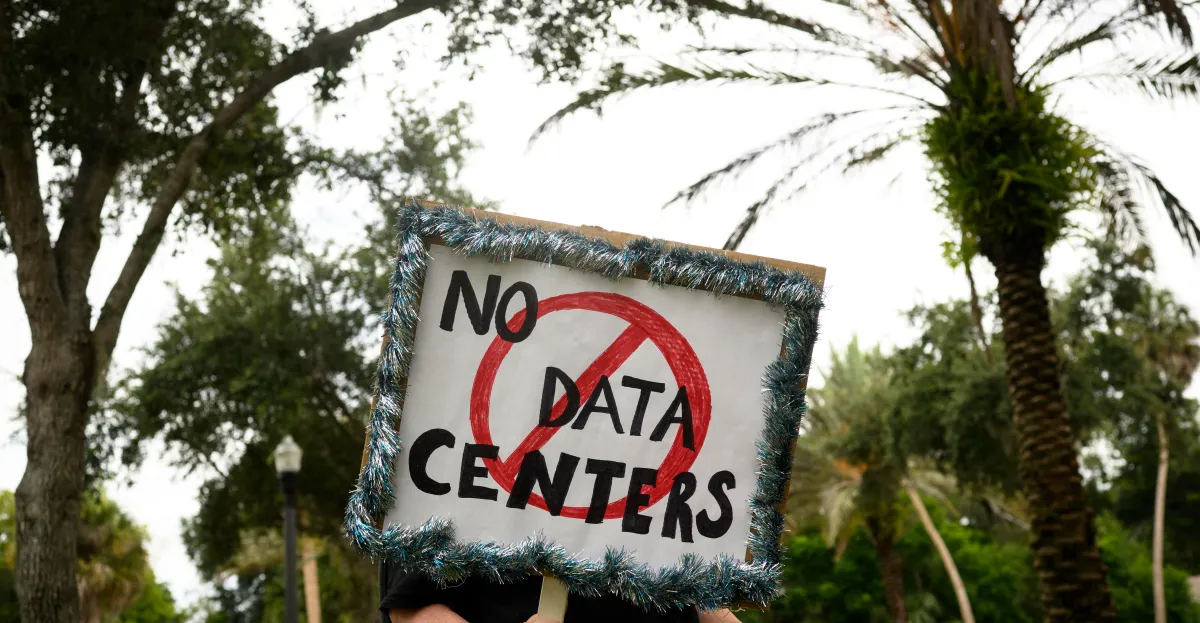
On a humid Saturday in central Florida, fewer than a dozen people gathered outside the Spring Hill Branch Library to push for a ban on hyperscale data centers in Hernando County. The county had already approved a one-year moratorium, but organizers insisted a temporary pause was not enough. They wanted a permanent stop to future projects.
The scene was modest, but the issue was not. Similar protests have emerged in dozens of communities, where residents worry that giant data centers will bring noise, heavy power demand, water use, traffic, and permanent changes to their neighborhoods. The Hernando County event was one stop in a broader day of action connected to Humans First, a conservative movement that says the future of AI should be decided by ordinary people rather than corporations or federal agencies.
“We are going to fight, fight, fight,” said one organizer, a retired radio host and lifelong conservative who argued that people living near data centers could be forced to endure constant noise and neighborhood disruption.
That same organizer also voiced fears that data centers are not just physical intrusions but cultural ones, warning about the social consequences of AI tools becoming deeply embedded in everyday life. Her concerns ranged from local quality of life to stories of friends making major personal decisions based on ChatGPT’s advice.
Why are conservatives protesting data centers?
They are protesting because the issue combines familiar conservative instincts about property rights, local control, distrust of elites, and suspicion of foreign influence with newer anxieties about AI, surveillance, and the pace of technological change.
In the Florida protests, opponents cited a wide range of objections. Some are the same concerns often voiced by left-leaning activists: environmental damage, electricity consumption, water use, and the loss of rural character. Others are more distinctly partisan, especially claims that AI infrastructure depends too heavily on Chinese-made components or that the industry weakens U.S. national security.
That blend has created an unusual coalition. Republicans, Democrats, independents, and nonaligned local activists are increasingly standing together at county commission meetings and zoning hearings. The shared message is simple: growth is welcome only if it does not overwhelm the community.
What makes hyperscale data centers different?
Hyperscale data centers are not ordinary server rooms. They are huge facilities, often spanning at least 10,000 square feet and drawing 100 megawatts or more of power, designed to support AI systems and massive digital workloads.
Because they are so large, they can require major utility upgrades, grid planning, and land-use changes. That scale is exactly why they have become politically explosive in places that once welcomed almost any kind of development.
The Florida fight is about more than AI
In Hernando County, the opposition was not framed as a simple anti-tech crusade. Instead, residents described a broader battle over how Florida should grow and who gets to profit from that growth. Several activists said they were not rejecting development altogether; they were rejecting outside developers who, in their view, extract value without respecting local communities.
That distinction matters. Many residents backing moratoriums say they support economic development in principle but want it to be smaller, slower, and better integrated into existing land use. They prefer projects they believe will preserve local identity rather than transform entire areas into industrial support zones for cloud computing and AI.
One organizer described the state’s development model as too aggressive and too disconnected from the people who actually live there. Another said the concern was not just about noise or construction but about whether public officials were too eager to give incentives to companies that do not have roots in the region.
How do residents describe the harms?
They usually describe the harms in three categories: environmental damage, neighborhood disruption, and political displacement.
- Environmental: worries about power demand, water use, land clearing, and pollution.
- Neighborhood: fears of constant equipment noise, traffic, and lost rural character.
- Political: frustration that state leaders and developers appear to prioritize investment over residents’ concerns.
Some of the claims circulating at rallies are more speculative than verifiable, including anecdotes linking nearby data centers to livestock problems or harms to pollinators. But even when the science is uncertain, the political effect is real: residents are organizing, petitioning, and showing up at public meetings in large enough numbers to slow projects down.
How Florida Republicans became part of the backlash
Florida’s data center opposition is especially notable because it comes from voters who are usually aligned with the Republican Party. That has created tension for state officials and GOP candidates who want to present themselves as pro-business without appearing indifferent to local complaints.
Gov. Ron DeSantis has tried to occupy that middle ground. He has publicly cast himself as cautious about AI and signed legislation in May requiring hyperscale facilities to pay their own utility-related costs and allowing local governments to regulate water use for such projects. At the same time, his administration has supported the sector with substantial tax breaks, according to reporting cited by local outlets, which has led critics to accuse him of saying one thing and doing another.
The contradiction is politically awkward because many of the residents fighting data centers still consider themselves reliable conservatives. They are not protesting from the left; they are protesting from within the Republican base.
| Issue | What residents say | Political impact |
|---|---|---|
| Noise and neighborhood disruption | Concern about constant operational sounds and changes to rural areas | Creates local organizing around zoning and land-use restrictions |
| Energy and water use | Fears about utility bills, grid strain, and resource consumption | Pushes counties toward moratoriums and tougher rules |
| AI ethics and surveillance | Worries about government monitoring and dependence on AI systems | Broadens the coalition beyond traditional environmental activism |
| China and supply chains | Suspicion of foreign-made components and national security risk | Gives the issue a more explicitly nationalist Republican framing |
Who is Amy Kremer and why does Humans First matter?
Amy Kremer matters because she helps explain why this backlash is so politically potent. She is a longtime conservative activist associated with the Tea Party era and later with pro-Trump organizing, including Women for Trump and Women for America First. That background gives Humans First credibility among Republican voters who might ignore a traditional anti-development campaign if it came from the left.
Humans First began as a bipartisan offshoot of the Center for AI Safety, but in practice it has become a vehicle for conservative local activism against data centers and broader AI adoption. Its messaging emphasizes ordinary people, local control, and skepticism toward the tech industry’s influence over public policy.
That framing matters because it allows people who might reject progressive environmental politics to still oppose a project on conservative grounds. In other words, the issue is not being sold as climate activism alone. It is being sold as a defense of community, sovereignty, and family life.
What did the Hernando County rally show?
The Hernando County rally showed that the anti-data center movement can travel across ideological lines while still speaking the language of conservative politics.
At the event, a firefighter running for agricultural commissioner handed out signs, and a Republican county commission candidate made an appearance. A land-use expert then explained how local governments can change zoning rules to block hyperscale projects. The atmosphere was practical rather than theatrical: people talked about ordinances, water use, and land-use codes, not national partisan slogans.
One attendee, who works in IT and supports the county’s anti-data-center effort, said she had even found a useful explanation of the issue on a progressive outlet and did not care where the information came from as long as it helped her understand the threat. That kind of cross-ideological information-sharing is one reason the movement has been difficult for both parties to label cleanly.
The Byron Donalds problem for Florida Republicans
Byron Donalds, the Republican front-runner in Florida’s governor’s race, has become a focal point for the backlash because he is openly supportive of data center development. That stance is creating friction with conservative voters who otherwise align with him on most issues.
Donalds has argued that data centers are part of the country’s future and said he is not opposed to them as long as there is a plan. He has also spoken enthusiastically about making Florida a financial capital and attracting outside investment. But those comments have become liabilities in parts of the state where residents now equate development with outside control and higher living costs.
Donalds’ opponents are using the issue to paint him as too closely tied to the tech industry. Recent attack messaging has highlighted donations from pro-AI political committees and industry-linked groups, reinforcing the perception that he is aligned with developers over neighborhood residents.
One local activist said that if Donalds wins the GOP primary, she would be willing to vote Democrat instead, arguing that the issue is not party loyalty but whether a candidate protects “human life” and community well-being.
How widespread is the opposition?
The opposition is widespread enough that it is now influencing policy across Florida. More than 20 counties and municipalities have discussed or adopted moratoriums on data center construction, according to reporting cited in the source material. In some places, the threat of restrictions has already prompted developers to pull back.
In Citrus County, for example, a proposed 800-acre data center project was withdrawn after county leaders approved a one-year moratorium on rezoning applications tied to such facilities. That episode suggests local resistance can do more than slow projects; it can kill them outright.
The momentum is also making industry advocates nervous. Trade groups warn that moratoriums and restrictive ordinances could send a message that communities are closed to broader investment, not just data centers. Local activists, however, view that argument as a pressure tactic meant to discourage governments from protecting their residents.
Why are counties choosing moratoriums?
They are choosing moratoriums because they buy time.
Local governments often feel unprepared to evaluate the long-term effects of a hyperscale project, especially when the proposals involve complex questions about electricity infrastructure, zoning, water use, and tax treatment. A moratorium allows officials to study the issue before approving projects that may be difficult to reverse later.
- Pause new applications.
- Review zoning and utility rules.
- Draft updated ordinances.
- Decide whether and where such facilities can be built.
For residents, that process is often the only leverage they have. Once a site is approved, a community may be stuck with the consequences for decades.
The national politics of AI infrastructure
The backlash to data centers shows that AI is not just a software story. It is also a land-use story, an energy story, and a local-government story. The scale of the physical infrastructure required for AI is forcing communities to confront questions they can no longer ignore: Where does the power come from? Who pays for upgrades? What happens to water supplies, roadways, and nearby neighborhoods?
Those questions are being asked in a country that is already divided over technology, immigration, global supply chains, and the role of government. That is why the data center fight has become politically flexible. Environmentalists see pollution and overconsumption. Conservatives see outside control, foreign dependency, and cultural disruption. Many local residents simply see a project they do not want next door.
Industry supporters insist the facilities are essential for jobs, investment, and AI competitiveness. They argue that if the United States wants to lead in artificial intelligence, it has to build the infrastructure that supports it. Opponents counter that a community should not be asked to sacrifice its land, utilities, and peace of mind for a promise of abstract future growth.
What the Florida revolt says about the future of AI growth
The Florida fight suggests that the next stage of AI politics may be less about model benchmarks and more about permits, tax incentives, and county commission meetings. As AI systems become more powerful, the infrastructure behind them will become more visible, more expensive, and more politically vulnerable.
That visibility is especially dangerous for the industry because local opposition can unite voters who normally disagree on almost everything else. In Hernando County, a conservative retiree worried about pollinators and Chinese chips stood alongside other Republicans upset about development and utility costs. That kind of coalition can complicate campaigns, delay projects, and force state leaders to recalibrate.
For Republicans, the issue also presents a strategic test. The party has long campaigned on property rights, local control, and opposition to overreach. But those principles can collide with pro-growth economics and big-tech partnerships. If data centers continue spreading rapidly, more GOP candidates may find themselves torn between developer donations and base-level resistance.
For now, the message from Florida’s anti-data-center activists is clear: they do not want to be persuaded that every new project is inevitable. They want elected officials to treat AI infrastructure like any other major industrial land use — something that should be questioned, regulated, and in some cases rejected entirely.
Key dates and developments
| Date | Event | Why it matters |
|---|---|---|
| June 2026 | Hernando County approves a one-year moratorium on hyperscale data centers | Shows local officials responding to public pressure |
| June 2026 | Citrus County sponsor withdraws an 800-acre data center proposal | Demonstrates that moratoriums can stop projects |
| May 2026 | Florida enacts a law making hyperscale centers cover utility costs and allowing water-use rules | Signals state-level concern, but stops short of a full crackdown |
| July 2026 | Humans First-aligned protests are held across the country | Confirms the issue has become a national political movement |
Bottom line
The conservative revolt against data centers is no longer a curiosity. It is becoming a serious political force, especially in states like Florida where growth, energy demand, and AI investment are colliding with local resistance. The result is a strange but powerful alliance: people who disagree on almost everything else now agree that a data center down the road may be one development too many.
Frequently asked questions
Why are conservatives protesting data centers in Florida?
They are protesting because they see hyperscale data centers as threats to local control, property values, utility costs, and neighborhood quality of life. Many also worry about environmental damage, AI surveillance, and foreign dependence in the technology supply chain.
What is a hyperscale data center?
A hyperscale data center is a very large facility built to handle massive computing demands, often for AI and cloud services. These sites usually occupy at least 10,000 square feet and can draw 100 megawatts or more of electricity.
How is the data center issue affecting Florida politics?
It is putting pressure on Republican leaders by creating a backlash among conservative voters who oppose nearby development. That tension is especially visible in the governor’s race, where pro-growth candidates are being criticized by voters who want stricter limits.
What has Florida done about data centers so far?
Florida has passed a law requiring hyperscale data centers to cover their own utility costs and allowing local governments to regulate water use. Separately, more than 20 counties and cities have discussed or adopted moratoriums on data center construction.
Are all data center opponents against development in general?
No. Many opponents say they are not anti-growth but want development that fits their communities and does not rely on public subsidies or overwhelm local infrastructure. Their argument is usually about scale, placement, and accountability rather than rejecting growth outright.