Updated July 17, 2026 6:25 pm
In short
Roblox is rolling out its AI Build tool on mobile, while also expanding its AI roadmap with creator assistants, 3D asset generation, scene creation and the planned shutdown of Roblox Connect.
- Roblox’s new Build feature turns text prompts into basic games on mobile.
- The public alpha starts July 28 in New Zealand for verified users aged 9 and older.
- Roblox says game discovery will still reward retention, not AI volume.
- The company is also developing AI agents for playtesting and analytics.
Update — July 17, 2026 6:25 pm
Roblox also says it is working on AI agents that would help creators playtest games and review analytics. The company expects those tools to arrive in the coming months.
The Build announcement is part of a wider AI push at Roblox that already includes a model for generating 3D assets, a developer chatbot and a new scene-generation system that can turn a text prompt into an editable playable environment.
Roblox also linked the rollout to its recent plan to discontinue Roblox Connect, its avatar-based video calling feature.
Update — July 16, 2026 9:53 pm
Roblox says it is also building AI agents that will help creators test games and review analytics, with those tools expected to arrive in the coming months.
The company also tied the Build announcement to a broader AI push that now includes a 3D asset model, a developer chatbot and a scene-generation system for creating editable playable environments from a text prompt.
Separately, Roblox recently said it plans to shut down Roblox Connect, its avatar-based video calling feature launched in 2023.
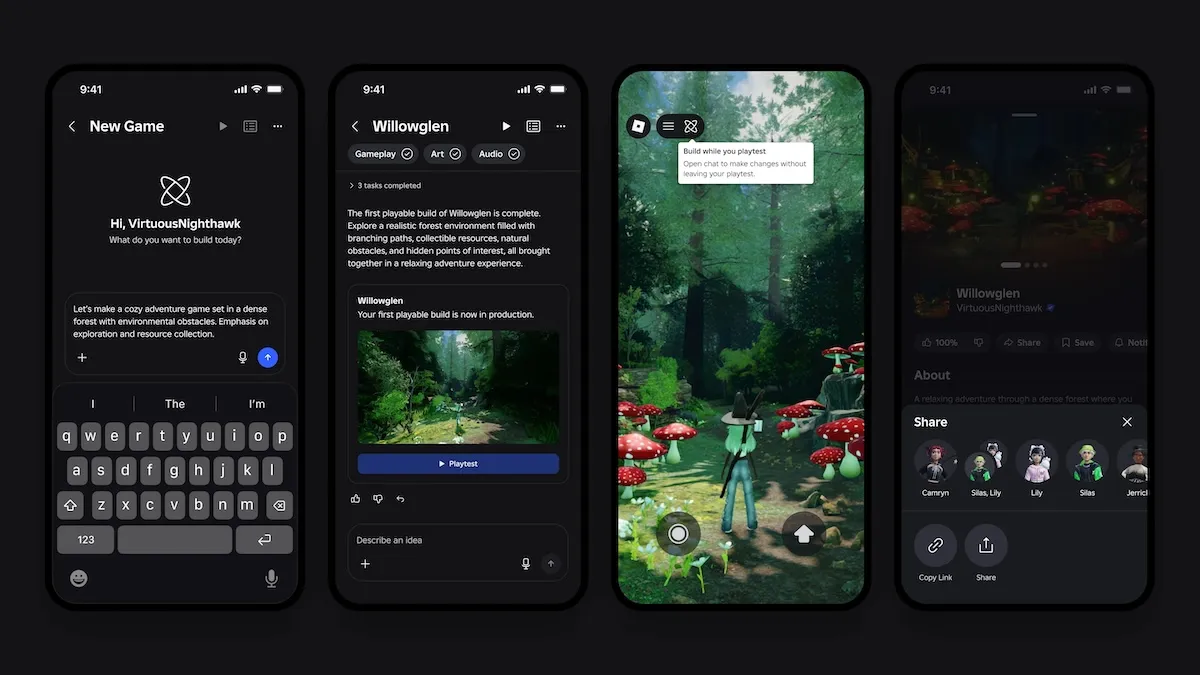
Roblox is rolling out an AI-powered game creation feature called Build that lets users generate a basic game from a text prompt directly in the mobile app. The launch matters because it could make game-making far more accessible for younger and nontechnical creators while also intensifying debate over AI-generated content on the platform.
The new tool, announced Thursday, turns plain-language ideas into an editable starting point. Users can describe a game concept in ordinary words, then refine the AI-generated result and share it with others. Roblox says the feature is designed to speed up creation without requiring users to know how to code.
What Roblox is launching
Build is Roblox’s latest step toward bringing generative AI into the core of its creation ecosystem. The feature is built into the mobile app and allows a user to ask for a game idea in a sentence or two, after which the system assembles a simple playable foundation.
That foundation is not meant to be the final product. Instead, Roblox says it gives creators a place to start, with the option to adjust gameplay elements, the setting, the characters and the overall look and feel before publishing or sharing the experience.
The company says Build is powered by a mix of open-source and proprietary AI models developed for Roblox’s own platform needs. According to the company, the system can help produce gameplay mechanics, environments, character elements, visual style, audio and other pieces of a game.
How Build works on mobile
Build is designed to lower the barrier to entry for new creators. A user can enter a prompt such as a fantasy adventure, a social hangout or a survival challenge, and Roblox will generate an initial version of that idea that can be further edited.
The company is positioning the feature as a creation accelerator rather than a replacement for human creativity. In practical terms, that means it aims to provide structure, not final polish, while leaving room for users to shape the experience into something more personal.
- Users enter a natural-language prompt.
- Roblox generates a playable starting point.
- Creators can edit and refine the result.
- Eligible users can eventually publish it to the platform.
Why this matters for Roblox creators
Roblox’s audience includes many younger users and aspiring developers who may have ideas but not the technical skills to build them from scratch. Build could make it easier for those users to move from concept to playable game in minutes instead of days or weeks.
That convenience could be especially important on mobile, where creation tools have historically been more limited than desktop-based workflows. By putting AI generation inside the app, Roblox is betting that creation will become more social, more spontaneous and more frequent.
The company also appears to be trying to widen participation in the creator economy on its platform. Roblox has long relied on user-generated content, and Build may help new creators enter that ecosystem more quickly.
Roblox says the purpose of its new tools is to speed up creation for users at every skill level while keeping the platform focused on games that players actually engage with.
What are the risks of AI-generated games?
AI game generation has excited some users but worried many developers. The core concern is that text-to-game tools can flood platforms with low-effort, repetitive or poorly designed content that adds noise without adding value.
Industry critics argue that if anyone can create a game in seconds, the platform could become crowded with shallow experiences that mimic each other. That dynamic could make it harder for original human-made games to stand out, especially on discovery surfaces such as homepages and recommendation feeds.
There is also concern about competition. Human developers may find themselves competing not just with one another but with a stream of AI-generated projects that can be produced much faster and at lower cost.
Those worries are not hypothetical. They align with a broader skepticism inside the games industry. A recent Game Developer Conference survey found that 52% of professionals believe generative AI is having a negative effect on the sector.
How Roblox says it will curb low-quality content
Roblox says its discovery systems will continue to prioritize games that retain players over time. In other words, if a game does not attract sustained engagement, it is less likely to be prominently surfaced to other users.
The company says that approach should help prevent low-value AI-generated content from overwhelming the platform. Its logic is simple: games that nobody plays are unlikely to gain visibility.
Roblox has said its recommendation systems are built to elevate experiences with long-term retention and that this approach is intended to keep weak or spammy content from dominating the homepage.
That strategy may help, but it does not eliminate the underlying debate. Discovery filters can reduce noise, yet they cannot fully solve the larger question of whether AI creation tools will raise overall quality or merely increase the volume of mediocre games.
When will Build be available?
Roblox says Build will enter public alpha testing on July 28. The first rollout will be limited to users in New Zealand who are at least nine years old and have verified their age.
Users aged 16 and older will also be able to publish their creations to a global audience, giving the test a limited but potentially important path from experimentation to public release.
The company says there will be a free basic version, along with paid options. That suggests Roblox may eventually use Build as part of a broader monetization strategy, even if the early version is aimed primarily at testing and feedback.
| Key detail | Roblox Build launch information |
|---|---|
| Feature name | Build |
| Main function | AI-generated game creation from text prompts |
| Platform | Roblox mobile app |
| Public alpha date | July 28 |
| Initial market | New Zealand |
| Age requirement | Users 9+ with verified age |
| Publishing access | Users 16+ can publish globally |
| Pricing | Free basic access plus paid tiers |
How does Build fit into Roblox’s broader AI strategy?
Build is not an isolated experiment. Roblox has spent the past several months layering AI deeper into its development tools and platform infrastructure, signaling a long-term effort to make creation faster and more automated.
Among the company’s other AI projects are a foundation model for generating 3D game assets, a chatbot intended to help developers through the building process and a new scene-generation model that can produce editable 3D environments from a single text prompt.
These tools suggest Roblox is trying to address different stages of development, from asset creation to scene assembly to workflow support. Together, they point to a platform that wants to reduce the friction involved in making interactive content.
What AI agents are coming next?
Roblox is also developing AI agents that will help creators test their games and analyze performance. The company says those functions should arrive in the coming months.
That addition could prove especially useful because game creation is only part of the challenge. Testing, iteration and data analysis are often what separate a rough prototype from a polished experience that can retain players.
If those agents work as intended, creators may be able to move through the full loop of ideation, building, testing and improving without leaving Roblox’s ecosystem.
How does Roblox compare with Google, Microsoft and Tencent?
Roblox is not alone in experimenting with AI-assisted content creation. Google, Microsoft and Tencent have all developed or demonstrated similar tools that can help users generate digital content with prompts.
The broader trend is clear: major tech companies are racing to make generative AI useful in practical creative workflows, especially in products where users may not have professional training. In gaming, that means turning abstract ideas into playable material more quickly than traditional development pipelines allow.
What makes Roblox different is its audience and its ecosystem. Unlike general-purpose creative software, Roblox operates a consumer platform where publishing, discovery and audience engagement are all tightly connected. That gives the company a strong incentive to manage quality carefully if it wants AI tools to feel empowering rather than overwhelming.
| Company | AI game/content tool focus | Platform context |
|---|---|---|
| Roblox | Prompt-based game creation and creator support | Consumer game platform with discovery and publishing |
| AI-assisted generation tools | General-purpose products and services | |
| Microsoft | AI creation and productivity tools | Cloud and software ecosystem |
| Tencent | Generative tools for digital experiences | Large gaming and internet portfolio |
What the launch says about Roblox’s priorities
Build shows that Roblox is leaning into a future where AI is woven into the act of making games, not just the act of playing them. That is a significant strategic choice for a company that has built much of its identity around user-created experiences.
The company appears to be balancing two goals at once: broadening access to creation and protecting the quality of its marketplace. Those goals are not always easy to reconcile, particularly when generative tools can produce content at scale.
By tying visibility to retention, Roblox is signaling that it does not plan to reward output alone. The platform seems determined to reward engagement instead, which is an important distinction in a world where AI can make creation cheap but cannot guarantee that people will care about the result.
Why the timing matters now
The announcement arrives at a moment when the games industry is still wrestling with the consequences of generative AI. Tools like Build are becoming more capable just as developers, publishers and players are asking hard questions about originality, labor and platform quality.
Roblox’s move also comes shortly after the company said it would shut down Roblox Connect, its avatar-based video calling feature introduced in 2023. That decision suggests the company is making active choices about where to invest and which experiments to abandon as it refocuses on creator tools and AI infrastructure.
In that context, Build is more than a feature launch. It is a statement about where Roblox believes the future of play and creation is headed.
Timeline of Roblox’s recent AI and product moves
Roblox has been steadily expanding its AI capabilities while pruning some other parts of its product lineup. The sequence below captures the most notable developments referenced in the announcement.
- 2023: Roblox introduces Roblox Connect, an avatar-based video calling feature.
- Over the past year: Roblox continues developing AI tools for 3D assets, developer assistance and scene generation.
- Thursday, July 16, 2026: Roblox announces Build, an AI game-making feature in the mobile app.
- July 28, 2026: Public alpha testing for Build begins in New Zealand.
- Upcoming months: Roblox expects to roll out AI agents for playtesting and analytics.
What happens next
The next test for Roblox is whether Build actually helps more people create meaningful games instead of simply increasing the number of unfinished or forgettable ones. Early access in New Zealand should provide the company with a controlled environment to observe usage, quality and moderation challenges.
If the feature gains traction, Roblox could expand it more broadly and possibly make AI-assisted creation a default part of how its platform works. If it struggles with quality problems or user backlash, the company may need to tighten the tool or slow its rollout.
For now, the launch places Roblox at the center of a bigger industry conversation: whether AI will democratize game development or drown it in sameness. The answer may depend less on how fast the tools generate content and more on whether platforms can preserve taste, originality and discovery in the age of prompts.
Frequently asked questions
What is Roblox Build?
Roblox Build is an AI-powered creation tool inside the Roblox mobile app that generates a basic game from a text prompt. Users can then edit the result, refine the experience and, if eligible, share or publish it.
When will Roblox Build be available?
Roblox Build will enter public alpha testing on July 28, starting in New Zealand. The first rollout is limited to verified users aged nine and older, while users 16 and up can eventually publish to a global audience.
Will AI-generated Roblox games flood the platform?
Roblox says its discovery system will still prioritize games with strong player retention, which should reduce the visibility of weak or repetitive AI-generated content. However, critics still worry the overall volume of low-quality games could rise.
Does Roblox have other AI tools for creators?
Yes. Roblox is also working on AI tools for 3D asset generation, developer support, scene creation and upcoming AI agents that can help with playtesting and analytics.