In short
OpenAI has launched the Codex Micro, a $230 keyboard made to control its AI coding agents, marking its first public hardware release. The move comes as Apple sues OpenAI over alleged trade secret misuse tied to a separate reported device in development.
- OpenAI released the Codex Micro, a limited-run $230 keyboard built with Work Louder for Codex users.
- The device is designed as a control center for AI coding agents, with lights, shortcuts, a joystick and a reasoning dial.
- Bloomberg separately reported that OpenAI is developing a screenless portable speaker-like device with moving mechanical parts.
- Apple has sued OpenAI over alleged trade secret misuse, raising the stakes for the company’s hardware ambitions.
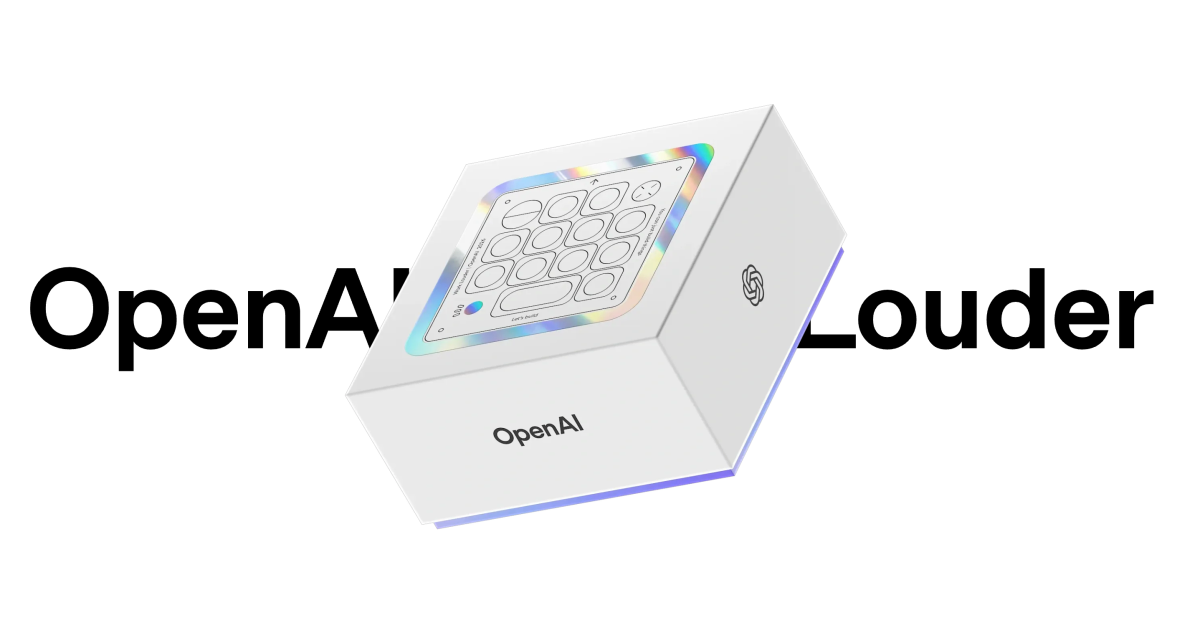
OpenAI has taken its first public step into hardware with the Codex Micro, a $230 illuminated keyboard built for people using its AI coding assistant, Codex. The limited-run accessory, co-designed with keyboard maker Work Louder, is meant to help users control fleets of coding agents more quickly, while a separate OpenAI device reported this week suggests the company is also exploring a more ambitious consumer product line.
The timing matters because OpenAI is entering hardware just as it faces a high-profile legal fight with Apple, which recently accused the company of using confidential information in its own device development. Together, the keyboard launch and the reported speaker-like gadget show that OpenAI is trying to move beyond software and into the physical products market at a moment when that expansion is already under scrutiny.
Rather than a conventional keyboard, the Codex Micro is being pitched as a compact control hub for agentic work. In OpenAI’s framing, it is less about typing and more about orchestrating the company’s semi-autonomous coding bots, which can draft and run code with limited direct intervention from a human operator.
What OpenAI launched: a keyboard built for AI agents
OpenAI’s new accessory is called the Codex Micro, and it is designed to work with Codex, the company’s AI coding assistant. The device is a limited-edition collaboration with Work Louder, a specialty keyboard brand known for making customizable input devices.
At $230, the keyboard is not positioned as a mass-market productivity tool. Instead, it reads like an early hardware experiment: a premium desk accessory intended to turn OpenAI’s software into something tactile, visible and easy to use while coding with agents.
The keyboard’s most notable features are built around workflow control rather than traditional text entry. According to OpenAI’s description, the Micro includes illuminated keys that display agent status, user-programmable command buttons for repeated Codex functions, and a joystick for launching common tasks.
It also includes a dial that adjusts how much reasoning an agent should use on a given request. In practical terms, that means users can trade speed and compute for deeper analysis depending on the task. That kind of control suggests OpenAI is trying to make agent management feel more hands-on and more understandable to developers.
Why the design matters
The Codex Micro is significant because it shows how OpenAI wants people to interact with AI agents in everyday work. Instead of opening a separate dashboard, mobile app or browser tab to manage multiple agents, users can physically control them through a dedicated peripheral.
That approach reflects a broader industry shift. As AI tools become more autonomous, software makers are searching for better interfaces that let humans supervise, interrupt, or guide automated systems without getting buried in menus and prompts. OpenAI’s answer is a device that behaves like a command console for coding tasks.
OpenAI described the keyboard as a command center for “agentic work,” framing the product as a control layer for managing AI-driven workflows rather than a standard typing device.
How the Codex Micro works
The Codex Micro is meant to give developers faster access to common Codex functions and to make the state of AI agents easier to see at a glance. It does that through a small set of physical controls and lights that correspond to tasks and status indicators.
OpenAI says the device is customizable through the ChatGPT desktop application, which allows users to tailor how the keyboard behaves. That is important because the product is not a fixed, one-size-fits-all accessory. It appears to be built for people who want to shape the interface around their own coding habits.
In the company’s telling, the keyboard is also meant to make agentic work feel more intuitive. Semi-autonomous software can be powerful, but it can also be opaque. A dedicated controller gives users a clearer sense of what their agents are doing and when they need human oversight.
Key hardware features at a glance
| Feature | What it does | Why it matters |
|---|---|---|
| Light-up Agent Keys | Show agent status visually | Helps users monitor multiple AI agents at once |
| Custom Command Keys | Trigger frequent Codex actions | Speeds up repetitive workflows |
| Joystick | Starts common workflows | Creates a more tactile control experience |
| Reasoning Dial | Adjusts how much compute an agent uses | Lets users balance speed, cost and depth |
| ChatGPT desktop integration | Enables configuration and control | Ties the hardware directly to OpenAI’s software ecosystem |
Why is OpenAI entering hardware now?
OpenAI is likely moving into hardware because the company sees an opportunity to shape how people interact with AI beyond the screen. As coding agents become more capable, the interface problem becomes more important: users need efficient ways to manage them, not just generate text.
A device like the Codex Micro helps OpenAI create a branded experience around its software. It also gives the company a physical presence on users’ desks, which can deepen product loyalty and reinforce the sense that OpenAI’s tools are part of a broader ecosystem rather than isolated software services.
There is also a strategic signal in the limited-run approach. By releasing a niche accessory first, OpenAI can test demand, generate publicity and learn how users respond to a hardware form factor without committing to a major launch.
In that sense, the keyboard looks more like a public proof of concept than a flagship product. It lets OpenAI explore hardware branding while keeping the financial and logistical risks relatively low.
A novelty product with a larger message
OpenAI told TechCrunch that the Micro is a limited collaboration, which strongly suggests the company does not view it as a large-scale consumer line item. But even as a novelty, the device has significance because it signals intent.
The company is showing that it wants to move from being known primarily as a software maker to being seen as a platform company with hardware ambitions. That shift mirrors moves seen across the technology industry, where software firms increasingly try to own the full user experience.
For developers, the immediate appeal may be practical: programmable shortcuts, visible status indicators and direct control over agent reasoning can all be useful. For OpenAI, the deeper value may be branding and ecosystem design.
What about the other OpenAI device?
The more consequential hardware development is not the keyboard but a separate device reported this week by Bloomberg. That product, still unreleased and still in development, is said to be a portable smart speaker without a screen and to include mechanical elements that move on their own.
Those details are unusual enough that the final design is still hard to picture. OpenAI has not publicly explained how the form factor would work, and Bloomberg’s reporting indicates the project remains in flux.
Even so, the rumored device points to a more serious hardware effort than the keyboard collaboration. A screenless, portable speaker that integrates with ChatGPT would represent a direct attempt to place OpenAI’s assistant into the home or another shared physical setting, much like a next-generation voice device.
The presence of moving mechanical parts adds another layer of intrigue. If accurate, the device may be trying to create a more expressive or interactive physical presence than a standard smart speaker, though what that means in practice remains unclear.
How the reported speaker differs from the keyboard
The Codex Micro is a niche developer peripheral; the reported speaker sounds like a consumer-facing product with broader ambitions. The keyboard is designed to support work inside OpenAI’s software ecosystem, while the speaker could be aimed at more general-purpose ChatGPT usage.
That distinction matters because it suggests OpenAI may be pursuing two tracks at once: one hardware product for a narrow professional audience and another for the mass market. The keyboard can be used to experiment. The speaker, if it reaches production, could help define OpenAI’s consumer hardware identity.
The reported speaker also raises different questions about privacy, design and functionality. A screenless device relies heavily on voice and ambient interaction, which makes the user experience more dependent on accuracy, latency and trust.
Why Apple is paying close attention
Apple’s concern is not just about competition; it is also about trade secrets. Last week, Apple sued OpenAI, alleging that senior leaders at the company pursued a deliberate strategy to gain access to Apple’s confidential information and then used it in hardware development.
OpenAI has denied the accusation. But the lawsuit adds a political and legal dimension to any hardware announcement the company makes. What might otherwise be read as a product teaser now lands as evidence in a larger battle over talent, ideas and competitive boundaries.
The connection to Apple is especially sensitive because Bloomberg’s report said the new OpenAI device is being developed with help from former Apple engineers. In the current legal climate, that detail is likely to draw attention whether or not the individuals involved actually used any protected information.
In the hardware industry, hiring experienced designers and engineers from rival firms is common. But when the rival is already accusing a company of misusing secrets, even ordinary staffing decisions can become part of a legal narrative.
Apple’s lawsuit argues that OpenAI’s leadership intentionally sought confidential information and then used it in hardware plans, while OpenAI rejects the claim and denies any wrongdoing.
What the lawsuit means for OpenAI’s hardware push
The legal dispute could shape how aggressively OpenAI expands into physical products. If the company proceeds with a speaker or other consumer device, it will likely face questions not just about product design but about how the product was conceived and who helped build it.
That does not mean OpenAI cannot release hardware. It can. But it does mean every new announcement may be viewed through a litigation lens, especially if the product resembles anything Apple is known for: minimalist industrial design, tightly integrated software and a premium consumer experience.
OpenAI’s challenge is to prove that its hardware plans are independently developed and strategically justified. The company will want to frame the effort as a natural extension of its AI products, not a copy of a rival’s playbook.
At the same time, the lawsuit may actually reinforce the importance of hardware for OpenAI. If the company believes future AI experiences require dedicated devices, then delays or caution may be costly. The pressure to establish its own hardware identity could outweigh the risks of entering the category while under legal scrutiny.
How the market should read the Codex Micro
The easiest mistake would be to treat the Codex Micro as just a quirky keyboard. It is more useful to see it as a signal about how OpenAI thinks agentic software should be controlled.
By building a dedicated accessory around Codex, OpenAI is effectively saying that software agents are becoming important enough to deserve their own physical interface. That is a notable shift from the standard model of interacting with AI through a chat box alone.
It also hints at a future in which AI work is increasingly managed through hybrid systems: voice, touch, physical controls and traditional screens all working together. For professionals who spend long hours in developer tools, that could be a welcome evolution.
Still, the product’s novelty status matters. OpenAI appears to be testing market interest, not announcing a sweeping hardware strategy. The keyboard may generate buzz precisely because it is unusual, collectible and visually striking.
Potential benefits for developers
- Faster access to frequently used Codex actions
- Clearer visibility into agent status
- Physical controls for adjusting reasoning depth
- More efficient supervision of multiple AI coding agents
- Customizable setup through the ChatGPT desktop app
What this says about the future of AI interfaces
The launch points to a broader debate inside the AI industry: if models become more autonomous, how should people control them? A text prompt is useful, but it may not be enough when users are coordinating multiple systems at once.
Hardware can solve part of that problem by making abstract processes visible and manageable. A light-up key that shows whether an agent is active, paused or waiting for input is more immediate than checking a software dashboard. A dial that changes reasoning depth can make compute tradeoffs more intuitive than a settings menu.
That is why OpenAI’s move may matter beyond one accessory. It reflects an emerging belief that the next generation of AI tools will need purpose-built interfaces, not just better models. In other words, the race is no longer only about who builds the smartest software, but who designs the best way for humans to work with it.
Timeline: OpenAI’s hardware moment
| Date | Event | Why it matters |
|---|---|---|
| Last week | Apple filed a trade secrets lawsuit against OpenAI | Raised legal pressure around OpenAI’s hardware ambitions |
| Tuesday | Bloomberg reported on a separate OpenAI device in development | Suggested OpenAI has a more ambitious hardware project underway |
| Wednesday | OpenAI announced the Codex Micro keyboard | Marked the company’s first visible hardware release |
| Ongoing | The Codex Micro remains a limited-run collaboration | Indicates an experimental launch rather than a mass-market rollout |
The bigger picture
OpenAI’s keyboard launch is small in scale but large in symbolism. It shows a company known for software now experimenting with physical objects that make AI tools easier to control, easier to see and more tightly embedded in daily work.
At the same time, the company is doing so while under a legal microscope. Apple’s lawsuit means OpenAI’s hardware aspirations will be judged not only on whether they are innovative, but also on whether they can withstand allegations about how those products were developed.
For now, the Codex Micro looks like a flashy first step: part tool, part desk accessory, part signal that OpenAI wants to own more of the user experience. The rumored speaker-like device suggests the company may be aiming far beyond novelty merchandise. If both efforts continue, OpenAI could soon become as much a hardware story as a software one.
The question is no longer whether OpenAI is interested in hardware. The question is how far it wants to go, and whether it can do so while navigating a dispute with one of the most influential hardware companies in the world.
Frequently asked questions
What is the Codex Micro?
The Codex Micro is OpenAI’s limited-run $230 keyboard made with Work Louder. It is designed to help users manage Codex, OpenAI’s AI coding assistant, through physical controls such as shortcut keys, a joystick and a reasoning dial.
Why is OpenAI making hardware?
OpenAI appears to be making hardware to improve how people control AI agents and to create a more complete product ecosystem. A dedicated device can make agent workflows faster, more visible and easier to supervise than software alone.
Is the Codex Micro a mass-market product?
No, the Codex Micro does not appear to be a mass-market product. OpenAI described it as a limited collaboration, which suggests it is more of an experimental accessory and branding move than a full-scale hardware launch.
How does Apple factor into this story?
Apple matters because it recently sued OpenAI, accusing the company of using confidential information in hardware development. That lawsuit adds legal pressure and makes any OpenAI hardware announcement more closely watched.
Is OpenAI building any other devices?
Yes, according to Bloomberg, OpenAI is also developing a separate device that is reportedly a portable, screenless smart speaker with moving mechanical elements. The product is still in development and its final design could change.