In short
Acti has launched an AI keyboard for iOS and Android that can trigger actions, run custom Skills and keep user context local-first. The Singapore startup also disclosed a $5.3 million seed round led by BITKRAFT Ventures.
- Acti turns the smartphone keyboard into an AI agent surface for actions, shortcuts and live information.
- The Singapore startup says its local-first design keeps private context on-device by default.
- Acti raised $5.3 million in seed funding led by BITKRAFT Ventures.
- Users can create no-code Skills and share them in a marketplace, hinting at future monetization.
- The app is powered by Google Gemini and is available on iOS and Android.
A Singapore startup is making a bold bet on where consumers will first feel the next wave of artificial intelligence: not in a standalone chatbot, but inside the keyboard they already use to text, email, post, and search every day. Acti, a new company founded by former Baidu executive Young Wang, has launched an “agentic” keyboard for iPhone and Android devices that can do more than predict the next word. It is designed to carry out tasks, surface live information, and trigger automated actions without forcing people to jump between apps.
The idea reflects a broader shift in the AI industry. After two years of chatbot hype, many builders are now looking for interfaces that make AI less like a destination and more like an invisible layer across existing software. Acti’s pitch is that the keyboard, one of the most universal entry points on a smartphone, is a powerful place to bring that change to life.
On Tuesday, the company announced the app’s launch and revealed that it had raised $5.3 million in seed funding, with BITKRAFT Ventures leading the round. Acti says the product is already available on both iOS and Android and is built around Google’s Gemini models. Its core promise is simple: let users invoke AI actions in the middle of normal communication, rather than opening another app, copying context, and pasting it somewhere else.
Why the keyboard matters in the AI era
The average smartphone keyboard sits at the center of nearly everything people do on a phone. It appears in messages, social apps, email clients, notes, and browser forms. That makes it one of the few surfaces that follows users from app to app without friction.
Acti is trying to turn that omnipresence into an advantage. Instead of treating the keyboard as a passive text input tool, the startup wants it to function like a lightweight control panel for AI. In practice, that means the keyboard could help draft a reply, translate a phrase, look up a location, insert live data into a conversation, or launch a preset workflow with a single key press.
For consumers, the appeal is convenience. For the company, it is a way to solve a problem that has become increasingly obvious as AI tools have multiplied: context is scattered. A user might ask one chatbot for help, then have to manually move the answer into WhatsApp, Gmail, Instagram, or Slack. Acti argues that this fragmentation gets in the way of the “agentic” future many AI companies are promising.
“Today’s AI agents are fundamentally limited because user context stays fragmented across separate apps,” Wang said in an email interview. He added that Acti is designed to sit across those apps and build a user-owned context layer rather than one controlled by a single platform.
That argument places Acti in a growing category of startups trying to make AI more ambient and less siloed. Rather than asking users to change habits, the company is trying to embed AI inside the habit that already exists: typing.
How Acti works on iPhone and Android
Acti is available as a keyboard app for both major mobile operating systems. Once installed, it can function like a traditional keyboard while also exposing AI-powered features and shortcuts. The company says the app works across email, messaging, social platforms, and other common mobile apps.
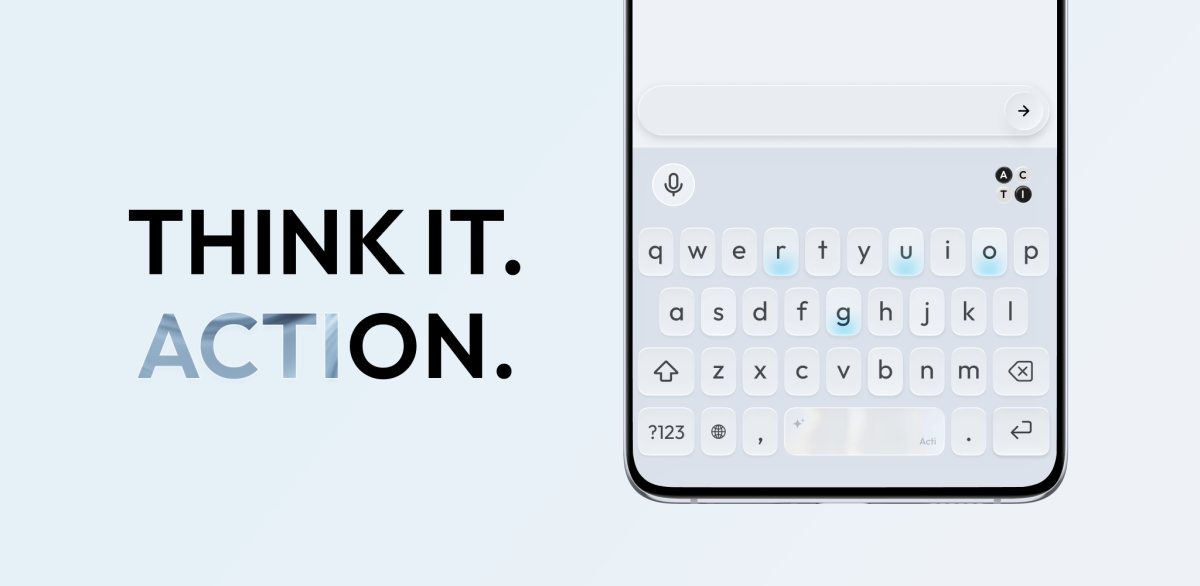
The most important element is what Acti calls “Skills.” These are programmable shortcuts that can be attached to individual keys on the keyboard. A user can long-press a key to trigger a repeated task, such as translating a message, inserting a calendar link, or pulling in a live result from the web.
The company says people do not need coding knowledge to build these Skills. Instead, they can describe what they want in plain language and let the system create the workflow. That lowers the barrier to customization and makes the product feel closer to a consumer AI assistant than a developer platform.
Examples of the built-in features
Acti ships with a small set of preloaded Skills intended to show what the product can do. Among them:
- Long-pressing the “T” key to translate a message into another language.
- Using the “C” key to insert a meeting link quickly.
- Pulling in contextual information such as local recommendations or live stock prices inside a chat.
Those examples may sound minor, but they point to the product’s broader design logic. Acti is not trying to replace full-featured AI apps. Instead, it aims to compress useful tasks into the exact moment they are needed, while preserving the surrounding conversation or workflow.
That distinction matters. A user asking where to eat nearby, for example, could get an answer without leaving the chat thread. If someone mentions a company ticker in conversation, the keyboard could potentially surface the current market price in place. The goal is to make AI feel immediate and contextual instead of separate and disruptive.
Local-first privacy is central to the pitch
Any product that sits inside a keyboard immediately raises privacy questions, and Acti is aware of that challenge. The company says its product is built on a local-first approach, meaning personal context remains on the device by default.
According to Acti, it does not read or store private messages, conversations, or personal data unless a user explicitly turns on a feature that requires outside processing. In other words, the company is drawing a line between on-device intelligence and remote model use, with user consent at the center of the experience.
That privacy posture could be critical for adoption. Keyboards are among the most sensitive pieces of software on a phone because they can see everything typed across apps. Any perception that a keyboard is too invasive can kill trust quickly, particularly in markets where consumers are increasingly aware of data collection and AI misuse.
By emphasizing local storage and limited access, Acti is trying to reassure users that the product is an assistant, not a surveillance layer. Whether that promise holds up in practice will depend on implementation, transparency, and how clearly the company explains which features require cloud processing.
Why Google’s Gemini is powering the product
Acti runs on Google’s Gemini models, a choice Wang says was driven by a blend of speed, reasoning quality, reliability, multilingual capability, and cost efficiency. The company also argues that Gemini is especially useful for the shortcut system behind Skills.
That matters because a keyboard agent needs to be fast enough to feel native. If every action introduces lag, users will revert to old habits. The underlying model therefore has to support quick reactions while still understanding enough context to complete a task accurately.
Multilingual performance is also important for a keyboard product built in Singapore and aimed at a global mobile audience. Translation, rewriting, and cross-language messaging are natural use cases for AI keyboards, and a model with strong language coverage gives Acti a broader international footprint from day one.
Model choice as product strategy
Acti’s reliance on Gemini is not just a technical detail; it is a strategic decision. The startup is effectively betting that model quality will be commoditized enough that the interface and workflow design matter more than owning the model stack outright.
That is a common pattern across the AI startup market. Many new companies are building products on top of larger foundation models from Google, OpenAI, Anthropic, and others, then differentiating through UX, distribution, or niche utility. In Acti’s case, the keyboard is the differentiator.
If the interface wins, the underlying model may be less visible to users than the speed and usefulness of the experience itself. But if competitors offer faster or cheaper keyboard assistants, model choice could still become a competitive issue.
From Baidu to startup founder
Acti’s founder brings significant experience in consumer software. Wang spent roughly a decade at Baidu, where he helped grow Facemoji Keyboard into a product with more than 300 million daily active users, according to the company.
That background explains why he is focused on the keyboard as a foundational mobile product rather than a niche AI toy. He has already worked at the scale where distribution, habit formation, and cross-app utility matter.
Wang said that the rise of large language models changed his thinking about typing, describing text as something that has become more than input. In his view, it is now a signal of intent that can often be converted directly into action.
He added that this realization convinced him it was time to reimagine one of the most basic tools people use on phones. Rather than build yet another standalone assistant, he wanted to rebuild the input layer itself for the AI age.
That is a compelling founder narrative: someone who already understands keyboard behavior at scale now using the latest model capabilities to redesign the same category from first principles.
Funding, team and investor backing
Acti’s seed round totaled $5.3 million and was led by BITKRAFT Ventures, a firm best known for backing consumer and gaming-adjacent startups. The investor rationale, according to partner Jonathan Huang, is rooted in the possibility that Acti could shape how people interact with computers in the coming years.
Huang said the firm backed Acti because the team appears to have a credible shot at owning a major part of the next phase of human-computer interaction.
That is a high bar, but it reflects a broader belief among investors that interface-layer companies can still generate significant value even in a crowded AI market. If users adopt a new habit, and if that habit becomes sticky, the product can become a distribution gateway for many other services.
The company’s leadership team includes:
- Young Wang, founder and CEO, previously at Baidu.
- Mike Sun, CTO, who was the founding technical lead on Yike Album, Baidu’s cloud photo platform.
- Junbo Yang, CSO, who joined from HashKey Capital, where he led consumer investments.
The backgrounds matter because Acti is building both consumer-facing software and the infrastructure for a marketplace of automations. That requires product, technical, and commercial experience across multiple domains.
What the Skills marketplace could become
One of Acti’s more interesting bets is the potential expansion of Skills into a marketplace. Users can currently create Skills for personal use or share them publicly with others. The company says early testers generated more than 1,000 Skills in under two weeks before launch, suggesting that the concept may be approachable for everyday users.
A public marketplace could turn the keyboard into a platform rather than just a tool. If people begin sharing useful shortcuts, the app could gain network effects: the more users create Skills, the more valuable the ecosystem becomes.
Potential use cases in a Skills hub
Acti says the marketplace already includes examples such as live World Cup data access and Polymarket-related links. Looking ahead, the company believes the hub could support monetization opportunities as well.
That opens several possibilities:
- Creators could share popular automations with other users.
- Premium Skills could be bundled into subscriptions.
- Specialized workflows might be sold for niche audiences.
- The marketplace could become a distribution layer for third-party services.
These are still early concepts, but they fit a familiar pattern in software: once users can customize the product, a community can begin to define the value of the platform.
The risk, of course, is fragmentation or low-quality submissions. A successful marketplace will need clear curation, search, trust and safety tools, and a compelling reason for users to keep returning.
Business model: subscriptions first, monetization later
Acti says its revenue model is still evolving, but subscriptions are likely to be the first major source of income. The plan is to charge for advanced AI models, higher usage limits, and premium features.
That approach is common among consumer AI apps. A free tier can help drive adoption, while paid plans convert power users who rely on the product daily. In Acti’s case, the strongest monetization path may be for people who write frequently across multiple apps and want a faster way to manage repeated tasks.
However, consumer subscription businesses face a familiar challenge: users must feel the product saves enough time, or adds enough utility, to justify recurring payments. For a keyboard tool, the subscription pitch will have to be especially clear because keyboards are typically expected to be free.
There is also the question of competition. Apple and Google continue to improve native system keyboards, while many messaging and productivity apps are adding their own AI features. Acti will need a reason for users to install a third-party keyboard and trust it with broad access across the phone.
How Acti fits into the wider AI interface race
Acti’s launch arrives at a moment when the AI industry is increasingly focused on distribution and interface design. The novelty of chatbots has faded somewhat, and companies are now searching for where AI should actually live in people’s daily routines.
Some firms are building browser copilots. Others are embedding AI into email, documents, and operating systems. Voice assistants have also been reimagined, though with mixed success. Acti’s argument is that the keyboard is more universal than most of these surfaces and more deeply woven into everyday behavior.
That may prove persuasive because the keyboard is already a place where intent is expressed. People type to ask, request, respond, confirm, book, and share. If AI can interpret that intent and act on it in real time, the experience could feel more natural than opening a chatbot and restating the same request.
Why this approach may resonate with consumers
Consumers often adopt AI not because it is futuristic, but because it saves effort. The less they have to learn, the more likely they are to use it. That makes a keyboard-based assistant attractive: it appears exactly where the user is already working.
This also helps with discovery. Many AI tools suffer from low retention because they require users to remember to open them. A keyboard, by contrast, appears automatically whenever the user types. That built-in exposure could make Acti easier to retain than a standalone app.
Still, success will depend on whether the utility is obvious. Keyboard AI must be accurate, fast, unobtrusive, and safe. If it interrupts too much or misunderstands too often, users will disable it quickly.
Market opportunity and execution challenges
The opportunity is significant, but the hurdles are just as real. A third-party keyboard must overcome skepticism, permission concerns, and the natural inertia of default system software. It must also prove that AI-driven actions are more useful than the familiar combination of copy, paste, and app switching.
Acti is entering a crowded field where many product categories are being redefined by generative AI. The winners may not be the companies with the most advanced models, but the ones that make AI feel woven into daily habits without becoming intrusive.
For Acti, the next phase will likely hinge on several questions:
- Can it build enough trust around privacy to overcome keyboard anxiety?
- Will users actually create and share Skills at scale?
- Can the product remain fast and accurate as usage grows?
- Does the subscription model convert casual users into paying customers?
- Can the company defend its position if platform owners copy the best ideas?
Those are not trivial issues, especially for a young startup. But they are also the same kinds of questions that define any interface company with platform ambitions.
Key facts about Acti’s launch
| Item | Details |
|---|---|
| Company | Acti, a Singapore-based startup |
| Product | AI-powered agentic keyboard for iOS and Android |
| Core idea | Let users trigger AI actions directly from the keyboard inside other apps |
| Models used | Google Gemini |
| Funding | $5.3 million seed round |
| Lead investor | BITKRAFT Ventures |
| Privacy stance | Local-first by default; private context stays on device unless external processing is required |
| Monetization plan | Subscriptions for advanced models, usage limits, and premium features |
| Notable feature | Custom “Skills” that can automate tasks and be shared in a marketplace |
What happens next
Acti’s launch is less about keyboards as a product category and more about the direction AI interfaces may take in the years ahead. The company is making a case that the best AI experiences will not ask users to leave the apps they already trust. They will live inside those apps, quietly helping at the exact point where action is needed.
If that idea catches on, the smartphone keyboard could become one of the most important distribution surfaces in consumer AI. It is already present in nearly every digital interaction. Acti wants to make it intelligent, actionable, and personal without becoming invasive.
Whether the startup can turn that vision into a lasting business will depend on execution: product quality, trust, ecosystem growth, and how well it navigates a fast-moving market where major platform companies can copy successful features quickly. But for now, Acti has made a clear statement about where it believes the future starts: not in a separate chatbot window, but in the box where people type every day.
And that may be exactly why the company’s idea feels timely. In an AI industry still searching for its most natural consumer interface, the keyboard may be one of the few surfaces that already knows what people mean before they finish pressing send.