In short
OpenAI has teased a new hardware accessory for Codex, built with Work Louder and set to launch on July 15. The device appears aimed at speeding up coding shortcuts rather than serving as the company’s separate Jony Ive hardware project.
- OpenAI is teasing a Codex-focused hardware device for launch on July 15.
- The accessory is reportedly being made with Work Louder, not Jony Ive.
- The product appears designed to speed up coding shortcuts and workflow actions.
- OpenAI has shared few details, leaving pricing and features unknown.
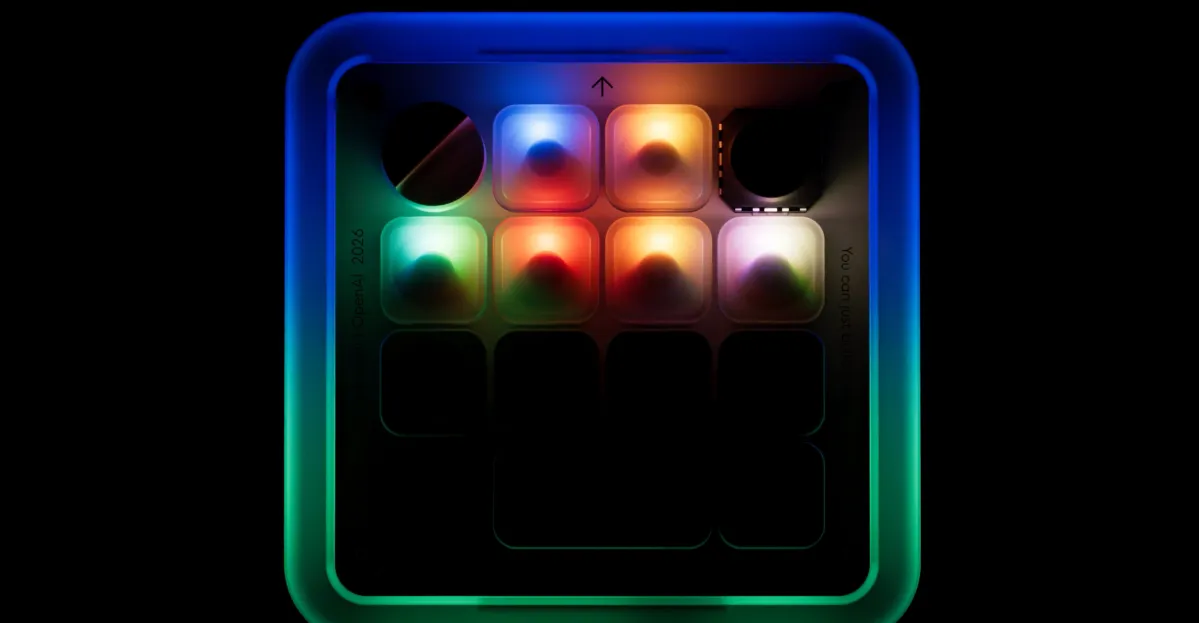
OpenAI is preparing to introduce a new piece of hardware built around Codex, its AI coding product, signaling that the company sees room for a dedicated physical interface in the increasingly crowded market for developer tools. A short teaser video posted to X shows a compact, square device with several controls and the caption suggesting that Codex shortcuts are about to get a major upgrade.
The company has not published a full product page or technical specification, but the timing is already clear: the device is set to be revealed on July 15. What is equally notable is what the teaser appears to confirm by omission. This is not the much-discussed hardware project OpenAI is pursuing with former Apple design chief Jony Ive. Instead, it looks like a separate collaboration with Work Louder, a company better known for modular keyboards and macro pads designed to speed up creative and professional workflows.
If that interpretation holds, the announcement would mark another step in OpenAI’s broader effort to move beyond software-only products. It would also reflect a growing trend in AI: companies are looking for ways to make everyday interactions with models faster, more tactile and more embedded in the user’s workflow. For coding tools especially, where efficiency is measured in seconds and keystrokes, a purpose-built controller could be more than a novelty.
What OpenAI has shown so far
The teaser is sparse, but it provides a few useful clues. The device appears to be roughly square, with multiple buttons arranged across the surface. The accompanying copy frames the product as an upgrade for Codex keyboard shortcuts, suggesting that the hardware may be intended to trigger common actions inside coding environments rather than serve as a general-purpose computer accessory.
That positioning matters. OpenAI is not presenting this as a standalone computer or as a consumer gadget aimed at the mass market. Instead, the device seems designed to sit on a desk next to a keyboard and mouse, giving users a faster way to invoke actions while working with Codex. In practice, that could mean shortcuts for code generation, editing, review, refactoring or other repetitive tasks associated with software development.
OpenAI has not explained whether the device will work only with Codex or whether it may support broader integrations. But the language in the teaser suggests a product tightly tied to the coding workflow. That would make sense for a hardware accessory that needs to justify itself against standard hotkeys, custom scripts and the programmable features already available in many modern keyboards and macro pads.
OpenAI’s message implied that Codex users should expect their shortcut workflow to become more powerful, but the company stopped short of describing the hardware in detail.
A Work Louder partnership, not the Jony Ive project
The teaser has generated interest partly because OpenAI is known to be exploring more ambitious hardware ambitions elsewhere. But this Codex device appears to be a separate effort. The collaboration is with Work Louder, a manufacturer that sells customizable mechanical keyboards, macro pads and related accessories built around programmable controls.
That partnership is a significant clue about the likely shape of the product. Work Louder’s existing devices lean heavily into tactile control surfaces, allowing users to assign custom functions to buttons, dials, toggles and other inputs. For designers, editors and developers, those kinds of tools can reduce context switching and make frequently used commands more accessible.
The silhouette in OpenAI’s teaser resembles one of Work Louder’s own products, the Creator Micro 2, a compact macro pad that includes mechanical switches, a joystick and a touch sensor. While OpenAI has not said the new device is based directly on that model, the visual similarity points to a product that may borrow the same compact, configurable form factor.
Work Louder has previously worked with software companies on similarly tailored accessories. Figma, for example, has offered a branded macro pad with preconfigured shortcuts. That precedent suggests OpenAI may be following a familiar playbook: partner with a hardware maker, embed workflow-specific shortcuts and market the result as a way to streamline a particular application rather than reinvent the entire input category.
Why a physical Codex device makes sense
At first glance, a dedicated device for an AI coding assistant may seem like an unusual move. Codex is already a software product, and developers are accustomed to using hotkeys, terminal commands and IDE plugins. But the logic becomes clearer when you consider how coding tools are actually used.
Developers often repeat the same set of actions many times a day. They run prompts, accept suggestions, request revisions, compare outputs and trigger tests. Even small delays add up. A hardware controller with one-touch actions can shave off friction, especially in workflows where the same commands are used constantly.
There is also a broader usability argument. AI tools are increasingly powerful, but they can still feel abstract and menu-driven. Dedicated hardware gives a product a physical presence and can make interactions feel more deliberate and immediate. For some users, that can translate into better adoption, less cognitive load and a stronger sense of control.
Possible benefits for developers
- Faster access to repetitive Codex actions
- Less need to memorize shortcuts or switch menus
- More efficient multitasking during coding sessions
- A tactile interface for common AI-assisted workflows
- Potentially easier onboarding for new Codex users
How this fits into OpenAI’s product strategy
OpenAI has spent much of the past two years broadening its identity from model builder to platform company. It now offers consumer chat tools, enterprise products, APIs and a growing set of workflow-specific services. A physical accessory for Codex fits that trajectory because it treats AI not as a novelty, but as part of daily professional infrastructure.
The move also hints at how OpenAI may think about developer loyalty. The AI coding market is becoming more competitive, with major players racing to embed models inside IDEs and development environments. If OpenAI can make Codex feel more integrated and faster to use than rival tools, even a small hardware accessory could become a meaningful differentiator.
There is, however, a question of scale. Hardware accessories rarely generate the kind of revenue software companies expect from subscription products. The real payoff may be less about unit sales and more about deepening user engagement with Codex. If the device helps developers use the service more often, it could strengthen retention and reinforce the product’s role in the workflow.
That kind of strategy has become common across the tech industry. Companies increasingly use physical products to make software habits stick. In this case, the hardware may function as both a utility and a signal: OpenAI wants Codex to be embedded in the tools developers reach for instinctively.
What Work Louder brings to the table
Work Louder is not a household name, but in the world of customizable input devices, it has built a recognizable niche. Its products are aimed at people who want more control than a standard keyboard offers. That makes it a natural fit for an AI shortcut device.
The company’s devices typically emphasize compact layouts, programmable inputs and tactile feedback. Those features are useful for creators who rely on repeated actions and fast switching between applications. A Codex-focused accessory would likely benefit from the same design philosophy, especially if OpenAI wants it to feel polished rather than experimental.
Partnerships like this also help explain how the product could come to market quickly. Rather than designing and manufacturing a brand-new device from scratch, OpenAI can collaborate with an existing hardware specialist and focus on the software experience, brand integration and shortcut logic. That can shorten development time and reduce some of the risks associated with launching hardware.
What we still do not know
Despite the teaser, many details remain unknown. OpenAI has not said how much the device will cost, whether it will be bundled with a Codex subscription or whether it will be sold separately. It has not described the exact controls, the number of customizable buttons, the materials used or the extent of its software compatibility.
The biggest unanswered question is whether the product is meant to be a niche accessory for power users or a more accessible gateway into Codex. Those are very different business propositions. A niche accessory would likely appeal to developers already invested in the ecosystem. A broader launch would require clearer onboarding, stronger cross-platform support and a more compelling explanation of why the device belongs on a crowded desk.
There is also the matter of timing. OpenAI has chosen to tease the product only two weeks before launch, which suggests the company is comfortable keeping the details under wraps until the reveal. That compressed runway may help control expectations, but it also means the company is asking viewers to fill in a lot of blanks.
| Key detail | What is known | What remains unclear |
|---|---|---|
| Product | Codex-related hardware device | Exact name and final design |
| Launch date | July 15 | Pricing and availability |
| Partner | Work Louder | How deep the collaboration goes |
| Purpose | Upgrade Codex shortcuts | Specific functions and supported apps |
| Form factor | Compact square device with buttons | Full control layout and materials |
The rise of AI hardware for niche workflows
OpenAI’s teaser fits into a larger pattern across the AI industry: more companies are exploring hardware as a way to make artificial intelligence feel less like a browser tab and more like an embedded part of work. So far, many of those efforts have taken the form of wearables, smart assistants or general-purpose AI devices. But workflow-specific hardware may prove more practical.
That is especially true in professions where repetition is common and latency matters. In creative software, video editing and coding, users often want AI support without losing momentum. A physical controller can offer that balance, providing instant access to high-value commands without forcing users to break concentration.
The potential downside is that hardware can be hard to sustain. It requires support, manufacturing, distribution and customer service. A software company entering the space must prove that the device offers real value beyond novelty. For OpenAI, the challenge will be demonstrating that the Codex accessory changes the way people work, not just how their desk looks.
Still, the idea has obvious appeal. Developers already build custom mechanical keyboards, macro decks and programmable shortcuts to streamline their workflow. A Codex-specific device simply formalizes a practice that many power users have already embraced. The difference is that OpenAI would be packaging that behavior around its own product, turning a personal customization into a branded experience.
How this compares with other shortcut devices
- Standard keyboards: flexible, but limited by generic layout
- Macro pads: compact and highly customizable, but often application-specific
- Stream-deck style controllers: visually friendly, but not always optimized for code
- OpenAI’s teased device: likely targeted at Codex-centric developer workflows
Why the launch matters beyond the gadget itself
The significance of this announcement does not rest solely on whether the device becomes a hit. It also speaks to how OpenAI is thinking about the future of its products. The company appears increasingly interested in building an ecosystem where AI tools are not just accessed, but physically activated in ways that fit the rhythm of the user’s day.
For the coding market, that could be especially important. Developers are among the most demanding users in tech. They value speed, precision and flexibility, and they are quick to abandon tools that slow them down. If OpenAI can win them over with a thoughtfully designed accessory, it may have found a way to make Codex feel stickier and more indispensable.
It would also be a small but telling reminder that AI competition is no longer confined to model benchmarks or chatbot features. Companies are competing on interface design, workflow integration and the places where software touches the physical world. In that context, a compact device for Codex is more than a curiosity. It is a signal that OpenAI wants its products to live on desks, not just in tabs.
What to watch on July 15
When OpenAI officially unveils the device, several details will determine whether it is a clever accessory or a meaningful product extension. The most important will be its controls, software compatibility and pricing. If the device is highly customizable and genuinely improves Codex workflows, it could become attractive to developers who spend hours inside AI-assisted environments.
Design will matter too. A hardware product from a company like OpenAI will inevitably be judged not only on function, but also on polish and identity. If the device looks and feels premium, it may reinforce the idea that AI tools belong in serious professional setups. If it feels gimmicky, it risks being dismissed as a branded novelty.
For now, the teaser leaves plenty of room for speculation. But it also confirms something important: OpenAI is still looking for new ways to make Codex more central to the developer experience. A small hardware device may not seem like the most obvious move, but in a market obsessed with efficiency, even a tiny shortcut can carry strategic weight.
The next two weeks should reveal whether OpenAI is launching a useful productivity tool, a limited-edition accessory or the first step toward a larger family of Codex-branded hardware. Either way, the company has succeeded in generating curiosity around a product category few expected it to enter so directly.