In short
Google’s new $99 Home Speaker delivers strong sound, reliable wake-word detection, and a distinctive design. But its real value depends on whether Gemini makes it a genuinely useful AI home assistant.
- The Google Home Speaker sounds impressive for its size and price.
- Voice detection was strong in early testing, even in noisy conditions.
- The minimalist design looks great but makes controls and indicators less intuitive.
- Google’s Gemini assistant will ultimately determine whether the speaker feels essential.
Google has returned to the smart-speaker market with a small, stylish device that makes a strong first impression. The new Google Home Speaker, priced at $99, delivers surprisingly full sound for its size, responds quickly to wake words, and looks more like a design object than a piece of home tech. But while the hardware appears promising, the bigger question is whether Google’s AI ambitions can turn a good speaker into a genuinely useful household assistant.
In early hands-on testing, the speaker stood out for two reasons: it sounded better than its size suggests, and it handled voice activation with impressive consistency. Even at maximum volume, it reliably caught “Hey, Google,” and it continued to hear commands in a shower test that often trips up other voice assistants. For a product meant to live in kitchens, bathrooms, bedrooms, and living rooms, that reliability matters.
Still, the new Home Speaker is not just another compact audio accessory. Google is pitching it as a front door to Gemini, its AI assistant, and as a device for managing routines, answering questions, and coordinating daily life. That makes the speaker’s design, microphone performance, and interface important — but only as the foundation for a much broader software experience.
A small speaker with big expectations
The device arrives after a long gap. Google has not released a new smart speaker in six years, a stretch that left the company’s home-audio lineup looking dated even as competitors continued iterating. That absence gives the Home Speaker added significance: it is not just a product refresh, but a reset for how Google wants people to think about smart home hardware in the Gemini era.
The model reviewed was the $99 version, a price that places it in the highly competitive midrange for smart speakers. At that level, Google is not trying to win on raw audio alone. It is trying to offer a package that blends design, voice control, streaming support, and AI-powered utility in one compact form factor.
That strategy depends on whether the speaker can perform the basics with confidence. A smart speaker that sounds good but fails to hear you, or hears you but feels awkward to operate, quickly becomes a source of frustration. Google seems to have focused heavily on solving the first problem.
Sound quality: the speaker’s strongest argument
The clearest early takeaway is that the Home Speaker sounds good for its size. Its compact mesh body produces fuller audio than many people would expect from a device this small, with enough volume to handle background listening in a kitchen, bedroom, or office without strain.
Its tuning leans toward bass more than some similarly sized competitors. That does not mean it delivers room-shaking low end — this is still a small speaker — but the sound profile gives music a warmer, richer character than some rivals that emphasize brightness and vocal clarity.
How it compares with familiar small speakers
In side-by-side impressions, the Home Speaker holds its own against portable Bluetooth options in the same size class. A long-time benchmark like the UE Wonderboom still has advantages in overall loudness and vocal presence, but Google’s speaker counters with more bass weight. That difference makes it a matter of preference rather than obvious superiority.
By contrast, the comparison with Amazon’s Echo Dot Max is far less close. Google’s new speaker appears cleaner, louder, and more refined across the board. In simple listening terms, it produces a more polished result, making the competing speaker seem less capable and less balanced.
| Feature | Google Home Speaker | Key takeaway |
|---|---|---|
| Price | $99 | Midrange smart-speaker pricing |
| Size | Softball-sized compact design | Small footprint for kitchens and side tables |
| Sound profile | Warm, bass-leaning, loud for its size | Strong everyday listening performance |
| Voice pickup | Three microphones | Reliable wake-word detection in testing |
| Smart features | Gemini-powered assistant | Designed for more than music playback |
One practical implication is that the Home Speaker may be especially well suited to casual listening rather than critical audio playback. It seems likely to shine as a kitchen companion, a background-music device, or a speaker for radio and playlists. For users who want a small speaker that can fill a space without calling attention to itself, the hardware seems well judged.
Design that blends in — and stands out
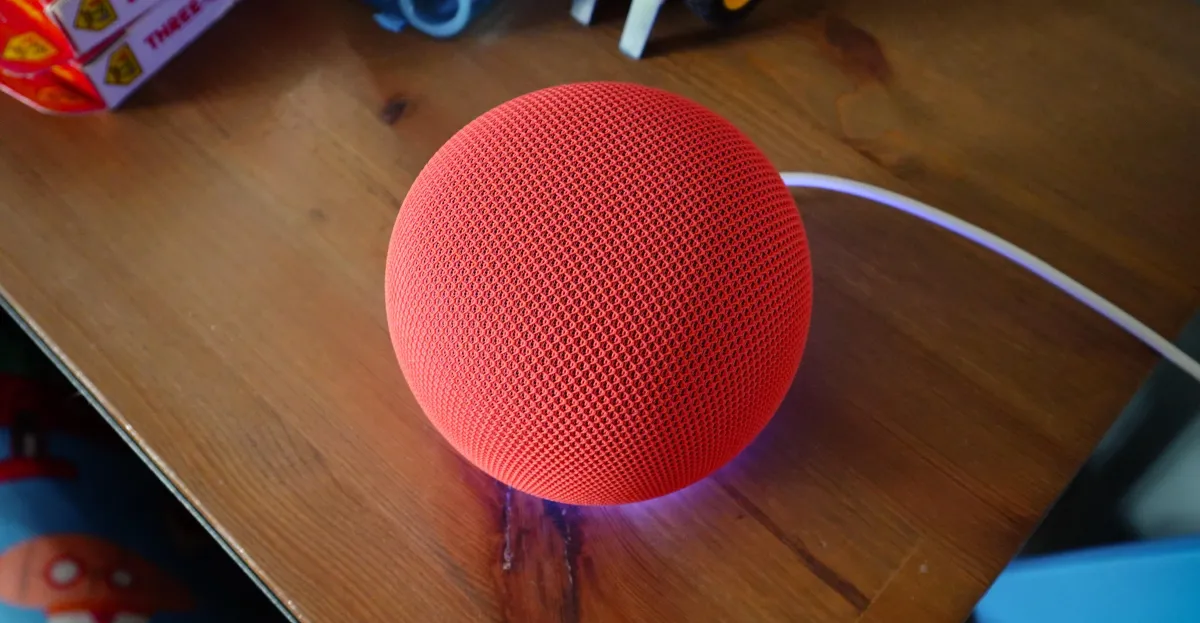
Google has taken a notably restrained approach to the Home Speaker’s look. The device resembles a colorful ball of yarn or a soft, rounded pebble, depending on the color finish. In red, it reads less like a conventional gadget and more like a decorative object, which appears to be part of the point.
The minimalism is effective. There are no obvious seams, no front-facing buttons, and very little visual clutter. The only clear external interruption is the white USB-C cable emerging from the rear. The result is a speaker that can sit in a room without looking overly technical or aggressively branded.
That design choice may help Google position the device as an ambient household tool rather than a piece of consumer electronics that demands attention. It is meant to disappear into daily life, even while being ready to step in as an assistant when needed.
The trade-off: form over immediate clarity
Minimalist hardware often asks users to learn new behaviors, and the Home Speaker is no exception. The controls are not especially intuitive at first glance. Volume changes happen through taps on the left or right side of the rounded body, but the touch zones are not obvious, and the spherical shape makes orientation less self-explanatory than on rectangular devices.
That learning curve is a nuisance, especially for guests or family members who do not use the speaker every day. A simple button layout can be easier to understand than touch-sensitive zones hidden in a rounded form factor. Google clearly prioritized clean design, but it sacrificed a little usability in the process.
The same tension appears in the status light. The ring that glows while Gemini is listening or responding sits underneath the speaker, which means it may not be visible unless the device is positioned above eye level. For a product that depends on trust and feedback, that hidden indicator is a meaningful flaw.
In practical terms, the Home Speaker’s biggest design weakness is that some of its most important controls and signals are too subtle for instant use.
Voice detection is the part that matters most
For any smart speaker, microphone performance is non-negotiable. A product can sound excellent and still fail its real mission if it does not consistently hear the user. On that front, Google appears to have built a strong foundation.
Across two days of testing, the Home Speaker responded reliably to the wake phrase, even when music was playing loudly. It also picked up commands in a bathroom shower environment, where many assistants struggle because of water noise and echo. Those results suggest that Google has paid close attention to microphone tuning and far-field voice recognition.
That is especially important now that smart speakers are being asked to do more than stream audio. They are expected to act as home hubs, information endpoints, and voice-first interfaces for increasingly capable AI systems. If Gemini is going to play a meaningful role in the home, it has to be reachable in everyday, noisy, imperfect settings.
What the early testing does and does not prove
Quick hands-on impressions are not the same as a long-term review. Two days of testing can reveal whether a device gets the basics right, but they do not show how it behaves after weeks of use, in different rooms, or with multiple users and routines.
Even so, strong wake-word handling is a good sign. It means the speaker is likely to feel responsive and dependable in daily use, which is one of the most important qualities a smart-home product can have. If Google had missed this part, the rest of the package would not matter much.
There was one exception: a deliberately whispered command from another room while trying not to wake a baby did not register. That is not necessarily a fair criticism of the device, but it does underline the limits of any voice-first system. Smart speakers are improving, but they still depend on a reasonably direct line between the person speaking and the microphone array.
Gemini is the real story
Google’s pitch for the Home Speaker goes far beyond sound. The company wants the device to serve as a home base for Gemini, allowing users to ask questions, run their day, and manage tasks through conversational AI. That means the speaker should be judged not only on audio quality, but on whether the assistant inside it is actually useful.
This is where the stakes rise. A compact speaker with decent sound can be a successful niche product. A compact speaker that aims to become a central control point for a household has to deliver far more: fast responses, accurate answers, trustworthy automation, and a clear sense of what the assistant can and cannot do.
Google’s timing suggests it sees the Home Speaker as part of a broader effort to bring Gemini into daily routines in a tangible way. Rather than leaving the model confined to phones, laptops, or web interfaces, the company is placing it in a device designed to be heard, summoned, and used constantly throughout the day.
Why the assistant matters more than the audio
If the Home Speaker were only a music device, the evaluation would be simple. It sounds good, looks nice, and costs a reasonable amount. But the moment Gemini becomes central to the product, the bar changes. The device must prove that conversational AI is genuinely helpful in the home and not just a marketing layer on familiar speaker hardware.
That means the real assessment will come from practical use cases: setting timers, controlling lights, checking calendars, managing routines, playing content, and handling follow-up questions without requiring users to repeat themselves. It also means the assistant has to feel fast and dependable enough that people will actually reach for it instead of their phones.
In that sense, the speaker is both a hardware launch and a test case for Google’s AI strategy. If it succeeds, it could become the most natural way for many households to interact with Gemini. If it fails, it may end up as another well-built gadget whose software never quite lived up to the promise.
How it fits into the smart-home market
The Home Speaker enters a market that is familiar but still unsettled. Consumers already have access to speakers from Google, Amazon, Apple, and a range of audio and smart-home brands. Many households own at least one device that can answer questions, set alarms, and play music. The challenge is no longer introducing the category; it is making it feel indispensable.
Google’s advantage may lie in integrating voice control with its broader AI ecosystem. If Gemini can deliver more natural, more capable interactions than older assistant systems, the Home Speaker could become a meaningful upgrade rather than just another endpoint.
But there are also risks. Smart speakers have historically struggled when companies overpromise on assistant intelligence or fail to maintain momentum after launch. Google’s six-year pause in this category may have allowed competitors to normalize certain expectations while the company focused elsewhere.
What users may want from a modern smart speaker
- Reliable wake-word detection across noisy environments
- Clear and easy-to-understand physical controls
- Enough sound quality for daily listening
- Visible feedback that shows when the assistant is active
- Useful AI features that save time, not just answer trivia
The Home Speaker appears to succeed on some of these points and fall short on others. The audio is strong. The microphones seem promising. The controls and indicator placement are less successful. The AI experience remains the biggest unknown.
Price, value, and the role of the bundle
At $99, Google is trying to thread a difficult needle. The price is high enough to imply premium value, but low enough to remain accessible to mainstream buyers. That makes the Home Speaker easy to imagine as a first smart speaker, a secondary room speaker, or a holiday gift for someone already using Google services.
In that context, value will depend on how much the device can do beyond audio playback. A strong speaker at $99 is competitive. A strong speaker that becomes a practical AI interface may feel like a bargain. A speaker that promises that future but struggles in execution will feel overpriced, no matter how good it sounds.
Google may also be thinking about ecosystem lock-in. A user who buys one Home Speaker and later adds more to create grouped audio, or connects them to a Google TV Streamer for improved television sound, becomes more embedded in the Google home environment. That strategy has long been central to smart-home hardware, and it depends on getting early adoption right.
Home audio, TV audio, and multiroom potential
Beyond standalone use, Google says the Home Speaker can be grouped with other units for synchronized playback around the house. It can also be paired with a Google TV Streamer to improve television audio. That expands the device’s appeal beyond pure voice-assistant duties and into flexible home entertainment.
It will not replace a dedicated soundbar or a full Sonos-style setup, but it may outperform TV speakers by a wide margin. For many households, that is enough. A small, attractive speaker that improves television sound, supports music, and responds to voice commands could be an easy sell.
The limitation is that Google does not appear to want this product to act as a standard Bluetooth speaker. Instead, it leans on Google Cast for media streaming. That keeps the experience tied closely to the Google ecosystem, which may be convenient for existing users but less flexible for people who prefer universal connectivity.
What still needs to be tested
The early verdict is promising but incomplete. The biggest questions remain open: How well does Gemini handle real home tasks? How quickly does it respond to follow-up requests? Does it stay reliable after days or weeks of use? And does the overall experience justify making the speaker a central part of the household?
There are also broader questions about how people will use a speaker like this in the age of AI. If an assistant can do more than play music and set timers, will users trust it with scheduling, reminders, information lookup, and daily planning? Will they find the interaction style genuinely helpful, or will it feel like another layer of complexity?
Google’s answer appears to be that the smart speaker can once again be a front-line AI product. The hardware supports that argument. The microphones suggest it is ready for it. But the software story is still unfolding.
Bottom line: strong hardware, uncertain destiny
The new Google Home Speaker makes a persuasive case for itself as a compact, attractive, and unusually capable small speaker. It sounds better than its size suggests, catches wake words reliably, and offers a design that stands apart from the usual gray and black boxes of home audio.
Yet the device’s most important feature is not its sound or its appearance. It is Gemini. Google has not merely built a speaker; it has built a platform for a more ambitious home assistant. Whether that ambition pays off will depend on how well the AI performs in everyday life, not in demos or launch materials.
For now, the Home Speaker looks like a successful piece of hardware with an unresolved identity. It is appealing enough to buy on the strength of its audio and design alone. But Google clearly wants it to be more than that — a new kind of domestic interface for the Gemini era. The company’s next step is to prove that the software can match the promise of the shell around it.
| Aspect | Assessment | Why it matters |
|---|---|---|
| Audio quality | Strong for the size | Sets the product up as a credible everyday speaker |
| Wake-word performance | Very reliable in early testing | Essential for a voice-first device |
| Controls | Functional but not obvious | Could frustrate new users and guests |
| Design | Minimal, colorful, distinctive | Helps the speaker blend into a home environment |
| AI ambition | High | Gemini will determine long-term value |
Google’s first new smart speaker in years is off to a solid start. The next test is whether it can become essential, not just agreeable.