In short
Marc Isaacs’ new hybrid film Synthetic Sincerity uses a fictional AI lab to explore how artificial intelligence could mine human emotion from documentary work. The film doubles as a critique of authenticity, cultural erasure and the shrinking space for ordinary people on screen.
- Synthetic Sincerity is a fictionalised documentary about an AI lab training on Marc Isaacs’ films.
- The film argues that AI intensifies long-running problems around authenticity and representation.
- Isaacs and writer Adam Ganz say mainstream documentaries are sidelining ordinary people in favour of celebrity.
- The project blends satire, staged performance and real-world anxieties about data, voice and likeness.
Marc Isaacs has spent much of his career filming people the television industry tends to overlook: pensioners, commuters, factory workers, migrants, neighbours, drifters and dreamers. Now the British filmmaker has made a film about what happens when those same lives are filtered through artificial intelligence — and what is lost when systems are trained to extract human feeling without human context.
His latest project, Synthetic Sincerity, arrives with the look of a documentary but is built on a deliberately fictional premise: a university research lab that allegedly licences Isaacs’ entire body of work in order to mine it for emotional data. The idea is absurd on its face, and Isaacs wants viewers to know it. The joke, however, points to something real: the growing appetite of AI systems for vast quantities of cultural material, and the uneasy questions that come with it.
In the film and in conversation around it, Isaacs uses invention to examine authenticity, representation and the creeping sense that ordinary people are being pushed out of the picture. The result is a 70-minute hybrid that is funny, unsettling and fiercely alive to the contradictions of documentary filmmaking in the AI age.
A fictional university, a real debate
Isaacs says the university at the centre of the story does not exist. The “University of Southern England” is a fabrication, created so the film could dramatise a scenario that would otherwise require legal permissions and contractual realities to be navigated. That fictional device gives Isaacs and writer Adam Ganz the freedom to push the premise as far as they want.
The setup is simple but provocative. A research team claims it can feed Isaacs’ films into a system, analyse the performances and extract emotional patterns that can be used to build AI-generated characters. In the real world, such a request has not happened to Isaacs, but he says it would not shock him if it did.
That distance between the made-up frame and the very real industry anxiety is where the film finds its force. It is not a cautionary lecture about machines taking over cinema. Instead, it is a layered reflection on who gets represented, who gets sampled and who gets to define what counts as truth.
Why the film feels documentary-like
Isaacs has long worked at the border of fact and performance. His films often resemble observational documentaries, yet they incorporate scripted dialogue, non-actors and staged encounters. That approach is not new in world cinema — it has strong precedents in Iranian filmmaking, particularly Abbas Kiarostami’s Close-Up — but Isaacs has made it a signature of his own work in Britain.
With Synthetic Sincerity, he and Ganz extend that practice into AI territory. The film looks grounded because it is populated by recognisable locations, faces and textures, but it is also knowingly unstable. Viewers are invited to keep asking what is authentic, what is staged and why the distinction matters.
Marc Isaacs and the long tradition of staged reality
For Isaacs, the debate over AI is inseparable from a larger argument about documentary itself. He has never embraced the idea that film can be “pure” or unmediated. In his view, every documentary is shaped by selection, framing, editing and performance — even when no one says the word “fiction.”
That philosophy has guided much of his career. In earlier work, he regularly blurred the line between actuality and construction. In one notable film, he shot conversations at a roadside food van while keeping hidden the fact that the customers had been cast in advance and brought to the location. In another, he confined the action mostly to his own home as visitors drifted through over the course of a day.
Those choices do not undermine the value of the work. On the contrary, Isaacs argues that they make the films more honest about the realities of filmmaking itself: people behave differently when they know they are being watched, and “reality” on screen is always the product of decisions.
From observational film to hybrid form
The shift toward scripted or semi-scripted documentary has a long and complicated history. In British television, the style is often associated with reality franchises and glossy constructed formats. In cinema, it has produced work as varied as Michael Winterbottom’s refugee drama In This World and Jack Hazan’s portrait of David Hockney, A Bigger Splash, which is frequently mislabelled as a straightforward documentary.
Isaacs’ films sit within this lineage but keep their own tone: intimate, dryly comic and attentive to small social details. His work often finds drama in ordinary settings rather than in high-concept spectacle, which is one reason the AI premise in Synthetic Sincerity feels so pointed. He is not asking what happens when robots become superheroes; he is asking what happens when the textures of ordinary life are mined, processed and repackaged.
What the film is really arguing about AI
At one level, the movie is about the mechanics of machine learning and the current race to gather data. At another, it is about cultural disappearance. Isaacs and Ganz are concerned that contemporary media increasingly privileges celebrity, brand recognition and pre-packaged spectacle over the lives of everyday people.
They argue that British documentary used to provide a rare window into lives outside the mainstream. According to that view, the field has narrowed: streaming platforms and premium factual series now favour glossy, familiar subject matter, often centred on fame, aspiration or a highly polished version of hardship.
The complaint is not simply nostalgic. It is political. If ordinary people are not being filmed, or if they are only filmed as background texture for a more marketable story, then their lives become harder to see on screen — and easier to erase from public imagination.
Isaacs and Ganz see the current documentary landscape as less interested in diverse everyday lives than in celebrity-driven, heavily branded storytelling, warning that ordinary people are being pushed out of view.
The film’s broader social canvas
Although the story begins with AI and filmmaking, Synthetic Sincerity reaches outward to several wider issues. It touches on the war in Lebanon, the experience of Uyghur communities, and tensions around political censorship in British universities. Those references do not feel bolted on; they reflect Isaacs’ long-standing interest in how global power shapes local lives.
That breadth gives the film a larger frame. It is not only about technological change but about the institutions and assumptions that decide which voices are amplified, which are recorded and which are ignored.
The human face at the centre of the satire
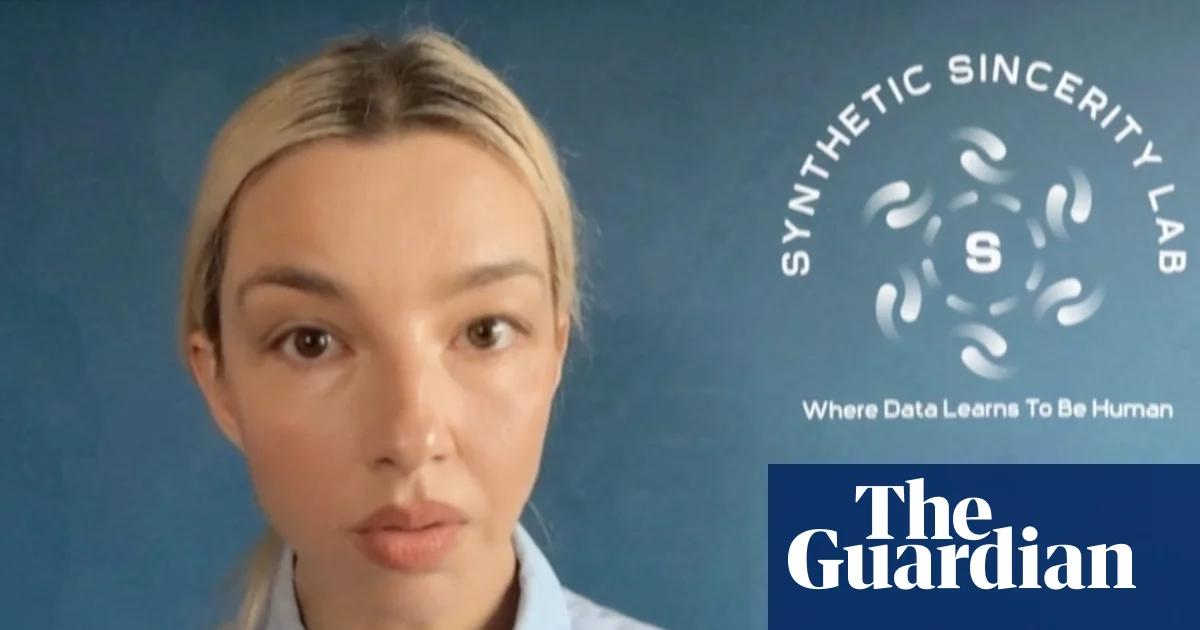
One of the film’s most memorable ideas is the pairing of Isaacs with a female AI avatar. The avatar flatters him, needles him and occasionally corrects him, giving the film a comic rhythm as well as a conceptual edge. It also ensures that the debate never stays abstract; it becomes a conversation between a filmmaker and a synthetic figure that appears to know him all too well.
The avatar is played by Romanian actor Ilinca Manolache, who has already used AI-related visual tricks in other work, including Radu Jude’s Do Not Expect Too Much From the End of the World. For Isaacs’ film, she was filmed through Snapchat and then processed through AI tools, creating a digital presence that is knowingly artificial but still recognisably expressive.
That tension matters. Rather than presenting AI as a cold, alien intelligence, the film shows how persuasive and collaborative such imagery can be. The avatar is not just a gadget; she becomes a scene partner, a critic and a mirror for Isaacs himself.
A performer facing her own obsolescence
Manolache’s involvement carries an added irony. She is a working actor whose craft is rooted in embodiment, timing and emotional nuance, yet she is also comfortable experimenting with the very tools that threaten to reduce performance to data. Isaacs clearly enjoys the contradiction.
In his telling, the project is not a solemn warning that all acting will vanish. It is more complicated than that. The film suggests that AI may create new forms of performance even as it destabilises old ones — and that artists will increasingly be asked to negotiate both possibilities at once.
How much of it is real?
That question is central to the film’s design. Isaacs says he was surprised that some viewers did not immediately recognise the fictional structure. He thought a clue would be the moment when the avatar invites him to visit “the place where I was made,” effectively dragging the story into the lab itself and exposing its own artifice.
Yet the fact that some audiences reacted as if the setup might be factual only strengthens the film’s point. In an era of deepfakes, synthetic voices and manipulated images, the line between document and invention is already unstable. Synthetic Sincerity merely makes that instability visible.
Isaacs also recalls a festival audience member who took issue with the film after a screening, arguing that it showed no belief in anything. For the director, that criticism misses the point. Uncertainty, he says, is not a failure of the film but its subject.
Isaacs argues that films do not exist to hand down verdicts; instead, they should raise questions and unsettle complacent assumptions about truth, image-making and authority.
The old lie inside the new technology
To reinforce the argument, Isaacs folds in material from an unreleased BBC documentary he made years ago. That earlier project followed a man claiming to be an Iraq war veteran and aspiring bounty hunter, only for him later to be exposed as a fantasist.
The inclusion is clever because it reminds viewers that falsehood did not begin with AI. People have always lied on camera, exaggerated their lives or performed identities for an audience. What is changing now is the speed, scale and sophistication with which those performances can be generated, duplicated and circulated.
That makes the film less a condemnation of technology than a study of continuity. AI does not invent inauthenticity; it industrialises it.
Why Isaacs refuses the apocalypse script
Despite the sharpness of its critique, Synthetic Sincerity is not a doom-laden film. Isaacs seems determined to avoid the familiar dystopian posture that dominates much public discussion of AI. He is sceptical of sensationalism, especially the kind that treats every new tool as a portal to the end of culture.
He does not dismiss the risks, but he is also wary of exaggeration. In his view, the more interesting question is not whether AI will destroy cinema overnight, but how it can be used — and misused — within the existing realities of production.
There are, he suggests, areas where AI is plainly practical. Large-scale battle scenes, crowd simulation and other expensive visual effects may well become cheaper and easier to generate. But the harder challenge is the representation of lived human experience, and whether synthetic tools can ever really stand in for the social world.
Can AI make a great film?
Isaacs is open to the possibility that some artist may eventually make a striking film with AI at its core. But he insists that such a project would have to be self-aware and formally adventurous, not merely efficient or novelty-driven.
In other words, AI might become artistically useful only when it is treated as a subject worthy of interrogation rather than a shortcut to scale. That distinction is central to the film’s ethic: technology should not hide the act of making; it should expose it.
He is equally clear that AI will not spontaneously generate a new film movement, let alone a replacement for the cultural breakthroughs of the past. The tools may change, but the need for strong ideas, perspective and point of view remains unchanged.
Isaacs’ career in context
Part of what makes the film effective is the body of work behind it. Isaacs is not a newcomer making a late conversion to experimental form. He has spent decades charting everyday Britain with curiosity and wit, and many viewers associate him with a humane, offbeat observational style.
That background helps explain why his response to AI feels so grounded. He is not speaking as a technician or a Silicon Valley critic. He is speaking as someone who has spent years trying to preserve the specificity of human life on camera.
His films have often found beauty in overlooked spaces: tower blocks, suburban streets, marginal workplaces, forgotten towns. That attention is part of what gives Synthetic Sincerity its emotional resonance. The film’s concern is not only that AI may copy faces or voices, but that it may flatten the social world those faces and voices come from.
Key facts at a glance
| Topic | Details |
|---|---|
| Film | Synthetic Sincerity |
| Director | Marc Isaacs |
| Writer | Adam Ganz |
| Running time | About 70 minutes |
| Format | Hybrid documentary with fictional elements |
| Central premise | A fictional AI lab licences Isaacs’ work to harvest emotional data |
| Key performer | Ilinca Manolache as the AI avatar |
| Core themes | AI, authenticity, documentary ethics, representation, cultural erasure |
Timeline of the ideas behind the film
| Stage | What happened |
|---|---|
| Earlier work | Isaacs developed a body of films mixing observational realism with staged situations |
| Preceding experiments | Works such as The Filmmaker’s House and This Blessed Plot pushed further into hybrid storytelling |
| AI premise | Isaacs and Ganz imagined a university lab that claims it can extract emotion from his films |
| Production | Manolache was filmed and processed through AI tools to create the avatar character |
| Release | Synthetic Sincerity emerges as a commentary on film, truth and machine-made culture |
What makes the film resonate now
The timing of Synthetic Sincerity matters. AI has moved from speculative discussion to everyday infrastructure across entertainment, media and creative work. Writers, actors, editors and documentary makers are being asked to think about model training, licensing, likeness rights and synthetic content at the same time as they are trying to protect their own craft.
Against that backdrop, Isaacs’ film stands out because it does not reduce the debate to fear. It asks sharper questions: what happens when lived experience becomes training material? What happens when audiences cannot tell whether a face, voice or emotion was recorded or generated? And what kinds of stories disappear when culture rewards sameness?
Those are not abstract questions for Isaacs. They sit at the heart of how he has always worked. His films depend on observation, surprise and the irreducible oddness of actual people. AI, as he presents it here, threatens that ecosystem not only by copying it, but by making its replacement look efficient.
The final irony: the filmmaker using AI himself
Perhaps the most telling detail in the whole story is that Isaacs is not rejecting AI out of hand. During development of his next film, he admits to testing early script ideas with ChatGPT to see what came back. Some of the suggestions, he says, were not useless.
That admission does not weaken his critique. If anything, it sharpens it. The film-maker who is warning about synthetic culture is also curious enough to experiment with it, which makes his position more believable and more interesting. He is neither a purist nor a convert; he is a pragmatist trying to understand what the tools can do without surrendering authorship to them.
His collaborator’s reaction to the ChatGPT experiment was blunt, which may be the healthiest response available. But Isaacs seems to relish that friction. The argument itself is part of the process, and part of the art.
Why this hybrid film matters
Synthetic Sincerity is not trying to provide a single verdict on artificial intelligence. It is trying to show how the language of AI, the machinery of documentary and the politics of representation overlap in ways that are already reshaping culture.
That makes it more than a niche art-house experiment. It is a film about labour, visibility, authorship and memory. It asks who gets to be seen, who gets to speak and who gets turned into data. Those are questions that extend far beyond cinema.
By making the film playful, Isaacs avoids the trap of treating AI as an all-powerful myth. By making it unstable, he reminds viewers that truth in cinema has always depended on trust, framing and context. And by placing ordinary people at the centre of the discussion, he reasserts the value of the very lives that algorithmic culture so often smooths away.
In an age of increasingly polished synthetic media, that may be the most radical thing a film can do.
At a glance: why audiences are talking about it
- It uses fiction to expose real anxieties about AI and data extraction.
- It continues Isaacs’ long-running experiment with hybrid documentary form.
- It argues that mainstream factual media is sidelining ordinary lives.
- It treats authenticity as a question, not a slogan.
- It shows AI as both a creative tool and a cultural threat.
Whether audiences leave Synthetic Sincerity amused, irritated or unsettled, the film seems designed to do one thing above all: make them look again at what they think they are seeing.