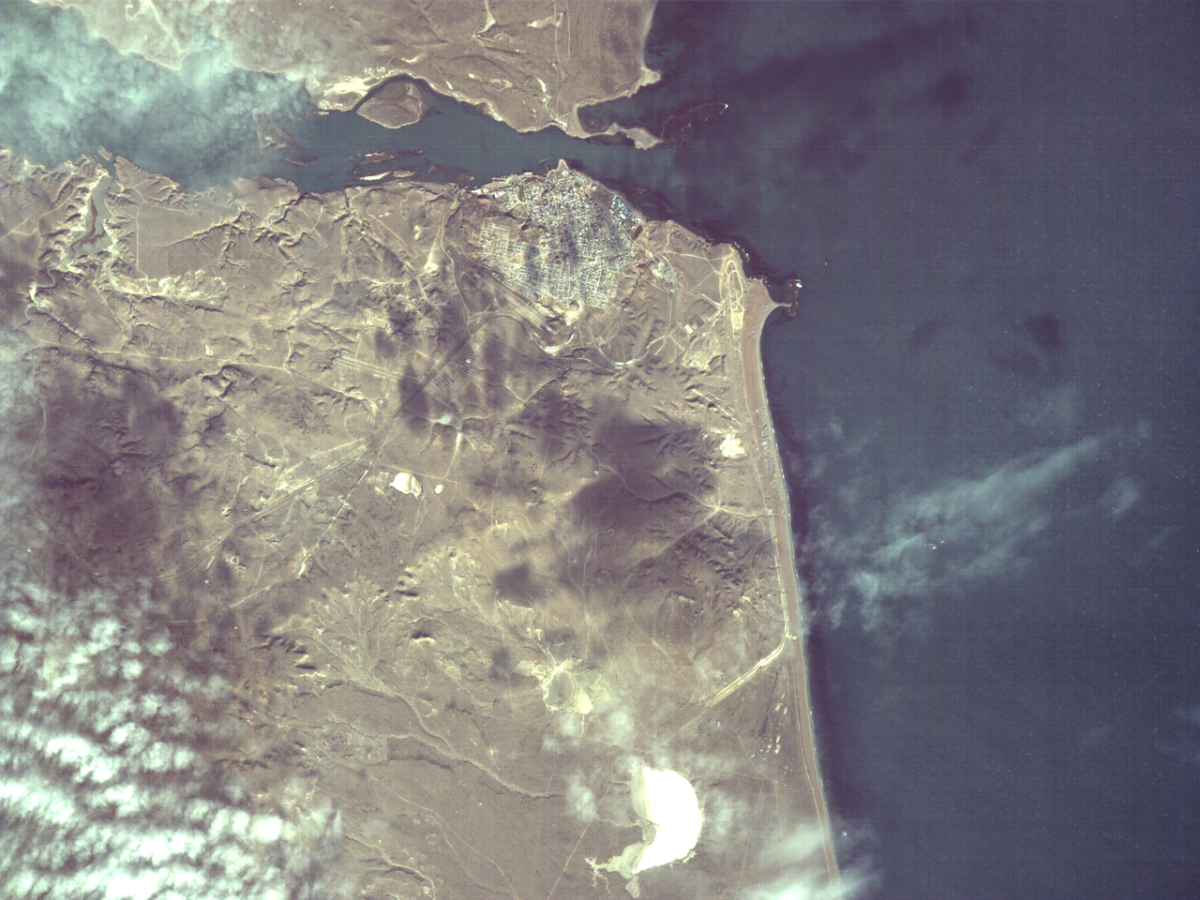
For the first time, a satellite in Earth orbit has successfully searched for a target using artificial intelligence on board, without waiting for analysts on the ground to sift through images later. The test, carried out in April and disclosed this week, marks the first reported use of a vision-language model in space and may prove to be an important step toward satellites that can interpret what they see in real time.
The demonstration was modest in scale but big in implication. Instead of downlinking large data sets for human review, the spacecraft used onboard software to respond to natural-language prompts and identify regions of interest itself. That shift could help space companies and government missions cut delays, reduce bandwidth demands and make satellite data far more actionable.
At the center of the experiment was Yam-9, a spacecraft built by space infrastructure company Loft Orbital. Running on a Nvidia Jetson AGX Orin GPU, the satellite used Google DeepMind’s Gemma 3 vision-language model through software developed by NASA’s Jet Propulsion Laboratory. The system identified features such as areas where the natural environment meets human development and infrastructure near rail hubs — tasks that traditionally require analysts on Earth.
While the immediate use case is narrow, the result matters because it shows AI models can do more than merely classify images after the fact. They can help satellites decide what matters in the first place.
Why this orbiting AI test matters
Earth observation has long depended on a data pipeline built around abundance. Satellites collect vast amounts of imagery and sensor data, then send it to the ground, where humans or conventional machine learning tools sort through the material. That approach works, but it is slow, bandwidth-intensive and expensive when the goal is to monitor large areas continuously.
The new demonstration points to a different model: let the satellite do the first pass in orbit. If a spacecraft can recognize what a user is asking for — a border crossing, a rail center, a patch of urban expansion, a change in shoreline, a suspicious vehicle cluster — it could prioritize only the most relevant frames for transmission back to Earth.
That would make the satellite less like a passive camera and more like an active observer.
Loft Orbital’s head of AI, Paul Lasserre, said the result suggests a future in which satellites operate in persistent patrol mode, able to monitor areas of interest and respond interactively to instructions. The idea is straightforward: instead of simply collecting imagery, the spacecraft can be asked to keep watch and alert operators when something unusual appears.
Lasserre described the long-term vision as an always-on orbital monitoring layer, where a user could direct a satellite to watch a region and flag suspicious changes without waiting for a human analyst to inspect every image first.
How the system worked
The headline technology was not a custom AI model trained solely for space, but a vision-language model that was adapted for the constraints of orbit. VLMs combine image understanding with the language capabilities that have made large language models so versatile. In practice, that means a user can ask a system in plain language what it sees, and the model can answer using the image data available to it.
That combination is especially attractive for edge computing, where hardware is limited and cannot rely on a constant connection to cloud data centers. Satellites are the ultimate edge environment: power is constrained, memory is precious, and every byte sent to Earth has a cost.
To make the experiment practical, NASA JPL engineers built NAVI-Orbital, a software harness that helped Gemma 3 run in space. The model itself was available off the shelf, but the surrounding software needed to be slimmed down so it would fit the limited compute envelope aboard the satellite.
According to the team, the challenge was not just getting the model to run. It was getting it to run reliably with fewer dependencies, lower memory overhead and the discipline demanded by orbital hardware.
From image collection to on-orbit decision making
For decades, satellites have excelled at sensing but not at interpretation. They were built to take pictures, record measurements and send the data home. Interpretation happened later, often after a delay that reduced the value of time-sensitive information.
Onboard AI changes that logic. Even a small model that can perform initial triage may dramatically increase the utility of a spacecraft.
There are several practical advantages:
- Lower downlink burden: only relevant scenes need to be transmitted.
- Faster response times: operators can be alerted sooner to urgent events.
- Better use of sensor time: satellites can prioritize what to observe next.
- Higher data value: customers may pay more for curated, near-real-time insights.
In other words, the value of an Earth observation satellite could shift from how much raw imagery it captures to how intelligently it filters and interprets that imagery before sending it home.
Loft Orbital’s infrastructure-first model
The company behind the spacecraft, Loft Orbital, is not selling satellites in the traditional sense. Its business model resembles infrastructure-as-a-service: Loft builds, launches and operates spacecraft that third-party customers can use for their own missions.
That model is particularly well suited to AI experiments because it lets customers bring new applications to orbit without building a custom satellite every time. Loft can host different payloads, compute systems and software stacks, then adapt them for individual use cases.
The company has already demonstrated this kind of flexibility with commercial customers. In one recent arrangement, it built and operates six satellites for EarthDaily, a company that plans to analyze and sell data from the spacecraft.
Yam-9 was launched in the fall of 2025 as a pathfinder for Loft’s orbital AI ambitions. It serves as an early testbed for onboard intelligence and for the operational details that matter most in space: power budgets, thermal limits, memory management and reliability.
The hardware stack onboard Yam-9
The satellite includes a Nvidia Jetson AGX Orin, one of the most widely used processors for edge AI applications. The choice reflects a broader trend in space technology: reuse terrestrial AI hardware where possible, then harden the software layer around it for orbital conditions.
That approach helps reduce development cost and speeds up deployment. But it also means engineers must carefully optimize every layer of the system so the computer can withstand the demands of space and still perform useful work.
What exactly is a vision-language model?
Vision-language models are a newer class of AI system that can understand both images and text. Rather than simply recognizing objects in a picture, they can interpret visual scenes in response to a prompt.
That makes them more flexible than older image classifiers. A conventional model might be trained to label “road,” “building” or “train track.” A vision-language model can be asked, in plain English, to look for a railway hub, identify surrounding infrastructure or point to places where urban development meets open land.
In the Yam-9 demonstration, that flexibility was key. Researchers used the model to respond to natural-language requests and locate areas of interest in sensor imagery. The task was less about generic labeling and more about matching a user’s intent to visual patterns in the scene.
That is an important distinction. It suggests satellites may one day be able to behave less like automated cameras and more like interactive assistants in orbit.
How other companies are likely to follow
Loft’s test appears to be the first publicly reported use of a vision-language model in orbit, but it is unlikely to remain alone for long. Satellite operators are already investing in onboard compute, and some have hardware in space that could support similar applications.
Planet Labs, for example, flies satellites equipped with Jetson Orin processors. For now, its on-orbit AI use cases are said to focus on simpler object detection, but the company says it is researching broader applications, including vision-language models.
Kepler Communications, which says it operates the largest group of GPUs in space, has not disclosed whether it has already deployed VLMs because of confidentiality agreements with partners. The company did note that its space compute environment has supported multiple undisclosed use cases since its satellites launched in January.
The competitive implication is clear: the first company to make onboard interpretation reliable at scale may unlock a meaningful advantage in timeliness and product value.
A likely roadmap for orbital AI
- Start with classification and object detection onboard.
- Move to model-assisted triage of scenes and regions.
- Add natural-language prompting for mission operators.
- Expand to persistent monitoring and event detection.
- Eventually support more autonomous decision-making in orbit.
That progression may sound incremental, but each step increases the autonomy of the spacecraft and the value of the data it gathers.
The bigger prize: real-time coverage of Earth
Loft argues that proving a VLM can work in orbit is only the first step. The company’s longer-term goal is to build a constellation large enough to provide near-real-time coverage of the planet.
According to Lasserre, that would likely require somewhere between 50 and 100 satellites similar to Yam-9. Loft currently has 12 spacecraft in orbit.
That is a sizable gap, but the direction is easy to see. If onboard AI makes each satellite more productive, fewer spacecraft may be needed to generate the same level of usable insight — or the same number of satellites could deliver significantly more value.
In practical terms, this is where the economics of space AI start to become interesting. A satellite that can process imagery itself may reduce ground-station congestion, lower bandwidth expenses and improve response times, all of which could translate into a better return on investment.
Why power and memory are the real story
For all the excitement around AI in orbit, the breakthrough is as much about engineering discipline as it is about machine learning. Space systems are unforgiving. Every extra dependency, every unnecessary library and every memory spike matters.
That is why the JPL team had to adapt the software layer around Gemma 3 so carefully. The model may have been designed for edge use, but spacecraft edge environments are especially constrained. Engineers must think about heat dissipation, power availability, memory usage and how gracefully the system recovers if anything goes wrong.
Those lessons will matter well beyond this single mission. As companies look to deploy larger AI models in space, the bottlenecks may not be intelligence itself so much as the infrastructure required to support it.
In that sense, Yam-9 is a pathfinder not only for orbital AI applications but also for the practical design patterns that future space computers will need.
Beyond commercial imagery: science and exploration
The implications go beyond Earth observation. NASA researchers began thinking about the NAVI-Space concept with future astronauts in mind, particularly those operating on the Moon or Mars.
In those environments, a hands-free digital assistant could be more than a convenience. It could be essential. Astronauts wearing pressurized suits cannot easily interact with keyboards or conventional interfaces, yet they may need to carry out complex tasks, query systems or receive step-by-step guidance in real time.
Researchers involved in the project described the concept as an interactive assistant for space explorers, something closer to the helpful AI interfaces seen in science fiction than to a traditional command-and-control terminal.
That vision raises its own questions about safety, autonomy and trust. But it also highlights why the first orbiting VLM matters: it creates a technical foundation for more sophisticated assistants in future missions.
What the milestone does not mean
Despite the headline, this is not evidence that satellites are about to become fully autonomous or that spacecraft AI is ready to replace human judgment. The system was a controlled demonstration of a limited model performing specific tasks under carefully managed conditions.
It also does not mean larger AI systems can now be dropped into orbit without serious redesign. Space remains a difficult environment for computation, and every layer of the stack must be optimized with care.
Still, milestones in emerging industries matter because they show what has moved from theory to practice. In this case, the practice is enough to change how the sector thinks about onboard compute.
Key facts at a glance
| Item | Details |
|---|---|
| Milestone | First reported use of a vision-language model in orbit |
| Satellite | Yam-9, built by Loft Orbital |
| AI model | Google DeepMind’s Gemma 3 |
| Onboard software | NAVI-Orbital, developed by NASA JPL |
| Hardware | Nvidia Jetson AGX Orin GPU |
| Timing | Demonstration occurred in April 2026 |
| Launch date | Fall 2025 |
| Loft Orbital fleet | 12 spacecraft currently in orbit |
| Estimated constellation for real-time coverage | 50 to 100 satellites |
Timeline of the project
| Date | Event |
|---|---|
| Fall 2025 | Yam-9 launches as a pathfinder for orbital AI projects |
| January 2026 | Kepler Communications launches satellites with space GPUs |
| April 2026 | Yam-9 successfully uses a VLM to identify targets on its own |
| June 2026 | The demonstration becomes public and draws attention as a first-of-its-kind milestone |
What happens next
The next phase will likely focus on proving reliability, expanding workloads and testing whether onboard AI can support more complex mission goals. That includes broader image interpretation, more interactive operator workflows and possibly multi-satellite coordination.
If those tests succeed, the commercial model for Earth observation could change in fundamental ways. Customers may stop buying raw pixels and start buying decisions, alerts and curated intelligence. That would shift value from ground-based analysis centers to the satellites themselves.
It could also intensify competition among companies building space compute platforms, since the winners may be the operators that can move fastest from experimental demos to production systems.
For now, Yam-9 has done something small but historic: it learned how to look for something in orbit, using its own onboard intelligence. That may be the first sign of a much larger transformation in how space systems observe the planet — and perhaps, one day, how they help humans explore beyond it.
Not every satellite will need a vision-language model. But the ones that do may soon be able to see, decide and respond in ways that were impossible only a year ago.