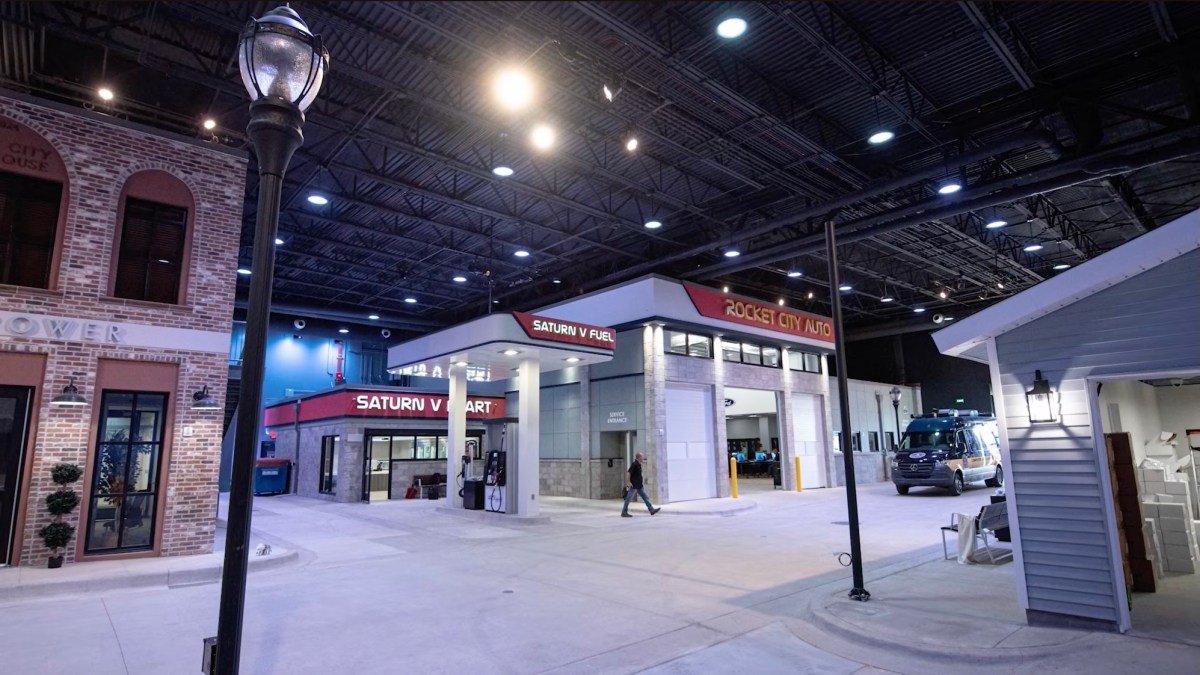
On an FBI campus in Huntsville, Alabama, investigators are stepping into a neighborhood that does not exist anywhere on a map. There are streets, traffic lights, a courthouse, a gas station, a grocery store, a hospital and even a power company, all packed into a 22,000-square-foot environment designed to look and behave like a real American community. The twist is that every building, device and network inside the site exists for one purpose: preparing law enforcement for the chaos of modern cybercrime.
The Bureau calls the space the Kinetic Cyber Range, and it is one of the clearest signs yet that digital investigations are no longer confined to conference rooms, slide decks or lab exercises. Federal agents and their partners now need a place where they can rehearse the kinds of incidents that increasingly define public safety and national security: ransomware attacks that shut down hospitals, intrusions into local government systems, compromises of private networks and forensic examinations of encrypted devices that may contain evidence in criminal cases.
The training facility opened in February 2025 and, according to the FBI, has already trained more than 1,400 students, including Bureau personnel and outside partners from federal, state and local agencies. Its launch comes as cybercrime losses in the United States continue to climb. The FBI’s 2025 Internet Crime Report, which drew on more than one million complaints, put nationwide losses at a record $20.9 billion, a 26% increase from the year before. Ransomware, the report said, remains the leading threat affecting critical infrastructure.
For a security agency used to operating in controlled environments, the logic behind the replica town is simple: cyber incidents do not stay neat. They affect hospitals, utilities, courthouses, retail systems and ordinary people trying to go about their day. The Kinetic Cyber Range is meant to expose investigators to that complexity before they face it in the field.
A training town built for the age of ransomware
The FBI’s range is not a movie set and not a conventional classroom. It is a purpose-built operational environment where real hardware and real software are arranged to mirror the kinds of systems investigators are likely to encounter during a breach response or a court-authorized search.
The setup includes a fully furnished hotel, homes, a hospital, a grocery mart, a gas station, a courthouse and a power utility. Roads and traffic signals connect the buildings, reinforcing the illusion of a live community. But unlike a real town, the environment can be carefully isolated so that simulated intrusions, malware events and forensic exercises cannot leak outside the facility.
That isolation matters. The FBI and its law enforcement partners need to practice against attacks without creating real damage, especially when scenarios involve infrastructure that can affect public safety. A ransomware event at a hospital, for example, is not merely a data problem. It can interrupt patient care, force operational shutdowns and create life-or-death consequences in minutes.
The range gives trainers the ability to stage those scenarios and see how investigators respond under pressure. That includes not just technical analysis, but coordination, evidence handling, operational decision-making and communication across agencies.
Why a fake town makes sense
Cybercrime has become a systems-level problem. Criminal groups no longer limit themselves to stealing passwords or locking up a single computer. They increasingly target services that keep communities functioning. Schools, local governments, hospitals, utilities and contractors all sit inside the blast radius of a successful intrusion.
A classroom can teach process. A replica town can teach consequence.
That is the main value of the Kinetic Cyber Range: it turns abstract cyber risk into something investigators can see, touch and troubleshoot in real time. It also allows trainers to recreate the messy conditions that often complicate a real response, such as power interruptions, network segmentation problems, mixed operating systems and the challenge of preserving digital evidence while stopping an active threat.
What investigators find inside the range
One of the most notable parts of the facility is its data center, which contains more than 200 physical servers. The machines run a mix of Windows and Linux systems, reflecting the kind of heterogeneity investigators often encounter in corporate and government environments.
That detail may sound mundane, but it is central to the FBI’s goal. Real-world incidents rarely unfold in tidy, standardised environments. A breach might start on a workstation, jump to a virtual machine, exploit a misconfigured server and then pivot into a cloud-connected service or backup system. Investigators need to understand how these pieces fit together, how they fail and how to collect evidence without destroying it.
Program manager Dave Beachboard described the server room in stark terms in the Bureau’s own materials, emphasizing how unpleasant the environment is meant to feel. His point was not about comfort. It was about realism. Data centers are often cramped, loud, dark and physically demanding places to work, especially when teams are under pressure to stop an active incident while preserving the chain of custody for evidence.
According to the FBI’s training materials, the data center is intentionally built to feel harsh and claustrophobic, because real incident response often happens in uncomfortable, high-stress conditions rather than ideal lab settings.
That realism extends beyond the server room. The simulated town includes functioning devices and systems designed to behave the way they would in a community or business environment, giving instructors room to stage both broad attacks and highly specific technical exercises.
Training for the hardest cyber decisions
Not every cyber incident is a purely technical puzzle. Some are operational crises with public consequences. That is especially true when hospitals, utilities or municipal systems are disrupted.
The Kinetic Cyber Range is designed to help investigators practice the decisions that become difficult when seconds matter. Should a system be isolated immediately, even if doing so will interrupt services? How do you protect evidence while preventing a threat from spreading? What happens when a ransomware event affects patient care or another critical function? These are not questions that can be answered well in the abstract.
By simulating those incidents in a controlled environment, the FBI can train personnel to think through trade-offs before they face them in the wild. That kind of rehearsal may prove especially important as attackers become more organized and more willing to target institutions that cannot afford downtime.
Ransomware is not just an IT problem
The FBI’s own crime data shows why the issue has become a priority. A record $20.9 billion in reported cybercrime losses in 2025 represents more than a statistical milestone. It suggests a threat landscape where attacks are scaling faster than many organizations can defend themselves.
Ransomware remains among the most disruptive threats because it weaponizes dependency. Criminals know that hospitals need records, municipalities need systems and utilities need uptime. The more essential the victim, the more leverage an attacker can exert.
That is why the Bureau’s replica town includes institutions such as a hospital and power company. The point is not simply to simulate compromise, but to model the consequences of compromise in sectors where people feel the effects immediately.
The forensic side of the mission
The Kinetic Cyber Range is not only about incident response. It also supports digital forensics training, a field that has become central to modern investigations.
Digital forensics is the practice of extracting and analyzing data from phones, computers and other devices so that investigators can build a criminal case. In many investigations, especially those involving encrypted consumer devices, law enforcement may use tools that exploit undisclosed software vulnerabilities to access data that would otherwise remain protected.
Those tools are controversial because the same vulnerabilities that help investigators can also leave devices less secure if they are not disclosed to manufacturers. The tension is longstanding and familiar to companies such as Apple and Google, whose platforms are often at the center of these debates.
The FBI’s training facility gives investigators a place to work through those issues in controlled scenarios. It helps them practice not only the technical steps of imaging or extracting data, but also the legal and procedural discipline required when handling sensitive evidence.
The debate over device access
Law enforcement argues that encrypted devices can hide evidence in serious cases involving terrorism, child exploitation, organized crime and other offenses. Technology companies and privacy advocates counter that broad access tools can weaken the security of millions of ordinary users if vulnerabilities remain undisclosed or if the methods become abused.
The training range does not resolve that conflict, but it does make one part of it clearer: investigators increasingly need advanced technical skill to access data that may be critical to a case. Whether that access is achieved through commercial forensic tools, lawful hacking methods or other techniques, the process is specialized and sensitive.
In that sense, the replica town is as much about capability as it is about policy. It helps the FBI prepare personnel for a landscape where criminal evidence is often locked behind consumer-grade encryption and business-grade security controls.
How the FBI’s cyber training fits the bigger picture
The rise of the Kinetic Cyber Range reflects a broader shift inside law enforcement. The agency is no longer dealing primarily with isolated computer intrusions or opportunistic scams. It is confronting a mature criminal ecosystem that uses professionalized infrastructure, exploits widely deployed technologies and targets industries where disruption has immediate economic and social impact.
That shift requires a different kind of preparation. Investigators must understand cloud services, endpoint security, identity systems, server architecture, network segmentation, evidence preservation and cross-agency coordination. They also need to be comfortable working in conditions that approximate actual breach scenes rather than sanitized training labs.
In that respect, the Huntsville site is part simulation center, part operational rehearsal space and part evidence lab. Its value lies in forcing investigators to work across disciplines the way they would during a real-world incident.
Why physical realism still matters in cyber defense
Cybersecurity is often described as a digital contest, but many of its consequences are physical. A disabled hospital system can delay treatment. A compromised utility can interrupt essential services. A breached government office can undermine public trust. Even when the attack begins in software, the fallout arrives in the real world.
That is why the FBI chose to build a town rather than simply another lab. A town creates context. It reminds trainees that cyberattacks do not exist in isolation; they affect institutions that people rely on every day.
The use of roads, storefronts and public buildings also forces scenario design to reflect coordination between different sectors. A ransomware event at a hospital may require not just digital containment, but law enforcement, emergency planning, utility support and legal oversight. The training range can recreate that complexity in a way a standard classroom cannot.
Inside the numbers: cybercrime and training at a glance
The scale of the FBI’s effort becomes clearer when set against the size of the threat it is preparing for.
| Key measure | Detail |
|---|---|
| Facility name | Kinetic Cyber Range |
| Location | FBI campus in Huntsville, Alabama |
| Size | 22,000 square feet |
| Opening date | February 2025 |
| Students trained | More than 1,400 |
| Data center servers | More than 200 physical machines |
| 2025 U.S. cybercrime losses | $20.9 billion |
| Year-over-year loss increase | 26% |
Those figures show a gap the FBI is trying to close: an expanding cyber threat environment on one side, and a growing need for practical, scenario-based training on the other.
From complaints to consequences
The FBI’s latest Internet Crime Report helps explain why investments like the Kinetic Cyber Range are gaining urgency. More than one million complaints fed into the 2025 report, and the losses tallied were not theoretical. They represent stolen funds, interrupted services, extortion payments, fraud and operational damage across the country.
For law enforcement, the challenge is not just volume. It is tempo. Attacks happen quickly, spread rapidly and often cross jurisdictions. A local police department may be the first to see the effects of an incident that originated overseas, moved through a rented server and ended up affecting a hospital in a different state.
Training that prepares investigators for those realities is increasingly important. The FBI’s replica town may look unusual, but it is built around a conventional truth: cybercrime now touches conventional life.
What the range says about the future of law enforcement
The Kinetic Cyber Range is also a signal about how the FBI sees its own future. The Bureau is acknowledging that successful investigations will require more than warrants and interviews. They will require technical fluency, forensic capability and the ability to respond to live incidents in environments where digital and physical systems intersect.
That evolution will likely continue as attackers focus on sectors that were once considered outside the core of cybersecurity. Small towns, regional hospitals, utilities and municipal agencies have become attractive targets because they often have limited security resources but high operational dependence on technology.
By training in a simulated town, the FBI is trying to prepare its people for the kinds of failures that can ripple outward from one compromised system to an entire community.
- It can teach investigators how to navigate ransomware incidents without escalating harm.
- It can help teams preserve evidence under time pressure.
- It can prepare agencies to work together when an attack crosses jurisdictional lines.
- It can simulate the technical realities of mixed operating systems and physical infrastructure.
- It can expose trainees to the ethical and legal complexity of device forensics.
The bottom line
The FBI’s replica town is unusual, but the threat model behind it is not. Cyberattacks increasingly resemble real-world emergencies, affecting hospitals, utilities, courthouses and businesses with little warning. In that environment, training that feels close to reality may be one of the Bureau’s most useful tools.
The Kinetic Cyber Range suggests that law enforcement is moving toward a future where cyber readiness is practiced like emergency response: repeatedly, collaboratively and under conditions that imitate the stress of the real thing. In a year when U.S. cybercrime losses hit a record high, that kind of preparation is not a novelty. It is a necessity.
And if the FBI’s miniature town looks strange at first glance, that may be the point. The digital threats it is meant to counter are already reshaping the real world. The training site is simply a place where investigators can rehearse that reality before it arrives at their doorstep.